
by Jim Hodgson
U.S. President Donald Trump has again interfered in a Latin American election, this time endorsing far-right candidate Abelardo de la Espriella in Colombia’s June 21 presidential runoff. Trump called him a “smart, strong, and tough leader” and described his opponent, Senator Iván Cepeda, as a “radical left Marxist.”
I beg to differ. Cepeda is a long-time human rights defender. My first awareness of his work dates from 2008 when he was with the National Movement of Victims of State Crimes (MOVICE). The first time that I can remember meeting him was in November 2015 at a breakfast meeting in Bogotá. By then he was a senator and had joined about 60 people from church and other civil society groups to hear reports from the peace negotiations that sputtered along in Havana ahead of the 2016 agreement.
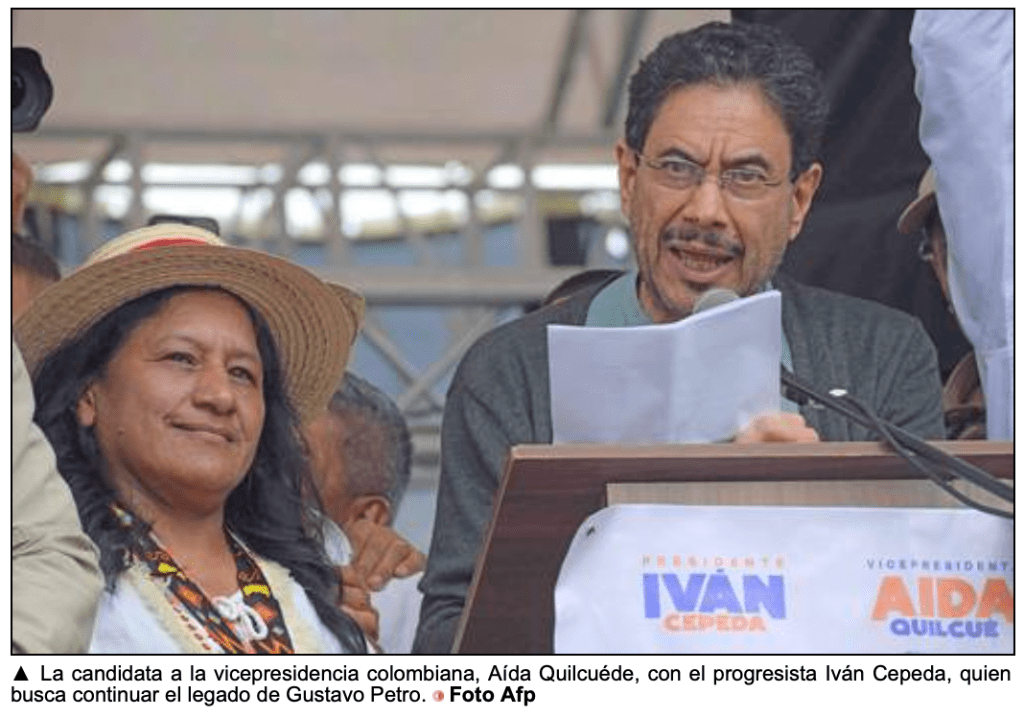
Cepeda and de la Espriella will face each other in a second round of presidential voting on June 21. They were the top two candidates after a first round of voting May 31. De la Espriella won 44 per cent of votes, while Cepeda obtained 41 per cent.
Petro urges mass mobilization
Colombia’s incumbent president, Gustavo Petro, swiftly condemned Trump’s backing of de la Espriella as a threat to Colombian sovereignty.
“When a country interferes in the decisions of another country, freedom dies,” Petro wrote. “I invite all of Colombia to vote in full freedom and not become either slaves or a colony of anyone.” Petro invoked Simón Bolívar and Antonio Nariño, the founding fathers of Colombian independence from Spain in the early 19th century, to draw a parallel between historical colonial subjugation and what he characterized as modern American meddling. “If the heart of the world loses its freedom and sovereignty, the hope of the world and of Colombia fades away.”
Petro had earlier cast the presidential runoff as a historic struggle between democracy and what he called “mafia fascism,” accusing de la Espriella of ties to paramilitary death squads and alleging widespread vote-buying during the first round. Petro argued that fascist movements have produced catastrophic human suffering wherever they have ruled and said Colombians have a moral obligation to defeat them at the ballot box.
For his part, Cepeda challenged his opponent to a public debate and called for an investigation into what he described as 885,000 electoral irregularities in the first-round vote, also alleging foreign interference in the election.
“Every single ant is out moving mountains”
Among international observers, Rev. Emilie Teresa Smith of the Anglican diocese of New Westminster (B.C.) said in a Facebook post June 3 that “the forces of manipulation and corruption are deep and powerful.”
She looked at the context: that Trump and Secretary of State Marco Rubio had already re-configured the 19th-century Monroe Doctrine and declared Abya Yala (Latin America and the Caribbean) “their territory to control, exploit and destroy.”
Smith also pointed to the April audio leaks of Honduran leaders, including convicted drug-trafficker and former president Juan Orlando Hernández. Together these comprise “Hondurasgate,” an international conspiracy to influence the last election in Honduras and to “extend the same operation across the region, targeting the progressive governments of Latin America.”
She also wrote of preparations for the next round of voting: “Every single ant is out moving mountains.”
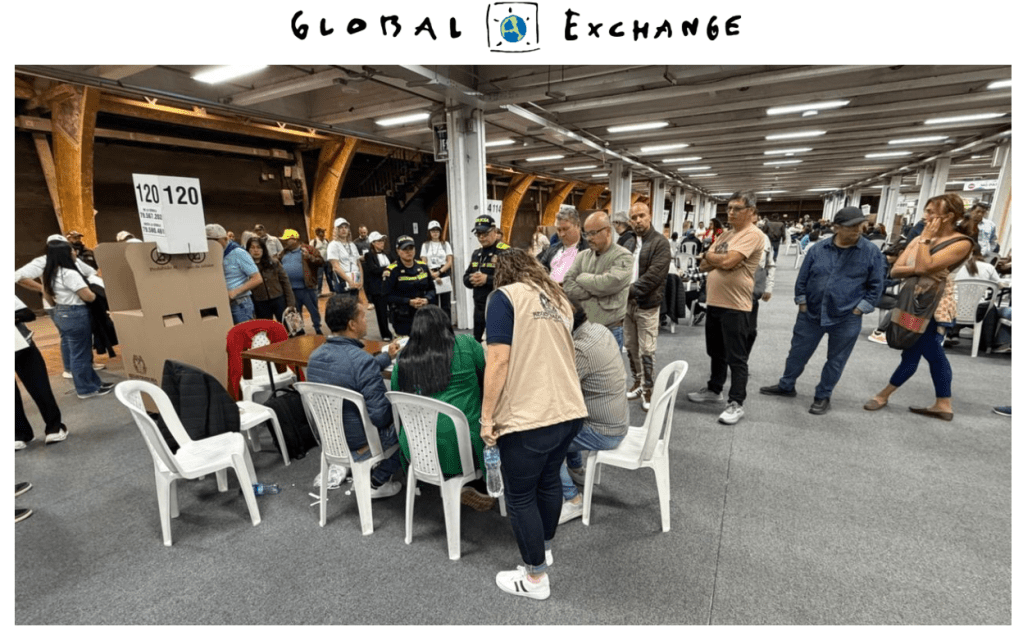
In its observation report, the San Francisco-based human rights group Global Exchange said that for the first time in Colombian history, the U.S. embassy sent 86 observers to the polls. Among them was Ohio Republican Senator Bernie Moreno, born in Bogotá and now a close Trump ally. Weeks earlier, he warned that Washington might refuse to recognize results if evidence of coercion emerged and conditioned future U.S. assistance explicitly on the election’s outcome. A Florida member of the House of Representatives, María Elvira Salazar, went further. She publicly endorsed de la Espriella and urged Colombians to vote for him. After the vote, Moreno reported that the elections were “completely free and well run.”
The first-round result was unexpectedly close. The vote for a third candidate, Paloma Valencia, seemed to collapse, despite backing from former hard-right president Álvaro Uribe.
The election also had a higher voter turnout – almost 58 per cent – than any first-round vote since the new constitution came into force in 1991. To win, Cepeda will need to add to Petro’s coalition.
“What happens in Colombia on June 21 will not stay in Colombia,” concluded the Global Exchange report. “It will send a signal to every progressive movement in the hemisphere about whether it is possible to govern — and to be succeeded — under the weight of the Donroe Doctrine.”


3 thoughts on “In Colombia, “mass mobilization” needed to counter Trump’s candidate”