After grief, the resistance begins

by Jim Hodgson

I feel some relief this morning by two newsletters from U.S. activists that arrived in my email.

One is from “Stop The Coup 2025,” a campaign to fight Project 2025 (the Republicans’ plan for the next Trump administration). It has a toolkit for community organizers that includes a section, “Spotlight on Risk Preparedness/Criminalization/Underground Survival Tips.” It discusses the importance of organizations and individuals taking steps now to prepare and assess their vulnerability to Project 2025’s agenda and learning from LGBTQIA+ activists in other places who have been forced to live and organize under the radar due to state-sanctioned criminalization.

Here’s a bit more information about Project 2025:

Project 2025 has a radical anti-democracy, anti-diversity, anti-gender agenda to:

  • systematically dismantle the federal government – a soft coup
  • give the next Republican president new “supreme powers” – an autocracy
  • use Executive Orders to “legally” reverse many of our civil rights
  • use the military to help clamp down on domestic dissent
  • criminalize & erase gender & LGBTQIA+ identity from government protection
  • reverse racial equality, attack diversity, and reverse environmental gains
  • replace secular education with Christian theocracy and a pro-life agenda
  • recruit and train 20,000 conservatives for government jobs 
  • Use “Schedule F” to remove 50,000 civil servants 
  • Require government “Loyalty Pledges” to an extremist right-wing agenda 
  • Reverse historic US defense policy of deterrence to offense 
  • Require US foreign policy, USAID to align with pro-life agenda 
  • LAUNCH THEIR 180-DAY ADMINISTRATION TAKEOVER ON January 20, 2025

The other newsletter that brought hope to my inbox today came from Codepink, the U.S. network of feminist peace activists. I’ve worked with them in the past to counter the harm caused by U.S. sanctions in Venezuela, Cuba and elsewhere, and some of my colleagues have worked with them for peace in the Korean peninsula and the Middle East. Part of the message today:

We don’t want to waste your time with platitudes about how everything will be okay or even talk about the breakdown of the election. We think it’s more useful to go off what we know for certain now: Donald Trump is going to be president in January. 

But, a majority of Americans oppose U.S. support for Israel, and don’t want their tax dollars funding weapons that murder innocent people and destroy the earth. A greater majority of Americans oppose the U.S. starting new wars. It’s okay to feel deflated and discouraged, but don’t forget that the people are on our side – all we have to do is reach them.  

We will continue to do what we have always done: educate by exposing horrific violence carried out by those in power, activate a movement for peace, and cultivate local communities that represent the world we want to live in. Solidarity is our best friend. Finding new and creative ways to scratch at power is our path forward.

Political signs of the times at a rest stop near Junction, Texas.

Last time, and this time: concern for rights of refugees

Back in 2016, I was in Antofagasta, Chile, when I learned that Donald Trump had defeated Hillary Clinton and won the U.S. election. The news was unexpected, just like now. 

I was in Chile’s far north to meet and show solidarity with Chilean Methodists who were working with migrants who had come from Colombia and other parts of Latin America and the Caribbean, including Haiti. 

Indeed, a great deal of my personal and professional life has been devoted to work with refugees and other people who are forced to flee their homelands because of various political, economic and environmental causes. 

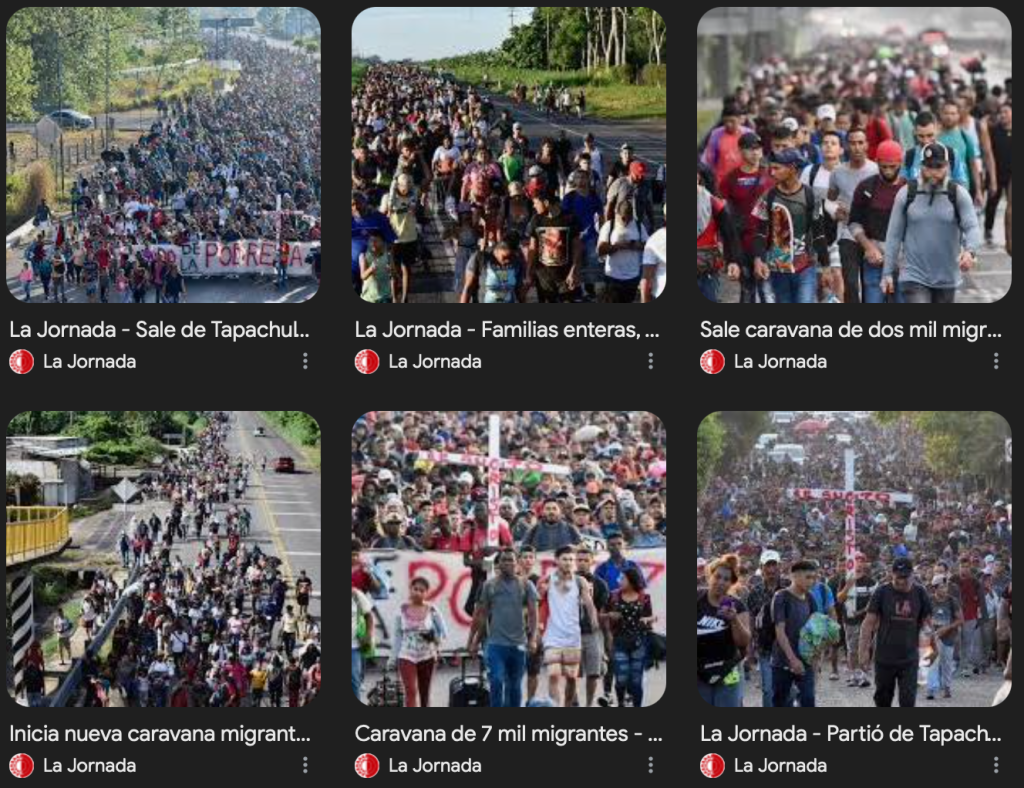
Caravans of migrants from many countries continue to cross Chiapas on their way north, holding out hope that they might score a formal U.S. refugee application before January 20 when Trump, who promises mass deportations, will take power. (Images: La Jornada, Mexico). 

Now I am in north-western Chiapas, having crossed in recent weeks several of the “red states” where support for Trump is strong.

In the wake of the election, pundits point out that Trump weaponized ‘fake news.’ He played to machismo and racists and to people who haven’t a clue what being Trans even means. That he won over a smart, articulate, experienced woman of colour after being convicted of crimes and successfully sued for sexual assault is an indictment of U.S. democracy.

Some, including Sen. Bernie Sanders, point as well to the Democratic Party establishment which again defended the status quo. “It should come as no surprise that a Democratic Party which has abandoned working class people would find that the working class has abandoned them.”

As ever, don’t expect the Democratic Party to save us. Now is the time for grassroots action.

For Natasha Lennard, writing in The Intercept, the answer is radical action from the grassroots: 

“Far-right policies and parties tend to win the day when so-called centrists take up conservative platforms to purportedly capture disaffected white voters and thus keep the far-right at bay; the upshot is treating conservative nationalism as the fulcrum of all politics. This is what the Harris campaign did, particularly when it came to immigration. At best, as with Britain’s currently ruling Labour Party, the Tories might have lost, but right-wing politics have been reconfigured as the normalized center.”

Almost a decade later, truth still elusive in case of the 43 students in Guerrero, Mexico 

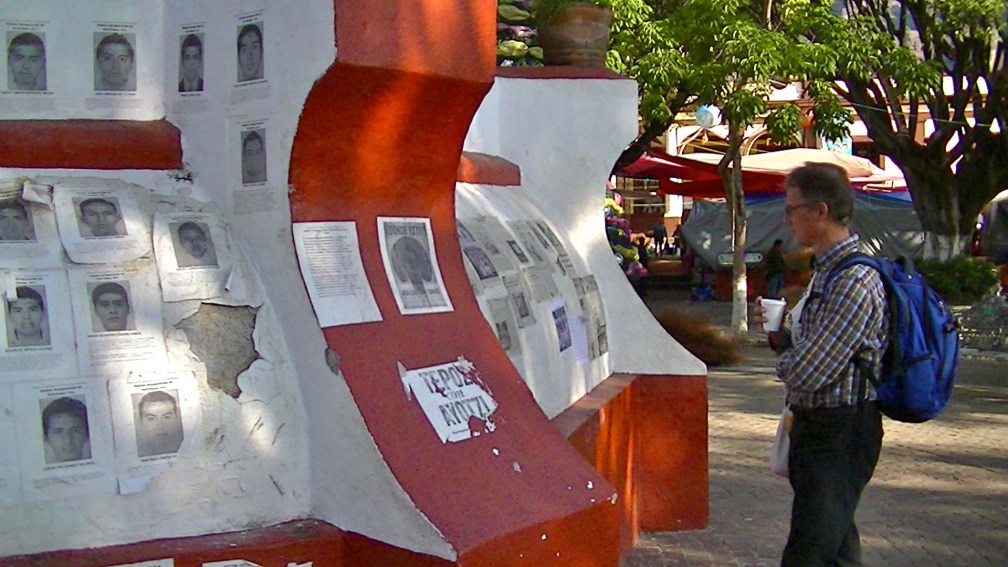
They’ve been gone for almost 10 years now, those 43 education students who were taken one night in Iguala, Guerrero. Hypotheses abound but despite promises and investigations, the crime is not solved. 

But there are new revelations about the cover-up orchestrated at the highest levels of the Mexican state in weeks after the disappearance (see below).

President Andrés Manuel López Obrador (known popularly as AMLO) has done many good things as he nears completion of his six-year term. But his failure to press finally for the full truth of the Mexican army’s involvement in the disappearance of the students who attended the Ayotzinapa teachers training school stains his record. 

“A decade of failure,” says a headline in the Mexico City daily newspaper, La Jornada. Students, teachers and family members say their struggle will continue.

During a march in Mexico City on Monday, Aug. 27, Luz María Telumbre, mother of one of the disappeared students, told a reporter that she would be among the parents who would meet the president again the following day. This time, she said, it will be to say: “’thanks for nothing’ because we’re still walking, shouting in the streets for justice and truth.”

Another mother, Joaquína García, said “it isn’t fair that we should be in the streets for 10 years seeking justice and we still don’t know anything about the boys.” She added that she wants to tell the next president, Claudia Sheinbaum, “that we will not stop struggling until we find them and that as a woman and mother, we hope she will understand us.”

On the night of Sept. 26, 2014, students from the Ayotzinapa Normal School were attacked in Iguala, Guerrero, after they had commandeered buses to travel onward to Mexico City for a protest over the Oct. 2, 1968, massacre of student protesters at Tlatelolco plaza in Mexico City.

In Iguala, six people—including three students—were killed in the assault, 25 were injured and 43 students were abducted and presumably murdered later. Leading suspects are members of the Mexican army who worked alongside municipal officials and drug-traffickers who were trying to move opium gum (semi-processed heroin) on one of the buses that was taken.

What happened before?

One afternoon in the late 1990s, I accompanied a group of students from Canada and the United States to a meeting with rural teachers in the mountains near Tlapa in northeast Guerrero.

These teachers spoke for communities afflicted by poverty, military incursions and the drug war. They taught their students in Spanish as well as in Nahuatl or one of the other Indigenous languages spoken in the area. They dedicated their lives to strengthening rural communities through the education of children. They were convinced that people needed to be able to organize themselves and demand that their rights be respected so that things would begin to change.

“The rural teachers colleges are among the only means of social mobility within the reach of young people from campesino communities,” wrote Luis Hernández Navarro, opinion editor at La Jornada, back in 2011. “Through them, they have access to education, housing, food and later, with luck, a job they are qualified to do.” 

The first time I that I can recall hearing of the Ayotzinapa school was in January 2008, when Blanche Petrich, another La Jornada journalist, came to Toronto to support work by Canadian churches in defense of refugees from Mexico. She told us:

“To describe the panorama of repression in Guerrero, it’s enough to follow the route of the popular movement. ‘Wherever there is organization, protest, defense of human rights, mobilization of roadblocks, there is repression, irregular apprehensions and arrest warrants,’ we’re told by the [Tlachinollan] human rights organization in the La Montaña area, led by Abel Barrera. That is, the campesinos who oppose the taking of their lands for a dam in La Perota, close to Acapulco, the ecologists who resist cutting of trees in the Petatlán sierra, the laid-off workers of a government office in the state capital of Chipalcingo, the community leaders of Xochistlaguaca, the students at the normal school in Ayotzinapa: they all suffer persecution.”

And what’s new?

Through an access to information request, journalists obtained new information about the cover-up that was orchestrated after the abductions by high ranking authorities in the government during meetings presided over by then-President Enrique Peña Nieto and attended by then-Attorney General Jesús Murillo Karam and other officials. Their “historic truth” version—since proven false—contended that local police turned the students over to a drug gang which murdered them, burned the bodies at a garbage dump, and put the remains into a river.

AP photo and story (left) about revelations by a former senior official; a tweet by the Fábrica de Periodismo about the cover-up led by high officials of the previous Mexican government.

Tomás Zerón, former head of investigations for Mexico’s Attorney General’s Office, is now a fugitive hiding in Israel, beyond the reach of the Mexican justice system. But in 2022, he answered questions posed in writing by Alejandro Encinas, then Mexico’s Interior Undersecretary for Human Rights.

Appointed by AMLO’s government, Encinas chaired the Commission for Truth and Access to Justice in the Ayotzinapa Case (COVAJ). The commission included family members and their advisors. Their report, published in August 2022, said federal, state and municipal politicians, along with the armed forces and local police, knew what had happened. 

But that report and a subsequent one in September 2023 have been undermined by the refusal of President López Obrador to accept its conclusions and his accusations against the human rights groups that accompany the families, including Tlachinollan and the Jesuit-backed Miguel Augustín Pro Human Rights Centre.

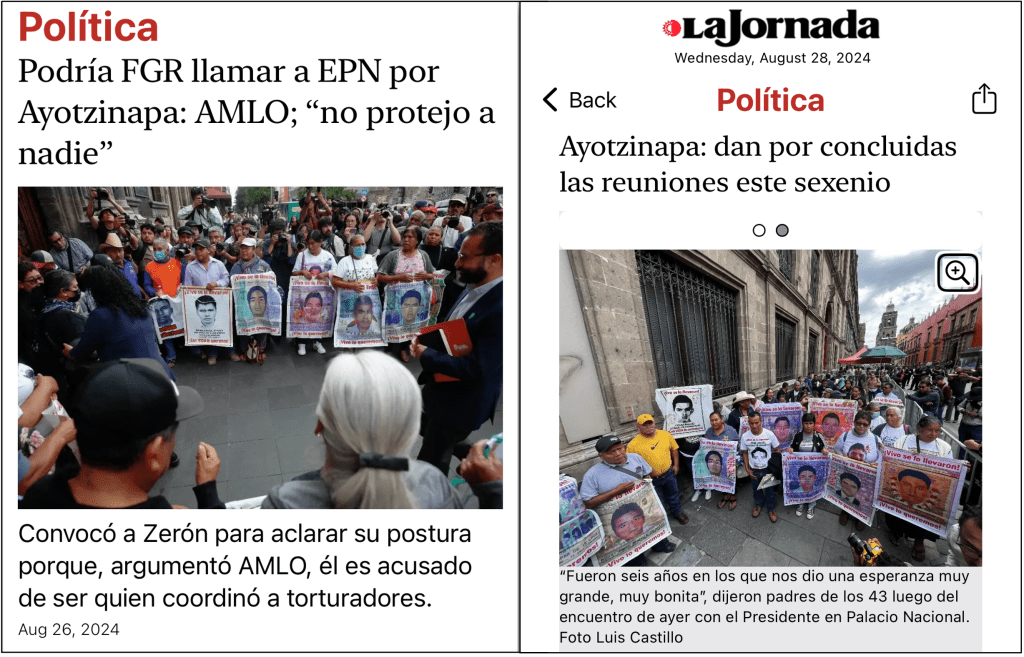
Left: La Jornada story Tuesday with headlines (adding my own details): federal prosecutors may call former president Ernesto Peña Nieto to testify about Ayotzinapa; AMLO: “I don’t protect anybody.” Below the photo, the text says that AMLO has also called on Zerón “to clarify his position because he is accused of coordinating the torturers.” Right: story today about the last of the parents’ meetings with AMLO.

After a meeting Tuesday (Aug. 27) with the president, the parents said it was the last one they would hold with him before he leaves office Oct. 1. 

“We ended badly,” said their lawyer, Vidulfo Rosales of Tlachinollan. He added that while in the first three years of this government, they saw clear good will to get to the truth, in 2022, the situation changed. “This is when we touched the sensitive fibres of the Mexican Army; we could advance no further. There was a break, a crisis, including in the relationship, the dialogue.”

“This government, unfortunately, could not give us truth and justice,” he added.

Mexico celebrates Presidenta Sheinbaum

by Jim Hodgson

For the first time, Mexicans have chosen a woman to be their president. She is Claudia Sheinbaum, 61, a climate scientist who previously served as mayor of Mexico City. 

“The transformation continues!” A campaign billboard promotes the campaign of Claudia Sheinbaum in the southern state of Chiapas. The slogan refers to the ‘Fourth Transformation‘ of Mexican political institutions and the economy begun by her predecessor, Andrés Manuel López Obrador.

That a woman is president is no minor detail. It was only in the middle of the last century that women in Mexico won the rights to vote and to run for public office. Even now, only 14 of 193 nations have women in power as presidents or prime ministers.

Sheinbaum can be expected to continue the generally progressive approaches taken by her predecessor, Andrés Manuel López Obrador (known as AMLO). Her leading opponent was businesswoman and former senator Xóchitl Gálvez, candidate of a centre-right coalition. 

CBC News report days earlier said that neither Sheinbaum nor Gálvez actually committed themselves to “real change for women” on issues such as pay equity, reproductive rights, or violence against women. 

One of Mexico’s leading journalists, Blanche Petrich, wrote that three women (Michelle Bachelet in Chile, Cristina Fernández in Argentina, and Dilma Rousseff in Brazil) who were representative of the progressive “pink wave” governments in Latin America did not “leave a legacy that would definitively reverse gender inequality.” 

A CBC News report on the quality of feminism represented by Mexico’s two leading candidates, and Blanche Petrich’s review in La Jornada of past experiences of women as presidents in Latin America.

Bachelet, notes Petrich, once said: 

“What does it mean to be a woman in public office? Is it to be the same as a man, but with a skirt? No. When a woman arrives alone in politics, the woman changes. When many women arrive in politics, politics change. And clearly, one of the challenges and needs of our democracy is to improve the quality of politics.”

In the Mexican election, Sheinbaum and Gálvez tended to address issues of concern to women within a range of economic, social and criminal justice proposals. Framed this way, there were sharp differences between the two.

Sheinbaum will continue to give priority to social programs, pensions and scholarships that benefit the least advantaged, as well as concentrating on investment in infrastructure to support industries that create jobs. The approach by Gálvez was that of conservatives everywhere: keep taxes—and wages—low and let the market take care of the rest (though she did promise to maintain AMLO’s social programs).

At her victory celebration late Sunday night, Sheinbaum affirmed her movement’s commitment to democracy. “By conviction, we will never make an authoritarian or repressive government. We will also respect political, social, cultural and religious freedoms, and gender and sexual diversity.”

Regarding criminal justice issues (which media tend to subsume under the heading “security”), Mexico obviously has serious problems. At least 34 candidates were killed during the election period that included national as well as some state and municipal elections. 

There are still about 30,000 homicides per year, though the government says the number has been dropping by about five per cent per year. 

AMLO tried to turn back the violence unleashed by one of his predecessors. In 2006, then-President Felipe Calderón, with backing from the United States, launched a military-led offensive against the drug cartels to curb their violent turf wars. Instead, the violence became much worse. 

AMLO promoted an approach he called “abrazos no balazos”–hugs not bullets. It meant addressing the social roots of violence by giving people the education and other resources they need to avoid being drawn into the drug-trafficking cartels and their systems of power. Over the long term, the approach should lead to reduced levels of violence.

But it has been controversial and is subject to manipulation, even in mainstream media like The New York Times, and has led to threats of military intervention from various U.S. politicians, including the presumptive Republican nominee, Donald Trump. 

Even within the AMLO-Sheinbaum coalition, there is agitation. When Eduardo Ramírez–a former AMLO opponent who, like too many others, opportunistically shifted loyalties–celebrated his victory as governor of Chiapas Sunday night, he said: “There will be hugs, but no impunity.”