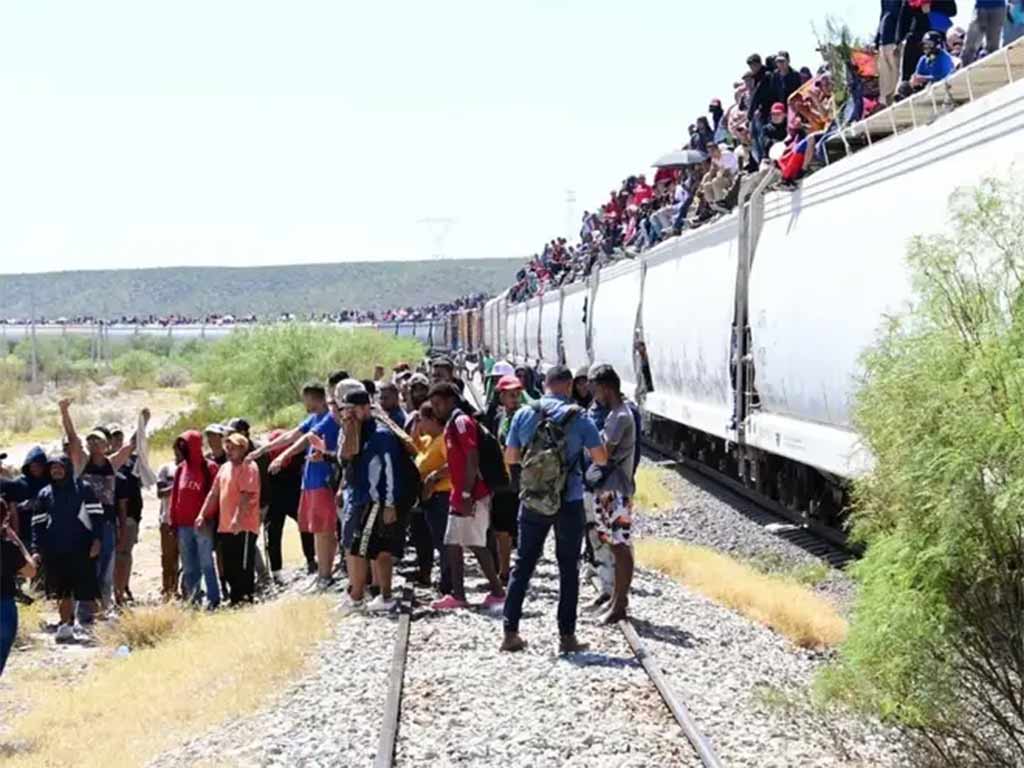
With a dizzying array of executive orders, Trump attacks the vulnerable

The White House, February 1982, just after the inauguration of Ronald Reagan. (Jim Hodgson photo)

by Jim Hodgson

“American inauguration day was a grim business, like someone slamming a baseball bat into the concept of human decency all day long until it was bleeding and paper-thin,” wrote Heather Mallick today in the Toronto Star.
In a blizzard of speeches, insults and executive orders, Donald Trump erased anything positive about the legacy of the interregnum president, Joe Biden. “Que sigue la continuidad” (follow the continuity) is the inept slogan of a local politician in the village in Chiapas where family responsibilities have placed me for a few months, but it could well have been the title of Trump’s work plan for the day.
I started keeping a list. Eventually, my journalist brain took over. I had to make choices and prioritize. 
The one specific action that I expected with dread came in the evening: revocation of Biden’s announcement six days earlier that some of the cruel U.S. sanctions levelled against Cuba would be eased. Cuban President Miguel Diaz-Canel responded on social media late on Monday, calling Trump’s decision to revoke Biden’s measures an “act of mockery and abuse.”
Here’s my list, drawn partly from Associated Press and the Toronto Star, with additional sources as noted below. At the end, a treat: an eloquent plea for mercy spoken in Trump’s presence by Washington’s Episcopal bishop, the Right Rev. Mariann Edgar Budde.


Trump suspends U.S. foreign aid for 90 days pending reviews
Because this blog is broadly about issues related to development, let me start here: Trump temporarily suspended all U.S. foreign assistance programs for 90 days pending reviews to determine whether they are aligned with his policy goals. (From other statements, it’s pretty clear he is going after support for women’s sexual and reproductive health.) It was not immediately clear how much assistance can be affected by the order. Funding for many programs has already been appropriated by Congress and must be spent. And there are contracts that must be honoured.

Mexico is not alone in feeling nervous over Trump’s designation of cartels and gangs as “terrorist organizations.” Right: La Jornada reports that the deportations have already begun in Ciudad Juárez and Matamoros.


Trump declares a border emergency
As he had promised, Trump declared a national emergency on the U.S.-Mexico border, suspending refugee resettlement and ending automatic citizenship for anyone born in the U.S. La Jornada reported that he suspended the U.S. government’s CBP One app that asylum-seekers waiting in Mexico use to make appointments for their claim to be heard by officials on the U.S. side of the border.
Trump acknowledged an imminent legal challenge to overturning birthright citizenship, which has been enshrined in the U.S. Constitution since 1868. He said automatic citizenship was “just ridiculous” and that he believes he was on “good (legal) ground” to change it.
Rainbow Railroad newsletter, Jan. 21: Trump signed an executive order that suspended the U.S. Refugee Admission Program, halting the processing of LGBTQI+ refugees already approved for resettlement, and leaving vulnerable and displaced queer and trans individuals stranded in dangerous and precarious conditions.


Use of wartime power act to deport gang members
Trump raised the possibility of using the Alien Enemies Act of 1798 (last used during World War II to detain Japanese people) to deport gang members who are deemed members of a foreign terrorist organization. His executive order paves the way for criminal organizations such as MS-13 to be named “foreign terrorist organizations.” His government will also return “millions of foreign criminals” to their places of origin. 

Late Tuesday, Trump ordered that all U.S. government staff working on diversity, equity and inclusion (DEI) schemes be put on immediate paid administrative leave, and called for an end to the “dangerous, demeaning and immoral” programs.


Ending protection from discrimination based on gender identity or sexual orientation
Trump rescinded a 2021 order (Title IX) that the Education Department used to protect against discrimination based on gender identity or sexual orientation.
A couple of paragraphs from the Rolling Stone’s excellent coverage:
Earlier in the day, Trump declared in his inaugural address: “As of today It will henceforth be the official policy of the United States government that there are only two genders, male and female.” 
Trump intends to sign an executive order that prohibits federal recognition of transgender Americans. The anticipated order, leaked to the right-leaning Free Press, will reportedly bar government issued identification like passports from listing anything other than a person’s birth gender, remove transgender individuals from protection of laws barring sex-discrimination, end funding for transition surgeries for federal prisoners, and purport to protect the First Amendment and other rights of those who flout “preferred pronouns” or refuse to recognize the reality of transgender individuals. 
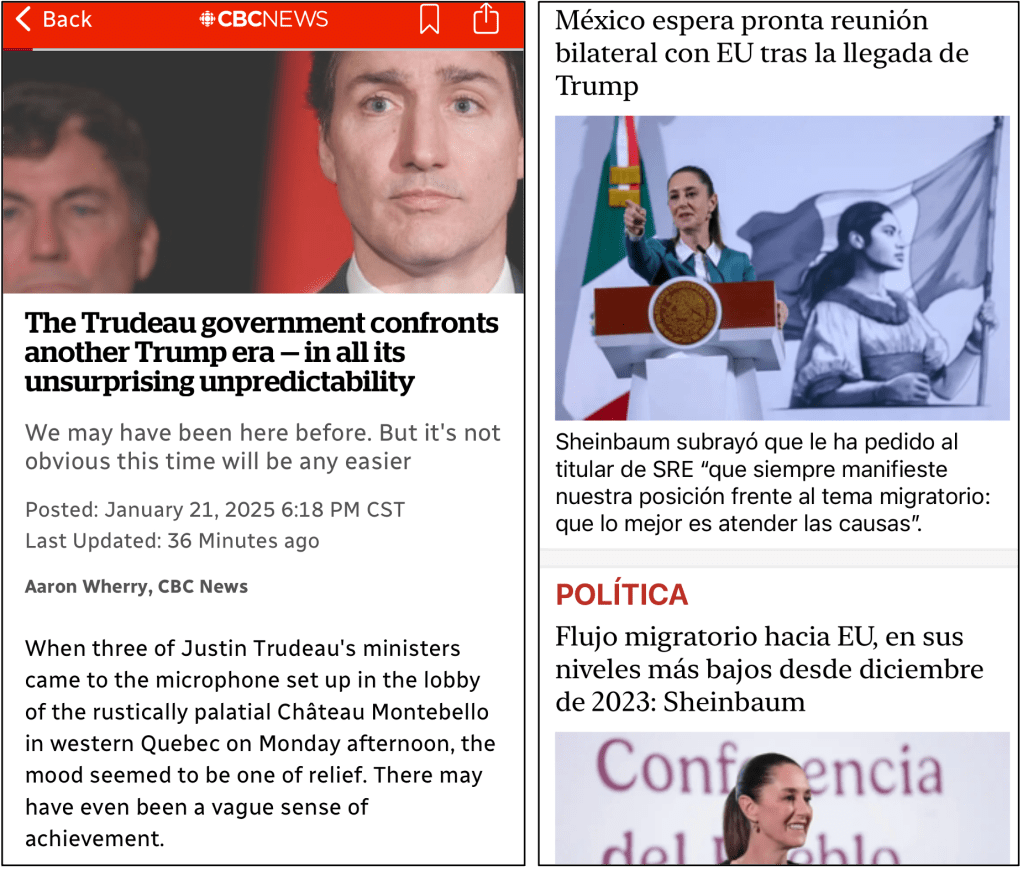
Canadian Prime Minister Justin Trudeau and Mexican President Claudia Sheinbaum and their respective ministers are preparing responses to whatever comes from Trump after Feb. 1 with regard to tariffs. Both leaders are trying to ease tension about their borders with the United States. Trump may go after China with tariffs that day too.


In addition to a federal hiring freeze, other measures include:

  • Pardons and commutations that Trump said would cover about 1,500 people criminally charged in the attack on the Capitol on Jan. 6, 2021
  • Halting 78 Biden-era executive actions
  • A regulatory freeze preventing bureaucrats from issuing regulations until the Trump administration has full control of the government
  • A freeze on all federal hiring except for military and a few other essential areas
  • A requirement that federal workers return to full-time in-person work
  • A directive to every department and agency to address the cost of living crisis
  • Withdrawal from the Paris climate treaty as Los Angeles burns [Canada’s environment minister Steven Guilbeault called the move “deplorable”]
  • Withdrawal from the World Health Organization (WHO)
  • A government order restoring freedom of speech and preventing censorship of free speech
  • Ending the “weaponization of government against the political adversaries of the previous administration”

Episcopal bishop asks Trump ‘to have mercy’ on LGBTQ+ communities and immigrants
video
Washington’s Episcopal bishop, the Right Rev. Mariann Edgar Budde:
“Let me make one final plea, Mr. President. Millions have put their trust in you, and as you told the nation yesterday, you have felt the providential hand of a loving God. In the name of our God, I ask you to have mercy upon the people in our country who are scared now. There are gay, lesbian, and transgender children in Democratic, Republican, and independent families, some who fear for their lives. The people who pick our crops and clean our office buildings, who labor in poultry farms and meatpacking plants, who wash the dishes after we eat in restaurants and work the night shifts in hospitals, they may not be citizens or have the proper documentation, but the vast majority of immigrants are not criminals. They pay taxes and are good neighbors. They are faithful members of our churches and mosques, synagogues, gurdwara, and temples.
I ask you to have mercy, Mr. President, on those in our communities whose children fear their parents will be taken away, and that you help those who are fleeing war zones and persecution in their own lands to find compassion and welcome here. Our God teaches us that we are to be merciful to the stranger, for we were all once strangers in this land. May God grant us the strength and courage to honor the dignity of every human being, to speak the truth to one another in love, and walk humbly with each other and our God, for the good of all people, the good of all people in this nation and the world. Amen.”

A day later, Trump called the bishop a “Radical Left hard line Trump hater,” “ungracious,” “nasty” and “not compelling or smart.”

From Palenque, Chiapas, Latin American leaders call for migration solutions

In recent weeks, my partner and I took a long drive from British Columbia through the western United States and then almost the length of Mexico to arrive in Chiapas.

While people who migrate northwards either for seasonal work or for more permanent refuge from poverty, violence and impacts of climate change were on our minds and in the news, at least some of the people we met alongside us in gas stations and cafés were seasonal workers heading home for the winter. 

Migration, my friends, is normal. In southern Texas and northern Mexico, we encountered thousands of monarch butterflies as they headed for Michoacán. And here in Chiapas, the migratory birds are arriving daily.

At around the time of our trip, leaders of ten nations of Latin America and the Caribbean – frustrated by slow progress with the United States (and other northern countries) in advancing meaningful human development and managing the flow of people – gathered in the historic Maya city of Palenque, Chiapas, and proposed some ways forward.

Photo from the Office of the President of Mexico

Led by Mexico, the governments of Belize, Colombia, Costa Rica, Cuba, El Salvador, Haiti, Honduras, Panama and Venezuela signed the Palenque Declaration on Oct. 22 and called for solutions. (A representative of the newly-elected government in Guatemala also joined the talks.)

In the declaration, presented by the Mexican Foreign Minister, Alicia Bárcena, the leaders described several structural causes of migration: internally political, economic, social factors and the effects of climate change. But they also pointed to “external factors such as unilateral coercive measures of an indiscriminate nature – dictated from the United States – that negatively affect entire populations and, to a greater extent, the most vulnerable people and communities.”

They urged the United States to lift the sanctions imposed on Cuba and Venezuela that help drive the exodus. Such sanctions are against international law and, as the migration flow shows, they have impacts beyond the countries to which they are applied.

The document also proposed undertaking efforts to modify the financial architecture of debt; to close social gaps to as to reduce the impulse to migrate; push for measures aimed at increasing agricultural activity to promote food self-sufficiency in the region; and to promote intraregional trade and investment for socioeconomic development.

The signatory nations stressed that measures must be taken to confront transnational organized crime, human trafficking and corruption, as well as promote joint cooperation in security matters.

They called for destination countries to “adopt immigration policies and practices in line with the current reality of our region and abandon those that are inconsistent and selective, to avoid arbitrarily producing both ‘call effects’ and ‘deterrent effects’ – advantages given to certain countries for political reasons while nationals of other countries are blocked.

They encouraged destination countries to widen their regular migration pathways, with emphasis on labour mobility and promotion of re-integration and safe return of temporary workers to their homes.

The declaration makes special mention of Haiti, and called on nations to support efforts by the United Nations and others to re-establish conditions for human security so that the political, economic and social situation may be normalized, and to focus on sustainable development. (The presence of the Haitian president at the gathering angered some of the Haitian migrants camped out in the centre of Palenque, reported La Jornada.)

Undated photo from Prensa Latina.

The declaration’s emphasis on economic drivers of migration did not satisfy everyone. Eunice Rendón of the Mexican advocacy group Agenda Migrante told Courthouse News Service that while insecurity was mentioned as a factor driving migration, “it’s not one of the causes, it’s the principal cause,” Rendón said.

“People go because the gang members threaten to kill them, because they try to forcibly recruit them,” she said. (Some might argue that the lack of education and employment opportunities are drivers as well in recruitment for organized crime.)

Meanwhile, migration dramas continue. On Nov. 9, authorities reported that they found found 123 Central and South American migrants trapped in a trailer in Matehuala, San Luís Potosí (less than a week after we passed through there). And than 400,000 migrants have crossed the Darien Gap from Colombia into Panama in 2023, according to the Panamanian government, up from 250,000 in 2022.

Turning the world upside down: systemic change needed now

Photo: Granma.cu

by Jim Hodgson

In the face of deep inequality within and among the nations of the world, leaders of the so-called “less developed countries” find they must still appeal for basic fairness from their richer neighbours.

More than 75 years after the United Nations was formed, and almost that long since the first development programs were implemented (e.g., the Colombo Plan, 1950), and almost 60 years since the first gathering of the Group of 77 developing nations, leaders gathered last week in Havana and this week in New York to plead their case again.

Not that you would have read about the Havana meeting in mainstream media, but representatives from 114 countries attended the G77+China meeting in Havana. Among them were 30 heads of state or government, as well as senior officials from international organisations and agencies, including UN Secretary-General Antonio Guterres.

The meeting was held under the banner title, “Current development challenges: The role of science, technology and innovation,” but the talk was all about the systems of wealth and power that are rigged against developing countries.

In their final declaration Sept. 16, the G77 demanded fair “access to health-related measures, products and technologies” – a problem highlighted by “vaccine apartheid” during the Covid pandemic when richer countries had first access to vaccines. 

G77 called for an end to “existing disparities between developed and developing countries in terms of conditions, possibilities and capacities to produce new scientific and technological knowledge.”

They revived calls for a “new international economic order” and “new financial architecture,” including “through increasing the representation of developing countries in global decision and policy-making bodies which will contribute to enhance the capacities of developing countries to access and develop science, technology and innovation.”

Among the countries participating (including the host, Cuba) were several that have been harmed by sanctions that are usually imposed by wealthier countries to try to provoke changed behaviour by less powerful countries. Sanctions (referred to in the declaration with the UN Human Rights Council term “unilateral coercive measures”), together with external debt, inflation, displacement of peoples, inequality and “the adverse effects of climate change” are all among the “major challenges generated by the current unfair international economic order” and there is “no clear roadmap so far to address these global problems.”

Criticism of the existing international order carried over from the G77 meeting to the UN General Assembly, which met days later in New York.

“They don’t have the $100 billion to aid countries so that they can defend themselves against floods, storms and hurricanes,” said Colombian President Gustavo Petro, referring to the Loss and Damage Fund promoted at the COP climate negotiations to “new and additional” funding from donor nations.

Wars and climate change, he said, are related to that other unprecedented crisis: migration. “The exodus of people toward the north is measured with excessive precision in the size of the failure of governments. This past year has been a time of defeat for governments, of defeat for humanity.”

The political systems that we use to effect policy changes are failing to respond to the urgent needs of our time. Most politicians are beholden to the corporations and rich people who fund their political parties and perpetuate their hegemony. In four-to-six year electoral cycles, the deep changes needed to confront those problems are rarely undertaken. 

In Canada, think of the power that mining corporations have wielded to block meaningful investigation of human rights and environmental abuses by their subsidiaries overseas. Or the influence land speculators have over the Ontario government. Or the actions of oil, gas, coal and pipeline companies to stall meaningful action to cut greenhouse gas emissions. 

And then scale that up globally. Think of the ways pharmaceutical companies blocked access to HIV and AIDS medications until a global fund was found to pay them – and then pulled the same stunt over Covid vaccines. At the UN on Sept. 20, Guterres said time was running short for climate action thanks to the “naked greed” of fossil fuel interests.

What is delivered through Official Development Assistance and Sustainable Development Goals may be crumbs and band-aids. While necessary, those funds are not sufficient to counter instruments of power like corporations and their allies in the international financial institutions like the World Bank and the International Monetary Fund.

Political change is required to make the systems change.

As Xiomara Castro, president of Honduras, told the G77 in Havana: “The time has come to put an end to the backyards [using a U.S. term referring to its relationship to Latin America] because we are not pieces on a chessboard of those who are apologists for dependence. Our nations should not continue to suffer the mass privatization of their territories.”

Mafalda: But Liberty, you’ve put the map upside down!
Liberty: Upside down compared to what? Earth is in space where there is no up or down.
Liberty: That story that says the north has to be above is a psychological trick invented by those on the top to make those who are on the bottom continue to believe that we are the bottom. But, beginning today, conventional ideas are over!
Last panel, a voice: Where were you, Mafalda?
Mafalda: I don’t know, but a conventional idea has taken a blow.

(For that last line, Quino, the great Argentinian cartoonist who created Mafalda, wrote in the original Spanish version, “No lo sé, pero algo acaba de sanseacabarse” – the sense being that something has ended.)