"Another World is Possible," World Social Forum, Porto Alegre, Brasil (2005)

The old order is dead. Let’s make a new, more just order.

by Jim Hodgson

It was too much to hope that the well-heeled audience at Davos would boo Donald Trump from the stage a day after they had offered Mark Carney a standing ovation. But by the end of Wednesday, it seemed that the wall of resistance to any U.S. take-over of Greenland was successful, and the president backed down. An important victory.
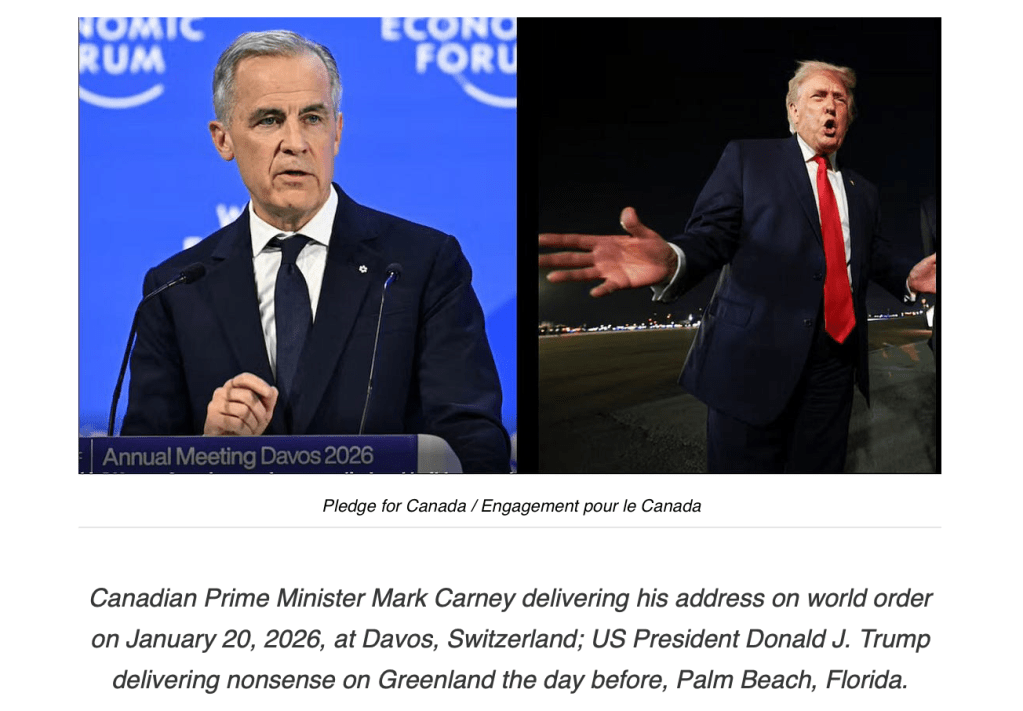

Still, “la rupture de l’ordre mondial” of which Carney spoke remains. And he’s right: we shouldn’t mourn it. The international financial institutions invented in 1944 at Bretton Woods, New Hampshire, gave overwhelming power to the rich countries of the Global North. 

And the United Nations system that followed, with a veto given to each of the five most powerful countries, has protected their interests – even in the face of overwhelming contrarian votes in the UN General Assembly. Think, for example, of the annual vote to end the cruel U.S. blockade of Cuba.

That order was designed by the nations that existed at the end of World War II, especially the colonial or neo-colonial states of Europe and the Americas. Most of the Caribbean, Africa and large parts of south Asia were still under colonial rule. That order imposed and perpetuated a Global North-based order on all the new nations that were born in the 25 years or so after the war: the majority of nations that exist today.

And that order, at least in the eyes of three of the five veto-holders, effectively imposed capitalism as a synonym for democracy. The United States and its allies were satisfied with a sort of formal democracy, a certain alternance between parties of the right and centre-right, and if that failed, then a military government was a useful interlude until the real order could be re-established and markets were safe. 

Canada would “go along to get along,” as Carney admitted. 

Just as it did less than three weeks ago when the United States bombed Venezuela and kidnapped its president. And just as it has for more than two years over Israel’s genocide in Gaza.

In his speech, Carney seemed to offer a vision of capitalism without the now-erratic United States. It’s still reliant on resource extraction, military spending, and massive capital investment.

But if we are all to grow and thrive, we must demand more. We require an end to practices that exploit social inequities and our shared ecology. 

Alternatives

Because of the paths on which my life has taken me, one that is especially close to my heart is the call from the Indigenous people of Zapatista communities in southern Mexico for “a world with room for all” – “un mundo donde quepan muchos mundos.” But other visions come from other places, including three decades of gatherings of the World Social Forum.
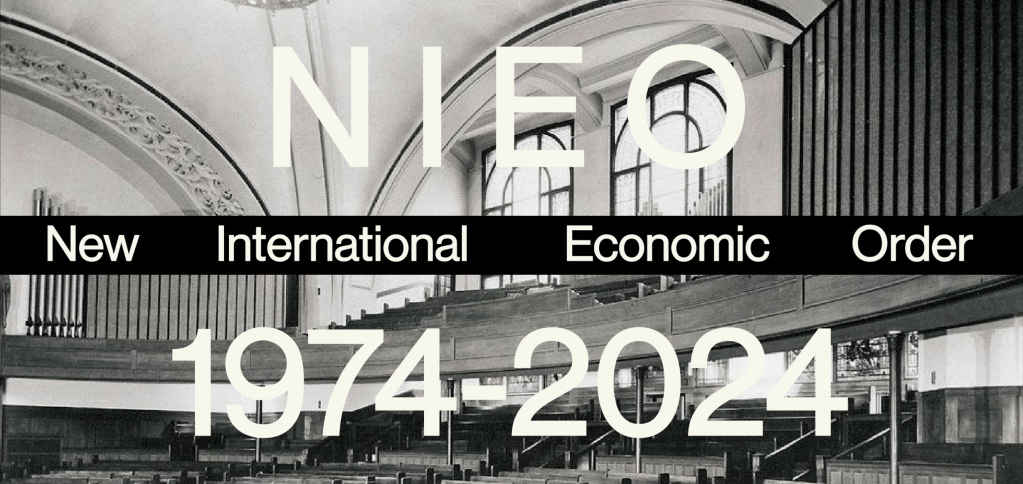
More than 50 years ago, the majority world united behind a vision of economic decolonization, sovereign development, and international cooperation across areas such as debt, trade, finance, and technology. That vision became known as the New International Economic Order (NIEO) and was adopted by the UN General Assembly. But, power relations being what they are, it was never implemented. (Progressive International put together a set of reflections that trace its history and update the proposals for the 21st century.)

In March last year, the World Council of Churches and several global communions of churches repeated their call for a New International Financial and Economic Architecture (NIFEA). “It is immoral that over a billion people – half of them children – subsist in poverty whilst billionaires increased their wealth by over 15% in 2024 to US$15 trillion. It is outrageous that the richest 10% of the global population receives more than half of global income, whereas the poorest half earns merely 8.5% of it,” they said in a statement.

They expressed deep concern about “a rapidly escalating climate and biodiversity emergency that jeopardises livelihoods and poses an existential threat to all life.” It notes that “several tipping points are close to being crossed or have already been crossed, leading us to recognise that we may be beyond a point of no return.”

The old order is dead. The time in which we are living demands we do better.
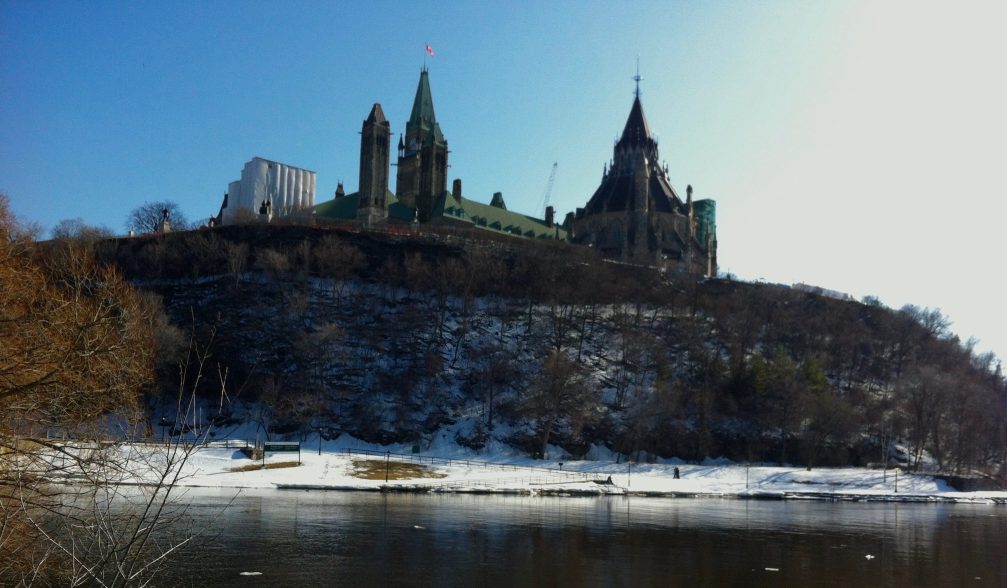
The “feminist foreign policy” is dead. What next?

by Jim Hodgson

A decade of promises and at least a measure of good will were flushed away with Prime Minister Mark Carney’s declaration that his government does not have a feminist foreign policy.

Speaking in Johannesburg at the end of the G20 summit, he said issues such as gender equality and reducing gender-based violence are an “aspect” of his government’s foreign policy. “But I wouldn’t describe our foreign policy as feminist foreign policy.”

Frankly, it was always hard to reconcile proclamations of feminist foreign policy (FFP, as it came to be known) by Prime Minister Justin Trudeau and his foreign ministers with Canada’s efforts to sell weapons abroadinaction in Gaza, and preference for threats and sanctions over dialogue in Venezuela. After all: wouldn’t a truly feminist foreign policy veto arms sales to Saudi Arabia because of its suppression of women’s rights? 

House of Commons finance committee chair Karina Gould, who served in several cabinet posts under Trudeau and ran against Carney for the Liberal leadership, told the Canadian Press that Carney’s words “certainly” mark a departure from the previous government. But she insisted the policy the prime minister described remains feminist.

“The ideals that he was talking about continue to be feminist, and I think that what it means is that as Canadians, we expect that we’re going to stand up for gender equality around the world and here in Canada,” she said.

“Prime Minister Carney is making it very clear he is no friend to women and he is no friend to gender equality in this country,” NDP MP Leah Gazan told reporters Nov. 24.

International Women’s Day march, Guatemala City, March 8, 2023 (Jim Hodgson photo)

Feminist aid policy

The Trudeau government did somewhat better with its Feminist International Assistance Policy (FIAP). Beyond policy documents, FIAP seemed to produce some results across the development cooperation sector with promotion of gender equity, empowerment of women and girls, and rights and inclusion for 2SLGBTQIA+ people. 

Even so, there were calls for more. Canada’s ecumenical justice coalition KAIROS said FIAP was “sound policy” but that its funding priorities needed “to align the advancement of human rights and women, peace and security with economic empowerment.”

After the Harper government in 2009 refused to support the KAIROS international assistance work, funding was restored by the Trudeau government to a revamped KAIROS Women, Peace and Security program. 

Now Trudeau is gone, his “sunny ways” undermined by the SNC Lavalin affair and his treatment of cabinet ministers who were women. And international development cooperation is being buried in favour of investment regimes, eternal debt and oceans that rise along with temperatures.

“Inside/outside strategies”

And so I find myself thinking in different ways. Sometimes I feel that I placed too much faith in the official spaces, even as I always identified most strongly with social movements. Sometimes we used “inside/outside” strategies: those who could talk to the politicians would do so; the rest of us would march in the street outside. I think of anti-free-trade demonstrations in Québec City in 2001 or the protests at the Toronto G7/G20 meeting in 2010.

Today in Mexico City’s La Jornada newspaper, Raúl Zibechi has a column in which he decries the “pyramids” of power we build within our progressive movements even as we denounce the pyramids of power in our capitalist “democracies.” He points to an event the Zapatistas will hold in San Cristóbal de Las Casas,  Chiapas, Dec. 26-30 this year. Zibechi and others will offer their “analyses on pyramids and on how histories are handled within the economic system, bad governments, laws and the judicial structure, resistance movements, the left and progressivism, human rights, the feminist struggle, and the arts.”

I can’t attend this year, but I will pay attention. As the new accord between Carney and the premier of Alberta showed this week, we can’t trust conventional power to make good choices on behalf of the people. We need to propose alternatives and press to make them reality.

Labour, development NGOs demand Canada condemn U.S. boat attacks in Caribbean

By Jim Hodgson 

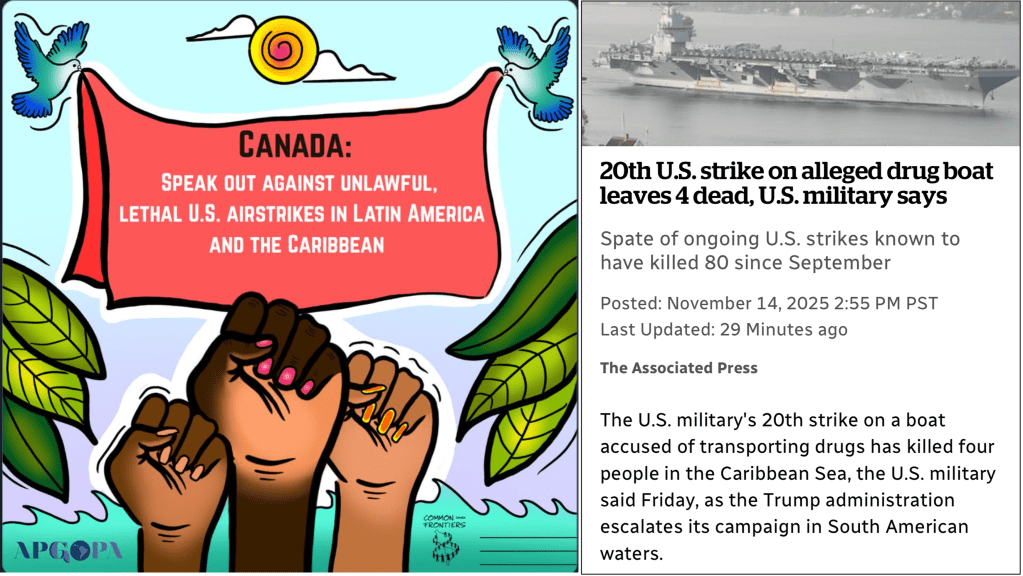
Canadians need to call on their government to speak out against illegal U.S. airstrikes on boats in the Caribbean and eastern Pacific, say two coalitions in which I have participated for nearly three decades. 

Left: Calling on Canadians to act (Artwork by Harmeet Rehal); Right: AP news story on the 20th boat strike carried out by the United States since September. Another attack was reported a day later.

Common Frontiers and the Americas Policy Group sent a letter Nov. 13 to Foreign Minister Anita Anand, Trade Minister Maninder Sidhu, and Defence Minister David McGinty urging Canada to: 

  • Speak out publicly and condemn the unlawful attacks and extrajudicial killings of civilians in the Caribbean and Pacific by the U.S. military;

  • Contribute to the promotion of peace and security in the region and join efforts to press the Trump administration to respect national sovereignty and uphold the rule of law;

  • Suspend participation in Operation CARIBBE to avoid the risk of Canadian complicity; and

  • Adhere to Canada’s obligations under the Arms Trade Treaty by removing regulatory exemptions that allow loopholes for the export of arms to the U.S. without oversight or human rights risk assessment.

Just a day earlier, Anand had told reporters that it was not her job to determine if the United States has breached international law when striking alleged drug boats in the Caribbean Sea. 

“As Canada’s foreign minister, I hold responsibility for Canada’s compliance with international law—we are always seeking to comply with international law,” Anand said. “Regarding the question that you asked, I would say it is within the purview of U.S. authorities to make that determination.”

Her comment was soundly criticized by international law experts, including Ketty Nivyabandi, secretary-general of Amnesty International Canada’s English section. She told Hill Times that international law only works if it is upheld by all states. 

“It is a collective responsibility to uphold international law. It is not up to a country to focus on itself and decide whether or not it is applying international law—in that case, nobody would,” she said. “What the United States is doing is truly making a mockery of international law. It is normalizing what are, in effect, extrajudicial killings.”

The attacks take place amidst months of arrests and deportations of Venezuelans in the United States; false allegations of Venezuelan state collusion with a criminal gang called Tren de Aragua; massive U.S. movement of troops and warships into the Caribbean; and conjecture about what the Trump regime intends to do. On Nov. 13, Defense Secretary Pete Hegseth posted on social media: “President Trump ordered action—and the Department of War is delivering. Today, I’m announcing Operation SOUTHERN SPEAR.”

Former CBC News correspondent Dan Rather cited the Washington Post in calling it the biggest military presence in the Caribbean in decades. And he added: 

… a curious build-up if the stated goal is simply drug interdiction. Another explanation would be Trump wagging the dog, creating a diversion by manufacturing a crisis that he can then fix and allowing him to flex and crow about taking down the leader of a small country. Or it could be just about commandeering Venezuela’s oil.

Here below, from the Venezuela Solidarity Network, are some reasons to help stop a potential U.S. war against Venezuela:

Please write to your own Member of Parliament to express your views.

Join actions across Canada for the No War on Venezuela Days of Action, November 15-23:

📍VANCOUVER, BC
Rally & Info Tabling
Friday, November 21, 5:00pm
Vancouver Art Gallery – Robson Street Side
Organized by Fire This Time Movement for Social Justice 

📍OTTAWA, ON
Saturday, November 22, 3:30pm
U.S. Embassy – York and Sussex
Organized by Alba Movimientos Ottawa

📍WINNIPEG, MB
Sunday, November 23, 1:00pm
River and Osborne
Sponsored by Peace Alliance Winnipeg, Manitoba-Cuba Solidarity Committee, United in Action, Communist Party of Canada – Manitoba & Araucaria

The Canada-Wide Peace and Justice Network (CWPJN) encourages members and all antiwar and peace organizations to register their actions at https://unac.notowar.net/no-war-on-venezuela-action-registration and with the CWPJN at canadapeaceandjustice@gmail.com
For updates visit: tinyurl.com/Hands-Off-Venezuela