Draw The Line for people, for peace, for the planet

Global Days of Action for systemic change on issues of debt, migration and ecology are set for Sept. 19-21. In Canada, several networks are focusing attention on Saturday, Sept. 20 – a National Day of Action.

With rallies, strikes, marches and gatherings, communities will mobilize across the country to demand that Prime Minister Mark Carney and the Canadian government pick a side: injustice, violence, and climate destruction – or a just and safe future for all of us.

For more information and to find an event near you, follow this link. Some of the Canadian organizations involved include the Climate Action Network, Migrant Rights Network and Indigenous Climate Action, among others. 

The campaign in Canada has these demands:

  • Put people over corporate profit. Fund our families and communities. “We refuse to accept poverty while the wealthy hoard billions.”
  • Refuse ongoing colonialism. Uphold Indigenous sovereignty. “Canada continues to enforce colonial violence through Missing and Murdered Indigenous Women, Girls, and Two-Spirit people, mass incarceration, child-welfare systems, the underfunding of services, and destructive development across Indigenous lands. … We refuse colonial violence and demand radical transformation away from capitalist systems, justice for MMIWG2S, the return of land to its rightful titleholders, and funding for Indigenous housing, languages, land-based economies, and Indigenous-led climate solutions.”
  • Stop blaming migrants. Demand full immigration status for all now! “Denied permanent status, migrants who grow food, build communities, and care for the sick face exploitation, wage theft and exclusion from services. Corporate elites scapegoat migrants to hide the real culprits: landlords, grocery monopolies, and bank CEOs profiting off our misery.”
  • End the war machine. Stand for justice and peace. “We demand an immediate two-way arms embargo on Israel, cancelling Canada’s plans to balloon its military budget, and a foreign policy based on diplomacy and peace-building.”
  • End the era of fossil fuels. Protect Mother Earth. “We demand Canada end all fossil fuel subsidies, kick fossil fuel companies and their lobbyists out of politics, make polluters pay, invest in a Youth Climate Corps and publicly-owned East-West electricity grid, and do its fair share globally by cancelling unjust debt and funding climate solutions in the Global South with grants, not loans.”

The global campaign focuses on systemic change

“All over the world, people and communities are fighting for survival, for their rights, for justice in the face of economic turmoil, ecological and climate catastrophes, political instability, vicious attacks on fundamental human rights, militarization, and, in places like Palestine and Sudan, genocide.”

This September, let us carry the following demands:

  • Change the System through an equitable and just transition towards a world that is in harmony with nature and centered on people – communities, workers, women, farmers, fishers, pastoralists, youth, children, indigenous peoples, migrants, refugees, people of color, LGBTQI*, and future generations
  • Phase out fossil fuels – fast, fair, feminist, and forever; Shut down polluters; Build renewable energy systems that work for people and planet; Shift from high-carbon agro-industrial farming to agroecology and sustainable, resilient food systems that prioritize healthy staple food production for domestic consumption and the right to food
  • Fund the future, not the crisis! Tax multinational corporations and billionaires; Cancel the debt; Deliver climate finance; Divest from war, fossil fuels, and harmful projects; Scale up quality public services; Support people and community-led solutions; Finance the transition to resilient, sustainable, and equitable economies. 
  • Reclaim the Commons for sustainable support for life; Respect and uphold the territories of Indigenous Peoples and Traditional Communities; Restore the health of ecosystems; Stop extractivism
  • Defend Human Rights and Reclaim Democracy; End war and genocide; Demilitarise and work for peace based on justice
  • End inequalities across countries and within countries: Democratize global economic and financial governance; Make trade, investments, and tax systems just and fair; Redistribute wealth and power; End colonialism, patriarchy, and racism; Build solidarity across peoples and nations

Time to end the hypocrisy on global debt

by Jim Hodgson

“From collapsing ecosystems to collapsing economies, our communities have been battered by a storm of climate chaos, debt distress, deepening inequality, and systemic exploitation. These crises are the direct result of a global economic system built to extract from our lands, our people, our futures—so the rich and powerful can thrive off our suffering.”

That was the message May 29 of the Asian Peoples’ Movement on Debt and Development (APMDD), a Manila-based network that calls for change in debt, climate, economic and development systems.

In June 2024, Pope Francis and other church leaders around the world launched a new Jubilee campaign for debt cancellation. In Canada, the call is taken up by KAIROS, the Canadian Council of Churches and by Development and Peace (D&P) — among others. KAIROS launched a “Turn Debt into Hope” Jubilee 2025 petition that by June 13 had been signed by more than 36,400 Canadians.

Promoters of the campaign gathered for a People’s Forum in Calgary this past weekend ahead of the G7 summit and joined Sunday’s protests in the heart of the city. The Catholic Register reported on the event:

Salome Owuonda, executive director at the Africa Centre for Sustainable and Inclusive Development (Africa CSID), spoke about the consequences of crushing debt in Kenya…. She told participants that in her East African country “50 per cent of revenue generated is directed toward paying debt” and that puts health care, education, climate action and food security at risk. “And things are not getting better,” said Owuonda. “The government is calling for more taxes as they have to try and pay the debt.”

Dean Dettloff, a research and advocacy officer at D&P, shared that over “3.3. billion people in the world live in countries that spend more paying the interest of their debt than health care and education.” He added that many nation states also direct more funds to these expenditures than safeguarding the environment.

Tarek Al-Zoughbi, a Palestinian Christian who serves as the project and youth coordinator at Wi’am: The Palestinian Conflict Transformation Centre in the West Bank, spoke about the suffering in Gaza and many countries around the world.

Al-Zoughbi said that during this Jubilee year, we “must begin to recognize this image of God that is in each of us and that is in the spirit of creation.” He called for an end to environmentally exploitative practices that contribute to ecological debt. 

Some readers will recall the the Millennium Jubilee of 2000, which mobilized millions globally to demand debt cancellation for nations in the Global South. KAIROS reminds us:

In Canada, this movement took shape as The Canadian Ecumenical Jubilee Initiative, the country’s most successful faith-based advocacy campaign. This powerful campaign, led by church-based justice organizations, KAIROS’ predecessor coalitions, and the Canadian Council of Churches, played a crucial role in achieving over $100 billion in global debt relief.  

Yet, 25 years later, a worsening global debt crisis continues to affect vulnerable populations, exacerbated by rising interest rates, climate change, and economic inequality. An unacknowledged “ecological debt” owed by the North to the South and Indigenous Peoples further exacerbates the crisis.

Global “Financing for Development” system is part of the problem

When Pope Francis launched the new Jubilee debt campaign a year ago, he called for a “new international financial architecture” that breaks the financial-debt cycle that has contributed to a current global debt now estimated at $313 trillion. 

That APMDD statement that I referred to above presses hard on that global financial architecture, describing a “rigged system” that favours creditors. It criticizes the Financing for Development (FfD) process, which was created to ensure fair and just financing for development and climate action—especially for the Global South. “Instead, it has become another space for the Global North to rewrite the rules to protect their power, shirk their responsibilities, and advance false solutions. Their hypocrisy is most glaring when it comes to climate finance.”

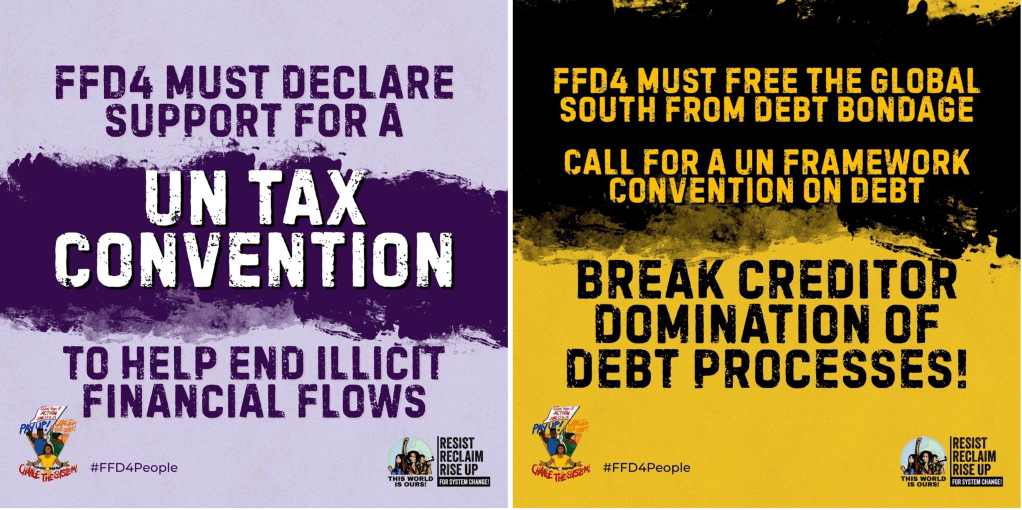
At the end of June, world leaders will gather in Seville, Spain, for the fourth international conference on financing for development, dubbed FfD4. (I attended an ecumenical pre-event at the first FfD conference in Monterrey, Mexico, in 2002 and wrote about it here.) In recent months, negotiations on the outcome document have sparked intense civil society campaigning

The Global Policy Forum said June 17 that the final draft retains an intergovernmental process for managing debt, but weakened its mandate to making “recommendations”. Critics argue that this could kill whatever hope remains for achieving Sustainable Development Goals (SDG) as “debt crises strangle fiscal space and derail the implementation of the Agenda 2030 for Sustainable Development.” Global Policy Forum describes some of what is gone from the outcome document (referred to now as the “Compromiso de Sevilla”):

The paragraph on phasing out fossil fuel subsidies (27i) has been deleted entirely, as well as the specification of asset types to be covered by national and global asset registries (28g). The language around the UN Framework Convention on International Tax Convention was also softened just two months before the first round of negotiations starts: “We support” was downgraded to “we encourage support” (28b).  A similar change occurred in the paragraph on investor-state dispute settlement, where the “we undertake reform” was replaced by “we support efforts to reform” (43l).

Meanwhile, the rich countries led by the United States are cutting international aid and increasing their military spending.

The G7 meeting near Calgary issued a series of statements (CBC, left) but one searches in vain for anything about debt cancellation or development assistance. The statement on “migrant smuggling” fails to address the question of why people leave their homes or how development aid and peace-making strategies can ease the problem.

The APMDD statement concludes:

“We are here to expose the Global North—not just for failing to deliver climate finance, but for actively sabotaging it in bad faith. This is no accident. It is a calculated strategy to protect their profits and deny justice to those they have exploited for centuries…. We see through every lie. We reject every excuse.”

Karl Marx in the Rose Garden

By Jim Hodgson

I take my title today from a subhead in a column by Enrique Galvan Ochoa in the Mexico City daily La Jornada. I’ll translate and summarise from his text here:

Not even Karl Marx would dare to imagine such a spectacular coup against neoliberalism and globalization as that carried out by President Donald Trump with his explosion of tariffs to the whole world on April 2 in the Rose Garden of the White House. The cathedrals of capitalism tumbled, from Wall Street to all the other global stock markets. In just a week, investors fled in search of refuge for their money: in gold, government bonds—swallows in search of a nest. The blow from that unpredictable businessman installed in Washington will have lasting effects. And it will hit the poor as well as the rich.

With respect, I am not so sure that it was a blow against neoliberalism so much as its logical next step: away from unrestricted movement of capital and toward concentration of wealth in ever-fewer hands. 

But that’s my point: I’m not sure. Daily—this has been going on since Trump began his run for political office a decade ago—new opinion pieces land in my inbox, many of them making strong historical analogies. Is he trying to restore a golden age/Belle Époque—think of the 1870s through to the start of the First World War and the beginning of income tax—for oligarchic billionaires and their closest allies, the mere millionaires? 

I loved seeing the rapper Lizzo on Saturday Night Live this past weekend wearing a cropped t-shirt emblazoned TARIFFIED. On the right: Trump in a storm.

What to make of these tariff wars and consequent stock market losses? I find myself pushed to go deeper.

You don’t have to be a Marxist—I think here of sociologist Max Weber and Canadian social democrat Tommy Douglas—to see how societies (including the liberal ones) are divided between the dominant structures defended by the elites and the counter movements supported by those with fewer privileges. 

And you don’t have to be a Marxist to appreciate his writing. A passage in The Communist Manifesto describes how love and poetry, religion and community, are “drowned in the icy waters of selfish calculation.”  All of these are drowned so that personal worth becomes exchange value—you sell your labour—and numberless freedoms are abolished in favour of “that single, unconscionable freedom—Free Trade.” * 

We might be forgiven if we thought free trade was invented at the time of the great debates ahead of the North American Free Trade Agreement (NAFTA) in 1994, or the Canada-U.S. agreement in 1989, or the advent of the common market in Europe in the 1960s. Some might know that elections in Canada were fought and lost at the end of the 19th and early 20th centuries over various proposals for free trade with the United States: “No truck or trade with the Yankees!” cried the Conservatives in 1911, defeating the Liberals of Sir Wilfred Laurier. 

Just before Marx and his co-author Friedrich Engels published their Manifesto in 1848, debate raged in Britain over the “Corn Laws.” These were tariffs and other trade restrictions on imported food enforced between 1815 and 1846. Large land-owners wanted the tariffs kept high to keep out competition. Industrialists wanted them lowered because cheaper food meant they could pay workers less. (The industrialists won.) In a speech in Brussels in January 1848, Marx said protectionism was conservative and free trade was destructive. But he also saw that free trade in that context “hastens the social revolution” and thus merited his support. 

I like to say that I have been fighting free trade since 1848. But truth is the first time I wrote about the free trade debate was in 1986 (above).

My issue wasn’t so much having about rules for international trade—and we always press for protection for labour, the environment and human rights—as it was the protections that were built into the trade agreements for corporations (always referred to as “investors”). Under those waves of free trade deals, governments were blocked from protecting public health or the environment. Corporations would bring their complaints to an “investor-state” dispute resolution tribunal. Most times, the tribunals would rule in favour of the corporation and the state would be on the hook for the corporation’s imagined future earnings. Or they would succumb to the threat of the suit, as Panama is doing now in the face of a $20-billion suit.

Now that Trump has thrown away the rule book, it may seem that people like me are suddenly defending free trade. I think we’re defending the idea of at least having rules. Even as we fight specific battles (I think of the lawsuit brought by Canadian mining companies against El Salvador), we learned to live with economic integration: even after the havoc caused in Canada to industrial jobs and farmers after the 1989 FTA with the United States; even after U.S. abandonment of its industrial workers; and even after two million Mexican farmers were forced from their land and into the cities and across the border after NAFTA in 1994. 

But let’s not lose sight of longer-term objectives. In the face of this crisis in capitalism, what are the opportunities? The “social revolution” envisioned by Marx may be distant, but in these last 40 years, social movements have never ceased to uphold human rights broadly understood: economic, social, cultural and environmental. 

Manuel Pérez Rocha works now with the Institute for Policy Studies and writes an occasional column for La Jornada. (In the late 90s, we both worked with the Mexican Action Network on Free Trade, RMALC). Recently, he pointed to a long list of actions taken together by Mexican, Canadian and U.S. organizations. He continued: 

“Under Trump, we suffer from a savage neoliberalism that evades treaties, written rules, and multilateral organizations. He sees no friends and only enemies. The only laws are those of the strongest and ‘I’m in charge.’ Mexico must respond by demanding a thorough review of the USMCA [called CUSMA in Canada and T-MEC in Mexico], chapter by chapter, since its purpose and content are largely the same as those of NAFTA: to make Mexico an export platform to take advantage of cheap labour. Together with Canada, we must promote this review by generating spaces and resources for democratic participation, not only for business leaders but also for grassroots organizations in all three countries.”

Meanwhile, Charlie Angus continues his resistance campaign. (In the current federal election, he is not running again.) On April 14, he reminded his Substack readers of Rules for Radicals by Saul Alinsky.

Angus points to what Alinsky would say about our collective sense of loss over what is happening in the world today:

“Do one of three things. One, go and find a wailing wall and feel sorry for yourselves. Two, go psycho and start bombing – but this will only swing people to the right. Three, learn a lesson. Go home, organize, build power.”

* Karl Marx and Friedrich Engels (1848), The Communist Manifesto in Essential Works of Marxism (18th ed., 1979), New York: Bantam, p.15.