Santa Marta: Transitioning away from fossil fuels

By Jim Hodgson

Good news may be hard to find these days. But here’s some. Representatives from about 60 nations met in northern Colombia in April to promote a transition away from fossil fuels.

The First Conference on Transitioning away from Fossil Fuels was a response to frustration felt after recent United Nations COP climate conferences, especially the one held last November in Belém, Brazil. Potential consensus around the transition away from fossil fuels broke down in the face of lobbying by oil companies and opposition from oil-producing nations.

The conference, co-sponsored by Colombia and Netherlands, ended April 29 with a clear message: the global conversation has shifted from whether to phase out oil, gas and coal to how to do it, with financing emerging as one of the biggest obstacles. As in many such international conferences, there were pre-events that gathered people from Indigenous, religious and other sectors.

By all accounts, the gathering in Santa Marta felt different from past climate talks. 

“The mood here in Santa Marta is euphoric,” said Tzeporah Berman, the founder and chair of the fossil fuel non-proliferation treaty initiative. “After years stuck in endless debates about whether to phase out fossil fuels, finally we are focusing on the how. We are no longer fighting for recognition of the problem, but creating solutions. It’s like watching a dam break – all that pent-up experience, knowledge and passion suddenly flowing into concrete ways to phase out dirty fuels. The hope is contagious.”
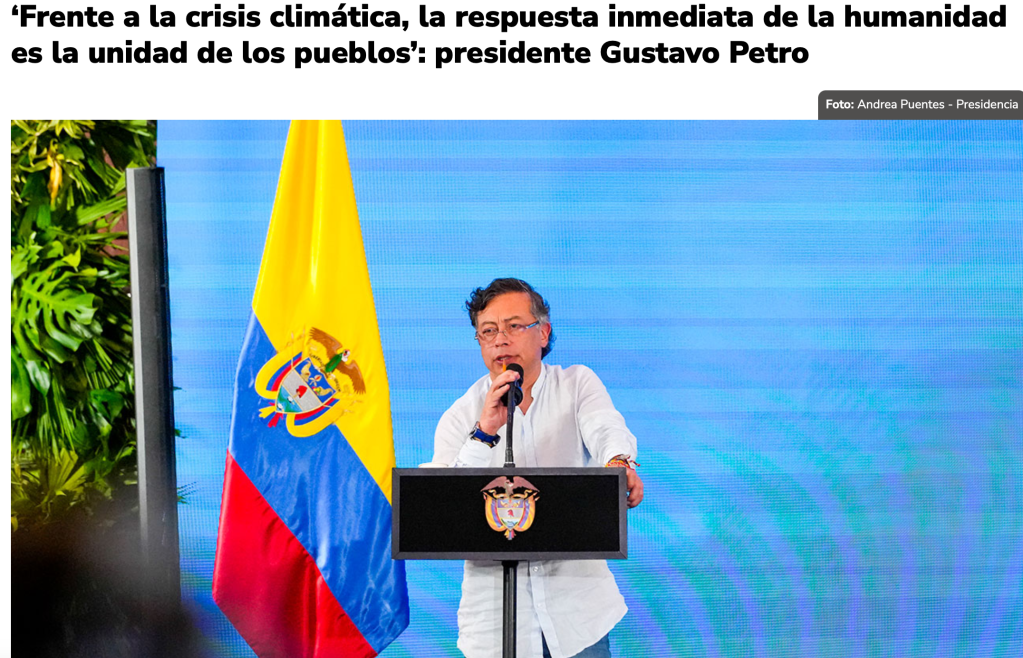
But participants were not unrealistic. Colombian President Gustavo Petro warned the world could “reach a point of no return” without the Amazon’s role in regulating the climate. Colombia is itself an oil-producing nation, but it has set a path of “gradual transition at home that balances climate goals with economic realities.”

Finding a good way forward requires addressing the global debt crisis. Countries in the global south that want to invest in renewable energy find themselves blocked by having to spend on high interest payments and imported fuel.

After the conference, Canadian scientist and broadcaster David Suzuki wrote: “Climate action requires unhinging power from foreign corporate privilege and putting it toward justice, democracy and the communities most affected.”
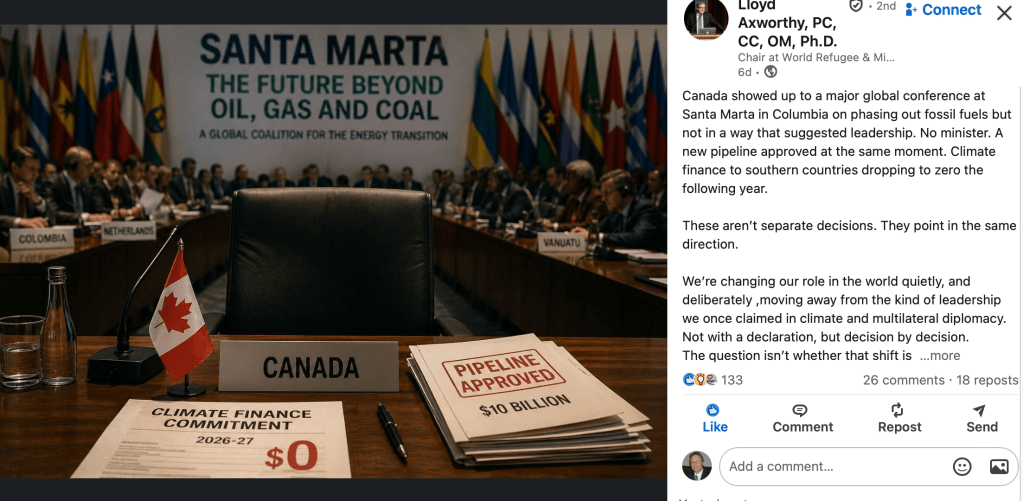
The Canadian government sent a representative: Jeanne-Marie Huddleston, Canada’s chief climate change negotiator – not a minister, but an employee of Environment Canada. Absence of a government minister was criticized (above) by Lloyd Axworthy, a former Canadian foreign minister who has emerged as a frequent critic of Prime Minister Mark Carney’s climate priorities – or lack of them.

In recent weeks, Canada has announced approval for expanding liquefied natural gas, a sovereign wealth fund — which among other things could help oil and gas projects of national interest — and its next budget looks to be cushioned by higher oil prices driven by the Iran war.

Participating states agreed to meet again in Tuvalu in early 2027, a gathering to be co-hosted by Ireland. Climate scientists and the UN have warned that the South Pacific island nation could be submerged by 2100 due to rising sea levels.
Fake criminal charges, mining justice and solidarity in El Salvador

My friend Antonio Pacheco, renowned leader of a community development group in northern El Salvador, was arrested with five other men on Jan. 11 and charged in connection with a war-time death that happened more than 30 years ago. They are also charged with “illicit association,” the accusation that has led to detention of more than 60,000 alleged gang members by the government of President Nayib Bukele. 

The charges, say friends and allies, have nothing to do with achieving justice for any of the 75,000 people who died during the civil war, and everything to do with the government’s drive to re-open metals mining in El Salvador in the wake of its Bitcoin cryptocurrency failure.

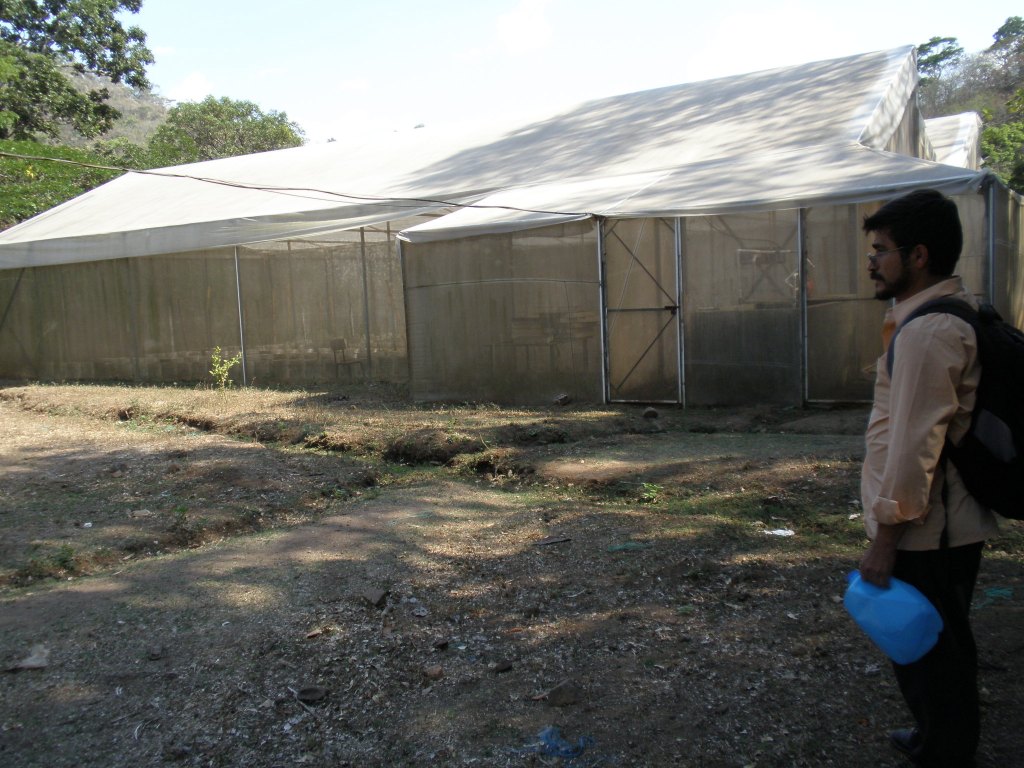
Antonio Pacheco observes an ADES greenhouse in Santa Marta in 2009. Photo: Jim Hodgson

Pacheco and members of the Santa Marta Development Association of El Salvador (ADES) were leaders in the successful effort to stop a gold mining project in Cabañas department, and part of El Salvador’s National Roundtable on Metals Mining that achieved a ban on metals mining in 2017. 

During the civil war in the 1980s, Santa Marta was targeted by the Salvadoran military and most residents fled to Honduras. Successive Salvadoran governments have not investigated the dozens of cases of human rights violations documented by the people of Santa Marta against the armed forces (including the Lempa River massacre in 1980, where 30 people were murdered and 189 others disappeared). 

The arrests last week drew global attention, including articles in The Guardian, the German news service DW and TeleSUR, and solidarity statements from the U.S. Institute for Policy Studies, the Honduran group COPINH, the U.S. Sister Cities network, and others. “Antonio Pacheco has struggled almost his entire life to build a country that seeks social, economic and cultural well-being and who is a friend to the causes of the Honduran people,” said COPIHN (the organization led by Bertha Cáceres until her murder in 2016).

I came to know Antonio, ADES and many other people the rural communities of northern Cabañas during the 20 years of my work with The United Church of Canada. I wrote about him several times, including a profile published in the United Church’s Mandate magazine in February 2011:

“A Life-Long Passion” (excerpt)

A child grows up in El Salvador in the 1960s. He asks: “Mamá, why are there poor people?”

Decades later, the question still animates Antonio Pacheco, executive director of ADES….

“I hardly ever talk about this,” Antonio said, smiling over his coffee in the food court below the United Church general council office in Toronto. “I had this intense curiosity. I asked lots of questions. I read, and read some more. I read the Bible, or tried to.”

In the sixties and seventies, Christians in Latin America began creating “base communities” to provide space for questions like those of Antonio and to share the Word of God among neighbours.

“One word caught my attention: solidarity. I began to understand why Jesus was taken to the cross,” Antonio said. 

“By the time I was 11, I understood that I wanted to work for the people. I wanted to be a doctor so that I could help.”

But as Antonio entered high school in the mid-seventies, El Salvador was in political upheaval. The base communities and church leaders became targets of repression. Antonio emerged as a leader of the student movement in his high school in San Salvador, and joined the revolutionary movement in 1977. Political and education work took him to Santa Marta for the first time in 1979, and by 1982 as the civil war raged, Antonio worked with the community directly in its education efforts. But aerial bombing grew so intense that the entire community fled into exile in Honduras in the mid-1980s.

It was after the return to Santa Marta in October 1987 that Antonio’s community development work really began to bear fruit. Even though a final peace accord was not achieved until 1992, the people of Santa Marta sought and found international help to rebuild. The United Church of Canada and the Anglican Primate’s World Relief and Development Fund were among the first partners. In 1993, ADES was born to secure and manage development funds. Antonio has served as executive director since 1998.

Today, formal education is one of Santa Marta’s great successes…. ADES continues to lead in agricultural development and training in northern Cabañas, but a number of programs have spun off in varying degrees of autonomy: a micro-credit program for market workers, a community radio station in nearby La Victoria, and an AIDS education program for rural youth that works on both sides of the border.

Now in the 2020s, ADES is working with support from the United Church and the Manitoba Council for International Co-operation to expand ecological agricultural practices in Cabañas.

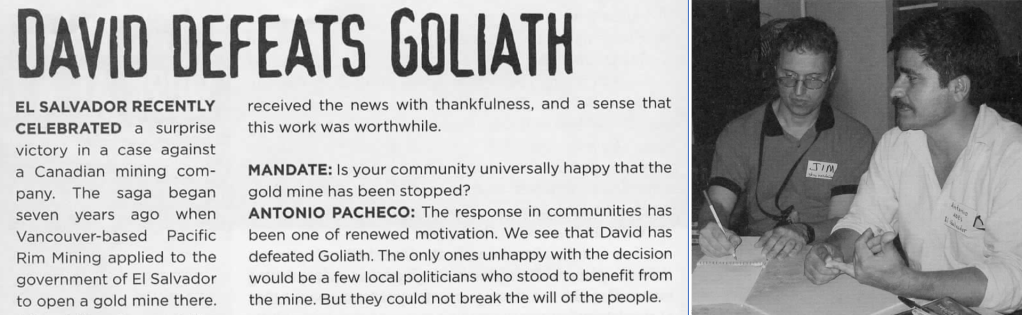
“David defeats Goliath”

With the mining victories in 2016 and 2017, Mandate published a short interview that I did with Antonio. At the end, I asked what he would say to Canadians about their responsibility to regulate their mining companies

“The Canadian people should be aware that Canadian companies operating outside the country have practices that fail to respect the human rights of the people in communities, and that they fail to repair damage to the environment. For those reasons, it is necessary and urgent that their actions abroad be regulated in Canada.”

Left: Mandate, February 2017. Right: Jim Hodgson with Antonio Pacheco, August 2006. Photo: Presbyterian World Service & Development.