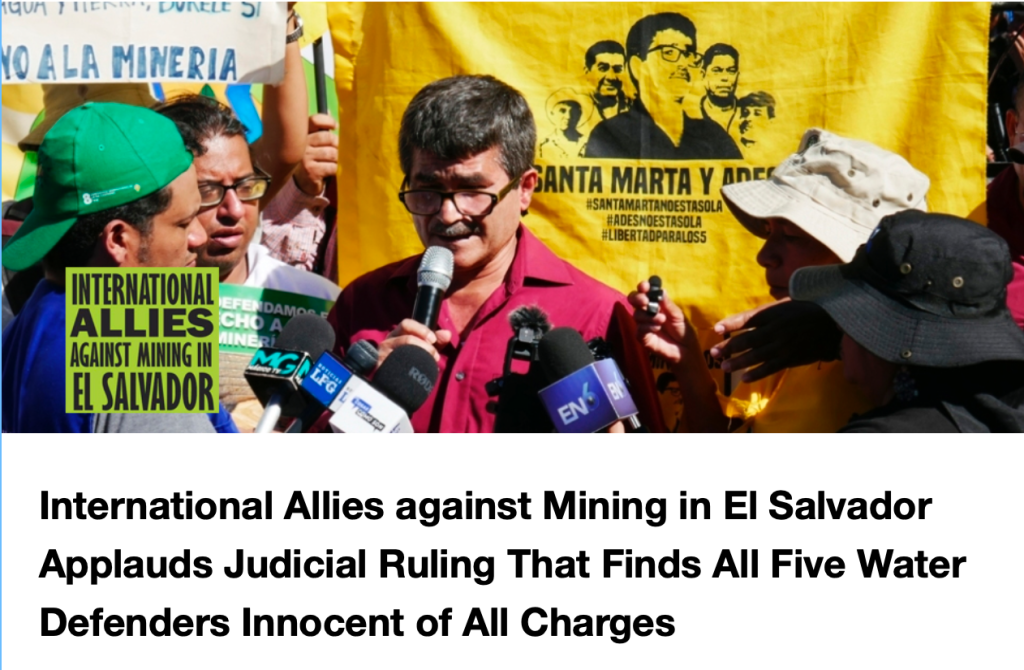
In El Salvador, the struggle continues as AG appeals not-guilty verdict in case of Santa Marta 5

The office of El Salvador’s Attorney General has decided to appeal the acquittal Oct. 18 of five community leaders, a move quickly rejected by their community and by Salvadoran and global organizations that have worked in solidarity for more than two decades to reject a proposed gold mine that threatened water resources.

Images: ACAFREMIN (the Central American Alliance Against Mining) and CISPES (Committee in Solidarity with the People of El Salvador)

The office of El Salvador’s Attorney General has decided to appeal the acquittal Oct. 18 of five community leaders, a move quickly rejected by their community and by Salvadoran and global organizations that have worked in solidarity for more than two decades to reject a proposed gold mine that threatened water resources.

Leonel Herrera, a journalist covering the case for Diario Co Latinocalls the decision to appeal “reprehensible.” Authorities should use their time and resources “to investigate true war crimes, beginning with the massacres committed against Santa Marta which took the lives of hundreds of civilians—mostly women, the elderly and children.” 

This was never a true criminal case, Herrera added, but rather “a spurious accusation invented to persecute a group of former guerrilla fighters not for war crimes, but rather for what they do now: care for the water, protect the ecosystem and attain the continuity of lives gravely threatened by the possible re-activation of mining projects.”

Santa Marta Rejects Appeal of Acquittal of Water Defenders

Translation by CISPES (Spanish original is  here)

We reject the appeal of the Attorney General’s Office and demand that the acquittal of our environmental leaders be upheld

The Attorney General’s Office (FGR) remains determined to prevent legality and justice from prevailing for the community leaders of Santa Marta and ADES, who were definitively acquitted last October 18 by the Sentencing Court of Sensuntepeque, Cabañas. For this reason, an appeal has been filed before the Criminal Chamber of Cojutepeque.
Despite multiple calls to respect the acquittal of the environmental activists of Cabañas, the Prosecutor’s Office seeks to reverse Sentencing Court’s ruling, which is in accordance with the law and congruent with the principles of due process. The appeal is characterized by a lack of valid legal argumentation and by the disrespectful way in which the representatives of the Prosecutor’s Office refer to the honorable sentencing judges.
In this sense, we ask the magistrates of the Criminal Chamber of Cojutepeque not to admit the appeal and to ratify the decision of the Sentencing Court of Sensuntepeque, which has acted independently, in accordance with the law and without being pressured by extrajudicial factors that conspire to condemn the defenders of water, the environment and life threatened by the possible reactivation of mining.
In this regard, it is worth remembering that the ruling of the Sensuntepeque Sentencing Court responds to the mandate of the Cojutepeque Criminal Chamber, which on two occasions transferred the decision of whether or not the alleged acts constituted crimes against humanity or war crimes to the Sensuntepeque Sentencing Court.
In accordance with this mandate, the sentencing judges analyzed the case and unanimously determined that the alleged crimes presented by the prosecution did not meet the definition of a crime against humanity or a war crime, as established in the Rome Statute and the Geneva Conventions, respectively. Therefore, they ruled that the criminal action was inadmissible due to the statute of limitations of the alleged crimes and decreed a definitive dismissal for the defendants.
We alert the country and the world of this attempt by the Salvadoran Attorney General’s Office to continue using the judicial system to persecute environmental activism and manipulate restorative and transitional justice to criminalize environmental defenders who warn about the serious dangers of mining extractivism.

Definitive freedom for the community leaders of Santa Marta and ADES!
Yes to Life, No to Mining!

Cabañas, El Salvador, October 30, 2024

Perceptions of the Ukraine war in the Global South and Reflections on Peace

Too few of us are talking about peace – or about dialogue and diplomacy – these days. As U.S. journalist Katherine vanden Heuvel writes, it’s time to challenge conventional views on the war in Ukraine.

On a humid evening at the end of May, I spoke with a local parish group convened by Toronto members of Development and Peace/Caritas Canada. I talked more than I usually do about my faith and about the teachings in our religious traditions about peace: “Blessed are the peace-makers,” the artisans of peace.
Not everyone sees this war in the same way. Whether every perception is correct is not the point. At their root is a reluctance to take sides in what looks like a conflict between the empires.

At the same time, Russia’s invasion draws from the tsarist past to violate Ukraine’s sovereignty and right to self-determination. It is also strengthening Ukrainians’ sense of identity and nationhood. Changes should be negotiated without military threats and consented to in free and fair referendums. The 2014-15 Minsk Accords might have offered a way forward.

“Many people think that it is better that the winners be those who oppose U.S. imperialism, which leads them to support Russia or China, or occasionally, Iran or any other nation that opposes the western powers,” writes Raúl Zibechi, the Uruguayan observer of Latin America’s social movements. “Social movements should oppose war so as to deepen their own agenda: strengthening their ‘territorial roots so as to exercise autonomy and self-government, building other worlds that are new and different from the capitalist, patriarchal and colonial world.”
Adolfo Pérez Esquivel, the Argentinean winner of the 1980 Nobel Peace Prize, says there are no “just wars.” But he adds that there are “just causes.” I think of the revolutionary struggles in Central America in the 1980s, but those did not bring about the social changes people hoped for (largely because the United States supplied weapons and mercenaries to the far-right forces), and tens of thousands of people died.
On the left is the garden were six Jesuits, their housekeeper and her daughter were murdered by a death squad in November 1989 at the University of Central America in San Salvador. On the right are Rev. Miguel Tomás Castro of Emmanuel Baptist Church in San Salvador and a group of student leaders in the ongoing effort to build a “culture of peace.”

The “peace” that Central Americans, together with others across the Global South, ended up with after the wars has advanced a model of development that impoverishes, excludes and drives people from their land. Even the new development proposals from the U.S. and Mexican governments are inadequate in the face of political-economic devastation and climate change. Hondurans, at least, at this moment, have a shot at something better. But their military (and its U.S. backers) may not tolerate real, meaningful change. The way forward must be different from the ways of the past.

The current war in Ukraine, in addition to the human and material costs of fighting, is having ripples far beyond the two countries directly involved. Not just higher energy prices, but the likelihood of food shortages. Russia and Ukraine have been responsible for more than a quarter of the world’s wheat exports and for large quantities of barley, corn and vegetable oil too.

I have been critical of the use of sanctions. Sanctions, as we see now in the case of Russia, are warfare by other means. (You can track the imposition of sanctions here.)

With regard to sanctions, it’s not the world against Russia. As Zhou Xiaoming has written, few non-Western countries have answered the U.S. call to isolate Russia economically, fearing the impact of disruptions to global production and trade on their own people. And countries that have already felt the effects of US sanctions and have no desire to inflict them on others.

This time, I am not exactly against the use of economic measures. Over the short-term, targeted measures seem reasonable. Between now and the onset of winter, their impact on civilians will need to be measured and their effectiveness evaluated. Space for diplomacy, public health and science, however, should remain open, including the Arctic Council and the International Space Station. 

What happened to our peace movement? NATO expanded, and seems likely to expand still further.

What should we do now?

We should do what we who believe in peace do in every other armed conflict: call for peace, withdrawal, dialogue, diplomacy. 

  • Support the refugees – and those Russians who dissent from Putin’s war. Indeed: support ALL refugees, wherever they are. By mid-2021, an unprecedented 82.4 million people around the world have been forced to flee their homes. Among them are 26.4 million refugees, around 42 per cent of whom are under the age of 18. 
  • Support humanitarian efforts by Development and Peace/Caritas Canada, the churches and agencies that are part of the global ACT Alliance, and other reputable organizations.
  • Revive conversations on common security and mutual understanding and increase official development assistance to 0.7 per cent of gross national income. These are investments in security and sustainability for all.
  • Whatever happens in Ukraine, keep nuclear weapons out
  • Support debt relief: Since the fall of the Soviet Union, Ukraine has borrowed more than $125 billion from international financial institutions, which pushed the sell-off of public enterprises and rewarded oligarchs and the super-rich with every loan they made. But being under attack doesn’t mean you can catch a break from international lenders. In 2022, unless loans are forgiven or suspended, Kyiv will spend $6.2 billion paying down foreign debt. Nearly half of that will go to the International Monetary Fund. 
The Hill Times, April 27, 2022. See as well a piece by Beth Woroniuk in iPolitics: “The world’s response to the invasion in Ukraine is only the latest example that ‘old school’ approaches to conflict resolution are not working. It is the time to bring anti-racist and decolonial analysis to international relations. It is time to ask questions about whose voices matter. This includes going beyond the warriors and including people who have a vested interest in stopping the guns for good, including women building peace at local, national and international levels.”

Early on in the conflict, it seemed that Pope Francis had potential as a mediator because of his pretty good relationship with Patriarch Kirill. But Kirill, like Putin, seems tied to a view of history – the Kievan Rus, the ancient state that converted to Christianity in 988 – that would subsume Ukraine into Russia. Meanwhile, the Ukrainian Orthodox Church has largely broken with the Moscow Patriarchate.
Can churches that have fomented division in the past now lead the way in showing they can live with diversity?

The horrible thing about making peace is that you have to talk with your enemies. Diplomacy is a tool for doing that.

Deliver us from evil, deliver our leaders from evil and grant us peace in our day.

Global inequality prompts call for new UN conference on Financing for Development

Jim Hodgson

The massive tragedies provoked by Russia’s invasion of Ukraine have pushed all other news to the margins. But urgent challenges remain: 

  • climate change – extreme  weather events will only increase (even as some politicians demand more oil and gas production)
  • vaccine apartheid – the global North continues to hog the means to stop the spread, while ignoring risks posed by new variants
  • debt-loads sustained by the most impoverished countries have risen as health and other emergency costs increased 

This week, civil society organizations around the world are calling for renewed conversation about Financing for Development (FfD). For all of its flaws (including the Security Council veto held by each of the 1945-era global powers), the United Nations is still a space where on some topics at least, countries can gather as equals.

The UN Conference on Financing for Development “remains the only place where developing countries are at the table with equal voice and vote on issues of global finance and development.”  

In the face of the power accrued to international financial institutions (IFIs, including the World Bank), developing countries and civil society organizations are demanding a fourth global conference, sometimes referring to “FfD4.”

“The FfD process is unique, as it is the only truly democratic space where global economic governance is addressed, while having the issues of climate change, inequalities and human rights at its core,” say the organizations pressing for a new global conference.

“FfD4 should ensure democratization of global economic governance, recognizing the right of every country to be at the decision-making table, and not only those with concentrated power or resources.”

“Globalizing the Fullness of Life”

Twenty years ago, in Monterrey, Mexico, the first International Conference on Financing for Development happened in Monterrey, Mexico. 

Some of the participants in the 2002 ecumenical pre-event in Monterrey.

Concerned that whatever goals we had for the “development of peoples” (a phrase offered by Pope Paul VI in his encyclical Populorum Progressio in 1967) were being sacrificed by corporate-led globalization, I attended an ecumenical pre-event that was organized by the Council of Latin American Churches (CLAI). Some participants stayed on for the UN event.

My own presentation focused on good experiences I had had in Canada and Mexico of church collaboration in ecumenical and multi-sector coalitions, encouraging participants to join with others beyond their Protestant churches to achieve goals of economic justice.Our closing declaration said participants were motivated to speak out because:

“Poverty, exclusion, misery, unemployment, underemployment, labour instability, the bankruptcy of small and medium-sized businesses, and the deterioration of the environment, have reached an unsustainable limit.” 

We then affirmed several proposals and ethical principles:

  • The market must not define the life projects of our countries. 
  • All economic growth must have the objective of improving the conditions of all of all of society, without exclusions.  
  • Globalization must be regulated with clear and just rules. This implies:
    • Strengthening participatory democracy in decision-making.
    • Creating mechanisms for control and arbitration at the national level that promote codes of conduct to regulate investments, capital flows and loans. 
    • Creating an international arbitration agency and mechanisms for the cancellation of foreign debt.
    • Reforming the international financial architecture, transforming its institutions and revising its mandates, methodologies and decision-making processes. 
  • The urgent need to cancel the debt of our peoples, so as to provide sustainable social development. But we firmly sustain that the roots of the debt be investigated, and that the creditors and debtors in the North and in the South who irresponsibly contracted these debts be made to pay them.
  • The need to amplify the access to information and technology by our developing countries. 

Our declaration closed with a call on “the powers of this world” to “place the market and the international financial system at the service of all people.” We added: “We affirm that the Reign of God is justice and that the blessing of the creator will be with those who hear the cry of the people.” 

One of the documents that inspired the World Council of Churches to participate in the Monterrey conference was “Justice, the heart of the matter,” prepared two years earlier by staff of the Canadian Ecumenical Coalition for Economic Justice (ECEJ) – one of the predecessors of KAIROS.