
by Jim Hodgson
In Jujuy, northwest Argentina, a struggle is playing out that shows how right-wing political forces repeatedly apply repression to hold on to power even as democratic space continues to open across most of Latin America.
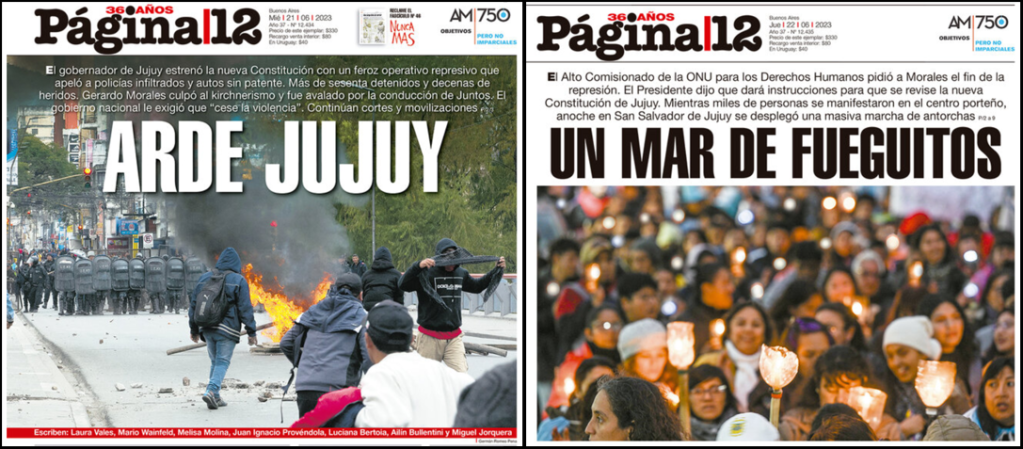
The most recent flare came after teachers went on strike to press their demand for salary increases amidst Argentina’s 114-per-cent inflation rate. Jujuy provincial governor Gerardo Morales responded by rushing through changes to the province’s constitution that restrict freedoms of assembly, protest and speech. The constitutional changes came without approval of the province’s Indigenous peoples.
“We have received reports of events that could constitute an improper use of force against individuals in the context of the demonstrations,” said Jan Jarab of the South America regional office of the United Nations’ High Commissioner for Human Rights. In a letter addressed to the governor, he also questioned “the handling of the recent demonstrations by the security forces, as well as about some of the provisions of the approved provincial constitutional reform text.”

Amnesty International also denounced those changes, and called for on the Jujuy government to cease the “excessive use of force against those exercising their right to peaceful protest, which has resulted in hundreds of people being injured in recent days.”
President Alberto Fernández responded to the continued unrest in Jujuy by saying he will seek to have the reforms to the provincial constitution struck down as unconstitutional.
Morales has used excessive measures before, notably in the case of Indigenous leader Milagro Sala, imprisoned since Jan. 16, 2016, after a protest. Sala is leader of the Movimiento Tupac Amaru, and led the creation of “workers’ neighbourhoods” that allowed workers to live for the first time in houses that they owned and to have access to schools and health centres.
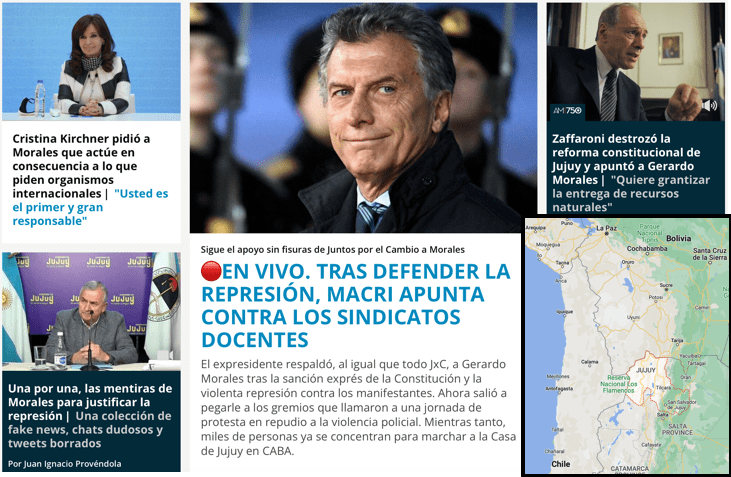
The drama in Jujuy plays out against the backdrop of Argentina’s volatile political calendar. The two-term Jujuy governor is the presidential candidate of one of the conservative parties, the Unión Civic Radical (UCR). The UCR is part of the centre-right coalition, Juntos por el Cambio “Together for Change”) which also includes former president Mauricio Macri.
That coalition, however, is fractured now by the emergence of Javier Milei, a libertarian economist, as a candidate who has drawn support from the right and from sectors of the centre-left dissatisfied with the current administration of Fernández and his vice-president, Cristina Fernández de Kirchner (triple-digit inflation and a deteriorating economic situation).
Primary elections will be held on Aug. 13 for parties that opt to choose candidates by that system. The general election is to be held Oct. 22, and a presidential run-off would follow Nov. 19 if necessary.
In a move that surprised many observers, the president and vice-president and other leaders of their Unión por la Patria (UP) coalition came together June 23 to back a single candidate and slate headed by Economy Minister Sergio Massa.
Along with the national political context, a second factor driving the repression is the presence of lithium in Jujuy (which borders the lithium-producing regions of northern Chile and southern Bolivia). Lithium is used in batteries for electronic vehicles.
A recent visit to the region by film-maker James Cameron was manipulated by Jujuy’s governor to give a positive spin to lithium mining operations undertaken despite Indigenous opposition.
Cameron, the director of Avatar and Titanic, said later: “Ironically, the outcome of this is that I am now aware of the problem and we will now assist through my foundation with the issue of Indigenous rights with respect to lithium extraction.”
A third factor in the present conflict is the region’s history of 480 years of colonial exploitation and Indigenous resistance.
A recent statement by archeologists and anthropologists declares their solidarity with the Indigenous people of Jujuy. “And without community territory, rights to the land and the possibility of social protest against diversion from that vision, there is no equality, inter-culturality, or social peace.”
 Unwrapping Development