The struggle over the new world (dis)order

by Jim Hodgson

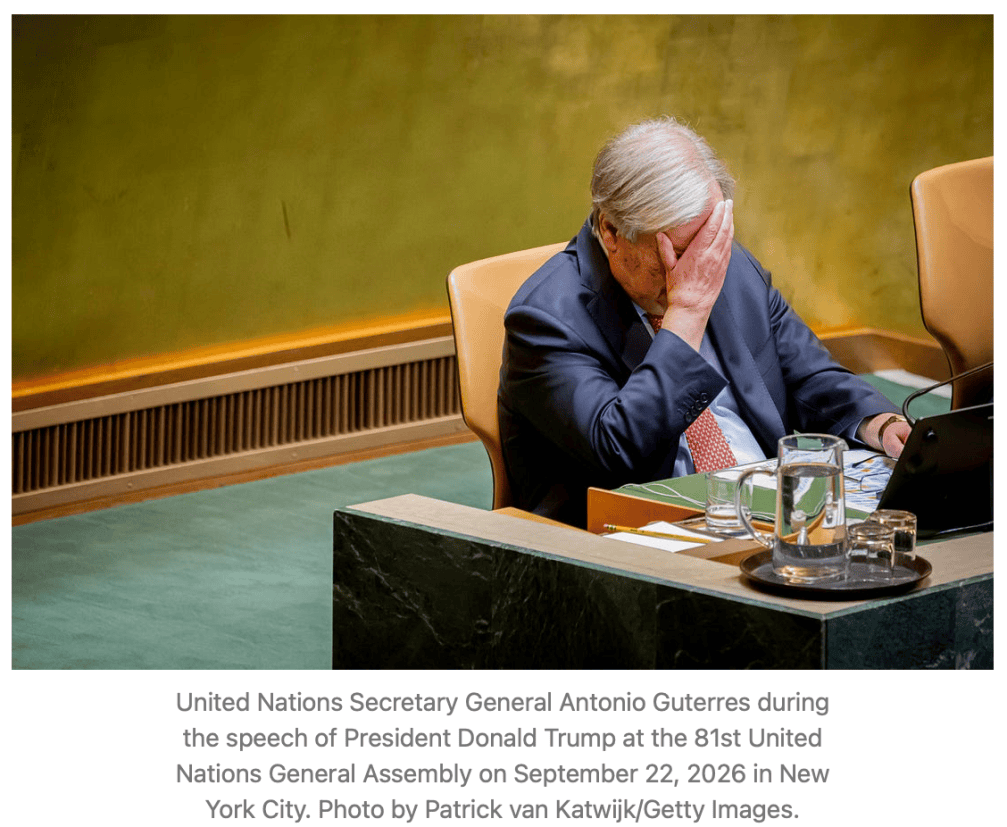
The first hours of the annual parade of world leaders at the UN General Assembly Sept. 22 showed again the sharp disagreement between the leader of the United States and many other leaders over multilateral cooperation and unilateral abuse of power.

In his speech, Donald Trump threatened to “annihilate” Iran, proclaimed his nation’s supremacy, and declared that “to the victor go the spoils.” He also called Cuba “a failed state,” though any “failure” is due to his country’s decades of interference, embargo and sanctions.
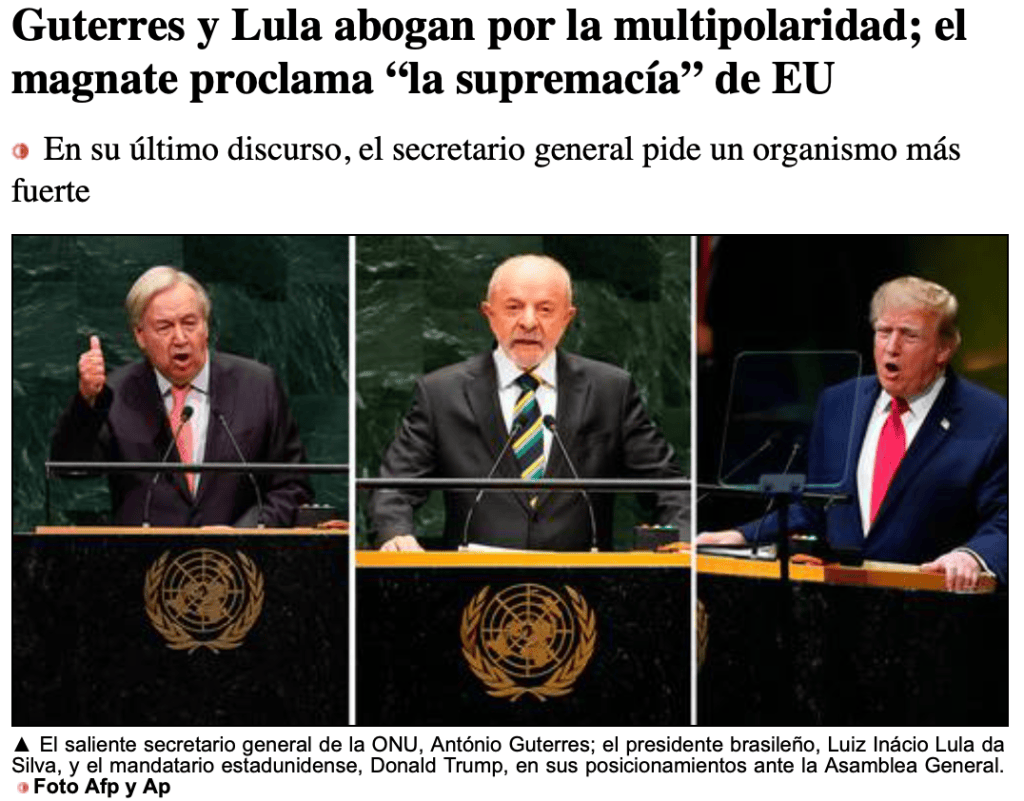

Trump’s speech followed those of UN Secretary General António Guterres (left) and Brazilian President Luiz Inácio (Lula) da Silva (centre), who both emphasized the need for multilateral cooperation in the face of the ecological, political and humanitarian crises that confront humanity. Guterres also called for debt relief that is timely and effective.

“In the face of a global catastrophe more than 80 years ago,” Guterres said, “the United Nations was created as an act of defiance. The defiance of people who refuse to surrender the future to fear. The defiance against the self-defeating notion that might makes right. The defiance of countries that know our futures are bound together. The defiance of hope.”

Lula, who seeks re-election in October, warned that countries should not interfere in the internal affairs of other nations. In the current campaign, Trump has openly backed Flávio Bolsonaro, son of a disgraced former president. Trump previously interfered in elections in Honduras, Argentina and Colombia.

Lula urged world leaders to take stronger action in response to intensifying global conflicts and called on the UN to recover its capacity for dialogue and mediation. He added that it is time to choose between multilateralism or global fragmentation.

“Concessions to the law of the stronger have surpassed all limits. This is not idealism, but pure realism,” he said. “War is not the continuation of politics by other means; it’s the complete breakdown of politics.”

In his speech, Trump said Mexico was the “epicentre” of drug-trafficking in Latin America and that it had ceded some of its territory to the cartels. 
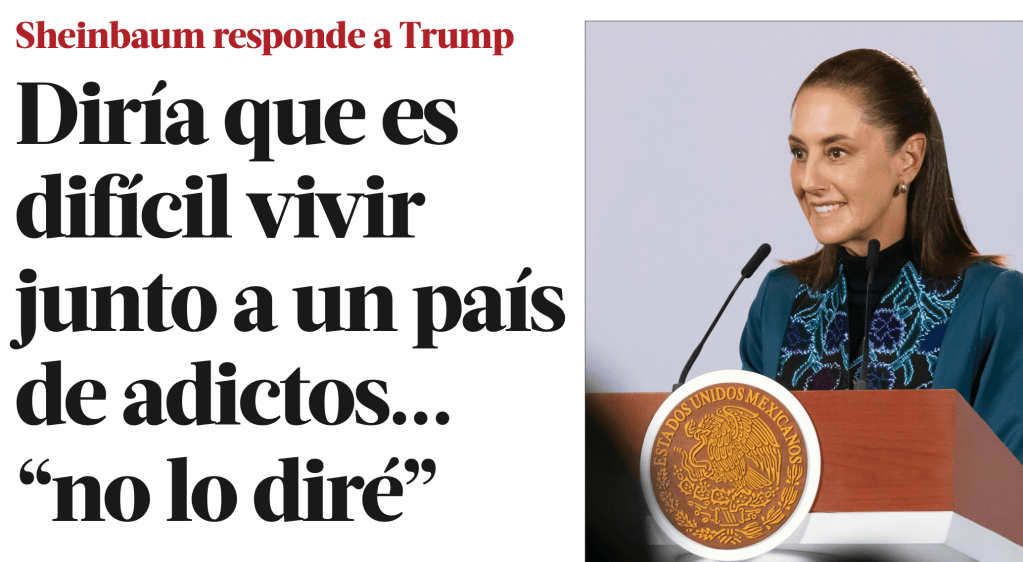
A day later, President Claudia Sheinbaum responded with irony: 

“I could say that it is very difficult to live next to a country with such a high level of consumption of illegal drugs. Or I could say that it is very difficult to live next to a country that produces so many weapons. But I won’t say that because we have a good relationship.”

(Sheinbaum did not attend the General Assembly; Mexico’s remarks were delivered Friday by Foreign Minister Roberto Velasco, who emphasized collaboration with other countries and reform of UN structures.) 

Trump gathers his “Shield of the Americas”

Since Trump returned to the White House in January 2025, the United States has tried to dominate its neighbours in the Western Hemisphere. The early 19th-century Monroe Doctrine (now dubbed “Donroe”) is revived to limit perceived threats in the region.

Over the past 13 months, the U.S. military has killed at least 230 people in about 70 air strikes on boats in the Caribbean and Eastern Pacific Ocean. In January, U.S. forces kidnapped Venezuelan President Nicolás Maduro and his spouse Cilia Flores, and now holds them in a prison in Brooklyn across the East River from the United Nations building.

In April, U.S. and Ecuadoran soldiers launched an effort to dismantle a drug-trafficking group. On Sept. 24, U.S. troops and the U.S. Drug Enforcement Administration assisted Ecuadoran authorities in arresting more than 30 people with alleged ties to Mexico’s Jalisco New Generation Cartel.

During the high-level General Assembly session, Trump gathered leaders of the 14 countries allied with him in his so-called “Shield of the Americas.” 

They pledged coordinated action against 24 organizations designated as “narco-terrorist.” The declaration calls for sanctions, intelligence sharing, security cooperation and a commitment to invoke the Inter-American Treaty of Reciprocal Assistance, or Rio Treaty, to consider collective military action against the groups.

New Canadian aid to Palestine and Haiti (but not Cuba)

Canada’s foreign minister, Anita Anand, also emphasized multilateral collaboration in her speech. Canada’s foreign policy, she said, is guided by establishing autonomy in strategic fields to limit superpower coercion, along with aspirations to lead middle powers.

“Great powers are walking away from global economic co-operation, dismantling economic integration,” Anand said. State sovereignty “has been treated with disdain.”

“We are facing serious challenges in the global order,” Anand said.

“We will lead other middle powers to act collectively and decisively, because middle powers are playing a key role in building the framework for the new international order — which is being established as we speak.”

Earlier in the week, Prime Minister Mark Carney pledged $100 million in aid for Palestine in an effort to preserve “the possibility of a two-state solution.”

The funding includes $80 million in humanitarian aid, while the rest is development funding for security initiatives, including top-up funds for a multi-year project to train police in the West Bank. 

Anand announced $25.4 million in new Canadian funding for Haiti to support security, governance and community resilience in Haiti. But there have been no new funding announcements for Cuba since commitments earlier this year of $13.5 million to the Pan-American Health Organization, the World Food Program and UNICEF for programs in Cuba.

(Images: http://www.lajornada.com.mx)
Canada-Ecuador free trade deal sparks concern in both countries

by Jim Hodgson

As ministers signed a new free trade agreement today in Ottawa, civil society organizations in Canada and Ecuador repeated their concerns about the deal.

The 26-chapter document was signed in Ottawa today by Canada’s international trade minister, Maninder Sidhu and Ecuador’s minister of production, foreign trade and investment, Luis Alberto Jaramillo.

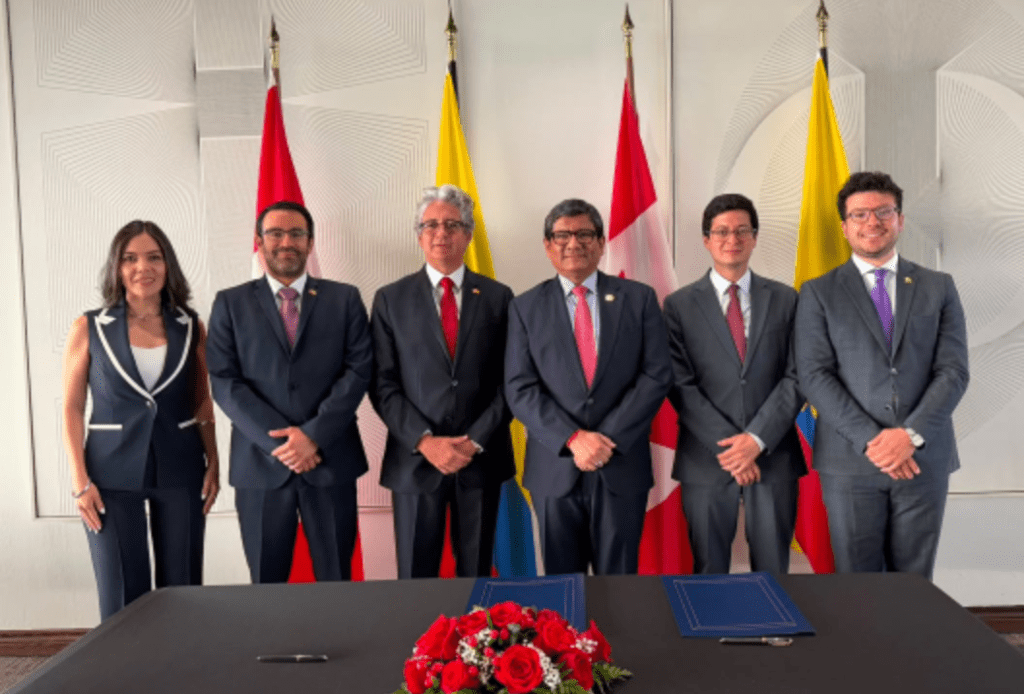
Ministers meet. Photo: Primicias, Ecuador.

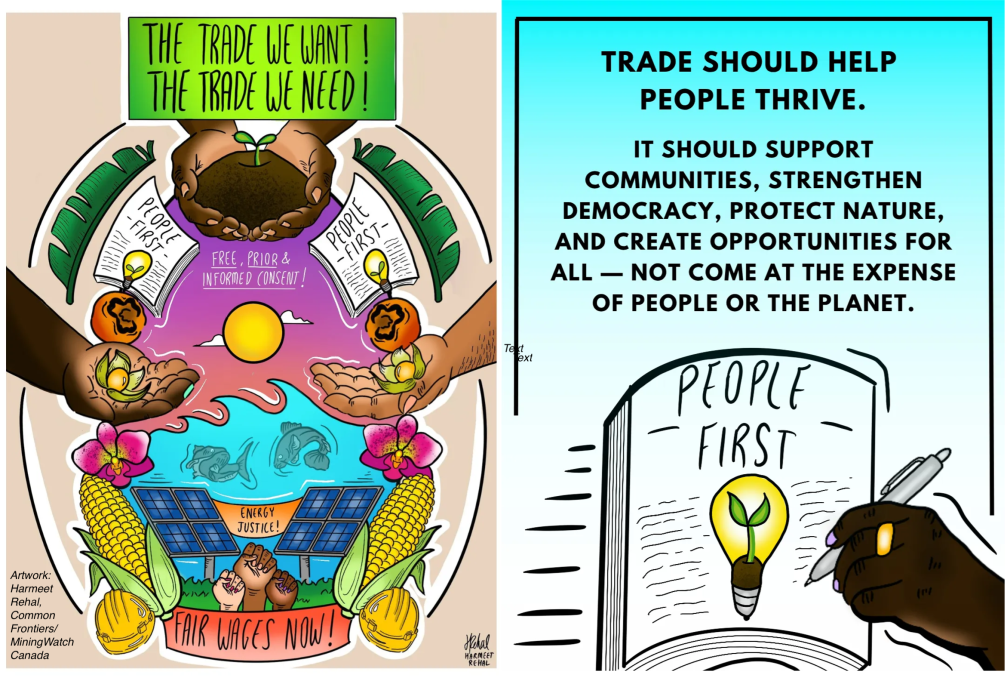
In Canada, Common Frontiers and MiningWatch Canada said the agreement was “deeply dangerous.” From what is known about the deal, it’s clear that it “grants sweeping and undemocratic protections to Canadian investors while deepening Ecuador’s human rights crisis.”

(I have worked with both organizations and their members for the better part of three decades – since our struggles over the North American FTA, opposition to the proposed Free Trade Area of the Americas – a fight we won in 2005 – and the impacts of Canadian mining companies in Guatemala and beyond. Challenging as the current situation in Ecuador is, I am pleased to see Common Frontiers and MiningWatch fighting the good fight against these FTAs that only benefit the rich.)

Groups in both countries had previously criticized Ecuador’s ban on its largest opposition party, ongoing criminalization of ecological defenders, failure to consult with Indigenous peoples, and collaboration with the United States in military attacks on supposed drug-traffickers.

Common Frontiers and MiningWatch prepared a four-page explainer on why the deal is bad. And here is a statement on the new FTA from colleagues at Latin America is Better without Free Trade.

Most of what follows is text from the Common Frontiers-MiningWatch news release:

Minister Sidhu said the agreement will “open new opportunities for Canadian companies in a growing market, strengthen supply chains, and provide more predictable access to goods, services, and investment.” But Canada’s own assessment of the agreement projected insignificant growth in trade. Its main purpose is to attract and protect Canadian investment in Ecuador’s mining sector. 

The agreement is massively opposed by a large share of Ecuadorian civil society and Indigenous groups.

Paramount among the concerns:

  • A worsening human rights crisis in Ecuador. Ecuadorian and international human rights organizations have documented widespread, systematic human rights violations, including increasing militarization, repression of dissent, the criminalization of environmental defenders, and the imposition of executive decrees that undermine the rule of law. Much of this is exacerbated by – or in support of – existing Canadian mining investment in the country.
  • No consultation, consent, or transparency. The agreement was negotiated and signed without the free, prior, and informed consent of affected Indigenous Peoples, violating the UN Declaration on the Rights of Indigenous Peoples and Ecuador’s obligations under the Escazú Agreement.
  • Investor protections that violate Ecuador’s constitution. The agreement contains an Investor-State Dispute Settlement (ISDS) mechanism that is prohibited by Ecuador’s constitution and was rejected in two recent plebiscites. According to former UN Rapporteur David Boyd, ISDS poses “catastrophic” consequences for climate action, environmental protection, and the realization of human rights.
  • No corporate accountability mechanism in Canada. The recent closure of the Canadian Ombudsperson for Responsible Enterprise (CORE) and the lack of due diligence legislation underscore a major accountability gap in Canada. Communities harmed by the operations of Canadian companies in Ecuador will have no standing in investor-state disputes and nowhere to turn for justice and remedy.

The agreement now heads to Parliament to be ratified. In response to repeated concerns raised by Ecuadorian civil society and Indigenous communities and echoed by prominent civil society voices in Canada, the organizations are urging Members of Parliament to reject the agreement.

In Ecuador, the Primicias news site said the trade agreement with Canada will allow almost all of the products that Ecuador exports to that market to enter with zero tariff, once it comes into force. According to the Government, the benefit covers 99.6% of items for Ecuador.

Among the products that will enter without paying tariffs are: textiles, vegetables, roses, sardines, confetti, chocolate and ceramics.

Likewise, some of the products imported from Canada that will reach Ecuador without paying tariffs, including: wheat, cell phones, cleaning products, laptops, drones, fertilizers, medicines and sporting goods.

Ecuador bans opposition party, criminalizes ecological defenders, joins U.S. military attacks

by Jim Hodgson

In a just world, news that Ecuador has banned its largest opposition party would be enough to scuttle Canada’s plans for a free trade agreement with the country – and even end U.S. military collaboration. But that is not the world we live in.

The news came as 77 organizations from Ecuador, Canada and around the world sent a letter to Canada’s ambassador in Ecuador urging the embassy to adopt Canada’s 2019 Voices at Risk: Canada’s Guidelines on Supporting Human Rights Defenders in response to the criminalization of Indigenous and environmental defenders. Among the signatories are MiningWatch Canada, Common Frontiers, and KAIROS Canada.

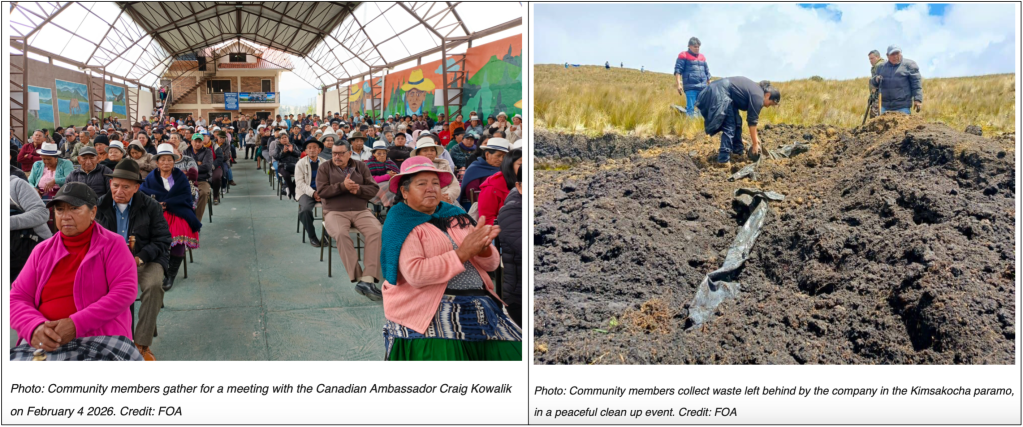
The letter to Ambassador Craig Kowalik was sent in response to the criminalization of Indigenous and environmental defenders from the Federation of Indigenous and Campesino Organizations of Azuay (FOA, Federación de Organizaciones lndigenas y Campesinas del Azuay). 

FOA members are facing criminal proceedings for their environmental defense work to safeguard the Kimsakocha páramo from the Loma Larga gold mining project, owned by Canadian mining company DPM Metals Inc.

The letter to the embassy expresses concern over criminal charges initiated by DPM Metals against six FOA members — Lauro Sigcha, Lizardo Zhaqui, Marco Tapia, Ruth Pugo, Carmita Pérez, and Yaku Pérez — following a peaceful clean-up action to remove mining waste left by the company near the headwaters of the Irquis and Tarqui rivers in the Kimsakocha páramo. The Kimsakocha páramo is a fragile ecosystem that regulates the regional hydrological cycle and provides fresh water to tens of thousands of people. For more than 30 years, Indigenous and peasant communities have defended this ecosystem against large-scale mining projects.

Ecuador bans opposition party

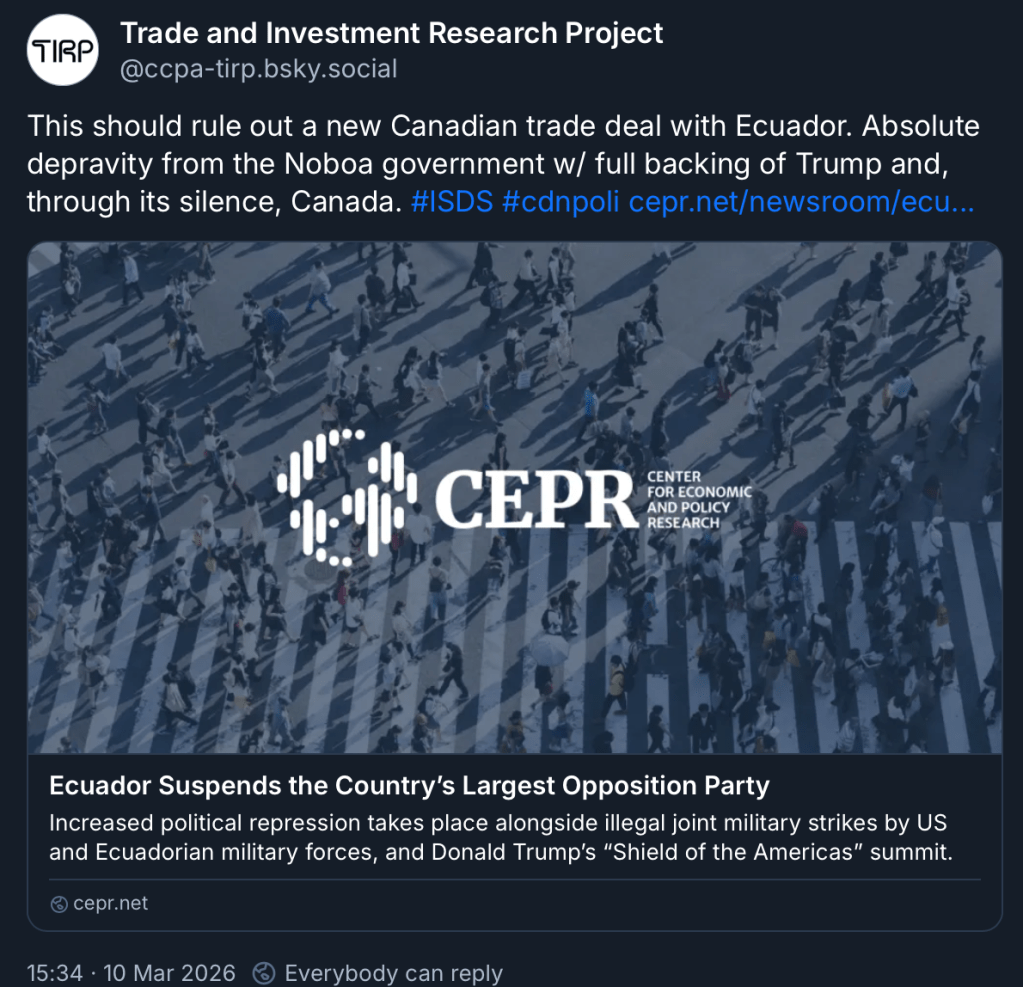
Acting on the request of the government-aligned Prosecutor General, an electoral judge in Ecuador on Friday (March 6) ordered the nine-month suspension of the country’s largest opposition party, the Citizens’ Revolution (RC ). 

The Center for Economic and Policy Research (CEPR) denounced the ban as the latest escalation in a broader pattern of authoritarian regression, including lawfare against opponents, repeated states of emergency, and deepening military ties with the Trump administration.

“The government of President Daniel Noboa, who is strongly backed by President Trump, is trying to accelerate the destruction of what is left of democracy in Ecuador,” said CEPR Co-Director Mark Weisbrot. The move bars RC –led by former President Rafael Correa – from local elections to be held in 2027.

U.S.-Ecuador military strikes

On the same day as the ban on the RC party, the Ecuadorian and U.S. militaries conducted joint airstrikes near the Colombian border targeting a site allegedly tied to dissidents from the former FARC guerrillas from Colombia. 

These “lethal kinetic operations,” as the U.S. military calls them, are another of Noboa’s efforts since his 2023 election to deepen ties with Washington — including a failed attempt to re-establish a U.S. military base in the country.

Days earlier, on Tuesday (March 3), the United States and Ecuador launched joint attacks against “designated terrorist organizations” – Trumpspeak for drug-traffickers.

Since September last year, the United States has attacked small boats in the Caribbean and eastern Pacific, but these attacks in Ecuador are the first known land operations by U.S. forces against drug cartels. At least 150 people have been killed in 44 known strikes. The United States has never shown proof that any of the dead were in fact moving illegal drugs.

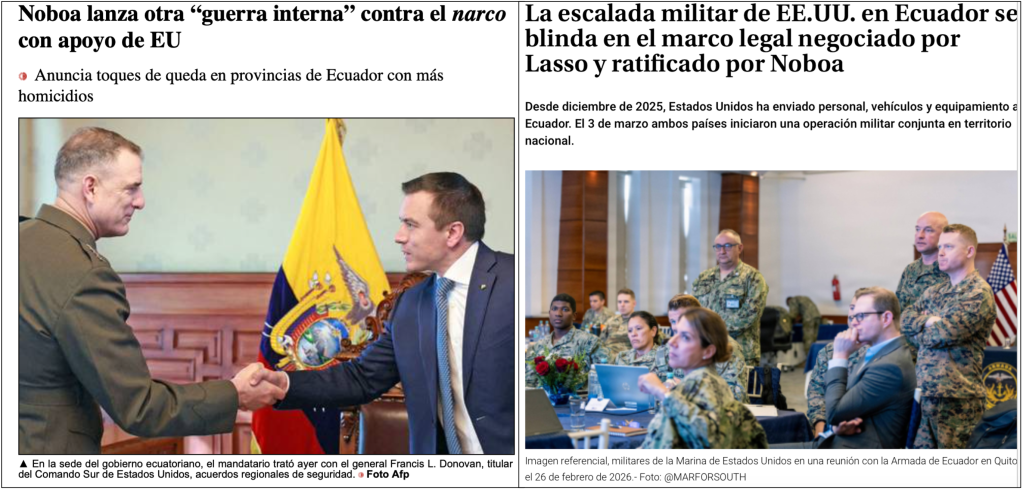
While neither government will say precisely where the attacks are happening, Noboa ordered curfews in four provinces west and southwest of Quito, extending to the city of Guayaquil and beyond. Noboa said his country was “entering a new phase in the internal war.”

* An update (March 25 from Drop Site News:

A New York Times investigation raises serious questions about a March 6 airstrike that Defense Secretary Pete Hegseth publicized on social media as proof the U.S. military was “now bombing Narco Terrorists on land.”

According to the Times, the target appears to have been a 350-acre cattle and dairy farm owned by a 32-year-old carpenter named Miguel, not a drug trafficking compound. Farm workers told the Times that Ecuadorean soldiers arrived three days earlier, beat and detained four Colombian workers, subjected them to waterboarding and electric shocks, doused structures with gasoline and set them alight—then returned on March 6 to film themselves bombing the smoldering ruins, producing footage Ecuador and the U.S. jointly promoted as the destruction of a traffickers’ training camp.

The Pentagon said the strike was conducted “jointly” with Ecuador, though Times sources said U.S. troops had no direct involvement in the bombing itself. Ecuador claimed to have recovered weapons and evidence of illicit activity but released no photographs, as it typically does following drug seizures. “It’s a lie that 50 people trained here,” Miguel said, standing amid his dead chickens. “There’s no logic.” (NYT)