Hey Canada! Just say NO to U.S. threats against Cuba

by Jim Hodgson

“The U.S. government is going crazy with its shameful war on Cuba,” writes Medea Benjamin of CodePink. “Every week, there’s a new sanction, a new restriction, a new way to punish the Cuban people.” She goes on to describe measures directed against U.S. travellers and solidarity groups. 

Here, I want to focus on the measures that are forcing foreign investors to abandon holdings in hotels, mines and other joint ventures – and forcing cancellations by still more airlines and abandonment of Cuba by the credit card duopoly of Visa and Mastercard. All of these actions hurt the Cuban people, directly or indirectly.

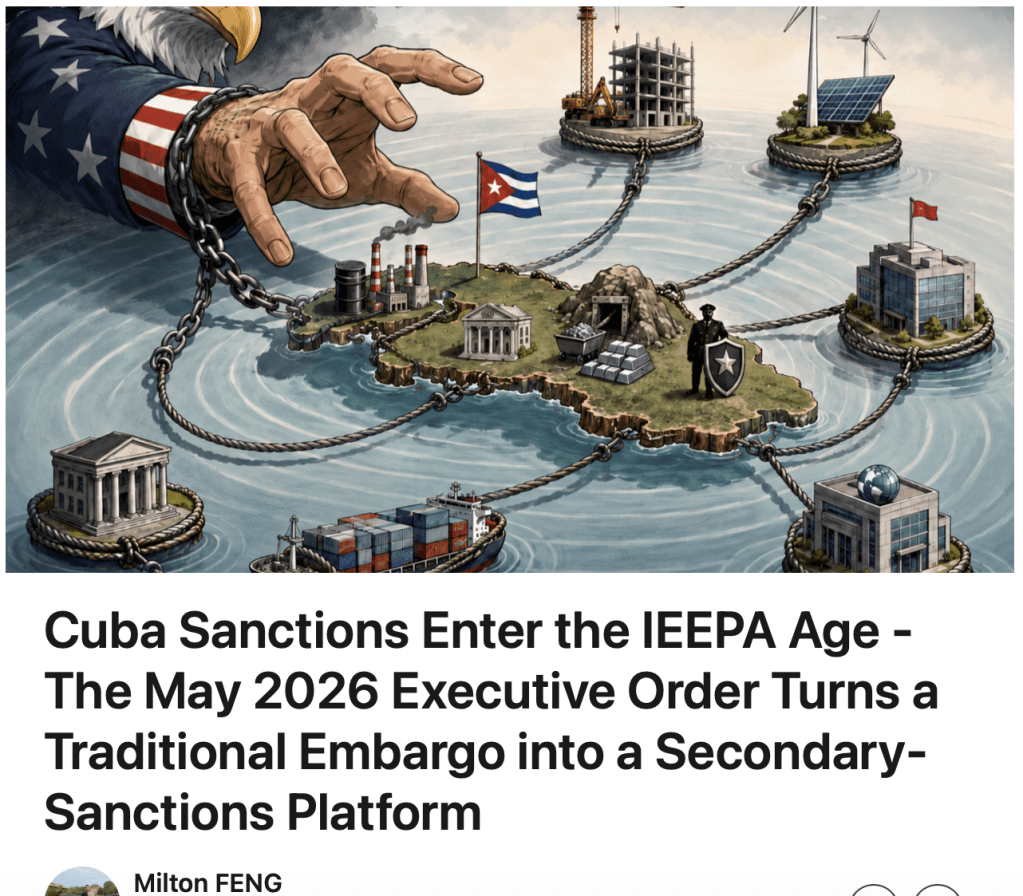
Unilateral sanctions applied by the United States are reaching new levels of cruelty in Cuba. The latest wave is rooted in the U.S. International Emergency Economic Powers Act (IEEPA), a 1977 law that allows a president to regulate international trade after declaring a national emergency in response to some extraordinary threat. It’s the law Trump used to apply his tariffs in early 2025, a move the U.S. Supreme Court struck down in February. Now he’s using the same law to punish Cuba. Milton Feng outlines Trump’s use of IEEPA to back his newest sanctions on Cuba in an essay here.

On May 1, U.S. President Donald Trump signed an executive order, effective June 5, that freezes U.S. assets of foreign companies and people that conduct business with the Cuban government.

A week later, U.S. Secretary of State Marco Rubio announced more details: the U.S. would impose additional sanctions on Cuban state-owned businesses that manage joint operations with foreign companies across tourism, retail, mining and distribution. The move had an immediate impact on Canadian investment in Cuba, notably nickel-miner Sherritt’s surrender to Gillon Capital LLC, the family office linked to Ray Washburne, a former adviser and appointee of Trump himself. 

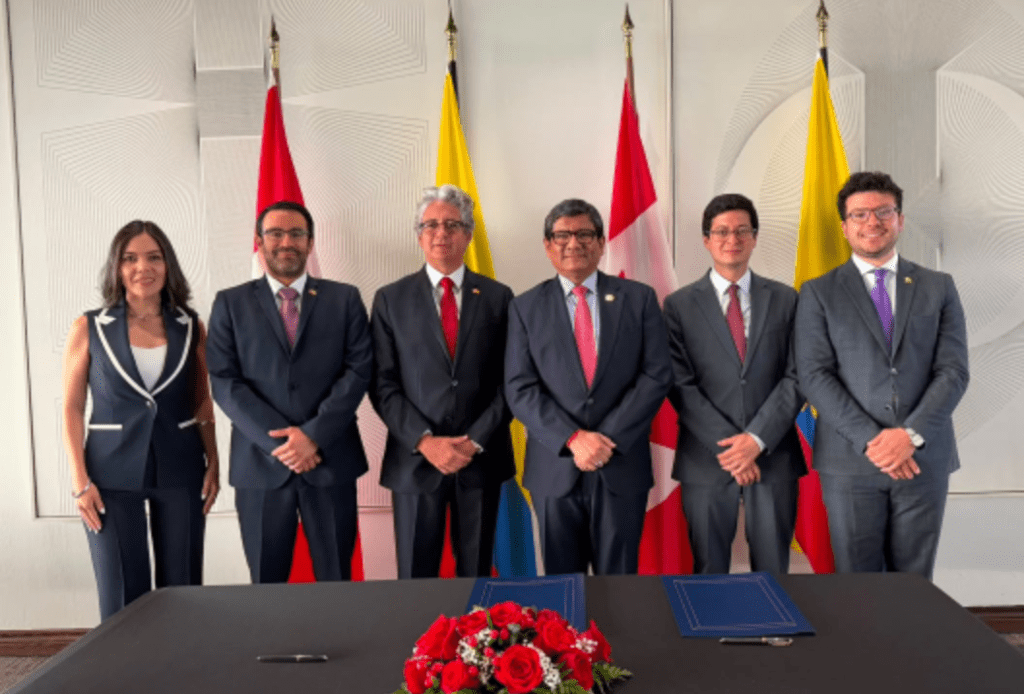
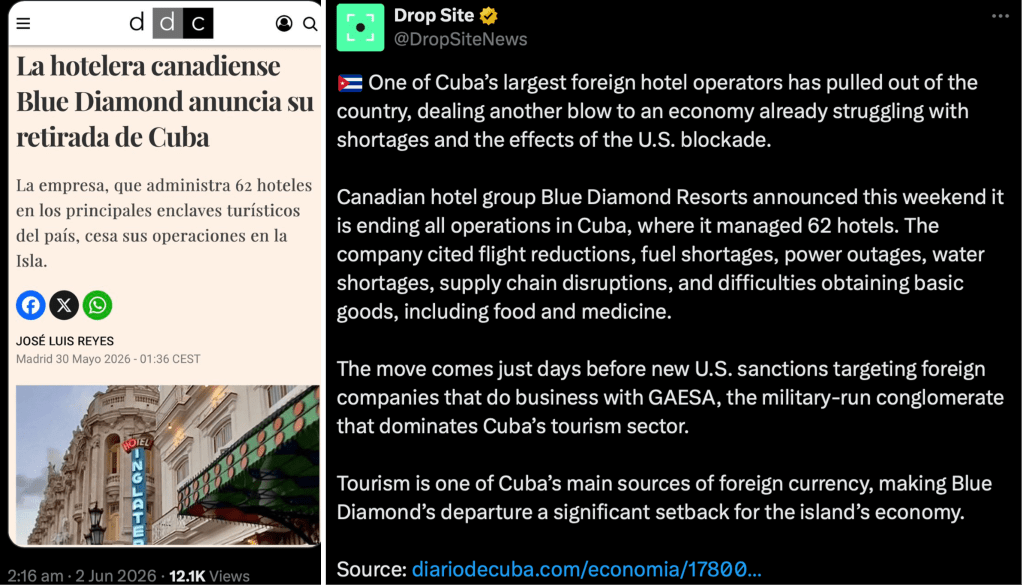
Montreal-based Royalton Hotels (which includes Blue Diamond, above) and Spanish hotel companies Melia and Iberostar ended their management and licensing operations in Cuba. Air Canada, WestJet and Air Transat have indefinitely suspended flights and vacation packages in Cuba. They had previously planned to resume service to Cuba this fall.

Many of the U.S. measures were aimed at partnerships with GAESA, a company linked to Cuba’s military. On June 2, the Cuban government defended GAESA, saying its joint ventures had funded housing, schools, clinics, and infrastructure.

The Spanish foreign minister said the moves against the hotel companies would aggravate the “humanitarian hardship” faced by the Cuban people in the wake of other U.S. sanctions and the fuel blockade underway since early this year. Church leaders from Canada and other parts of the world saw first-hand the impact of the U.S. blockade on ordinary people when they visited earlier this year.

But Canada has said nothing. 

Like the European Union, Canada has law to protect its companies from the kind of extraterritorial reach demonstrated by Trump’s executive order. Amendments in the 1990s to its Foreign Extraterritorial Measures Act (FEMA) explicitly prohibit Canadian corporations from complying with US extraterritorial measures that affect trade and commerce with Cuba. 

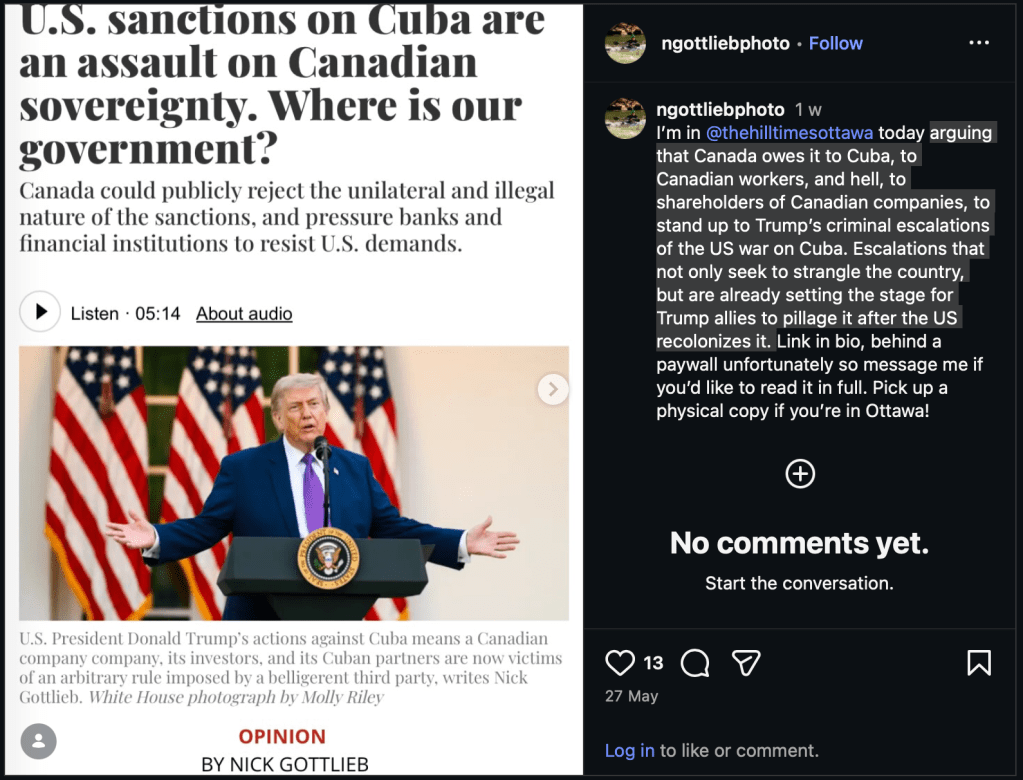
Nick Gottlieb’s op-ed comment in The Hill Times, Ottawa.

“If the Canadian government refuses to invoke FEMA at the precise moment it was designed for, then the legislation becomes little more than symbolic theatre,” wrote Dalhousie University’s Isaac Sainey in a Facebook post May 20. “Worse still, Canada effectively concedes that Washington possesses the right to determine Canadian economic policy and punish Canadian firms at will. This is not sovereignty. It is subordination.”

But CUSMA. Under Mark Carney’s leadership (not that he has said so yet), it seems Canada will not support Cuba as long as its free trade relationship with the United States is facing re-negotiation. In 2019, when Justin Trudeau was prime minister and Chrystia Freeland his foreign minister, Canada strongly defended the interests of Canadians doing business in Cuba.

When Trump threatened Canada last year, most of us joined with Carney in saying “#ElbowsUp.” That defiance needs to extend in solidarity with people in Cuba and in other parts of this hemisphere threatened by resurgent U.S. imperialism.

Please write (again) to the prime minister and to your member of parliament. If you are in a country other than Canada, please write to or call your representatives to ask for their solidarity with the people of Cuba.

Ecuador bans opposition party, criminalizes ecological defenders, joins U.S. military attacks

by Jim Hodgson

In a just world, news that Ecuador has banned its largest opposition party would be enough to scuttle Canada’s plans for a free trade agreement with the country – and even end U.S. military collaboration. But that is not the world we live in.

The news came as 77 organizations from Ecuador, Canada and around the world sent a letter to Canada’s ambassador in Ecuador urging the embassy to adopt Canada’s 2019 Voices at Risk: Canada’s Guidelines on Supporting Human Rights Defenders in response to the criminalization of Indigenous and environmental defenders. Among the signatories are MiningWatch Canada, Common Frontiers, and KAIROS Canada.

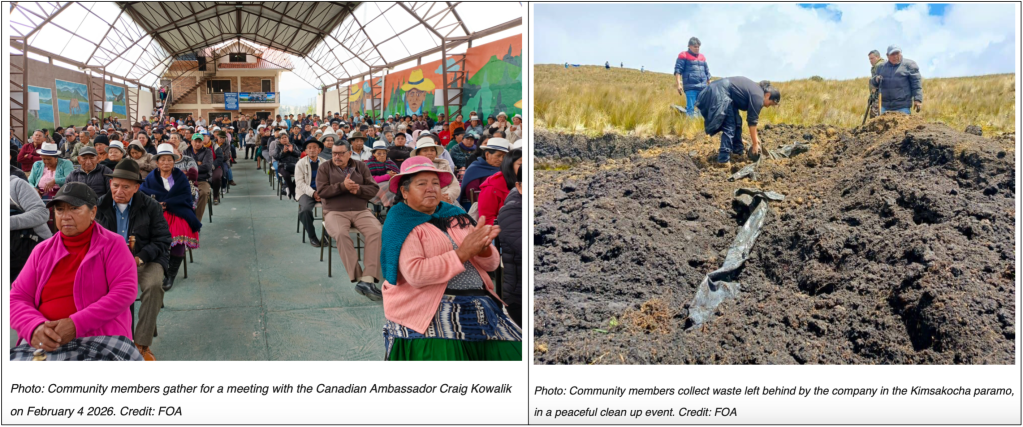
The letter to Ambassador Craig Kowalik was sent in response to the criminalization of Indigenous and environmental defenders from the Federation of Indigenous and Campesino Organizations of Azuay (FOA, Federación de Organizaciones lndigenas y Campesinas del Azuay). 

FOA members are facing criminal proceedings for their environmental defense work to safeguard the Kimsakocha páramo from the Loma Larga gold mining project, owned by Canadian mining company DPM Metals Inc.

The letter to the embassy expresses concern over criminal charges initiated by DPM Metals against six FOA members — Lauro Sigcha, Lizardo Zhaqui, Marco Tapia, Ruth Pugo, Carmita Pérez, and Yaku Pérez — following a peaceful clean-up action to remove mining waste left by the company near the headwaters of the Irquis and Tarqui rivers in the Kimsakocha páramo. The Kimsakocha páramo is a fragile ecosystem that regulates the regional hydrological cycle and provides fresh water to tens of thousands of people. For more than 30 years, Indigenous and peasant communities have defended this ecosystem against large-scale mining projects.

Ecuador bans opposition party

Acting on the request of the government-aligned Prosecutor General, an electoral judge in Ecuador on Friday (March 6) ordered the nine-month suspension of the country’s largest opposition party, the Citizens’ Revolution (RC ). 

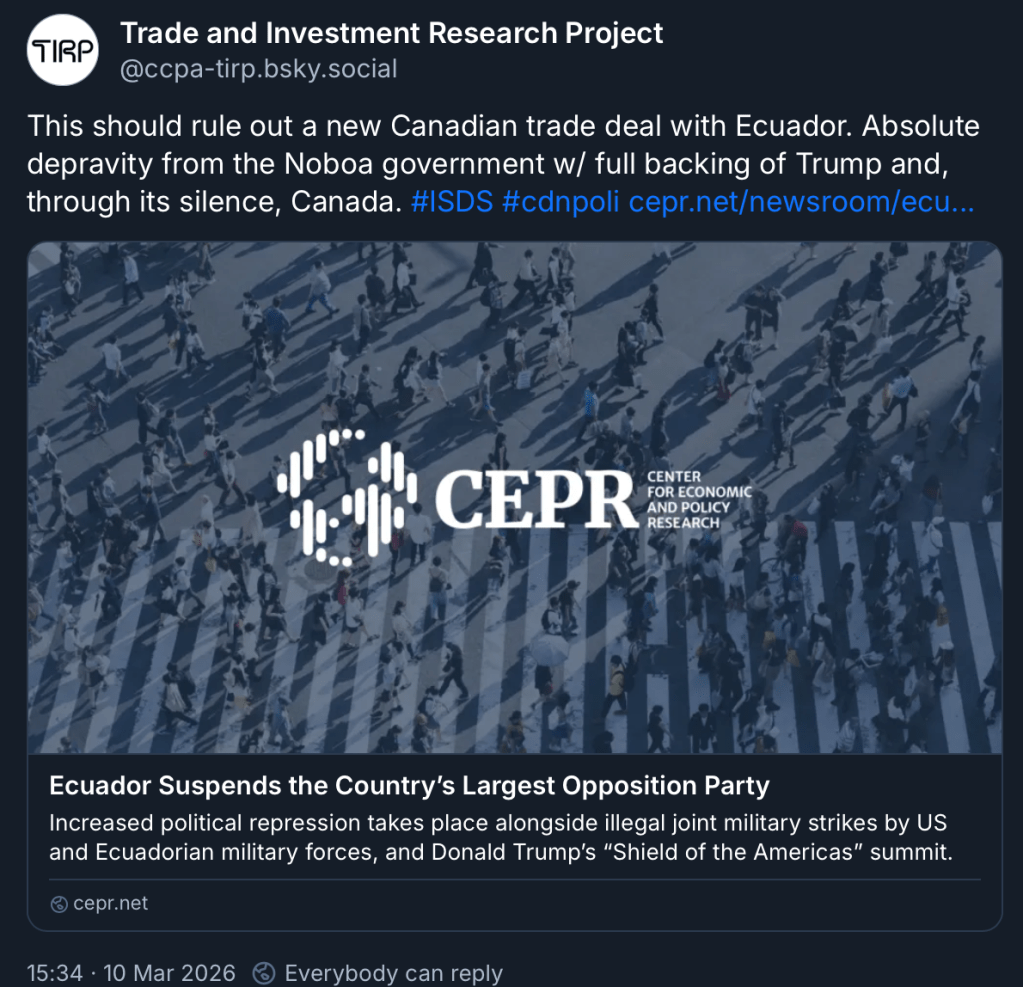
The Center for Economic and Policy Research (CEPR) denounced the ban as the latest escalation in a broader pattern of authoritarian regression, including lawfare against opponents, repeated states of emergency, and deepening military ties with the Trump administration.

“The government of President Daniel Noboa, who is strongly backed by President Trump, is trying to accelerate the destruction of what is left of democracy in Ecuador,” said CEPR Co-Director Mark Weisbrot. The move bars RC –led by former President Rafael Correa – from local elections to be held in 2027.

U.S.-Ecuador military strikes

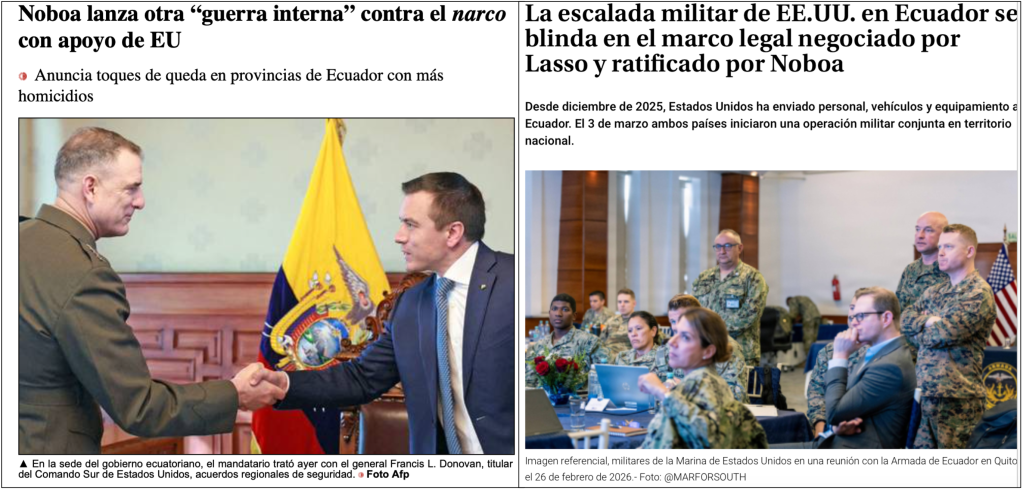
On the same day as the ban on the RC party, the Ecuadorian and U.S. militaries conducted joint airstrikes near the Colombian border targeting a site allegedly tied to dissidents from the former FARC guerrillas from Colombia. 

These “lethal kinetic operations,” as the U.S. military calls them, are another of Noboa’s efforts since his 2023 election to deepen ties with Washington — including a failed attempt to re-establish a U.S. military base in the country.

Days earlier, on Tuesday (March 3), the United States and Ecuador launched joint attacks against “designated terrorist organizations” – Trumpspeak for drug-traffickers.

Since September last year, the United States has attacked small boats in the Caribbean and eastern Pacific, but these attacks in Ecuador are the first known land operations by U.S. forces against drug cartels. At least 150 people have been killed in 44 known strikes. The United States has never shown proof that any of the dead were in fact moving illegal drugs.

While neither government will say precisely where the attacks are happening, Noboa ordered curfews in four provinces west and southwest of Quito, extending to the city of Guayaquil and beyond. Noboa said his country was “entering a new phase in the internal war.”

* An update (March 25 from Drop Site News:

New York Times investigation raises serious questions about a March 6 airstrike that Defense Secretary Pete Hegseth publicized on social media as proof the U.S. military was “now bombing Narco Terrorists on land.”

According to the Times, the target appears to have been a 350-acre cattle and dairy farm owned by a 32-year-old carpenter named Miguel, not a drug trafficking compound. Farm workers told the Times that Ecuadorean soldiers arrived three days earlier, beat and detained four Colombian workers, subjected them to waterboarding and electric shocks, doused structures with gasoline and set them alight—then returned on March 6 to film themselves bombing the smoldering ruins, producing footage Ecuador and the U.S. jointly promoted as the destruction of a traffickers’ training camp.

The Pentagon said the strike was conducted “jointly” with Ecuador, though Times sources said U.S. troops had no direct involvement in the bombing itself. Ecuador claimed to have recovered weapons and evidence of illicit activity but released no photographs, as it typically does following drug seizures. “It’s a lie that 50 people trained here,” Miguel said, standing amid his dead chickens. “There’s no logic.” (NYT)

"Another World is Possible," World Social Forum, Porto Alegre, Brasil (2005)

The old order is dead. Let’s make a new, more just order.

by Jim Hodgson

It was too much to hope that the well-heeled audience at Davos would boo Donald Trump from the stage a day after they had offered Mark Carney a standing ovation. But by the end of Wednesday, it seemed that the wall of resistance to any U.S. take-over of Greenland was successful, and the president backed down. An important victory.


Still, “la rupture de l’ordre mondial” of which Carney spoke remains. And he’s right: we shouldn’t mourn it. The international financial institutions invented in 1944 at Bretton Woods, New Hampshire, gave overwhelming power to the rich countries of the Global North. 

And the United Nations system that followed, with a veto given to each of the five most powerful countries, has protected their interests – even in the face of overwhelming contrarian votes in the UN General Assembly. Think, for example, of the annual vote to end the cruel U.S. blockade of Cuba.

That order was designed by the nations that existed at the end of World War II, especially the colonial or neo-colonial states of Europe and the Americas. Most of the Caribbean, Africa and large parts of south Asia were still under colonial rule. That order imposed and perpetuated a Global North-based order on all the new nations that were born in the 25 years or so after the war: the majority of nations that exist today.

And that order, at least in the eyes of three of the five veto-holders, effectively imposed capitalism as a synonym for democracy. The United States and its allies were satisfied with a sort of formal democracy, a certain alternance between parties of the right and centre-right, and if that failed, then a military government was a useful interlude until the real order could be re-established and markets were safe. 

Canada would “go along to get along,” as Carney admitted. 

Just as it did less than three weeks ago when the United States bombed Venezuela and kidnapped its president. And just as it has for more than two years over Israel’s genocide in Gaza.

In his speech, Carney seemed to offer a vision of capitalism without the now-erratic United States. It’s still reliant on resource extraction, military spending, and massive capital investment.

But if we are all to grow and thrive, we must demand more. We require an end to practices that exploit social inequities and our shared ecology. 

Alternatives

Because of the paths on which my life has taken me, one that is especially close to my heart is the call from the Indigenous people of Zapatista communities in southern Mexico for “a world with room for all” – “un mundo donde quepan muchos mundos.” But other visions come from other places, including three decades of gatherings of the World Social Forum.

More than 50 years ago, the majority world united behind a vision of economic decolonization, sovereign development, and international cooperation across areas such as debt, trade, finance, and technology. That vision became known as the New International Economic Order (NIEO) and was adopted by the UN General Assembly. But, power relations being what they are, it was never implemented. (Progressive International put together a set of reflections that trace its history and update the proposals for the 21st century.)

In March last year, the World Council of Churches and several global communions of churches repeated their call for a New International Financial and Economic Architecture (NIFEA). “It is immoral that over a billion people – half of them children – subsist in poverty whilst billionaires increased their wealth by over 15% in 2024 to US$15 trillion. It is outrageous that the richest 10% of the global population receives more than half of global income, whereas the poorest half earns merely 8.5% of it,” they said in a statement.

They expressed deep concern about “a rapidly escalating climate and biodiversity emergency that jeopardises livelihoods and poses an existential threat to all life.” It notes that “several tipping points are close to being crossed or have already been crossed, leading us to recognise that we may be beyond a point of no return.”

The old order is dead. The time in which we are living demands we do better.