
Jim Hodgson
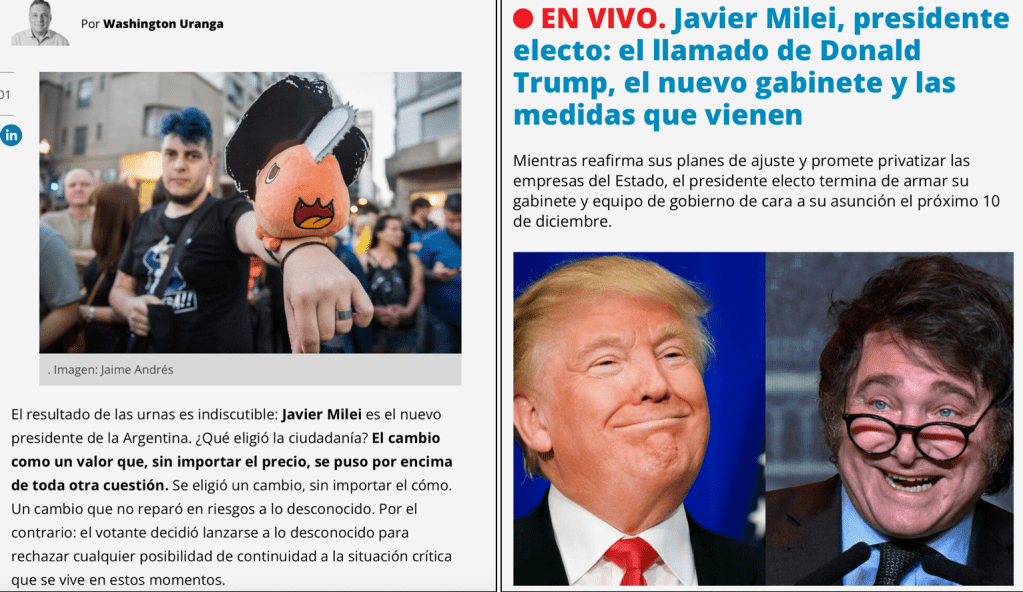
There’s that word again: populism. This month, it’s used to describe Javier Milei, the right-wing politician who won the presidential election in Argentina. Saying that he’ll take a chainsaw to chop down government spending, Milei is compared to politicians of the right, including Donald Trump in the United States, Jair Bolsonaro in Brazil, Giorgia Meloni in Italy and Marine Le Pen in France.
In other moments, the term populist is used to describe politicians of the left, like Mexican President Andrés Manuel López Obrador (AMLO), or the Podemos movement in Spain or Syriza in Greece.
At times I think populism is a term devoid of meaning. A Venezuelan colleague says that it’s used by élites and mainstream journalists when they don’t understand what is going on. Rather than using it, I look instead at the content of a political program.
But sometimes, the meaning is clear. Populism as a “people” that must be protected from some external or internal “other”—has an obvious fascist stink, but that doesn’t hold back Trump or a crop of other leaders from using its methods to rally the people against refugees.
But none of that is what left leaders like Hugo Chávez in Venezuela (1999-2013) or Lázaro Cárdenas in Mexico (1934-40) were about. If they talked about the “people,” it was to build solidarity across regions and identities (workers, farmers, Indigenous)—class consciousness, if you will—so as to turn the attention of the state towards resolving their problems, but not at the cost of other disadvantaged or racialized people.
When journalists and politicians use the term populism to denounce leaders of the left, beware: they are pretending that the ruling class is equivalent to some disadvantaged group—immigrants in the U.S. or European contexts—and promoting another big lie.

What happened in Argentina?
“People chose change, without considering its cost,” wrote Washington Uranga in the Buenos Aires daily Página/12. “Change was put above any other value. Voters chose to launch themselves into the unknown so as to reject continuity of the critical situation in which they live now: inflation.”
Almost 25 years ago, on Dec. 6, 1998, another so-called populist, Hugo Chávez Frías, won the presidential election in Venezuela. “The people, weary of corruption and ever more sceptical of the traditional way of carrying out politics, bet on a new type of candidate,” wrote Marta Harnecker, a close co-worker and one of his biographers.
“Into the unknown.” “A new type of candidate.” But any similarity ends right there. The program of Chávez (like that of AMLO or Lula in Brazil) was to turn the capacity of the state and the wealth of the nation in favour of the majority of the people so as to ease or end their poverty.
Milei faces enormous challenges. The state has no money, and there is a $44 billion debt that ballooned during the 2015-19 neo-liberal government of Mauricio Macri. Inflation is running at 150%. He wants to dollarize Argentina (as El Salvador and Ecuador have done), removing any capacity to shape the country’s economic future.
Milei will weaken the state through what he calls a program of “anarcho-capitalism.” Don’t be fooled: Milei is an extreme neo-liberal, holding more in common with the 1970s “Chicago School” of liberal economic theory and 1980s politicians like Ronald Reagan and Margaret Thatcher. He also calls himself a libertarian. He says he will remove legal protections for workers and eliminate the ministries of health and education. But he would also use the power of the state to restrict the rights of women. His vice-president, Victoria Villarruel, is a daughter of soldiers and already, lobbying has begun to free military people found guilty during the past two decades for crimes against humanity they committed during the military dictatorship.
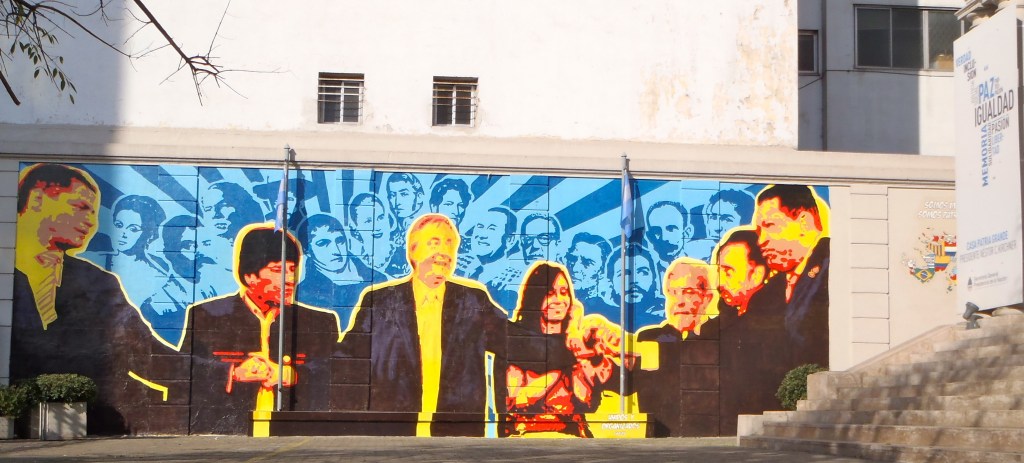
After the victories by Chávez in 1998 and Luiz Inácio (Lula) da Silva in Brazil in 2002, some of us starting talking about a “pink tide” sweeping across Latin America (forgetting perhaps that tides also recede). Since then, the tide has indeed ebbed and flowed, with electoral victories and defeats, along with coups or attempted coups in several countries and the phenomenon of “lawfare” – the “deployment of judicial power to persecute political opponents: candidates, parties, even entire organizations and social movements.” A current example is the Guatemalan attorney-general’s harassment of President-elect Bernardo Arévalo and of his Semilla (Seed) party.
In Argentina, after the collapse of a series of governments at the end of 2001 in the wake of a banking crises brought on by foreign debt acquired during the time of the military dictators, Néstor Kirchner and his spouse, Cristina Fernández, emerged from the left side of the Peronist party to lead the country from 2003 to 2015. Success they had in managing the debt, provoking economic growth and reducing poverty was undone by Macri, their successor, who resorted to new borrowing and a toxic relationship with the and the International Monetary Fund.
Cristina Fernández returned in 2019, this time as running mate to Alberto Fernández (no relation), who won the election. But their government (weakened somewhat by disagreements between the two and among their followers) was unable to undo the damage done by Macri. After the Milei victory, Nora Cortiñas of the Mothers of the Plaza de Mayo human rights group said that the business sector had driven prices of food and medicine higher so as to weaken the Fernández government.
 Unwrapping Development
One thought on “Unwrapping populism: the Milei victory in Argentina”