
by Jim Hodgson
Here today, I want to share some of the words and teaching of the Very Rev. Dr. Bruce McLeod, former moderator of The United Church of Canada (1972-74) and former president of the Canadian Council of Churches (1991-94). He passed away this week at age 96.
It was in that latter role that I knew him best. (The United Church’s memorial is here, and there is more information too on the site of the United Church’s archives.) He was interviewed by Broadview magazine less than a year ago.
I can’t be sure, but I think I first met him in the mid-80s when he co-hosted the United Church’s weekly television program Spirit Connection. (Bruce was also an early ally to 2SLGBTQIA+ people who sought full inclusion and ministry in the United Church and beyond.)
In 1989, I had joined the CCC staff to serve as its secretary for ecumenical education and communication. Bruce was an inspiration for me in my new role (and long since). Some reflections from those years follow.
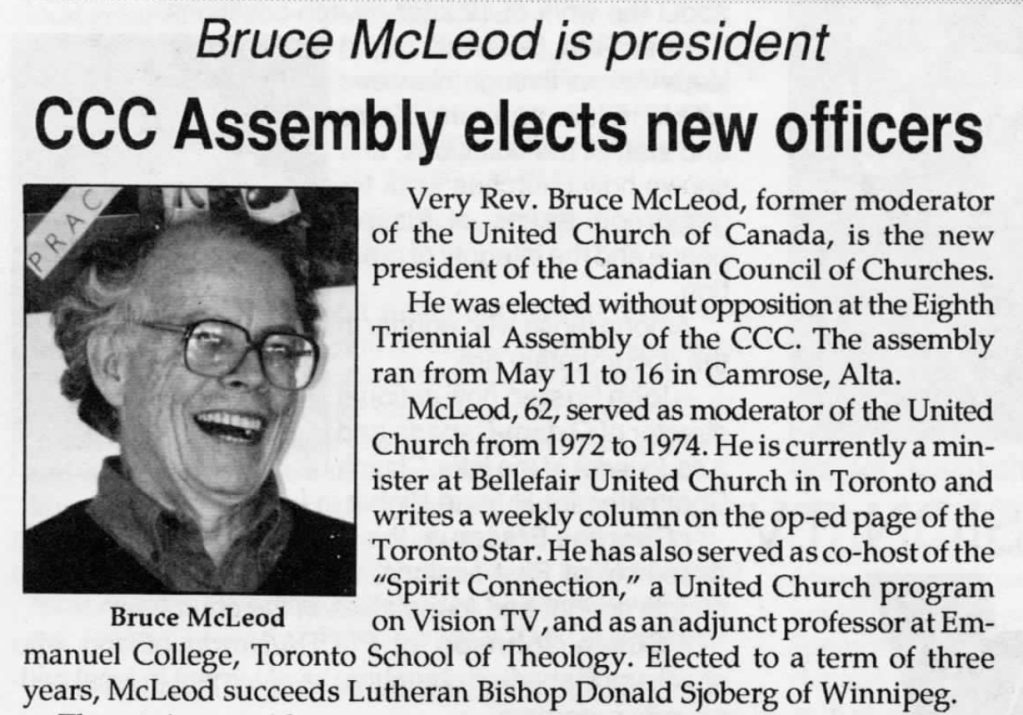
Soon after his election as CCC president, he spoke to the CCC’s executive (June 21, 1991):
It’s especially important, in this kairos time of economic retrenchment in which God speaks to us for the Council to address the churches from which we come.
- To remind them again of the Lund Principle which commits churches to doing separately in God’s world only those things which cannot be done together;
- To summon our member churches from those ingrown, competing and duplicated enterprises which often preoccupy us;
- To challenge separated structures (and our own denominational hearts) to think and act together – nationally, regionally and locally – in the name of Jesus who prays that we might be one.
Not for our sakes; but that the world might know that it’s bathed in the love of God, whose Spirit uses us, with others, to make the breaking world a home.
Refugee rights: “We saw their faces”
Back in the late 1980s, the government of Brian Mulroney brought in new rules to restrict the numbers of people who could claim refugee protection in Canada. Bruce was part of the CCC’s board when it launched a court challenge to a new refugee determination system in January 1989.
The churches’ concern then was much as it is today: rules were too tight and would endanger the lives of some refugee claimants by sending them back to persecution, imprisonment or possible death. The specific alarm was over the process for determining whether individuals were eligible to make a claim, and if rejected, whether they would be able to make a meaningful appeal. (We didn’t win the suit then and the fight for protection continues in the face of ever-harsher anti-refugee rhetoric and stricter measures in many parts of the world.)
In a sermon at the council’s assembly in Charlottetown in 1994, he said the churches challenged the new rules “because they knew refugees not as numbers or statistics; they saw their faces, knew their stories and wiped their tears. They heard God calling them to come; they did together what they couldn’t have done separately. It was as though something more than the initiative of the churches was at work here — as though a presence or purpose was waiting in the issues themselves, plucking at the churches to respond.”

To cherish and preserve this small world
I heard Bruce tell the story of his encounter in 1992 with astronomer Carl Sagan more than once. They met at a “religion and science” gathering in Washington, and he included the story in a report to the CCC executive that I reproduced in Entre-nous, the CCC newsletter, in July 1992:
“Sagan said that when the Voyager spacecraft spun past Neptune and Pluto edging beyond the solar system to wander forever across the Milky Way, its cameras focused backward for one last glimpse of home.
“’Planet earth from there is not the same as looking at it from the moon where you see the outlines of the continents. Planet earth from there is just a pale blue point of light. That’s where we live,’ he said, his brooding face alight. ‘Where every human being who ever lived, lived – every couple in love – every political leader,’ every church with its earnest positions. Voyager’s photographs he said, ‘conveyed a sense of vulnerability. At least to me it cries out the need to cherish and preserve this small world.’”
Bruce continued: “Here where it is night, we remember the words of Rubem Alves: ‘Hope is the melody of hearing God’s future, faith is dancing it now.’ Together in Jesus name, taking each other’s hands around this table and beyond our different churches, we dance as well we can.”
“God’s single love in the world”
In 1994, at the end of his term as CCC president, Bruce challenged the churches over funding cuts to ecumenical bodies. “Over-lapping mandates” was among the reasons cited for cuts to the council and the inter-church justice coalitions.
Bruce refused to accept those excuses. In a sermon delivered in Charlottetown in 1994 at the CCC’s triennial assembly, he said: “For all the shared ministries at the unpublicized edge, there’s no dearth of ecclesiastical leaders ready to explain why there have to be ten different churches, all struggling to repair their roofs, in one Ontario town with 2,200 people. For all the examples of coalition cooperation, there remain competing church publishing houses (each with separate, crushingly expensive, hymn book projects) and duplicated church head offices, each with floors devoted to world outreach and justice issues, all claiming their share of sacrificial weekly gifts dedicated, to the accompaniment of doxologies across the land, for the work of God’s single love in the world.”
 Unwrapping Development