Debt, vaccines, climate: from “blah-blah” to meaningful change on a global scale

This year, global network of organisations (including KAIROS Canada) sponsored Global Days of Action for Justice and Debt Cancellation during the last two weeks of October to focus attention on the intersections of debt, climate and pandemic.

In the wake of G20 summit in Rome and as the global climate meeting in Glasgow gets underway, those of us who hold out hope for an international system that can produce meaningful change are disappointed by failures both on debt cancellation and vaccine distribution—and working for better results on climate issues.

“Political games while the world burns” was the assessment by the European Network on Debt and Development (Eurodad) after the annual meetings Oct. 11-17 of the World Bank and International Monetary Fund.

Back in April 2020, when pandemic lockdowns still were a novelty, the G20 announced a debt service suspension initiative (DSSI). But the Jubilee Debt Campaign says that the DSSI has suspended less than a quarter of debt payments for a very limited group of 46 countries.

Tim Jones, Head of Policy at Jubilee Debt Campaign, said: “The failure to make banks, hedge funds and oil traders take part in the G20’s flagship debt suspension scheme has made a mockery of this initiative. Tens of billions of dollars have flooded out of lower income countries at a time when they were desperately needed to protect lives and livelihoods.”

The campaign also cited research showing that 34 countries spend five times more on debt payments than climate change mitigation or adaptation.

Vaccine sharing

Meanwhile, about 82 countries cannot meet the World Health Organization (WHO) target of 40 per cent Covid-19 vaccination coverage by end of the current year. The global vaccine-sharing arrangement known as COVAX has delivered only about 400 million doses to about 140 low- and middle-income countries.

On Oct. 28, WHO and other aid groups called on the G20 to fund a new, a U.S. $23.4 billion plan to bring vaccines, tests and drugs to impoverished countries in the next year.

During the G20 summit in Rome two days later, Canada announced it will donate 10 million Moderna vaccines and deliver 200 million doses by the end of next year. The new promise comes despite abject failure of the last set of promises: Canada delivered only 3 million doses out of a planned 40.7 million does announced at the G7 summit last June.

On average, the G20 countries have vaccinated about 55 per cent of their eligible populations, reported The Globe and Mail. Globally, the figure is 38 per cent, and in Africa, only seven per cent.

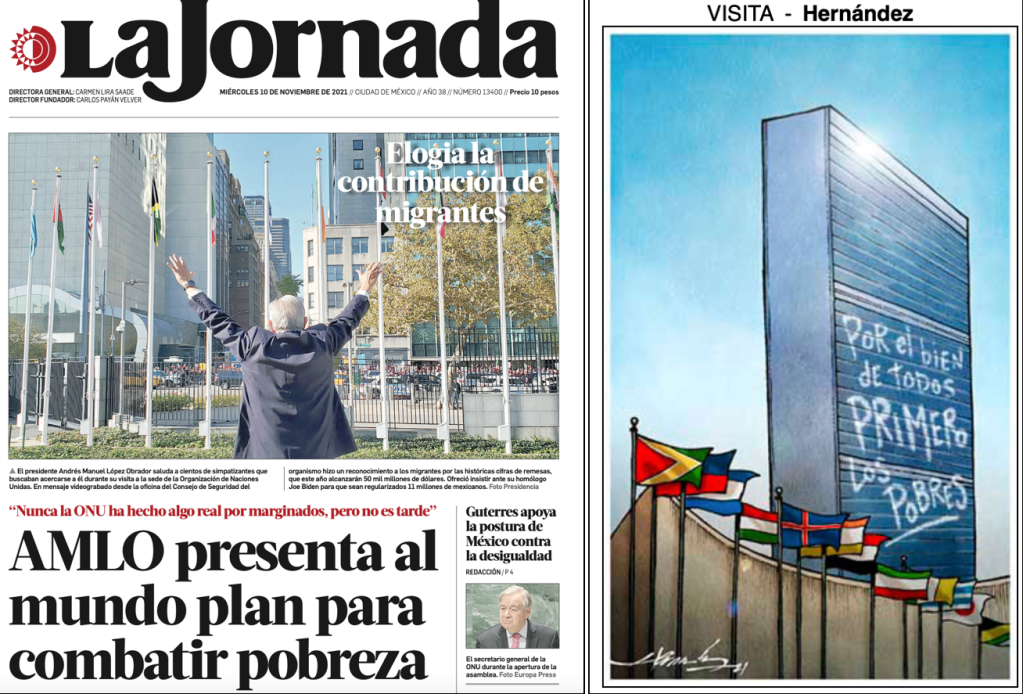
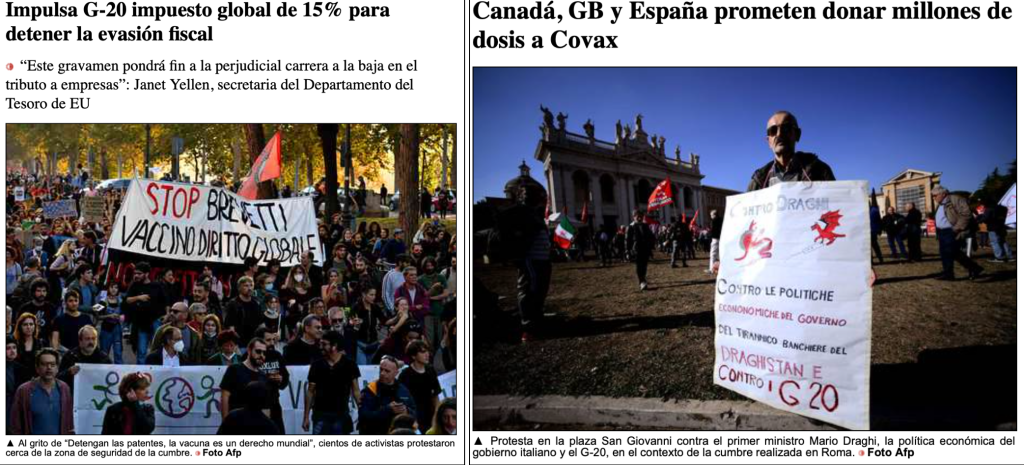
Today in La Jornada, Mexico City: Headlines acknowledge an agreement to impose a 15-per-cent global tax on transnational corporations and new promises to donate vaccines. Photos show protests. Carrying signs that condemned “profiting from the pandemic” (left), protesters in Rome drew attention to vaccine nationalism and called for an end to patent protection for vaccines: “a global right.” And (right) protesting economic policies of the Italian government and G20.

Sharing costs of climate change

A day before being shuffled out his job as Canada’s environment minister, Jonathan Wilkinson joined German and British counterparts in a news conference Oct. 25 to announce “significant progress” in getting commitments from rich countries to boost financing for climate change adaptation and mitigation in the developing world. 

At the Copenhagen summit 12 years ago, wealthy countries pledged channel U.S. $100 billion each year to fund this effort. That level was never achieved.

The plan announced by Wilkinson, together with Germany’s Jochen Flasbarth and the U.K.’s Alok Sharma—the COP26 president-designate—would see U.S. $500 billion flow over the five years 2021-25.

Access to climate finance has been a critical issue for many developing countries, and failure to meet past goals had become “a matter of trust,” the ministers said.

A report posted on the COP26 presidency’s website does not show the commitments of individual countries, noting, for example, that the Biden administration in Washington “will work closely with Congress” to achieve U.S. commitments.Moreover, about 70 per cent of the funds would be in the form of loans, not grants, and part of the funding would come too from the private sector.


Equitable financing—based on recognition that the wealthy countries foster an economic system that uses carbon-intensive technology to exploit of the planet’s resources—is part of the challenge everyone on the planet faces as the Glasgow COP gets underway.

But underlying the struggles over who pays is the issue of holding to the 2015 Paris commitment to limit the carbon-induced temperature rise to 1.5 degrees above pre-industrial levels. As “environmental icon” David Suzuki said on CBC Radio this morning, if we love our children and grand-children—and if we love participating with all of this planet’s life and generosity—we’ll stop adding more carbon to the atmosphere.

Many of Canada’s faith-based organizations have come together in an initiative called For the Love of Creation to mobilize education, reflection, action and advocacy for climate justice. The United Church of Canada has shared its accredited status at the COP with other members, and together they formed an ecumenical delegation to work “virtually” at the summit. You can follow the delegation’s activities at COP26 by following #FLCCOP26, #UCCanCOP26 on Facebook and Instagram.

Finding hope in Canada’s election, the UN General Assembly and CELAC

The concurrence this week of a federal election in Canada with the spurt of diplomatic action around the United Nations General Assembly reminds me that I value political debate, and that the world needs urgent action on multiple, related issues.

What we have in Canada is what Marta Harnecker and others have called “polyarchy”—the alternation of power among elites, or the choice from among the elites of whom we wish to govern us for the next few years. And no: we should not be satisfied with that, but rather build toward a system that ensures that everyone can have a meaningful sense of participation in the social, economic and political decisions that most affect their lives. That means having societies and governments that are strong enough to control the worst excesses of capitalism and flexible enough to embrace diversity.

Monday night, Sept. 20 – Liberal minority government projected.

But, in Canada for the moment, we have what we have. Perhaps the most optimistic view is that some sort of new coalition among Liberals, the NDP and the Greens will be strong enough to achieve solid measures to limit climate change, advance justice for Indigenous peoples, promote a global recovery from the pandemic, and quick action on housing and child care.

Meanwhile, at the United Nations, world leaders appeared at the General Assembly podium or via video link. Some emphasized the UN Charter, with its affirmations of national sovereignty and self-determination, and (rightly) criticized the sanctions applied by powerful states against the more vulnerable. Others promised new action to try to enforce their version of a rules-based international order (that is: the corporate-led, neo-liberal one).

Again, amidst the contradictions, one has to look for signs of hope. U.S. President Joe Biden, beset by divisions in his own party and fallout from his border patrol’s gross mistreatment of Haitian asylum-seekers, promised “relentless diplomacy” (an improvement, I hope, from “endless war”).

Biden held two online summits: one to try to advance action on climate goals, and the other to advance action on Covid vaccines—including the urgent need for a waiver that would allow more widespread manufacture of vaccines. Biden promised a new contribution of 500 million doses to the global effort, raising the U.S. commitment to 1.1 billion doses. Canadian Prime Minister Justin Trudeau, who joined Biden’s pandemic summit, promised in the Liberal election platform that Canada will donate “at least” 200 million doses of vaccine through COVAX, the UN vaccine-sharing program, by the end of next year. Critics say the contributions are insufficient.

Participants in the CELAC summit, Palacio Nacional, Mexico City, Sept. 18.

Monroísmo vs Bolivarianismo

A few days earlier, Mexican President Andrés Manuel López Obrador convened leaders of the Community of Latin American and Caribbean States (CELAC) for a summit in Mexico City, in part, at least to strengthen the forum as a counter-weight to the U.S.-dominated Organization of American States (OAS).

Venezuela’s Nicolás Maduro proposed replacing the “Monroe Doctrine” (promoted by the early 19th century U.S. President James Monroe—”America for the Americans,” meaning the United States and reflected today in the actions of the OAS) with a “Bolivarian Doctrine” that would uphold both the unity and the autonomy of the peoples of Latin American and the Caribbean, with CELAC as a space for common action.

Brazil and Colombia (led by the region’s two most conservative presidents) stayed away, but others either came or sent representatives. There were flare-ups over different approaches to human rights protection and economic policy, but in the end, the leaders issued a common declaration and called for an end to the U.S. embargo against Cuba.

Érika Mouynes (left), Panamá’s foreign minister, noted that she was just one of three women at the CELAC table. Claude Joseph (right), Haiti’s foreign minister, met outside the meeting with Mexico’s immigration service to express concern for Haitian migrants in Mexico.

Antidotes to neocolonial “development” in Central America

Santa Marta’s school, church and a greenhouse

Following on my post yesterday about the Biden Plan: what would it take for a development plan to work for Central Americans? We need to unwrap that word “development.”

Over many years, it has been my joy to work with organizations created by people in the region who talk about their aspirations in ways that are different from the White House or the World Bank.

In May 2018, I found myself in conversation with one of the founders of the Association for Economic and Social Development (ADES) in the northern part of Cabañas department in El Salvador. ADES sometimes describes itself as a “social movement that is organized as a non-governmental organization” (NGO).

I asked one of the founders, Alonso, about the word “development” in the organization’s name. In response, he gave me what he called the “A-B-C-D of all of this.” The roots of community organization in the area were in the growth of base Christian communities (CEBs) in the 1960s and 70s, he said. Because of persecution during the civil war in the 1980s, the people of Santa Marta fled to Honduras. As the war came to an end in the late 80s and early 90s, and as the people of Santa Marta returned in October 1987, ways had to be found for the people “to defend themselves” against local and national governments. Alonso said: 

“We had to create conditions for life. We wanted development in rural areas. We sought water, land, health. Later, this was organized in a more intentional way [with the creation of ADES in 1992]. The first thing we did was to build a community centre for events, parties, weddings, and meetings.” 

Over time, people—especially women—began to see different possibilities for changing their conditions. Women began a small store that they owned cooperatively. Other projects began and spun off: micro-credit, community radio, the regional AIDS committee CoCoSI, among others. The United Church of Canada and the Anglican Primate’s World Relief and Development Fund were supporters from the outset. Alonso added: 

“For us development means to improve a the conditions of the people a little bit: having water in the communities, sharing land, getting access to health care and education, and transportation.”

Today, formal education is one of Santa Marta’s great successes. More than 100 people graduate from high school each year. ADES continues to lead in agricultural development and training in northern Cabañas. Even so, about half of the young grads choose to leave each year to continue their educations or to work in other cities, but they leave with a huge educational advantage.

Leaders of ADES in 2016

Throughout Central America, churches and NGOs support a wide variety of initiatives that benefit small farmers, emphasizing good ecological practice including reforestation. They also work to strengthen the voices of women in community and in their churches.

The challenges are growing. Climate change has meant both prolonged drought and more severe storms, including two hurricanes this past November. Part of the problem, especially in El Salvador, Honduras and Guatemala, is high levels of violence that is partly related to the illegal drug trade and to the growth of street gangs. Those are factors leading to migration away from the region. 

In the face of violence in El Salvador, churches work to build a “culture of peace.” For example, Emmanuel Baptist Church (IBE) in San Salvador backs a program for youth led by youth. In a meeting in June 2019, 17-year old Laura said: “The way to achieve peace at the national level is to start from what is small. Begin with childhood. If someone beats a child, tell them not to, that’s not good. You have to treat them the way you want to be treated.” Peace, then, is the way of non-violence, providing people with the skills they need so they need so as not to be subject to the logic of the gangs. 

“Perhaps we are just a few people,” said Laura’s friend Michelle, also 17. “But if we come together, not just as church, not just as school, not just activists, but everyone, and if the government would support us, peace can be achieved.”

Yes. And:

In a conversation around the same time with another friend, Jorge, a leader in Guatemala’s LGBTI community, I said that it seemed to me that the violence in some Central American countries had to do with the failure of the peace accords that ended the civil wars, and the failure to provide some sort of authentic development across the region. 

But Jorge replied: “No, in fact, it has all worked out exactly the way that the elites and the big business-owners wanted: people are fighting with each other, too afraid to raise their voices, and they are afraid of their neighbours.” 

In that sense, the work of ADES and IBE represents signs of a future still to be attained. Part of the logic of ADES was for the people to live as if they had won the war: land was re-distributed, people were empowered for change.

But on the larger scale, our efforts for peace and a more inclusive vision of human development were largely defeated by a U.S.-backed military strategy and then by the imposition of a toxic development model, the one that has resulted in incredibly high rates of violence and unconstrained migration toward Mexico and the United States.