Haiti and Dominican Republic: renewed border conflict has deep historical roots

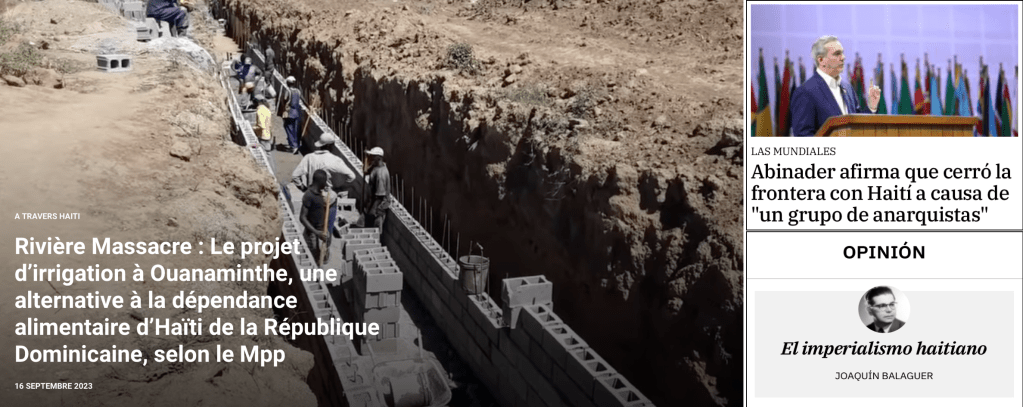
Some Haitians see the effort to construct an irrigation canal in north-east Haiti as an effort to reduce food dependence on the Dominican Republic (left, from the Alterpresse news site); the Dominican president sees the farmers’ action as that of a “group of anarchists” (top right); the conservative Dominican daily Listin Diario recycles a decades-old piece by former president Joaquín Balaguer on “Haitian imperialism” (lower right).

by Jim Hodgson

Over these past 40 years, I have understood that one of the hardest things for me to do is to talk about Haiti and the Dominican Republic in the same breath. Differences between these Caribbean neighbours are profound. I love them both and have developed strong friendships in both places. The relationship between the two countries is often made worse, both by xenophobic and racist politicians in the Dominican Republic, and the refusal of the international community and Haitian elites to allow an effective state to function in Haiti.

Dominican President Luis Abinader has now staked his re-election campaign on a quarrel with Haiti’s weak interim government over community efforts to build an irrigation canal from a river near the northern end of the two countries’ shared border.

Rio Dajabón (or Rivière Massacre in French) is only 55 km long. Its source is in the Central Cordillera of the Dominican Republic, but it has tributaries from the Haitian side as well. A series of treaties achieved between the two countries in the 1920s and 1930s are supposed to govern how waters are shared and disputes resolved, but the process is not being respected now.

When I first started visiting both countries back in the 1980s, most Haitians in the Dominican Republic were sugar cane-cutters brought over by a contract that saw the Dominican State Sugar Council (CEA) pay the Haitian dictator Jean-Claude Duvalier $2 million each year for the cane-cutters’ labour. This was, rightly, denounced as slavery. With the fall of Duvalier in 1986 and then the decline of the cane sugar industry (brought on by the United States’ preference for high-fructose corn syrup (HFCS) produced from corn in its own factories), the practice ended. But Haitians still needed work, and Dominican industries (agriculture, construction and tourism) still need cheap labour. 

In fits and starts, successive Dominican governments have tried to force Haitians from the country, often with cruel, arbitrary measures. This past week, many Haitians rushed to get home before Abinader closed the border on Sept. 15. 

“It’s really a very drastic measure that doesn’t make sense economically for either the Dominican Republic or Haiti,” Diego Da Rin of the International Crisis Group told Associated Press. “This will clearly have very bad consequences economically in the Dominican Republic, and it will very likely worsen the humanitarian situation mostly in the areas close to the border.”
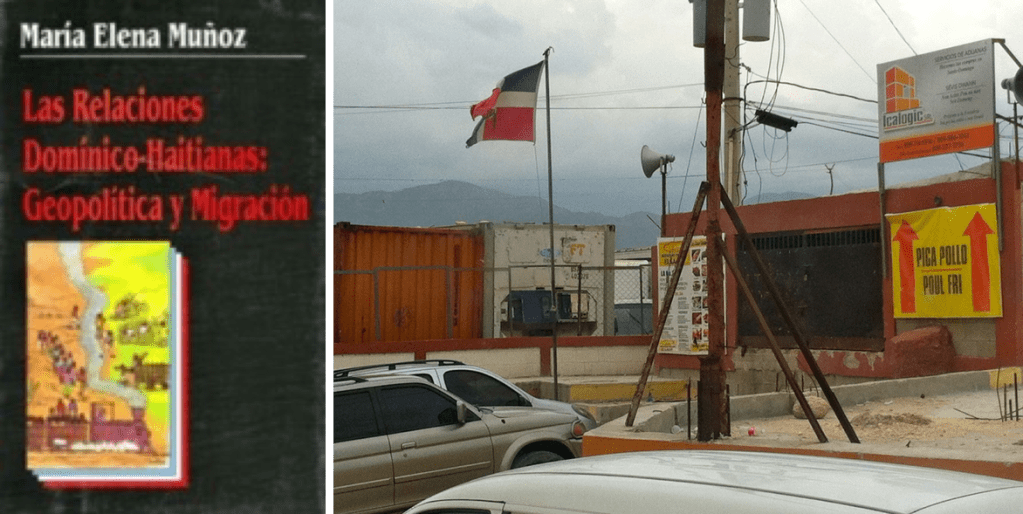
Historian María Elena Muñoz on Haitian-Dominican relations; the border at Jimaní-Malpasse in 2014.

Anti-Haitian campaigns in the Dominican Republic meet with some success because they echo traditional themes in Dominican history and culture. The problems which exist between the Haitian and Dominican peoples have roots in the colonial period. The colonial powers, Spain and France, divided the island between them in the 1697 Treaty of Ryswick which was signed to resolve a European conflict. 

A century later, a revolution by slaves in the French colony resulted in independence for Haiti in 1804. France fought a series of wars between 1795 and 1815 to recover what it had lost, and occasionally used the Spanish colony as a base for attacks on Haiti. 

During the same period, Haiti invaded the Spanish colony several times. Some Dominican historians (including Joaquín Balaguer, a former president) say Haiti’s leaders in this period and later were imperialists who tried to win control of the entire island. Some more progressive Dominicans counter this position with the argument that invasions of the eastern part of the island were designed to prevent its use as a French base for attacks on Haiti. 

Others say that Haiti’s new leaders proclaimed solidarity with their brothers and sisters who were still slaves in the Spanish colony. The invasions that took place between 1801 and 1856 came about because of a sense of solidarity based on shared class interests. 

It is the 1822 intervention that has had lasting consequences. Haiti seized the Spanish colony, and freed the slaves. It launched a land reform program, redistributing lands held by the rich and by the church. Dominican historian María Elena Muñoz argued in a 1995 book that the people did not feel themselves to be Spanish and preferred to benefit from what the Haitians had accomplished in their revolution. 

The occupation lasted until 1844, when the Dominican Republic won its independence in a rebellion against Haiti. While the rebellion’s leaders, particularly Juan Pablo Duarte, made clear that their movement was not aimed against Haitians because of their race or culture, his liberal views did not prevail in the new republic. Duarte was soon forced into exile, and the new Dominican leaders were more conservative and more fearful: they spent much of the next three or four decades trying to get their new country placed under a protectorate of some or other major power (especially Spain and France) for fear that the Haitians would come back.

It is in this period that anti-Haitian prejudice was born and talk of the “Haitian threat” began, because the interests of the elite classes were affected. But anti-Haitian prejudice based on the class interests of the wealthy could not catch on among the poorer classes, so it was disguised as racial prejudice. This had the effect that the elites wanted—division—and the anti-colonialist struggle was impeded.

The emergence of the Dominican state, brought about by the commercial class and perpetuated by other wealthy sectors, did much to damage the sense of identity which existed between oppressed people in the old Spanish colony and Haiti, a sense of identity which had been forged by the shared condition of slavery and the common enemy, European imperialism. Events of the past century—particularly the dictatorships of Rafael Trujillo (1930-61) and the Duvalier père et fils (1957-84)—have served to further isolate the two republics from one another, effectively creating two nations of people with differing views about each other and their places in the world. 


You can look at that history and find triumph: the liberation of the slaves in 1804 and 1822, and the acts of solidarity and compassion that occurred after the January 2010 earthquake when the first assistance that arrived in Haiti was brought by Dominicans. But you also find tragedy, notably the 1937 massacre of at least 18,000 Haitians ordered by Trujillo.
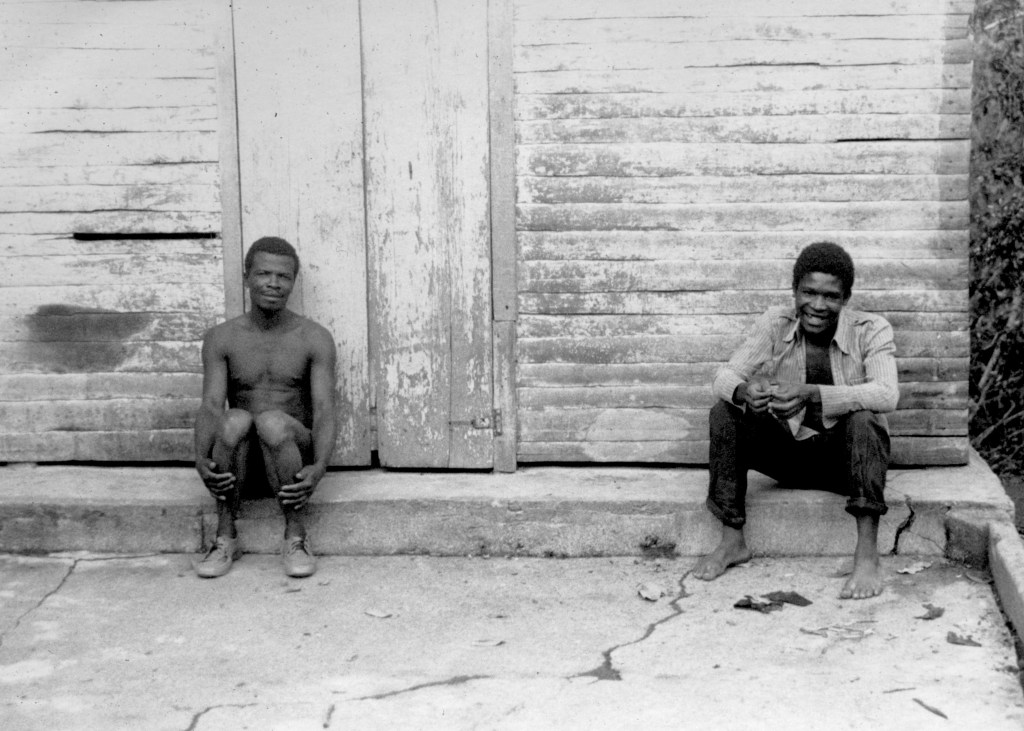
Haitian farm-workers that I met in 1987 in the mountains above San Cristóbal, Dominican Republic.

Cops, robbers and intervention talk in Haiti

by Jim Hodgson

A few nights ago, I watched the British actress Joanna Lumley in conversation with a group of homeless 14- and 15-year-old boys in Port-au-Prince. This was a scene in her 2019 documentary, “Hidden Caribbean,” about her travels in Cuba and Haiti.

I found myself thinking about similar conversations that I have had with teens in Mexico, Haiti, El Salvador and elsewhere: What about the gangs?

“They defend us,” said the teenage son of a woman I knew in La Estación, a neighbourhood where the train station used to be and near where I lived in Cuernavaca, Mexico, in the late ’90s. 

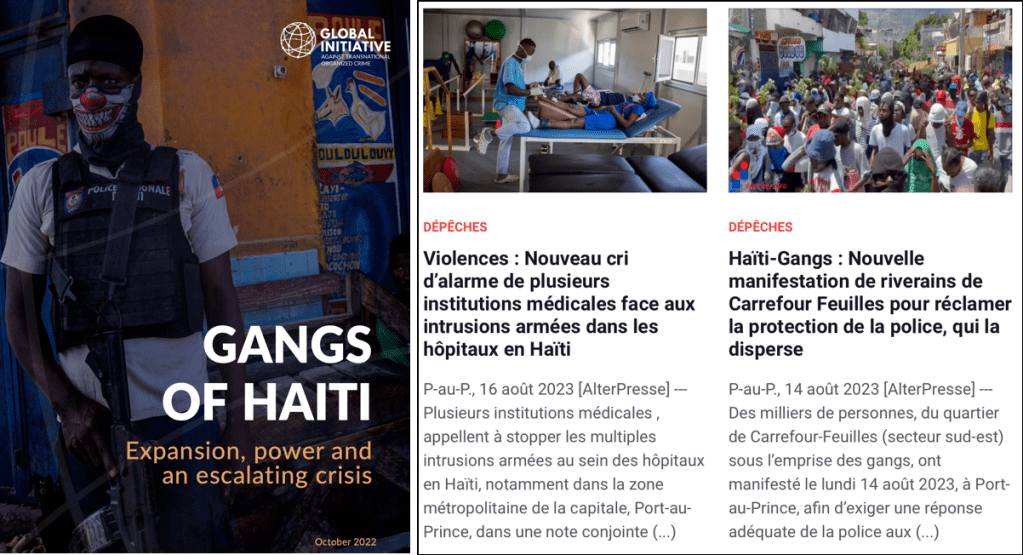
Global Initiative Against Transnational Organized Crime report, Gangs of Haiti. And headlines about gang violence from Alterpresse, an excellent alternative media site in Port-au-Prince. 

I’m not an expert on the sociology of gangs, but it seems to me that for unschooled, unemployed adolescent youth, they might provide a sense of team and friendship that in other places would be provided through schools, organized sports and other activities. And no doubt, there are people who manipulate younger people into activities to “defend” their barrio, and those then become fronts for extortion, drug-trafficking and kidnapping. (You can read more about the sociology of gangs of Haiti here and here.)

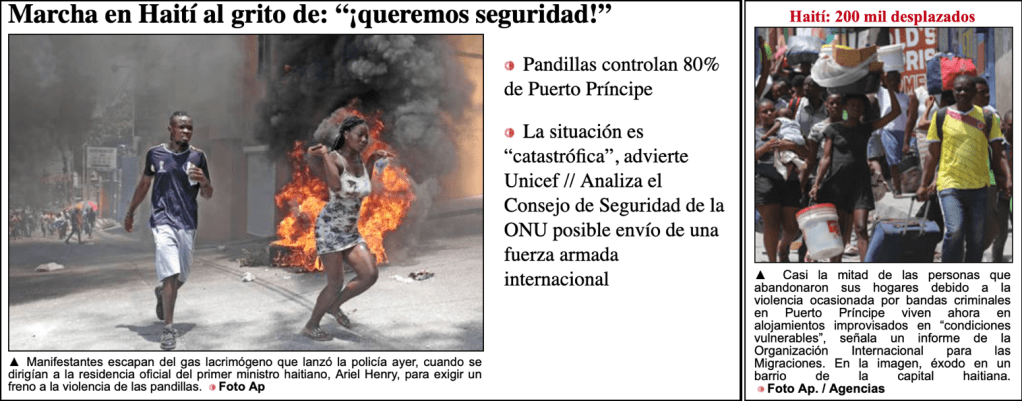
Criminal gangs are blamed for extreme levels of violence in and around Port-au-Prince, the Haitian capital. Their actions become justification for calls from the United Nations, Human Rights Watch and others for an international intervention – this time with police forces.

A “robust use of force” by a multinational police deployment is required to restore order in Haiti and to disarm the gangs, UN secretary general Antonio Guterres said in a report to the Security Council Aug. 15. Such a force may be led by Kenya, and also involve police forces from several Caribbean nations.

“The longer that we wait and don’t have this response, we’re going to see more Haitians being killed, raped and kidnapped, and more people suffering without enough to eat,” said Ida Sawyer of Human Rights Watch a few days earlier.

Headlines and photos from Mexico’s La Jornada daily newspaper: “Gangs control 80% of Port-au-Prince;” “200,000 displaced.”

By all accounts, the situation in Port-au-Prince is dire. On Aug. 17, Haitian aid groups backed by the International Rescue Committee (IRC) said they were temporarily shutting down operations, including some mobile health clinics, in the face of violence. Over the previous weekend, according to the UN, nearly 5,000 people fled their homes from areas around Carrefour Feuilles, Port-au-Prince. They are added to about 200,000 people displaced from their homes so far this year.

And more than 350 people are said to have been killed in lynchings by vigilantes since April.

You might think it’s progress that international actors are talking about police interventions rather than full-out military interventions after those have already failed in Haiti more than once. But decades of financial support and training of Haitian police (much of both coming from Canadafailed to overcome corruption and incompetence. 

Much of this could have been avoided. Three years ago, a viable set of proposals emerged from a coalition of civil society groups – the Montana Accord, named for the hotel where their accord was signed. They offered a “passarelle” or series of steps for an interim government as a way to move to new elections. If the imperial powers – Canada, the US and France – had backed those proposals instead of Ariel Henry (the unelected “prime minister”) things might be different today. 

Beyond the external powers, part of the problem is that the six richest families in Haiti don’t give a damn about the people or the violence, and prefer the current mess to a stronger and more effective state. 

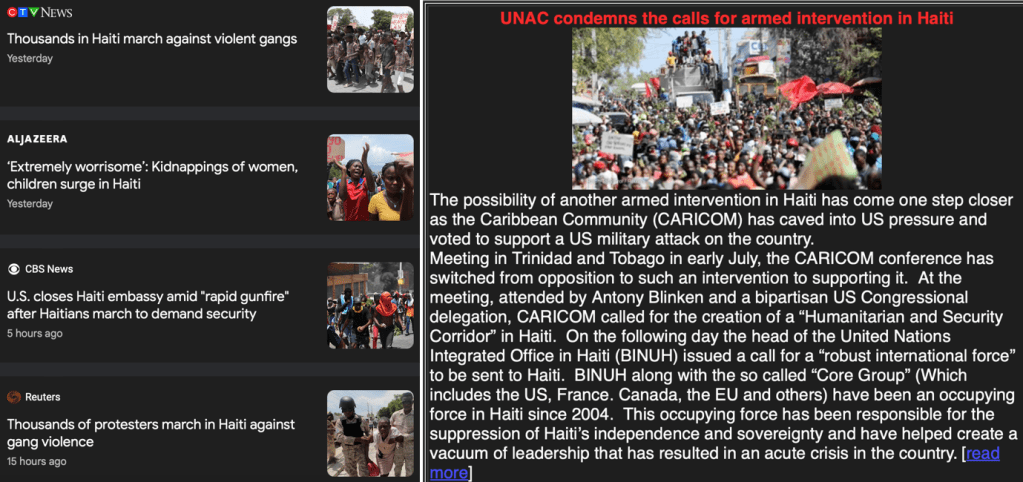
Recent headlines about the crisis in Haiti; a statement by the United National Antiwar Coalition (UNAC) condemning calls for armed intervention.

For now, the civil society groups continue to insist that theirs is the best way forward. There are various tables of negotiations to try to find a way forward. Some involve members of the Montana group and the acting prime minister. 

I think too that, for the sake of peace, the gang leaders, who perceive themselves as defenders of their communities, may need to be reckoned with as political actors, not mere criminals. In July, Tom Hagan, a U.S. Catholic priest, said he had worked out an agreement with four gang leaders in the Cité Soleil neighbourhood. They committed themselves “before God” to “work to put an end to the violence and to bring peace to all peoples.” In the past, bishops have enabled similar agreements in El Salvador and in Guerrero state, Mexico.

I made my first visit to Haiti in 1984, when the dictator Jean-Claude Duvalier was still in power, and I’ve been back countless times since then. High points for me were in August 1987, when a massive popular movement seemed capable of wresting power from the military, and in December 1990 with the election of Jean-Bertrand Aristide as president. What gives me hope is still the capacity of Haitian popular movements – workers, farmers, women, students – to organise and re-organise themselves for change, small and large.

What’s going on now in Haiti is a tragic mess that could have been prevented with some courage and imagination from the international community. In the first year or so after the 2010 earthquake, it seemed to me that the UN, foreign and Haitian NGOs, and the government of René Préval were working together toward a Haitian state that would be strong enough to deliver health, education, transportation, security, even land reform and other public services. But that was not the outcome sought by the United States and Haitian elites.

Debt crisis again provokes “deprivation and misery” in Global South

Asia Debt Monitor, April 2023 

by Jim Hodgson

Forty years ago, I spent five weeks of July and August in the Dominican Republic, learning from families, churches and unions about the ways people confronted their impoverishment. The people that I met taught me about long-haul, multi-generational struggle and solidarity.

Soon after that visit, protests in the D.R., Egypt and Peru erupted against conditions imposed by the International Monetary Fund (IMF) and foreign banks. The issue then – and again now – was how to cope with national debt, budget deficits, and rising interest rates.

The 1984 debt crisis: “Dominicans pay in blood”

You are plunging Global South countries into a greater debt debacle that will cause more deprivation and misery,” wrote the Asian Peoples’ Movement on Debt and Development (APMDD) to leaders of the G7 rich countries on the eve of their mid-May summit in Hiroshima, Japan. Countries as diverse as Argentina, Pakistan, Sri Lanka and Zambia have confronted large debt and harsh repayment conditions in recent months. (Zambia has reached an agreement with lenders to restructure $6.3 billion of debt.)

This month, new reports from two United Nations agencies provide warnings and suggest some solutions to the weight imposed by banks and Global North governments on the people of the Global South.

The UN Development Program (UNDP) said 165 million people were forced into poverty between 2020 to 2023 as debt servicing pushed aside expenditures for  social protection, health and education. All of these additionally impoverished people poor live in low- and lower-middle-income economies, with the most-impoverished 20 per cent in low-income countries suffering the most with incomes in 2023 still below the pre-pandemic levels. Their governments cannot do more to assist because of conditions attached to debt repayment plans.

The UN Conference on Trade and Development (UNCTAD) said that public debt has increased faster in developing countries compared to developed countries over the past decade. “When developing countries borrow money, they have to pay much higher interest rates compared to developed countries, even without considering the costs of exchange rate fluctuations. Countries in Africa borrow on average at rates that are four times higher than those of the United States and even eight times higher than those of Germany.”

UNCTAD reports that 3.3 billion people live in countries were interest payments on debts are greater than spending for education and health care. An editorial in Mexico City’s La Jornada daily newspaper recalled thatUN Secretary General Antonio Guterres has denounced this injustice as “systemic failure.”

In a second editorial a day later, La Jornada noted the impact of Global South debt on efforts to confront the climate emergency. “In 2015, the 10 per cent of the world’s wealthiest people were responsible for half of the greenhouse gas emissions, and only one per cent were responsible for 15 per cent of those emissions. The most impoverished half of the people of the Earth generated only seven per cent of the emissions, but it is they who are most affected by climate change, higher food prices and even the destruction of their homes in severe weather events. The countries whose transnational corporations devastate the environment of the Global South with their unceasing extraction of natural resources close their doors to migrants and condemn them to remain in regions that have become uninhabitable because of the actions of those corporations.”

Historically, the ways that the IMF, banks and Global North governments have contended with debt crises have been to use them as opportunities to push neoliberal development models: free trade, extractivism, privatisation of state-owned companies and services, low-wage factory jobs and export-focused agriculture. And they avoid conversations about debt cancellation and reparations for colonialism and slavery.

APMDD and other Global South movements propose different approaches. In the letter cited above, APMDD urged G7 governments to: 

  1. Cancel the debt for countries in need, including public debts of a questionable and fraudulent nature that violated human rights and contributed to exacerbating the climate crisis.
  2. Support the elimination of IMF surcharges, which penalizes the most debt-distressed countries and further erodes the capacity of developing countries to respond to urgent social needs. 
  3. Enact/strengthen national legislation to require the participation of private creditors in debt relief, which is a key element in any serious wide scale debt reduction or restructuring effort. 
  4. Immediately deliver new, additional and non-debt creating climate finance for adaptation, mitigation and loss and damage, much more than the unfulfilled $100 billion/year pledge, to adequately meet the needs of the Global South. 

Once in a while, cracks appear in the wall of Global North indifference. In June, French President Emmanuel Macron convened a summit to reach a new “global pact” to finance the fight against poverty and human-induced climate change. I’ll share some outcomes in coming days.

Womin is a network of women’s organisations across Africa that proposes cancellation of African debt and ecofeminist alternatives to extractives models of development.