Fifty years of A Theology of Liberation

Jim Hodgson

My background is in journalism (not theology), but I made a sort of career at the intersections of journalism, religion and Latin America. I have been close to conversations about and actions deriving from liberation theology for about 40 years. I am a follower of Jesus formed in liberation theologies that I learned alongside sugar-cane cutters, Indigenous communities, queer and trans people—folks who struggle for liberation the world over. Theirs are the stories I try to share.

Liberation theology is a method of doing theology, not a topic, Elsa Támez has said. It begins with a situation of repression and God’s call to transform that situation. Theology then is a reflection on God’s action in history. In the mid-1980s, however, Pope John Paul II and his head of the Congregation for the Doctrine of the Faith, Cardinal Joseph Ratzinger (later Pope Benedict XVI), made liberation theology a topic of heated debate. As a young journalist, I covered that debate (see the items at the bottom of this post), but over time, I concentrated more on the stories of the people who worked for change.

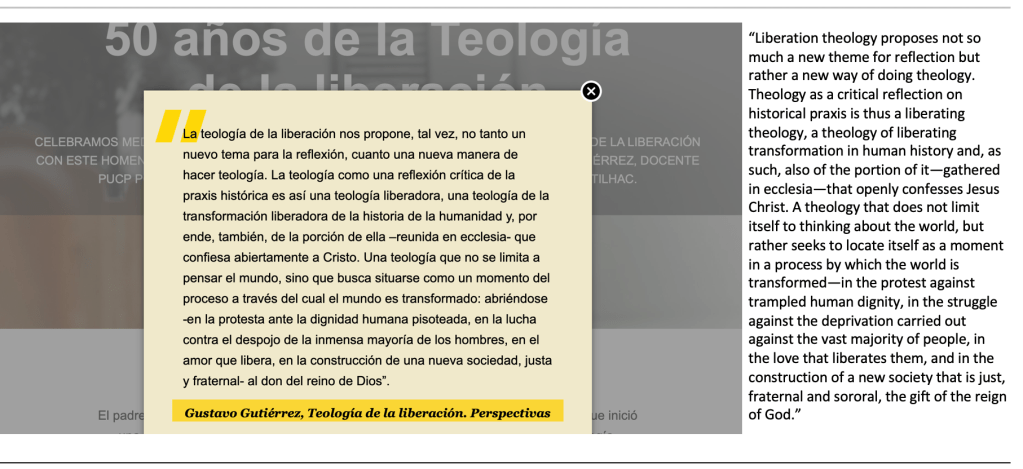
This year, we celebrate the publication 50 years ago of Teología de la Liberación, Perspectivas, the book that brought together a series of reflections on the practice of ministry, or the praxis of liberation, among the impoverished people of Latin America. The English translation, A Theology of Liberation (Orbis), appeared two years later. His second chapter is a critique of what was wrong with development in Latin America in the 1960s that remains valid today.

Image from the tribute to Gutiérrez on the website of the Pontificia Universidad Católica del Perú (PUCP).

The book’s author, the Peruvian priest Gustavo Gutiérrez, had been sharing his perspectives in conferences since the mid-60s, including in the summer of 1967 at the Faculty of Theology at the Université de Montréal.

He was never alone in those reflections, and others were working in similar or parallel veins. The African-American theologian James H. Cone published A Black Theology of Liberation in 1970 (Orbis). In Cuba during the 1960s, Sergio Arce developed a “theology in revolution,” which was about God in human history, especially in the revolution against poverty, exclusion and imperialism. In the 1960s and 70s, priests and other people of faith organized in new ways: Priests for the Third World in Argentina, the National Organization for Social Integration (ONIS) in Peru, the Golcanda group in Colombia, Christians for Socialism in Chile during the time of Salvador Allende.

Other contextual theologies emerged—Indigenous, feminist, womanist, queer, Minjung in South Korea—along with a wide spectrum of criticism, much of it helpful in adding “new subjects” that Gutiérrez had overlooked. But sometimes, the criticism was led directly to the persecution of the “church of the poor” and to countless murders and other violations of human rights. After the assassination in San Salvador in 1989 of six Jesuit priests, their housekeeper and her daughter, proponents of liberation theology spoke instead of Latin American theology, a situation that persisted until the election of Pope Francis in 2013.

From top left: Enrique Dussel, Elsa Támez, Frei Betto and Leonardo Boff. 
Bottom left: Chung Hyun Kyung, Miguel Concha. 
Dussel, born in Argentina and living in Mexico, is a philosopher and historian. Támez, born in Mexico, works with the Latin American Biblical University in Costa Rica and with Indigenus biblical translators. Frei Betto is best known for exploring political implications of liberation theology, and Boff is a leading proponent of ecological perspectives in theology: they are shown during a presentation at the first World Forum on Theology and Liberation, held in days ahead of the World Social Forum in Porto Alegre in January 2005.
In ecumenical circles, Chung is remembered for sparking good debate over Christian relations with other religions during and after the Canberra Assembly of the World Council of Churches in 1993. Concha is shown during a news conference by social movements during Pope John Paul II’s visit to Mexico City in 1999. Jim Hodgson photos.

Miguel Concha, a Mexican priest of the Dominican religious order and columnist at La Jornada, wrote on the occasion of the 40th anniversary of first publication of Gutiérrez’s book:

“Liberation theology is not limited to helping the poor individually. Nor is it reformist, trying to improve a situation but leaving intact the types of social relations and basic structures of an unjust society. Beyond moving ethically in the face of collective misery, it considers impoverished people to be subjects of their own liberation, valuing in them their awareness of their rights and capacity for resistance, organization and transformation of their situation.”

In these 50 years, I think the formal presentation of Gutiérrez’s method has become melded in our imaginations with other processes: 

  • the outcomes of the II Vatican Council and several meetings of Latin American bishops (CELAM), especially the articulation of the church’s “preferential option for the poor” at the CELAM conferences in Medellín in 1968 and in Puebla in 1979; 
  • the pastoral action of certain church leaders (Sergio Mendes Arceo, Hélder Câmara, Oscar Romero, Samuel Ruíz, the Argentinean Methodist Federico Pagura, among many others), whether they identified explicitly with liberation theology or not; 
  • a mix of popular education and base Christian community experiences; and the political action of movements like the Sandinista Front In Nicaragua in the 70s and 80s, or that which propelled Jean-Bertrand Aristide to the presidency of Haiti in 1990 and again in 2000.

During the last week of October, Fr. Gustavo, now 93 years of age, joined with scores of scholars and faithful for an online seminar to mark the anniversary. Videos of the presentations can be viewed (in Spanish) on the Facebook site of the Instituto Bartolomé de Las Casas.

I am appending here below parts of some to the articles I wrote in the mid-80s about the debates over liberation theology.

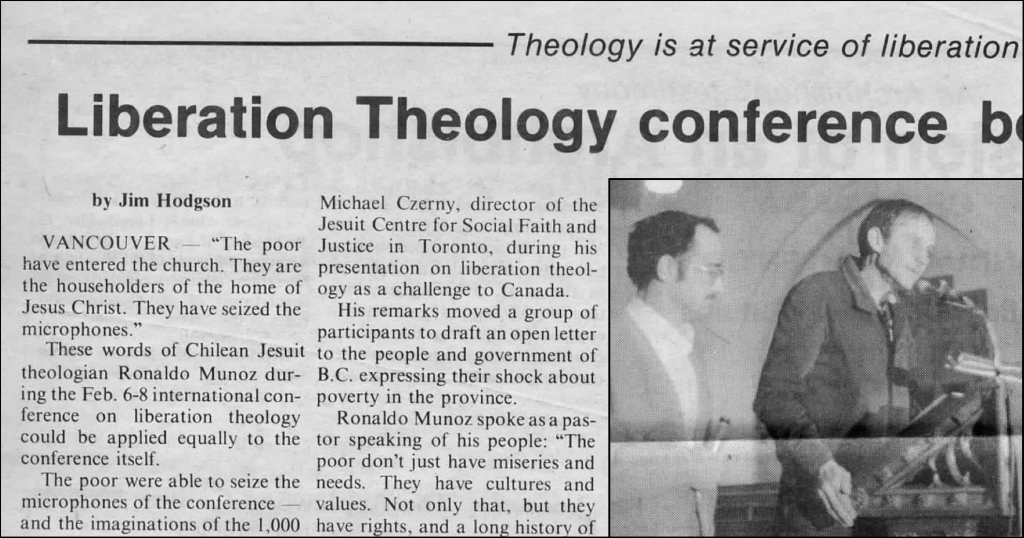
A thousand people attended a conference on liberation theology held at Simon Fraser University in February 1986. Among the speakers were Jesuit Fr. Michael Czerny (now a cardinal of the Roman Catholic Church) and Fr. Ronaldo Muñoz (not a Jesuit, but rather a priest of the Sacred Heart in Chile, who died in 2009). Muñoz said: “Liberation theology is telling of our experience of God in the context of our commitment to the struggle of the people: God in history, God in the Bible, in Jesus, in those who have been humiliated. The theologies of theologians, books, speeches, conferences in Vancouver, are in second place. Liberation theology seeks to be at the service of this struggle, this history of faith.”

Hélder Câmara (1909–1999) was the archbishop of Olinda and Recife, serving from 1964 to 1985. At the invitation of Youth Corps, a ministry of the archdiocese of Toronto, he participated events – “Circus of the Heart” and “Stories of the Heart” – in Toronto in 1985 and 1986. 
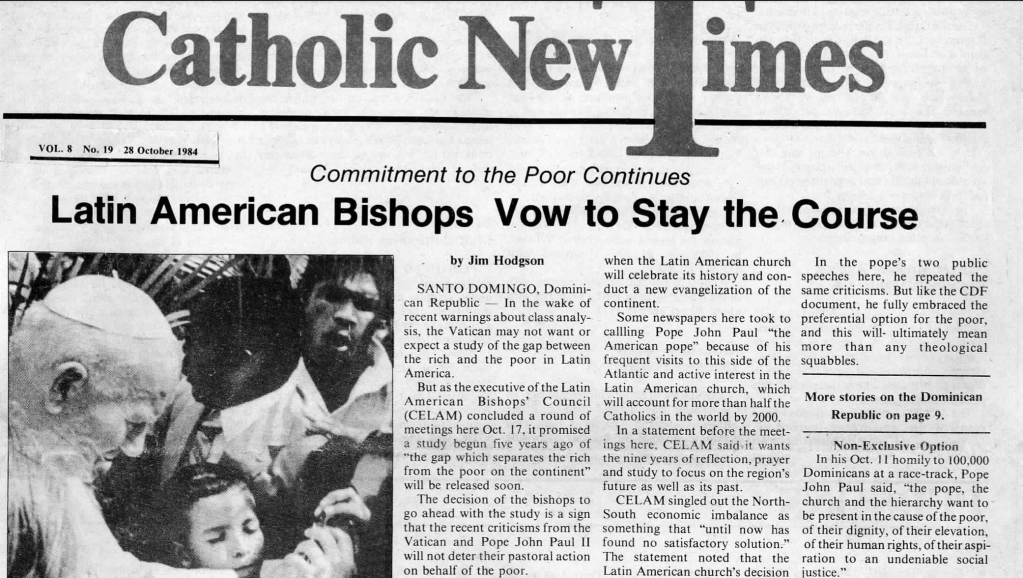
My first time “inside” the media bubble of accredited journalists on a papal visit. I remember the Vatican correspondents didn’t like me being on “their” bus around the Santo Domingo venues. Penny Lernoux (Cry of the People, 1980), Latin America correspondent of the National Catholic Reporter, took me under her wing to meetings with several of the more progressive Latin American bishops.

20 years: Digna Ochoa, ¡Presente!

“I learned that due to the rampant corruption and impunity in Mexico, it was not sufficient to be innocent, to be right, and to have the law on your side, but it was necessary to fight against an entire government structure that defends very specific political and economic interests.”

Digna Ochoa, speaking in September 2000 to the Enduring Spirit awards dinner in Los Angeles
Digna was remembered at an Amnesty International event in Toronto, 2011; Linda Diebel’s Betrayed: The Assassination of Digna Ochoa. The quote cited above is from p.445 of Diebel’s book.

Today marks the 20th anniversary of the murder of Digna Ochoa, a lawyer who defended the human rights of ecologists in Guerrero state and whose death remains a muddle of sloppy investigation, useless gossip, and high-level cover-ups.

While there are still a handful of officials who stick by their suicide-by-two-bullets version of events, the Mexican government this year admitted at least partial responsibility for her death. The admission came May 27 during a hearing of the Inter-American Commission on Human Rights (IACHR), and included a commitment to re-open the case. The new investigation will proceed with a human rights perspective and a gender approach under international standards, in addition to the participation of the family and their legal representation.

I met Digna on Nov. 25, 1999, a little less than two years before her death. Earlier that year, she had left the convent of Dominican nuns before taking her vows, and engaged herself fully in her original passion: the law. We were together in a fairly large group of representatives of Mexican non-governmental organizations who spent the day preparing a presentation delivered by a smaller group later that evening to Mary Robinson, the former Irish president who was then the head of the United Nations’ human rights commission. 

Digna’s legal defence of imprisoned and tortured rural ecologists who challenged logging companies in Guerrero—the Pacific coast state south of Mexico City that includes the resort cities of Acapulco and Ixtapa—brought her into conflict not just with the companies but the political establishment in Guerrero, and quite likely with the Mexican army and its allies in the national government and that of Mexico City. In the months before the meeting with Robinson, Digna had already been kidnapped twice and threatened countless times.

Our 40-page message (reduced to nine paragraphs for the oral presentation) to Robinson addressed these points:

  1. Obtaining and imparting justice: impunity, legalized repression, inefficiency in investigations, lack of independence, manipulation of the law, military justice, lack of knowledge of international protection.
  2. Militarization of public security and military presence in Indigenous and rural areas.
  3. The general situation of Indigenous people in Mexico: internal legislation, state institutions and public policies with regards to Indigenous women, Indigenous rights and the environment, land and territory.
  4. Economic, Social and Cultural Rights: globalization, labour rights, freedom of association, land rights and the situation of small farmers.
  5. Political rights in Mexico: institutional reform, electoral rights, and political rights in general.
  6. Harassment and aggression against defenders of human rights and journalists. (In the evening meeting with Robinson, Digna Ochoa read this section.) 

At that time, there was a lot of hope in Mexico that the long run of the PRI party was nearing its end. Indeed, the following July, Vicente Fox of the conservative PAN party won the election. But 21 years later—after two PAN governments, one more by the PRI, and now three years of the popular left administration of President Andrés Manuel López Obrador—few would argue that things have improved for most Mexicans. 

Today, a new civil society report to Robinson’s successor, Michelle Bachelet, might add a focus on the extremely high numbers of forced disappearances—about 91,000 between 2006 and 2021—and all of the issues related to migration from and through Mexico toward the United States. As it happens, Bachelet is collaborating with the Mexican government in ongoing investigation of the case of the 43 Ayotzinapa normal school students who were disappeared in Guerrero in 2014. 

It may be hard to find signs of improvement yet, but every step toward truth-telling and investigation of crimes old and new lays the foundation for a better future that is still being imagined.

Anacaona and the Day of Indigenous Resistance 

Today, October 12, is the Day of Indigenous Resistance, at least in Venezuela and in the hearts of millions of people in other lands. In Costa Rica, it’s the Día de las Culturas. But in many places, it’s still called Columbus Day or the Día de la Raza. In Canada, the date is mostly ignored. Here, I am sharing the lightly-edited text of a piece I wrote in 2011.

Now, 529 years have passed since Chris got lost in the Greater Antilles and was found by the Taíno Indigenous people. 

At La Caleta, near the entrance to the Santo Domingo airport, there is a park that contains an ancient burial ground of the Taíno people, the original inhabitants of Quisqueya or Ayiti (the island the Spanish called Española).

Within 50 years of the Spanish arrival, the Taíno people had been wiped out. We have many of their words: names of places and rivers, along with words (some shared with other First Nations languages) that found their way into Spanish and English, including: barbacoa (barbecue), hamaca (hammock), kanoa (canoe), tabaco (tobacco), juracán (hurricane), plus the names of the staple of the Taíno diet, cassava or yuca. 

Two views of a (now controversial) statue of Christopher Columbus and the Taíno leader Anacaona in the central plaza of Santo Domingo, Dominican Republic.

The history of Taíno resistance is not lost 

The story of one woman, Anacaona, stands out. My friend Félix Posada of the Latin American Centre for Popular Communication (CEPALC) in Colombia wrote about her in the January-March 2010 issue of CEPALC’s magazine, Encuentro. (Wikipedia has some accessible articles too, but the best source is the work of Bartolomé de Las Casas, the priest who wrote everything that he saw and heard over the first 50 years of the 16th century.) 

When Columbus showed up in 1492, there were five Taíno chiefdoms (cacicazgos) and territories on the island, each led by a principal cacique (chieftain). 

Anacaona, born in 1464, was chief of Jaragua, the territory on the southwest part of island. Her husband Canoabo was chief of neighbouring Maguana. They had a daughter, Higuerota. 

From the time Anacaona was small, she distinguished herself by her intelligence and talent for composing and memorizing poetry that she recited in festivals, in the areitos (party, song, dance, and rhythm, all at the same time). 

The cazicazgos of Ayiti/Quisqueya.

When the Spanish arrived, they were received with a certain sympathy. But disillusion came quickly. Columbus left a group of men in what was called “Fort Navidad” (located between the mouth of the Guarico River and Picolet Point on the northwest coast of what is now Haiti) while he returned to Spain to report on his discovery. 

The 39 men left behind stole from the Indigenous communities, mistreated and raped the people, and tried to destroy the local culture. Anacaona convinced Canoabo and other chieftains to attack and destroy the Spanish fortress and the soldiers who lived there. The attack was devastating: the soldiers were killed. Canoabo was eventually captured and shipped to Spain, dying in a shipwreck during the journey. 

Conflict, negotiation and treachery 

Columbus visited Anacaona and her brother Bohechío in Jaragua in late 1496. Columbus successfully negotiated for a tribute of food and cotton for the settlers under his command. Months later, Columbus arrived with a ship to collect part of the tribute. Anacaona and Bohechío sailed briefly aboard the ship in the Gulf of Gonâve, near today’s Port-au-Prince. 

Very quickly, Española became the centre of European colonization in the Americas. Santo Domingo, the city that Columbus founded on the south coast of the island, became home to civil servants, soldiers, missionaries and investors who took the best land, sought to enslave the Indigenous people and imported African slaves. 

As the Spanish presence grew, rumours of rebellion swept the island. Anacaona was a leader of the resistance movement, and her efforts became known to the Spanish governor, Nicolás de Ovando. Ovando sent a message to Anacaona that he would visit her in a spirit of friendship. He arrived at Yaguana with 350 soldiers. Received as a guest with feasts and dances, he ordered his men to burn the community and to make its leader his prisoner. 

Anacaona managed to escape together with her daughter Higuemota, grand-daughter Mencía, and also with the cacique Hatuey.

But Anacaona’s freedom did not last long. She was captured by Ovando and, at age 39, was hanged in 1504. 

The administration of Ovando was a cruel one. When the Spanish arrived in 1492, the Indigenous population was estimated at 500,000. According to a census taken in 1507, the Indigenous population had been reduced to 60,000.