Debt crisis again provokes “deprivation and misery” in Global South

Asia Debt Monitor, April 2023 

by Jim Hodgson

Forty years ago, I spent five weeks of July and August in the Dominican Republic, learning from families, churches and unions about the ways people confronted their impoverishment. The people that I met taught me about long-haul, multi-generational struggle and solidarity.

Soon after that visit, protests in the D.R., Egypt and Peru erupted against conditions imposed by the International Monetary Fund (IMF) and foreign banks. The issue then – and again now – was how to cope with national debt, budget deficits, and rising interest rates.

The 1984 debt crisis: “Dominicans pay in blood”

You are plunging Global South countries into a greater debt debacle that will cause more deprivation and misery,” wrote the Asian Peoples’ Movement on Debt and Development (APMDD) to leaders of the G7 rich countries on the eve of their mid-May summit in Hiroshima, Japan. Countries as diverse as Argentina, Pakistan, Sri Lanka and Zambia have confronted large debt and harsh repayment conditions in recent months. (Zambia has reached an agreement with lenders to restructure $6.3 billion of debt.)

This month, new reports from two United Nations agencies provide warnings and suggest some solutions to the weight imposed by banks and Global North governments on the people of the Global South.

The UN Development Program (UNDP) said 165 million people were forced into poverty between 2020 to 2023 as debt servicing pushed aside expenditures for  social protection, health and education. All of these additionally impoverished people poor live in low- and lower-middle-income economies, with the most-impoverished 20 per cent in low-income countries suffering the most with incomes in 2023 still below the pre-pandemic levels. Their governments cannot do more to assist because of conditions attached to debt repayment plans.

The UN Conference on Trade and Development (UNCTAD) said that public debt has increased faster in developing countries compared to developed countries over the past decade. “When developing countries borrow money, they have to pay much higher interest rates compared to developed countries, even without considering the costs of exchange rate fluctuations. Countries in Africa borrow on average at rates that are four times higher than those of the United States and even eight times higher than those of Germany.”

UNCTAD reports that 3.3 billion people live in countries were interest payments on debts are greater than spending for education and health care. An editorial in Mexico City’s La Jornada daily newspaper recalled thatUN Secretary General Antonio Guterres has denounced this injustice as “systemic failure.”

In a second editorial a day later, La Jornada noted the impact of Global South debt on efforts to confront the climate emergency. “In 2015, the 10 per cent of the world’s wealthiest people were responsible for half of the greenhouse gas emissions, and only one per cent were responsible for 15 per cent of those emissions. The most impoverished half of the people of the Earth generated only seven per cent of the emissions, but it is they who are most affected by climate change, higher food prices and even the destruction of their homes in severe weather events. The countries whose transnational corporations devastate the environment of the Global South with their unceasing extraction of natural resources close their doors to migrants and condemn them to remain in regions that have become uninhabitable because of the actions of those corporations.”

Historically, the ways that the IMF, banks and Global North governments have contended with debt crises have been to use them as opportunities to push neoliberal development models: free trade, extractivism, privatisation of state-owned companies and services, low-wage factory jobs and export-focused agriculture. And they avoid conversations about debt cancellation and reparations for colonialism and slavery.

APMDD and other Global South movements propose different approaches. In the letter cited above, APMDD urged G7 governments to: 

  1. Cancel the debt for countries in need, including public debts of a questionable and fraudulent nature that violated human rights and contributed to exacerbating the climate crisis.
  2. Support the elimination of IMF surcharges, which penalizes the most debt-distressed countries and further erodes the capacity of developing countries to respond to urgent social needs. 
  3. Enact/strengthen national legislation to require the participation of private creditors in debt relief, which is a key element in any serious wide scale debt reduction or restructuring effort. 
  4. Immediately deliver new, additional and non-debt creating climate finance for adaptation, mitigation and loss and damage, much more than the unfulfilled $100 billion/year pledge, to adequately meet the needs of the Global South. 

Once in a while, cracks appear in the wall of Global North indifference. In June, French President Emmanuel Macron convened a summit to reach a new “global pact” to finance the fight against poverty and human-induced climate change. I’ll share some outcomes in coming days.

Womin is a network of women’s organisations across Africa that proposes cancellation of African debt and ecofeminist alternatives to extractives models of development.
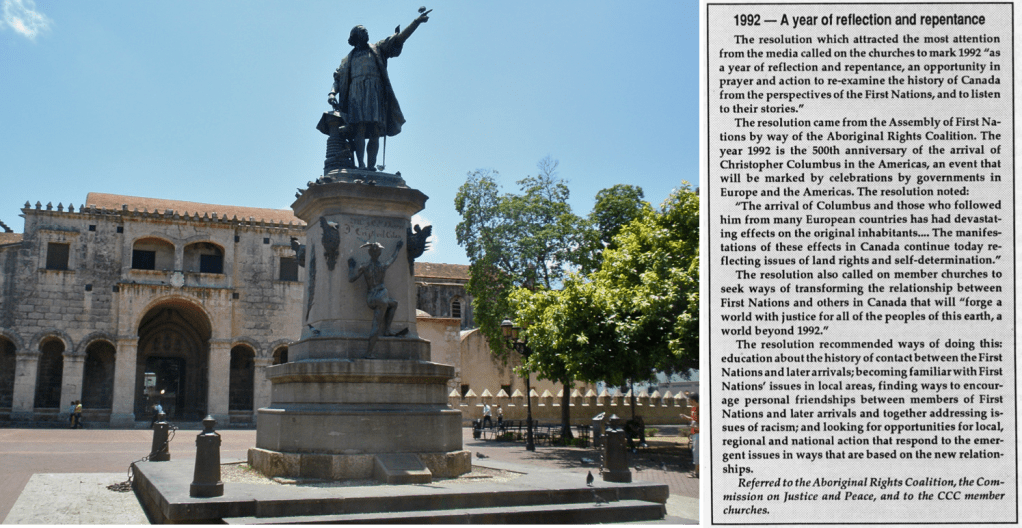
Santo Domingo in October 1992: 500 years of resistance and the Canadian Ecumenical Presence

Left: The statue of Christopher Columbus (“Cristóbal Colón” in Spanish) that stands in front of the Santo Domingo Cathedral today draws protests and calls for its removal.
Right: In May 1991, the Triennial Assembly of the Canadian Council of Churches (held in Camrose, Alta.) called on member churches to mark 1992 “as a year of reflection and repentance.”

by Jim Hodgson

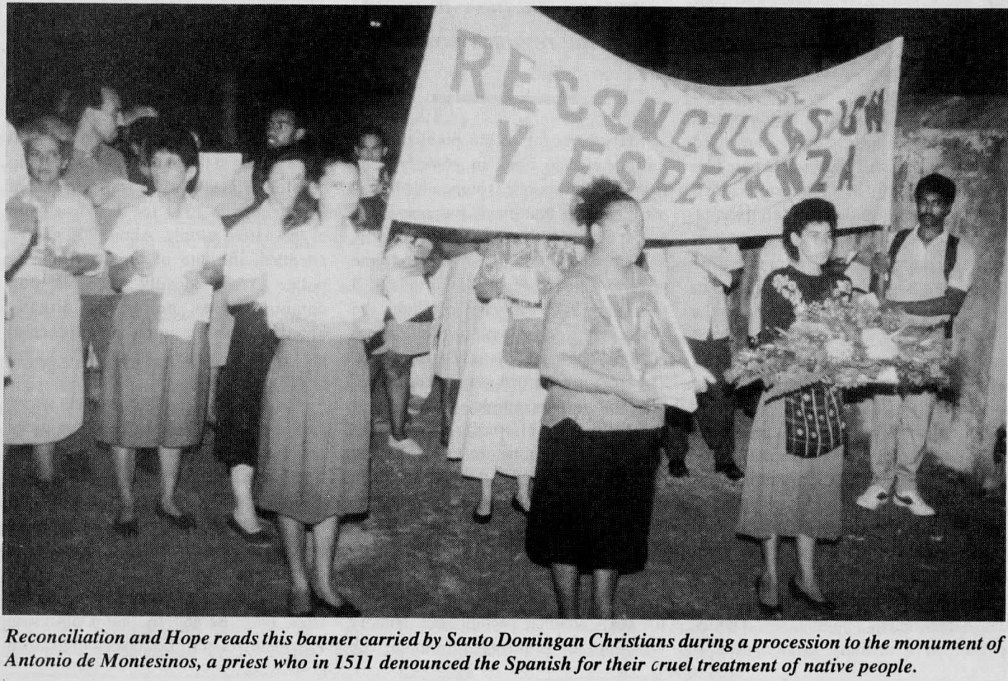
As my penitential pilgrimage continued at a distance from that of Pope Francis, I found myself thinking increasingly of another pilgrimage. In October 1992, about 200 people joined the Canadian Ecumenical Presence (CEP) in Santo Domingo. As I could find almost nothing on the internet, I thought I should share something here. CEP became an ecumenical educational exposure experience beyond compare.

We were not yet using language of reconciliation – and indeed it may be premature still: much truth-telling still needed! – but we were wrestling with colonialism and its devastation in company with Indigenous people, descendants of enslaved peoples brought by force from Africa, and all people who struggle for liberation from contemporary colonialism that presents itself as globalized capitalism, indebtedness, human-trafficking and imperialism.

It all began on the back of an envelope. I met for lunch with two ecumenical friends: Joe Mihevc, then the Toronto animator for the Canadian Catholic Organization for Development and Peace, and Patti Talbot, then on the staff of the Canadian Churches’ Forum for Global Ministries. “The only paper we could find among the three of us to jot notes was an old envelope from my purse,” Patti recalled later.

Soon, we were joined by other friends: ecumenical activist and educator Betsy Anderson of the Latin American Working Group (LAWG); Suzanne Rumsey of LAWG and later the Inter-Church Committee on Human Rights in Latin America (ICCHRLA); Rosalee Bender who became our program staff coordinator; Juan Rivas, coordinator of the Dominican Republic Experience; and Joe Byrne from the Latin America Mission Program of the Diocese of Charlottetown. 

Glad Tidings, the magazine of the Women’s Missionary Society of the Presbyterian Church in Canada, ends its print existence in 2020.
Entre-nous was a newsletter of the Canadian Council of Churches in the early 1990s.

From the time of the first CEP plan, the one drawn on the back of an envelope in a cafeteria, it had been our hope to be able to serve religious media by providing a relatively inexpensive place to stay, helping reporters get access to major events, and accompanying them in encounters with Dominicans who were working for change. 

CEP participants who had media accreditation were able to attend some of the official CELAM events and news conferences. It was a question from a Mohawk radio producer, Eric Gabriel, that turned what might have been a series of carefully-staged news conferences into informative briefings: “Will the bishops’ conference apologize to native people, and if not, why not?” First, there was silence — a silence that is captured beautifully in the documentary which Vision-TV broadcast in December 1992. Then one of the bishops on the panel sputtered an incoherent and embarrassing response to this sensitive question. The fumble prompted the CELAM media office to plan a 90-minute briefing on the church’s role in Indigenous issues the following day, featuring clergy and lay people who were Indigenous or who worked with Indigenous people. A day later, a thorough briefing on the situation of women was offered.

Clockwise from top left: Bishop Julio Cabrera of Quiché diocese in Guatemala; Jim Hodgson (and no: I do not understand the hat), Eric Gabriel, Fr. Jerome Kelleher, Leslie Wirpsa (National Catholic Reporter); José Álvarez Icaza, National Centre for Social Communications (CENCOS), Mexico; Raúl Rosales, Diego de Medellín Ecumenical Centre, Chile; and Rita Deverell of Vision TV speaking with Manuel Casado, a medical doctor serving in the Capotillo barrio of Santo Domingo.

Fifty years of A Theology of Liberation

Jim Hodgson

My background is in journalism (not theology), but I made a sort of career at the intersections of journalism, religion and Latin America. I have been close to conversations about and actions deriving from liberation theology for about 40 years. I am a follower of Jesus formed in liberation theologies that I learned alongside sugar-cane cutters, Indigenous communities, queer and trans people—folks who struggle for liberation the world over. Theirs are the stories I try to share.

Liberation theology is a method of doing theology, not a topic, Elsa Támez has said. It begins with a situation of repression and God’s call to transform that situation. Theology then is a reflection on God’s action in history. In the mid-1980s, however, Pope John Paul II and his head of the Congregation for the Doctrine of the Faith, Cardinal Joseph Ratzinger (later Pope Benedict XVI), made liberation theology a topic of heated debate. As a young journalist, I covered that debate (see the items at the bottom of this post), but over time, I concentrated more on the stories of the people who worked for change.

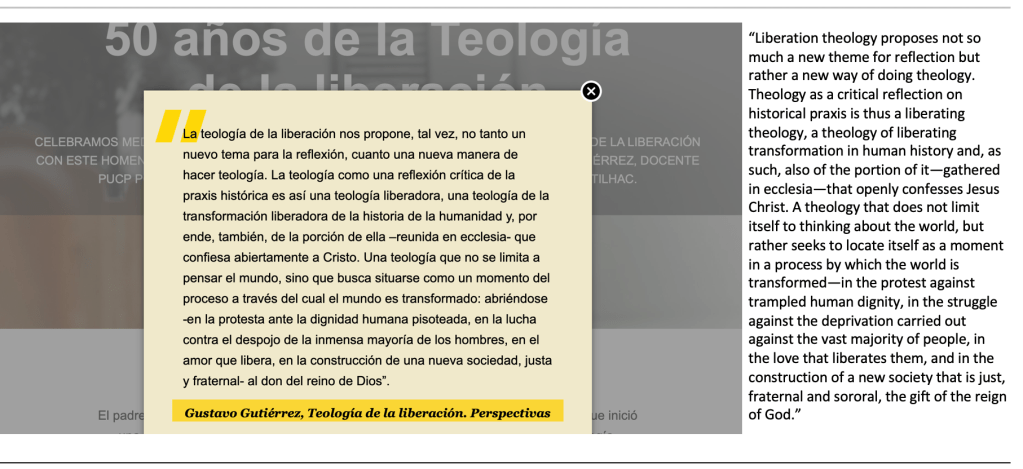
This year, we celebrate the publication 50 years ago of Teología de la Liberación, Perspectivas, the book that brought together a series of reflections on the practice of ministry, or the praxis of liberation, among the impoverished people of Latin America. The English translation, A Theology of Liberation (Orbis), appeared two years later. His second chapter is a critique of what was wrong with development in Latin America in the 1960s that remains valid today.

Image from the tribute to Gutiérrez on the website of the Pontificia Universidad Católica del Perú (PUCP).

The book’s author, the Peruvian priest Gustavo Gutiérrez, had been sharing his perspectives in conferences since the mid-60s, including in the summer of 1967 at the Faculty of Theology at the Université de Montréal.

He was never alone in those reflections, and others were working in similar or parallel veins. The African-American theologian James H. Cone published A Black Theology of Liberation in 1970 (Orbis). In Cuba during the 1960s, Sergio Arce developed a “theology in revolution,” which was about God in human history, especially in the revolution against poverty, exclusion and imperialism. In the 1960s and 70s, priests and other people of faith organized in new ways: Priests for the Third World in Argentina, the National Organization for Social Integration (ONIS) in Peru, the Golcanda group in Colombia, Christians for Socialism in Chile during the time of Salvador Allende.

Other contextual theologies emerged—Indigenous, feminist, womanist, queer, Minjung in South Korea—along with a wide spectrum of criticism, much of it helpful in adding “new subjects” that Gutiérrez had overlooked. But sometimes, the criticism was led directly to the persecution of the “church of the poor” and to countless murders and other violations of human rights. After the assassination in San Salvador in 1989 of six Jesuit priests, their housekeeper and her daughter, proponents of liberation theology spoke instead of Latin American theology, a situation that persisted until the election of Pope Francis in 2013.

From top left: Enrique Dussel, Elsa Támez, Frei Betto and Leonardo Boff. 
Bottom left: Chung Hyun Kyung, Miguel Concha. 
Dussel, born in Argentina and living in Mexico, is a philosopher and historian. Támez, born in Mexico, works with the Latin American Biblical University in Costa Rica and with Indigenus biblical translators. Frei Betto is best known for exploring political implications of liberation theology, and Boff is a leading proponent of ecological perspectives in theology: they are shown during a presentation at the first World Forum on Theology and Liberation, held in days ahead of the World Social Forum in Porto Alegre in January 2005.
In ecumenical circles, Chung is remembered for sparking good debate over Christian relations with other religions during and after the Canberra Assembly of the World Council of Churches in 1993. Concha is shown during a news conference by social movements during Pope John Paul II’s visit to Mexico City in 1999. Jim Hodgson photos.

Miguel Concha, a Mexican priest of the Dominican religious order and columnist at La Jornada, wrote on the occasion of the 40th anniversary of first publication of Gutiérrez’s book:

“Liberation theology is not limited to helping the poor individually. Nor is it reformist, trying to improve a situation but leaving intact the types of social relations and basic structures of an unjust society. Beyond moving ethically in the face of collective misery, it considers impoverished people to be subjects of their own liberation, valuing in them their awareness of their rights and capacity for resistance, organization and transformation of their situation.”

In these 50 years, I think the formal presentation of Gutiérrez’s method has become melded in our imaginations with other processes: 

  • the outcomes of the II Vatican Council and several meetings of Latin American bishops (CELAM), especially the articulation of the church’s “preferential option for the poor” at the CELAM conferences in Medellín in 1968 and in Puebla in 1979; 
  • the pastoral action of certain church leaders (Sergio Mendes Arceo, Hélder Câmara, Oscar Romero, Samuel Ruíz, the Argentinean Methodist Federico Pagura, among many others), whether they identified explicitly with liberation theology or not; 
  • a mix of popular education and base Christian community experiences; and the political action of movements like the Sandinista Front In Nicaragua in the 70s and 80s, or that which propelled Jean-Bertrand Aristide to the presidency of Haiti in 1990 and again in 2000.

During the last week of October, Fr. Gustavo, now 93 years of age, joined with scores of scholars and faithful for an online seminar to mark the anniversary. Videos of the presentations can be viewed (in Spanish) on the Facebook site of the Instituto Bartolomé de Las Casas.

I am appending here below parts of some to the articles I wrote in the mid-80s about the debates over liberation theology.

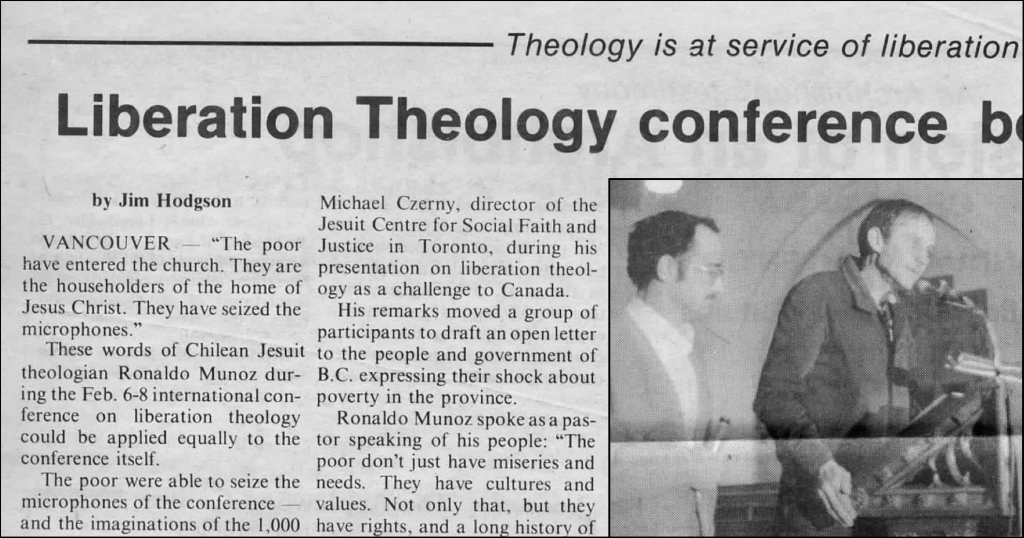
A thousand people attended a conference on liberation theology held at Simon Fraser University in February 1986. Among the speakers were Jesuit Fr. Michael Czerny (now a cardinal of the Roman Catholic Church) and Fr. Ronaldo Muñoz (not a Jesuit, but rather a priest of the Sacred Heart in Chile, who died in 2009). Muñoz said: “Liberation theology is telling of our experience of God in the context of our commitment to the struggle of the people: God in history, God in the Bible, in Jesus, in those who have been humiliated. The theologies of theologians, books, speeches, conferences in Vancouver, are in second place. Liberation theology seeks to be at the service of this struggle, this history of faith.”

Hélder Câmara (1909–1999) was the archbishop of Olinda and Recife, serving from 1964 to 1985. At the invitation of Youth Corps, a ministry of the archdiocese of Toronto, he participated events – “Circus of the Heart” and “Stories of the Heart” – in Toronto in 1985 and 1986. 
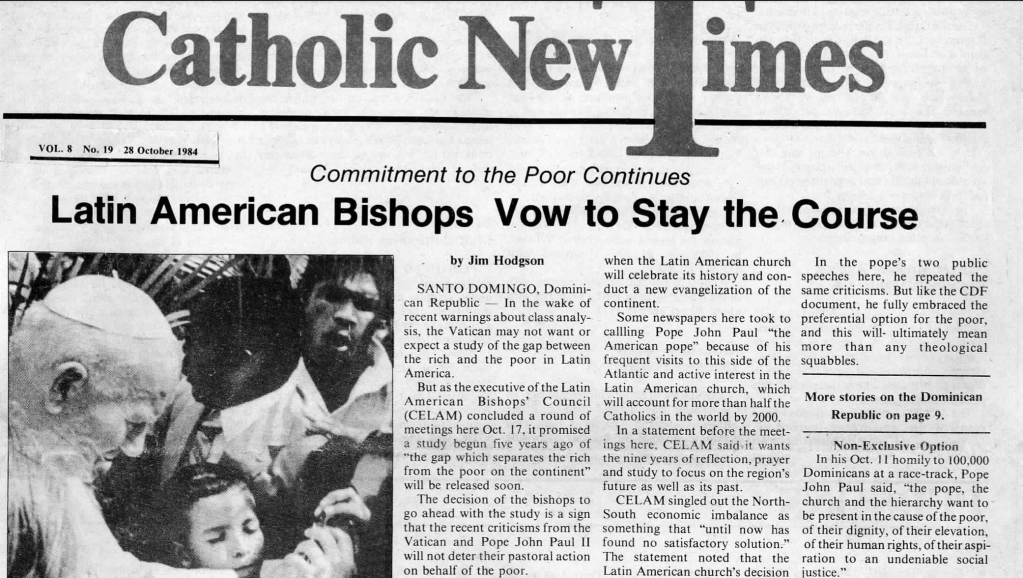
My first time “inside” the media bubble of accredited journalists on a papal visit. I remember the Vatican correspondents didn’t like me being on “their” bus around the Santo Domingo venues. Penny Lernoux (Cry of the People, 1980), Latin America correspondent of the National Catholic Reporter, took me under her wing to meetings with several of the more progressive Latin American bishops.