Anacaona and the Day of Indigenous Resistance 

Today, October 12, is the Day of Indigenous Resistance, at least in Venezuela and in the hearts of millions of people in other lands. In Costa Rica, it’s the Día de las Culturas. But in many places, it’s still called Columbus Day or the Día de la Raza. In Canada, the date is mostly ignored. Here, I am sharing the lightly-edited text of a piece I wrote in 2011.

Now, 529 years have passed since Chris got lost in the Greater Antilles and was found by the Taíno Indigenous people. 

At La Caleta, near the entrance to the Santo Domingo airport, there is a park that contains an ancient burial ground of the Taíno people, the original inhabitants of Quisqueya or Ayiti (the island the Spanish called Española).

Within 50 years of the Spanish arrival, the Taíno people had been wiped out. We have many of their words: names of places and rivers, along with words (some shared with other First Nations languages) that found their way into Spanish and English, including: barbacoa (barbecue), hamaca (hammock), kanoa (canoe), tabaco (tobacco), juracán (hurricane), plus the names of the staple of the Taíno diet, cassava or yuca. 
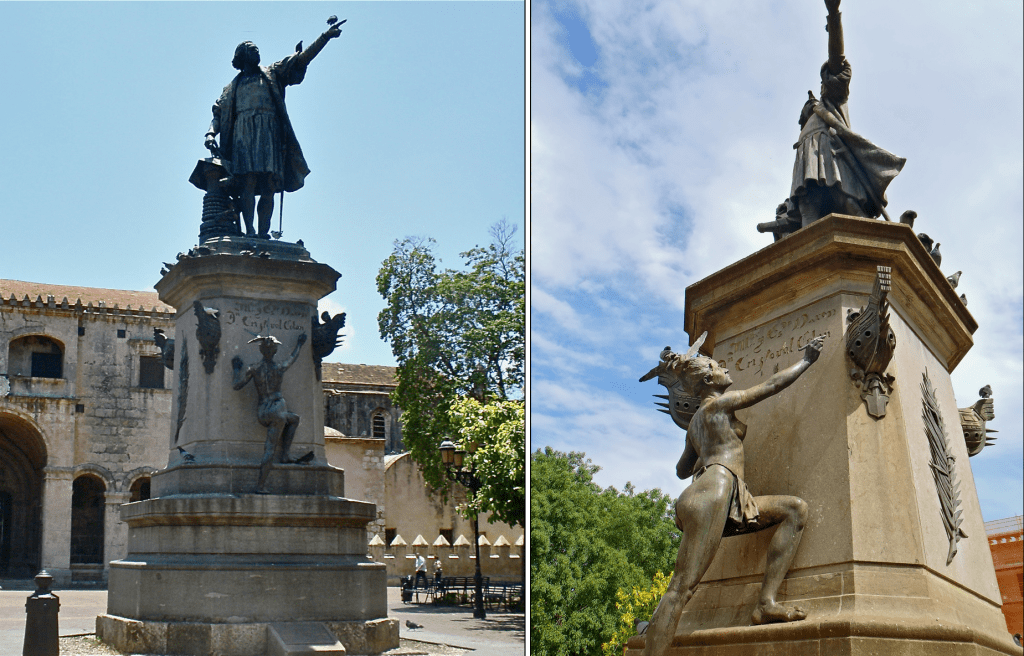
Two views of a (now controversial) statue of Christopher Columbus and the Taíno leader Anacaona in the central plaza of Santo Domingo, Dominican Republic.

The history of Taíno resistance is not lost 

The story of one woman, Anacaona, stands out. My friend Félix Posada of the Latin American Centre for Popular Communication (CEPALC) in Colombia wrote about her in the January-March 2010 issue of CEPALC’s magazine, Encuentro. (Wikipedia has some accessible articles too, but the best source is the work of Bartolomé de Las Casas, the priest who wrote everything that he saw and heard over the first 50 years of the 16th century.) 

When Columbus showed up in 1492, there were five Taíno chiefdoms (cacicazgos) and territories on the island, each led by a principal cacique (chieftain). 

Anacaona, born in 1464, was chief of Jaragua, the territory on the southwest part of island. Her husband Canoabo was chief of neighbouring Maguana. They had a daughter, Higuerota. 

From the time Anacaona was small, she distinguished herself by her intelligence and talent for composing and memorizing poetry that she recited in festivals, in the areitos (party, song, dance, and rhythm, all at the same time). 

The cazicazgos of Ayiti/Quisqueya.

When the Spanish arrived, they were received with a certain sympathy. But disillusion came quickly. Columbus left a group of men in what was called “Fort Navidad” (located between the mouth of the Guarico River and Picolet Point on the northwest coast of what is now Haiti) while he returned to Spain to report on his discovery. 

The 39 men left behind stole from the Indigenous communities, mistreated and raped the people, and tried to destroy the local culture. Anacaona convinced Canoabo and other chieftains to attack and destroy the Spanish fortress and the soldiers who lived there. The attack was devastating: the soldiers were killed. Canoabo was eventually captured and shipped to Spain, dying in a shipwreck during the journey. 

Conflict, negotiation and treachery 

Columbus visited Anacaona and her brother Bohechío in Jaragua in late 1496. Columbus successfully negotiated for a tribute of food and cotton for the settlers under his command. Months later, Columbus arrived with a ship to collect part of the tribute. Anacaona and Bohechío sailed briefly aboard the ship in the Gulf of Gonâve, near today’s Port-au-Prince. 

Very quickly, Española became the centre of European colonization in the Americas. Santo Domingo, the city that Columbus founded on the south coast of the island, became home to civil servants, soldiers, missionaries and investors who took the best land, sought to enslave the Indigenous people and imported African slaves. 

As the Spanish presence grew, rumours of rebellion swept the island. Anacaona was a leader of the resistance movement, and her efforts became known to the Spanish governor, Nicolás de Ovando. Ovando sent a message to Anacaona that he would visit her in a spirit of friendship. He arrived at Yaguana with 350 soldiers. Received as a guest with feasts and dances, he ordered his men to burn the community and to make its leader his prisoner. 

Anacaona managed to escape together with her daughter Higuemota, grand-daughter Mencía, and also with the cacique Hatuey.

But Anacaona’s freedom did not last long. She was captured by Ovando and, at age 39, was hanged in 1504. 

The administration of Ovando was a cruel one. When the Spanish arrived in 1492, the Indigenous population was estimated at 500,000. According to a census taken in 1507, the Indigenous population had been reduced to 60,000. 
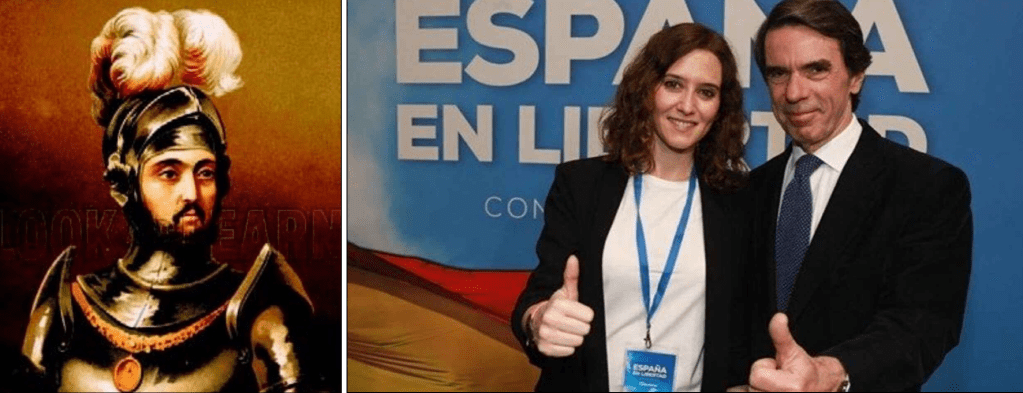
Pope Francis apologized to the people of Mexico, and conservatives in Spain are furious

While Indigenous people in the northern part of this continent await an apology from Pope Francis for abuse suffered in church-run residential schools (next steps to come after a series of conversations in Rome in December), the Pope apologized to the people of Mexico for the violence committed by Spanish conquerors during the colonization and evangelization of the Americas.

In March 2019, Mexican President Andrés Manuel López Obrador had written to King Felipe of Spain and Pope Francis, urging them to apologise for the “abuses” of colonialism and the conquest. (This year, Mexico has been marking the 500th anniversary of the fall of the Mexica capital, Tenochtitlán, to the conquistadores, and the 200th anniversary of Mexico’s independence from Spain.)

The apology by Pope Francis to the people of Mexico came in response to the letter from López Obrador. While it was made public Sept. 27 by the Mexican bishops conference, it was dated Sept. 16 and issued from Basilica of St. John Lateran—the cathedral church of the bishop of Rome.

In 1511, Diego Colón, governor of the Spanish colony of Santo Domingo, was furious when a young priest denounced land-owners and colonial authorities for their treatment of the Taíno Indigenous people. Contemporary Spanish politicians (among them Isabel Díaz Ayuso and José María Aznar) were similarly angered by Pope Francis’s recent apology to the people of Mexico.

The apology, received calmly in Mexico, set off a furor among conservative politicians in Spain. 

José María Aznar, a former president of the Spanish government, made a series of racist jokes about López Obrador during a meeting in Seville of his Partido Popular. Another prominent PP politician, Isabel Díaz Ayuso, head of the Madrid regional government, told a U.S. audience that Spain had brought to Latin America nothing but “freedom, prosperity, peace, understanding.” Spain’s socialist government had earlier dismissed the call for an apology, saying “the arrival of the Spanish on Mexican soil 500 years ago cannot be judged in the light of contemporary considerations.”

The Spanish reactions brought to mind the fury of Diego Colon, son of Christopher Columbus and governor of the Spanish colony of Santo Domingo when, in December 1511, a young priest denounced the crimes of the land-owners and colonial authorities against the Taíno Indigenous nation.

A large statue of Antonio de Montesinos delivering his sermon faces the Caribbean Sea in Santo Domingo, Dominican Republic. The stone and bronze statue is 15 metres tall and was designed by Mexican sculptor Antonio Castellanos. It was donated to the Dominican people by the Mexican government and inaugurated in 1982 by the presidents of Mexico and the Dominican Republic. Photo: Jim Hodgson
A Robert Lentz icon of Bartolomé de Las Casas adorns the cover of Gustavo Gutiérrez’s biography.

Leaders of the Dominican religious order in Santo Domingo had chosen Antón Montesino (more commonly referred to now as Antonio de Montesinos), to deliver a message to land-owners and the colonial authorities. By then, the leaders of the Taíno people had already been killed. Tens of thousands more died from famine and disease. 

Drawing from gospel descriptions of St. John the Baptist (John 1:19b-28), Montesino spoke: 

“I am the voice of one crying in the wilderness. In order to make your sins known to you I have mounted this pulpit, I who am the voice of Christ crying in the desert of this island… Tell me, by what right or justice do you hold these Indians in such cruel and horrible slavery? By what right do you wage such detestable wars on these people who lived mildly and peacefully in their own lands, where you have consumed infinite numbers of them with unheard of murders and desolations? Why do you so greatly oppress and fatigue them, not giving them enough to eat or caring for them when they fall ill from excessive labours, so that they die or rather are slain by you, so that you may extract and acquire gold every day?… Are you not bound to love them as you love yourselves?” 

The young priest’s words sparked immediate anger. In the congregation that day was Diego Colón, the island’s governor and son of Christopher Columbus. Montesino could barely complete the celebration of Mass. Later in the day, Colón led a delegation to a meeting with the Dominican superior, Pedro de Córdoba, who told him the sermon was the responsibility of the entire community. 

A week later, on Dec. 28, Montesino preached again on the same themes. This time, Colón and others sent their protests to King Ferdinand V in Madrid. Over subsequent years, priests were recalled, studies were carried out, promises were made and broken—and the Taíno people continued to die. Worse, the colonial enterprise, based on slavery and ruthless exploitation, expanded throughout the hemisphere. By the time Hernán Cortés headed for Mexico and new genocides in 1519, between 80 and 90 per cent of the Taíno population on Hispaniola had died, and the pattern was being repeated in Cuba and Puerto Rico. 

Also present for Montesino’s homilies was a young priest who was also a land-owner, Bartolomé de Las Casas. As became his practice over the next 55 years, he wrote everything down. 

The Montesino sermon was a turning point for Las Casas. He came to see that Jesus Christ was being crucified again in the slaughter of the Indigenous people. He joined the Dominicans and dedicated his life to challenging the church and the Spanish empire of his day. In 1543, he was named bishop of Chiapas, but only spent about six months there before opposition from colonial land-owners forced him to carry his struggle to defend the Indigenous people to Rome and Madrid. 

Much of what we know about the impact of the colonialism on the original peoples of the Americas in the 16th century is from what he wrote in his History of the Indies, published in 1561. In his long life, he was able to correct errors: among them, failure to denounce slavery, particularly that of Africans. He later advocated that all slavery be abolished.

This year marks the 50th anniversary of the first publication in Spanish of Gustavo Gutiérrez’s A Theology of Liberation, the book that opened the door to subsequent decades of writing theology from the context—the ways people practice their faith in their real lives. 

In Las Casas, Gutiérrez found a model leader and writer who bore faithful witness to the struggles of his time. Gutiérrez wrote a lively biography: Las Casas: In Search of the Poor of Jesus Christ (Orbis, 1993).

No global recovery so long as most countries are excluded from solutions

Back in the mid-1980s, as Dominican farmers and trade unionists were teaching me and the rest of the world about debt conditionality, structural adjustment and the International Monetary Fund, their critics said they merely mimicked the government’s excuses for inept policies. The fact that we’re having the same conversations again almost 40 years later says to me that the farmers and workers were right.

Take a moment to recall what people in many global South countries were enduring in the 1980s. A glut of oil money in U.S. and European banks in the 1970s had led to a loans frenzy: developing countries got cheap credit. But the recession in the 1980s saw interest rates skyrocket. 

Protesters in the Dominican Republic in 1984 took their protests into the street. Many civil society organizations try to carry voices of those locked out of decision-making spaces inside meetings like the UN gathering on debt relief.

The resulting “third-world debt crisis” (as it was called at the time) became a shock-doctrine opportunity to strengthen a harsher form of capitalism, one that came to be called “neo-liberal economic globalization” (or simply neoliberalism or globalization). Dominicans and countless others around the world protested, but by the turn of the millennium, this new world order was firmly entrenched.

A new crisis—the effects of the Covid-19 pandemic—has revealed the old, unhealed fractures as countries struggle to sustain already-weak health systems, provide testing and vaccines, and keep economies at least partly functioning. 

To their credit, the United Nations secretary general, Antonio Guterres, and Prime Ministers Justin Trudeau of Canada and Andrew Holness of Jamaica, convened a conversation March 29 among world leaders and heads of various international financial institutions.

Top row: Prime Minister Andrew Holness, Jamaica; Lidy Nacpil, Asian Peoples’ Movement on Debt and Development; Ngozi Okonjo-Iweala, World Trade Organization. Bottom row: Prime Minister Justin Trudeau, Canada; President Alberto Fernández, Argentina; and President Nicolás Maduro, Venezuela.

Holness and Argentinian President Alberto Fernández called for fundamental reform of “debt architecture” and the need for a “multilateral framework for debt restructuring.” Such steps would break from current practice, which allows wealthier countries (G7, G20) or groups dominated by them (the World Bank and International Monetary Fund), along with private creditors, to make decisions binding on all the other countries. Fernández added that there can’t be a global recovery when there are countries excluded from the solutions.

Venezuela’s president, Nicolás Maduro, said nations should ensure that “measures are not a weapon to control our countries.” He urged “comprehensive restructuring” and an end to use of “unilateral, coercive and criminal” sanctions against his country and others.

The civil society organizations (CSOs) that have laboured for decades to build a system to manage and resolve debt issues said later that the leaders “continue to kick the can down the road” on meaningful reform. The groups welcome measures like the G20 agreement to further delay debt payments by the most impoverished countries (a mechanism called the Debt Service Suspension Initiative, or DSSI) to June 2021, and action to use global reserve funds (“special drawing rights,” or SDRs) to support recovery efforts in developing countries. [On April 1, the IMF approved a third tranche of grants for debt service relief for 28 countries through Oct. 15.]

But more needs to be done, said the CSOs. “Rich countries are continuing to prioritise their own power over global solidarity, leaving many people behind.” Moreover, the measures do not do enough to assist middle-income countries (like Argentina and Jamaica) with their challenges, or address the problem of the private-debt “cartel.”

“Throughout decades of exploitation, rich countries accumulated a social and ecological debt owed to the people in developing countries which is higher than our financial debt. Today these same rich nations fail to deliver the system changing solutions that we need, including immediate debt cancellation by all lenders for all countries in need”.

Lidy Nacpil, Coordinator of the Asian Peoples’ Movement on Debt and Development (APMDD)

“A multilateral framework under the UN is the only way to resolve the crippling debt crises affecting the world’s poorest. This is the only way to ensure debt cancellation in a fair and orderly fashion, where developing countries have a seat at the table. This would ensure a future of responsible lending and borrowing together with regulation based on human rights and gender justice.”

Patricia Miranda, Advocacy Coordinator at the Latin American Network for Economic and Social Justice (Latindadd)
World Social Forum, Porto Alegre, January 2005

One potential forum for further work would be a global conference next year on Financing for Development—”Monterrey+20”—with the issue of global economic architecture firmly on the table.

At the 2002 Monterrey conference, the World Council of Churches was among those who pressed for  

“Pursuit of a permanent solution to the debt problem both for poor countries and middle-income countries starting with an immediate cancellation of the external debt of poor countries and setting up, under UN auspices, an independent and fair debt arbitration mechanism for current and future loans which will promote ethical lending and borrowing policies.”

As Ngozi Okonjo-Iweala, the newly appointed Director-General of the World Trade Organization, stated during the meeting: “lost decades are a policy choice.”

No doubt those Dominican farmers would agree.