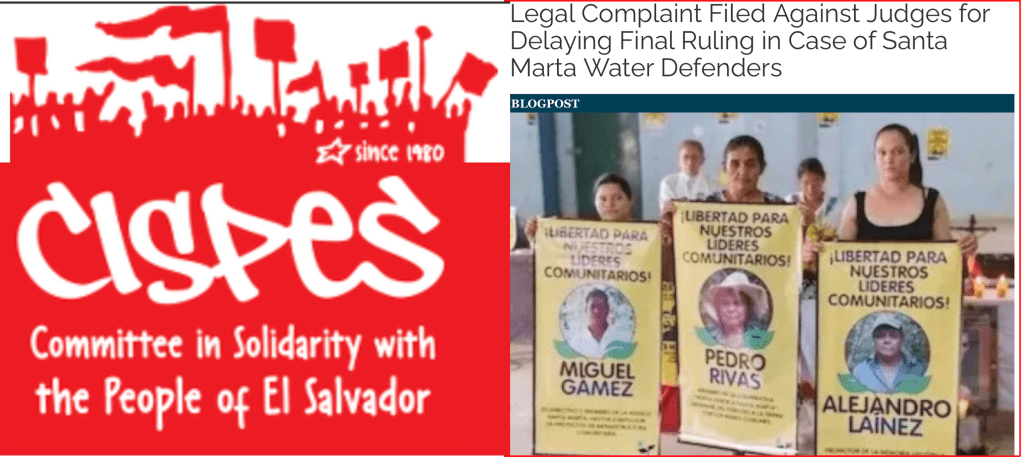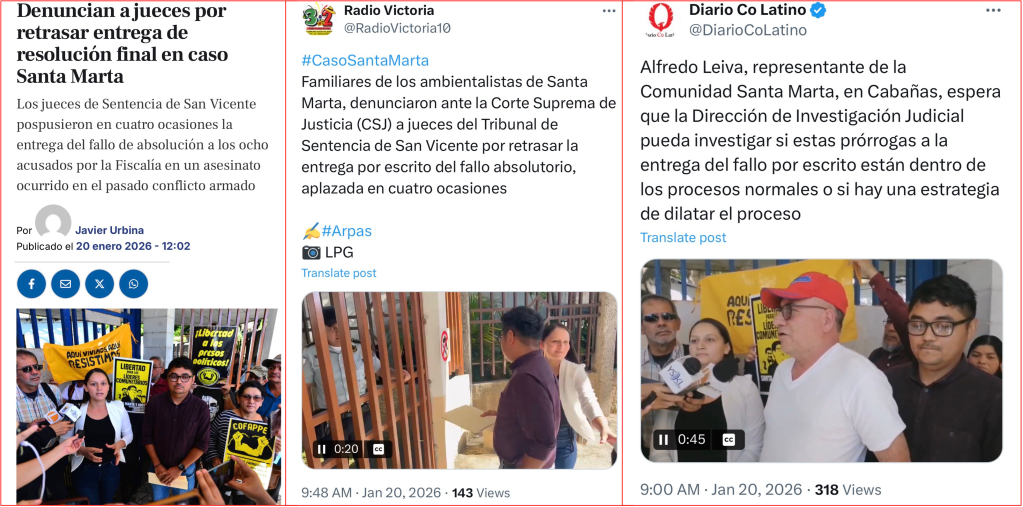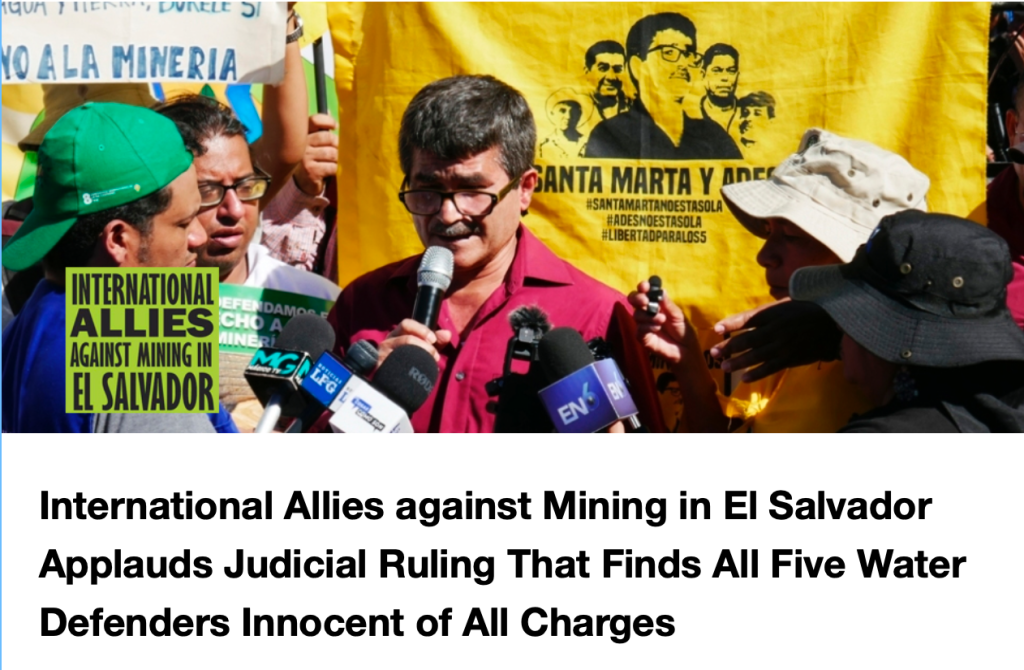
International allies against mining in El Salvador applaud new “not guilty” verdict

by Jim Hodgson

I write to share the statement Wednesday, Sept. 24, celebrating a second not guilty verdict in the political persecution of five environmental protectors in El Salvador. They should never have been arrested. See below for an action request. The statement comes from allies around the world who came together more than 15 years ago to accompany communities in El Salvador in their defence of water resources against a Canadian mining company….

San Salvador – On September 24, the presiding tribunal in San Vicente, El Salvador, found five prominent water defenders from Santa Marta, Miguel Ángel Gámez, Alejandro Laínez García, Pedro Antonio Rivas Laínez, Antonio Pacheco, and Saúl Agustín Rivas Ortega, innocent of charges of murder,  kidnapping, and illicit association. 

Once again, the five prominent Water Defenders who faced politically-motivated charges have been declared innocent — and they should never have been arrested. International Allies against Mining in El Salvador calls upon the Salvadoran Attorney General to abstain from further legal action and demands that all civil liabilities are dropped.

Representatives from the governments of Canada, France, and Germany appeared at the court today to observe the ruling, a reminder that governments and international civil society are watching this case closely.

“We call on the Attorney General’s office to respect the decision of the tribunal, to abstain from appealing this decision and stop wasting government resources to keep up the farce,” stated Alfredo Leiva from the community of Santa Marta, whose leading members were among those on trial. “Rather than insisting on prolonging this process any further, the Attorney General’s office should apologize to the five and to the community, and should dedicate themselves to investigating the real war crimes, starting with the massacres that were committed against Santa Marta and other communities.”

“The five Water Defenders should never have been charged, and the Salvadoran government’s willingness to pursue these accusations despite their clear innocence signals a worrying willingness to persecute the movement that these five water defenders represent. We call on the Salvadoran government to forgo future sham prosecutions and uphold the democratic rule of law in future pursuit of true justice,” said John Cavanagh, Senior Advisor at the Institute for Policy Studies. 

“We celebrate that the Water Defenders have on two occasions now been found innocent of all the charges laid against them. However, we are deeply concerned that the judicial system may continue to be used as a tool to persecute the leaders for their role in protecting the country’s scarce water resources. We ask that the findings of the two courts be respected. We look forward to the day when the Defenders can return to their community and families in full liberty, free from the threat of further persecution,” said Christie Neufeldt, Global Partnerships Coordinator for Latin America, The United Church of Canada.

“Despite the positive results, the international community should be aware that the struggle is far from over. The Attorney General still has the possibility of appealing the case and taking it all the way to the Supreme Court level, and it may take years before the Santa Marta Five are declared fully innocent,” said Pedro Cabezas, coordinator of the Central American Alliance on Mining.

“As was the case in their trial in Sensuntepeque in October 2024, the five water defenders of Santa Marta who were subjected to another trial have today again been found innocent of the charges of murder, kidnapping, and illicit association,” said Prof. Bernie Hammond, an international observer at the trial. “It is to be hoped that the Attorney General will have the good sense to let go of this case against the five. It has become clear to the legal community and to the general public that these charges were politically motivated and are a clear example of “lawfare” in which anti-mining advocacy on the part of the five were criminalized in order to change the 2017 law prohibiting mining in El Salvador.” 

In January 2023, police arrested the five prominent water defenders from the rural community of Santa Marta and the Association for Social and Economic Development of El Salvador (ADES) on charges allegedly dating back to the country’s civil war and held them incommunicado for over eight months and then placed them on house arrest until their trial date. The five had played an instrumental role in the country’s heroic and successful struggle to pass a historic 2017 law prohibiting toxic metals mining in El Salvador,  and were the first ones to denounce President Nayib Bukele’s intentions to  overturn it.

When the five were finally tried in October 2024,  after a long legal defense campaign that denounced a series of irregularities with the proceedings, the tribunal dismissed all charges against them due to lack of evidence, ruled that all five were completely innocent of the two sham charges of murder and illicit association that were laid against them. However, in aruling that has been widely condemned as a travesty of justice, an appeals court annulled the innocent verdict, allowing the Attorney General’s Office to try them again on the same charges.

Beyond the lack of evidence, the Salvadoran Attorney General’s pursuit of this case even after the original determination of innocence in October 2024 has dealt a serious blow to the Salvadoran government’s credibility, belying its claim that it remains a democracy and that it holds no political prisoners. The unceasing and courageous pressure from grassroots organizations in El Salvador – in concert with international solidarity – may have worked in favour of the Water Defenders today, but hundreds of political opponents, labour leaders and human rights defenders remain imprisoned. The community-led movement of water defenders still stands strong in the face of future attempts to undermine land and water protections for communities in El Salvador.

Our organizations support the call by Salvadoran civil society groups that the Salvadoran Attorney General should apologize to the five defendants, whose health has suffered greatly over the past two years that they have stood accused of false charges, and to the Santa Marta community, which suffered from genuine military atrocities during the Salvadoran Civil War in 1980-1992. 

Media contacts:

Action Request:

Can you join us in uplifting the calls of the community that the Attorney General [ @FGR_SV ] respect the tribunal’s ruling? The International Allies Against Mining in El Salvador is calling on our network to:

1) Share the International Allies against Mining in El Salvador’s statement with your networks (here in Spanish). You can also share posts from the Committee in Solidarity with the People of El Salvador on X and on Facebook.

2) Call on the Attorney General not to appeal the ruling and, in the words of the Santa Marta community, “end this judicial farce.”

Sample tweets:

  • I applaud this week’s ruling that found no basis for the charges brought against the #SantaMarta5 water defenders of El Salvador & call on the @FGR_SV to cease their unjust persecution. #NoALaMineria #EyesOnSantaMarta http://bit.ly/46Udt53
  • Aplaudo la decisión del tribunal que dejo absueltos de todas las acusaciones en contra de los defensores de agua de #SantaMarta y hago un llamado a la @FGR_SV que deje su persecución injusta en contra de ellos. #NoALaMineria #SantaMartaNoEstaSola http://bit.ly/4nlIZyD

El Salvador’s Bukele arrests rights defender Ruth López

El Salvador’s government has arrested Ruth Eleonora López, a prominent human rights lawyer, as it steps up attacks on rights defenders, environmentalists and journalists.


López leads anti-corruption work at Cristosal, one of the country’s leading human rights groups. It was created in 2000 with backing from the global Anglican communion in 2000. “To this day, our work is inspired by the Anglican communion’s commitment to justice and the dignity of every human being and demonstrated through the role of the church during El Salvador’s civil war,” its website states.

Cristosal helps document evidence of state crimes under El Salvador’s ongoing three-year state of emergency.The measure is used to arrest people believed to be associated with gang violence, but other people have been swept up as well. It restricts the right to gather, to be informed of rights and to have access to a lawyer. It extends to 15 days the time that someone can be held without charges. Associated Press says that some 85,000 people have been arrested under the state of emergency.

Al Jazeera reported that Cristosal has also tried to assist more than 250 Venezuelans who were sent by the United States to a jail in El Salvador.

On Sunday night (May 18), two weeks before Nayib Bukele reaches his sixth anniversary in power in El Salvador, the Attorney General’s Office announced the arrest of López via X (formerly Twitter). As of late afternoon Monday, her whereabouts were still unknown and her family joined Cristosal in demanding the government provide more information.

The English-language service of El Faro newspaper—itself under attack by the Bukele regime— said the arrest derives from accusations of embezzlement, but the case file is declared secret. Prosecutors claimed to have gathered information during raids carried out against Eugenio Chicas, a former president of the Supreme Electoral Tribunal arrested in February, and who remains in custody.

“The only reason for this detention is that I am a human rights defender and work for an NGO uncomfortable for the government,” López said upon her arrest. She told the officers: “Have some decency; one day this will all end. You must not play into this.”

El Faro said May 5 that a reliable source had told its reporters that the Bukele-controlled Attorney General’s Office is preparing at least seven arrest warrants for members of El Faro. The source reached out following the publication of interviews with former leaders of the Revolucionario faction of the 18th Street Gang (Barrio 18) about Bukele’s years-long relationship to gangs. 

If carried out, such arrests would be the first time in decades that prosecutors seek to press charges against individual journalists for their journalistic efforts.

One of the gang leaders said that he had been secretly released from custody at the height of the country’s ongoing state of exception as part of his gang’s continued negotiations with Bukele’s government. The interview focus attention on the extent to which Bukele’s rise to power was tied to secret negotiations with the country’s gangs.

The NACLA Update summarizes the interviews this way: 

El Faro’s reporting shows that the links between the Barrio 18 gang and Bukele began all the way back in 2014, when Bukele was a council member of small-town Nuevo Cuscatlán looking to run for mayor of San Salvador. During his campaign for mayor, a close Bukele ally warned gang members of impending police raids and delivered community development projects to the gang’s turf; in exchange, gang leaders cracked down on opposition activists and forced community members to vote for Bukele.

Ties between Bukele and the country’s gangs, including MS-13, have long been documented by El Faro and other outlets and have caused tensions with the United States. Nevertheless, news that a gang leader convicted of murder was released at the height of the crackdown brings unwanted scrutiny on the Salvadoran government at a time when Bukele has enthusiastically sought favor with the Trump administration.   

Justice denied: U.S. sends Venezuelan asylum-seekers to Salvadoran prison

Even in the face of the Trump regime’s horrific arrests, extraordinary renditions, and forced disappearances of immigrants and asylum-seekers, there are shreds of hope.

Activists and journalists are gradually identifying and sharing the stories of victims, including the 238 Venezuelans and 23 Salvadorans shipped to a prison in El Salvador on March 15. And judges and some politicians are more vocal in support of “due process”—the U.S. constitutional guarantee of at least being heard before being deprived of liberty—for all migrants.

One group has built a website: thedisappeared.org. They make prominent use of the blue triangle, the symbol used by Nazis in their concentration camps to designate migrants. About the 238 Venezuelans, they say: “There is no evidence to support the allegations that they are hardened criminals.” The group also posts on Facebook.

Above on the left is Andry Hernández Romero, age 31. I learned of his case the way many others did. A photojournalist, Philip Holsinger, met the airplanes that brought the Venezuelans to El Salvador and then accompanied them to the prison. A man who caught Holsinger’s attention shouted “I’m innocent” and “I’m gay,” and was crying as his head was shaved. From Holsinger’s photo, friends and family members identified him as Andry. Details of his situation were covered first in LGBTQIA+ media (The Advocate and the Washington Blade) and later by NBCCBS and elsewhere. His lawyer has mobilized political support in California, including that of Gov. Gavin Newsom and U.S. Rep. Robert Garcia.

The disappeared.org site draws attention to many other cases, including that of two-year-old Maikelys Antonella Espinoza Bernal (below) whose father, Maiker Espinoza Escalona, was sent to the prison in El Salvador. She and her mother Yorely Bernal Inciarte, were supposed to be sent together on a deportation flight back to Venezuela—part of her homeland’s “Vuelta a la Patria” program for citizens willing to go home. But the United States refused to return the child to her mother before she left.

When Yorely arrived back home alone, Venezuelan media and the government took up the family’s cause (image on the left, above). So too did CodePink (right), a women’s peace network in the United States with which I have collaborated to draw attention to the negative impact on Venezuelans of U.S. economic sanctions

The Disappeared shared a piece from a group called United Strength for Action about the U.S. role in creating the disaster that Venezuelans face. I can’t concur with all the group said–many people in the United States just can’t see the historical context of U.S. imperialism–but I am relieved that they at least acknowledged the role of U.S. sanctions in creating a humanitarian crisis that drives the exodus of refugees. “This wasn’t foreign policy; it was collective punishment that pushed millions of Venezuelans past their breaking point.”

Since 1998, successive U.S. administrations have done all they could to be rid of Nicolás Maduro and his predecessor, Hugo Chávez: a coup attempt in 2002, a “revocatory” referendum in 2004, the effort to impose a “president” (Juan Guaidó) whom nobody had voted for, and through waves of sanctions. Given the failure of those efforts to induce regime change and seeing the flow of migrants out of Venezuela, President Joe Biden for a time tried a different approach, one of dialogue and engagement. The early weeks of Trump’s administration gave some hope this could continue, but the hard-liners seem to hold sway once again.

At a May Day march, President Maduro vowed to “rescue” Maikelys along with the Venezuelans now held by El Salvador. He also spoke directly to the hundreds of thousands of Venezuelans who have tried to reach the United States in recent years: 

“Stop going there. The true dream is that of our land to build with our hands. Stop being victims of xenophobia, of abuse… The only land that will welcome you and serve you like the prodigal son is called the Bolivarian Republic of Venezuela. We must take care of it, fertilize it, and build it. This homeland belongs to all!”

Maduro emphasized Venezuela’s right to build its own social model. “We have the right to true democracy, to our cultural identity. We are not gringos. We are proudly Bolivarian, Latin American, Caribbean. We are Venezuelans!”

Venezuela says it is willing to receive people deported from other countries. Between February and April 25 this year, 3,241 Venezuelans had returned on 16 government-funded flights. Yorely (the mother of Maikelys) came home on just such a flight.

Two more issues. Trump officials say that the people sent to jail in El Salvador were linked to the Tren de Aragua criminal gang, and that they used tattoos to identify the gang members.

It’s good to see “mainstream” media like The New York Times (left) and Wall Street Journal (right) join the rest of us rabble-rousers in calling attention to the Trump regime’s actions.

Trump’s executive order decreeing the deportations said the gang is “conducting irregular warfare and undertaking hostile actions against the United States.”

But that is not true. In an article for The New York Times, a team of experts on violence in Venezuela said Tren de Aragua is not invading the United States. Nor is it a “terrorist organization,” and to call such “criminal groups terrorist is always a stretch since they usually do not aim at changing government policy.” The article goes on to show that Tren de Aragua is not centrally organized, though members were involved in migrant smuggling and the sexual exploitation of Venezuelan migrants in Colombia, Chile and Peru. 

The NYT piece adds that even U.S. intelligence officials do not believe the Maduro government is colluding with the gang, the key assertion in Trump’s justification for invoking the 1798 Alien Enemies Act to render Venezuelan migrants to El Salvador.

Immigration officials used tattoos to “determine” if someone was linked to Tren de Aragua, but the authors of the NYT piece say Venezuelan gangs (unlike Salvador groups like the MS-13) do not use tattoos that way. “Many young Venezuelans, like young people everywhere, borrow from the global culture of iconic symbols and get tattoos. That doesn’t mean they’re in a gang,” they wrote.

Moreover, the Tren de Aragua gang network in Venezuela is largely dismantled.

“The Tren de Aragua is cosmic dust in Venezuela; it no longer exists, we defeated it,” President Maduro said March 19. He was quoted by the English-language Orinoco Tribune in a longer article about the gang’s history in Venezuela.

Interior Minister Diosdado Cabello questioned whether all deportees were Tren de Aragua members, and demanded the US extradite captured suspects. “The US is acting in a confusing manner. They promised to send us Tren de Aragua members, but they have not. Someone there is lying.”

* Update, May 14 * Two-year-old Maikelys has been re-united with her mother in Venezuela. Her father remains in the Trump-Bukele prison in El Salvador. See the statement from CodePink.