Haiti will get support for its police. What it needs is a new government.

by Jim Hodgson

Now that the United Nations Security Council (UNSC) has approved deployment of a multinational force to Haiti, Haitian politicians and civil society organisations (CSOs) and their allies abroad respond with an array of positions.

UN Security Council (Alterpresse)

A new transitional government is urgently needed, says Pierre Espérance of Haiti’s National Human Rights Defense Network (RNDDH). Writing in the New York Times, Espérance called for renewed negotiations among CSOs and politicians (none of whom are elected) towards change.

“The talks should specify what qualifications are required for an individual to join the transitional government — and, critically, what would be disqualifying, to avert yet another criminal takeover.

“It wouldn’t be an easy task. But a new government formed along these lines would begin to bring long-awaited accountability to the police, as well as branches of government like the judiciary. Gangs would not disappear, but they would eventually exert less power and lose some of the vast territory they now control.”

Haiti has a “transition council” named by the interim government of the unelected prime minister, Ariel Henry. Head of the council is Mirlande Hyppolite Manigat, a constitutional law professor, presidential candidate in 2010, and widow of a man who was one of the 1988 coup-era presidents. 

At a news conference held in the presence of Henry and government ministers, Manigat expressed concern over Haiti’s “accelerated tumble” and said she saw the UNSC’s decision as an “expression of will to take charge of the deplorable situation” in which the country lives. 

“The country is going badly,” Manigat said. “It’s our fault that the UNSC has adopted this resolution.” “Velvet glove, iron hand,” responded Gotson Pierre, founding editor of Alterpresse, of Manigat’s comments. “Ariel Henry, serait-il sous pression?” [Is Henry under pressure?]

James Beltis, a member of the Montana Accord, the group made up of CSOs and opposition politicians that has its own transition proposal, called authorization of the mission a “setback.”

“We seem to be stuck with the same solution we’ve been using for the past 30 years” (referring to military interventions in 1994 and 2004), he told the Washington Post. “From a political perspective, this appears to be support for the current government.”

Beltis was also cited by the Haitian Times: “There is no possibility for Montana [political parties] to cohabit with Ariel Henry while he remains as prime minister.”

Past foreign interventions in Haiti and especially the one that followed the removal in February 2004 of President Jean-Bertrand Aristide are remembered for sexual abuse by UN soldiers and the introduction of a cholera epidemic that infected 800,000 people and took almost 10,000 lives.

This time, emphasis is placed on support to the Haitian National Police (PNH). The force will be led by Kenya (which has its own policing issues), with support from Bahamas, Jamaica and Antigua and Barbuda. The mission would be reviewed after nine months and be funded by voluntary contributions, with the United States promising up to $200 million.

Global Affairs Canada (GAC) said this country is likely to deploy RCMP officers to Haiti to act as trainers in the multinational intervention, promising an added emphasis on preventing sexual violence. 

The RCMP will be “focused on technical training,” GAC’s Lisa Vandehei told the Senate Foreign Affairs Committee Oct. 5. She said they would probably train agents of the PNH in “very specialized” technical areas using a model where each trained agent would continue to teach other Haitian peers. Vandehei leads an inter-departmental task group on Haiti.

From Jan. 1 through Aug. 15 this year, at least 2,439 people had been killed and a further 902 injured. In addition, 951 people were  kidnapped. Meanwhile, ever-larger numbers of Haitians are choosing to leave any way they can. (UN’s Office of the High Commissioner for Human Rights) Headlines and photos about recent attacks from Alterpresse.

Will it work?

Kenyan police “don’t know the turf, don’t speak the language,” said Amy Wilentz, author of The Rainy Season: Haiti Since Duvalier and a professor at the University of California, Irvine. She told CBS News the mission was “unlikely to be a success.”

“First, it’s too small,” Wilentz said of the projected 10,000-person deployment. “There are an estimated 20,000 active gang members in Port-au-Prince, and they are heavily armed. So in combat, the Kenyans will be outmanned and perhaps outgunned.”

Other critics are even more severe. “It is not ‘solidarity’ with the people of Haiti to respond to the unconstitutional request formulated by a dictatorial government, put in place and maintained by the same ‘international community’ that now redoubles its support contrary to the legitimate demands of a huge range of Haitian social, political and humanitarian organisations,” says a new statement by Latin American CSOs in 17 countries, among them Jubileo Sur/Américas.

“We reject the new invasion of Haiti!” “For a Haiti that is dignified, sovereign and free of all occupation.” (Partial text of poster announcing the new Latin American civil society declaration.)

“It is to once again disregard the sovereignty and self-determination of the Haitian people with their demands and proposals to resolve this crisis generated by the same long-standing foreign intervention.

“It is not ‘support’, to continue to ignore the people of Haiti, ignoring their denunciations that link Ariel Henry, the current de facto government and its ‘international protectors’, led by the US, with the proliferation of the armed gangs that these same actors now intend to control through this new invasion.”

In comments made after the UNSC vote, several members of the council, including China and Brazil, reiterated the necessity of a strong Haitian government. 

“This force is being considered as just one instrument to help stabilize the security situation in the country,” said Brazil’s UN ambassador, Sérgio França Danese. “This is just a first step in what we hope will be the direction in terms of assuring those security considerations that will allow the political process to go forward.”

“It is a condition that is necessary but, of course, not enough.”

China’s U.N. ambassador Zhang Jun said that while Beijing “appreciates Kenya’s willingness” to lead the mission, “without a legitimate, effective, and responsible government in place, any external support can hardly have any lasting effects.”

The UNSC expanded a UN arms embargo to include all gangs, a measure China wanted. Haitian officials have said guns used by gangs are believed to be mostly imported from the United States. The embargo previously only applied to specific individuals.

Haiti and Dominican Republic: renewed border conflict has deep historical roots

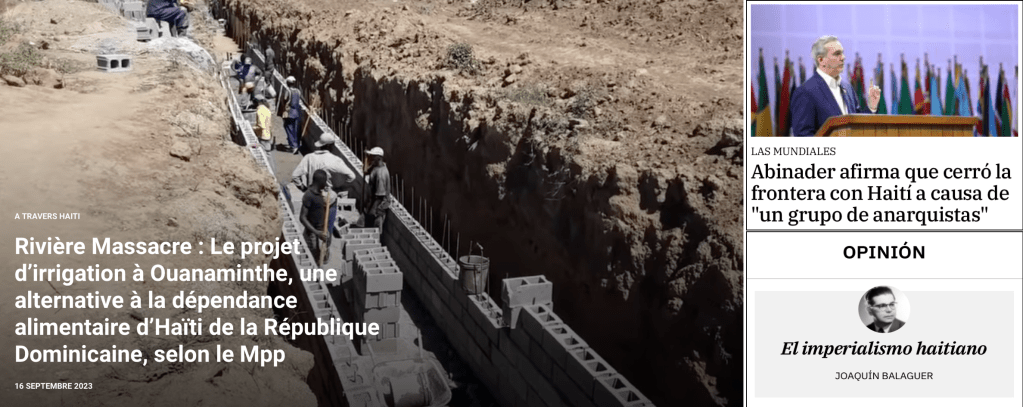
Some Haitians see the effort to construct an irrigation canal in north-east Haiti as an effort to reduce food dependence on the Dominican Republic (left, from the Alterpresse news site); the Dominican president sees the farmers’ action as that of a “group of anarchists” (top right); the conservative Dominican daily Listin Diario recycles a decades-old piece by former president Joaquín Balaguer on “Haitian imperialism” (lower right).

by Jim Hodgson

Over these past 40 years, I have understood that one of the hardest things for me to do is to talk about Haiti and the Dominican Republic in the same breath. Differences between these Caribbean neighbours are profound. I love them both and have developed strong friendships in both places. The relationship between the two countries is often made worse, both by xenophobic and racist politicians in the Dominican Republic, and the refusal of the international community and Haitian elites to allow an effective state to function in Haiti.

Dominican President Luis Abinader has now staked his re-election campaign on a quarrel with Haiti’s weak interim government over community efforts to build an irrigation canal from a river near the northern end of the two countries’ shared border.

Rio Dajabón (or Rivière Massacre in French) is only 55 km long. Its source is in the Central Cordillera of the Dominican Republic, but it has tributaries from the Haitian side as well. A series of treaties achieved between the two countries in the 1920s and 1930s are supposed to govern how waters are shared and disputes resolved, but the process is not being respected now.

When I first started visiting both countries back in the 1980s, most Haitians in the Dominican Republic were sugar cane-cutters brought over by a contract that saw the Dominican State Sugar Council (CEA) pay the Haitian dictator Jean-Claude Duvalier $2 million each year for the cane-cutters’ labour. This was, rightly, denounced as slavery. With the fall of Duvalier in 1986 and then the decline of the cane sugar industry (brought on by the United States’ preference for high-fructose corn syrup (HFCS) produced from corn in its own factories), the practice ended. But Haitians still needed work, and Dominican industries (agriculture, construction and tourism) still need cheap labour. 

In fits and starts, successive Dominican governments have tried to force Haitians from the country, often with cruel, arbitrary measures. This past week, many Haitians rushed to get home before Abinader closed the border on Sept. 15. 

“It’s really a very drastic measure that doesn’t make sense economically for either the Dominican Republic or Haiti,” Diego Da Rin of the International Crisis Group told Associated Press. “This will clearly have very bad consequences economically in the Dominican Republic, and it will very likely worsen the humanitarian situation mostly in the areas close to the border.”

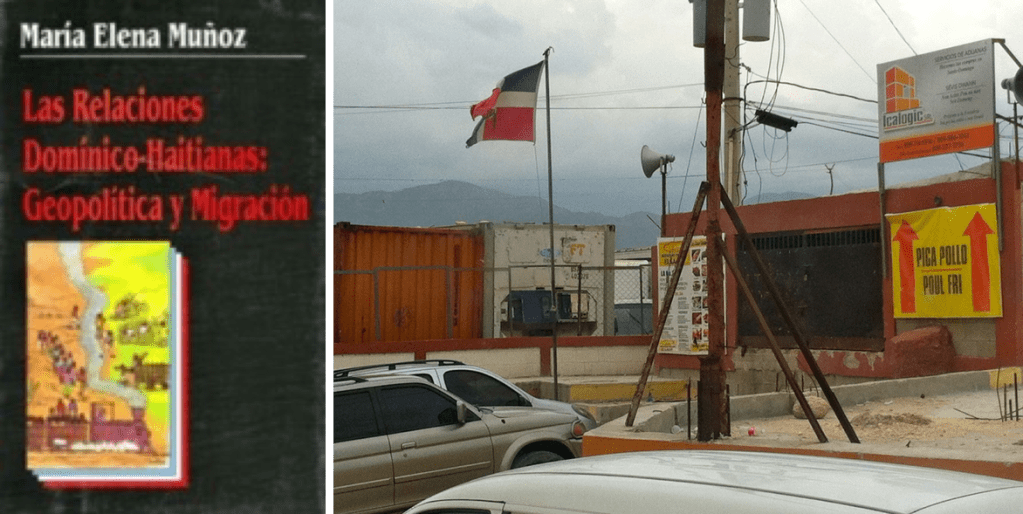
Historian María Elena Muñoz on Haitian-Dominican relations; the border at Jimaní-Malpasse in 2014.

Anti-Haitian campaigns in the Dominican Republic meet with some success because they echo traditional themes in Dominican history and culture. The problems which exist between the Haitian and Dominican peoples have roots in the colonial period. The colonial powers, Spain and France, divided the island between them in the 1697 Treaty of Ryswick which was signed to resolve a European conflict. 

A century later, a revolution by slaves in the French colony resulted in independence for Haiti in 1804. France fought a series of wars between 1795 and 1815 to recover what it had lost, and occasionally used the Spanish colony as a base for attacks on Haiti. 

During the same period, Haiti invaded the Spanish colony several times. Some Dominican historians (including Joaquín Balaguer, a former president) say Haiti’s leaders in this period and later were imperialists who tried to win control of the entire island. Some more progressive Dominicans counter this position with the argument that invasions of the eastern part of the island were designed to prevent its use as a French base for attacks on Haiti. 

Others say that Haiti’s new leaders proclaimed solidarity with their brothers and sisters who were still slaves in the Spanish colony. The invasions that took place between 1801 and 1856 came about because of a sense of solidarity based on shared class interests. 

It is the 1822 intervention that has had lasting consequences. Haiti seized the Spanish colony, and freed the slaves. It launched a land reform program, redistributing lands held by the rich and by the church. Dominican historian María Elena Muñoz argued in a 1995 book that the people did not feel themselves to be Spanish and preferred to benefit from what the Haitians had accomplished in their revolution. 

The occupation lasted until 1844, when the Dominican Republic won its independence in a rebellion against Haiti. While the rebellion’s leaders, particularly Juan Pablo Duarte, made clear that their movement was not aimed against Haitians because of their race or culture, his liberal views did not prevail in the new republic. Duarte was soon forced into exile, and the new Dominican leaders were more conservative and more fearful: they spent much of the next three or four decades trying to get their new country placed under a protectorate of some or other major power (especially Spain and France) for fear that the Haitians would come back.

It is in this period that anti-Haitian prejudice was born and talk of the “Haitian threat” began, because the interests of the elite classes were affected. But anti-Haitian prejudice based on the class interests of the wealthy could not catch on among the poorer classes, so it was disguised as racial prejudice. This had the effect that the elites wanted—division—and the anti-colonialist struggle was impeded.

The emergence of the Dominican state, brought about by the commercial class and perpetuated by other wealthy sectors, did much to damage the sense of identity which existed between oppressed people in the old Spanish colony and Haiti, a sense of identity which had been forged by the shared condition of slavery and the common enemy, European imperialism. Events of the past century—particularly the dictatorships of Rafael Trujillo (1930-61) and the Duvalier père et fils (1957-84)—have served to further isolate the two republics from one another, effectively creating two nations of people with differing views about each other and their places in the world. 


You can look at that history and find triumph: the liberation of the slaves in 1804 and 1822, and the acts of solidarity and compassion that occurred after the January 2010 earthquake when the first assistance that arrived in Haiti was brought by Dominicans. But you also find tragedy, notably the 1937 massacre of at least 18,000 Haitians ordered by Trujillo.

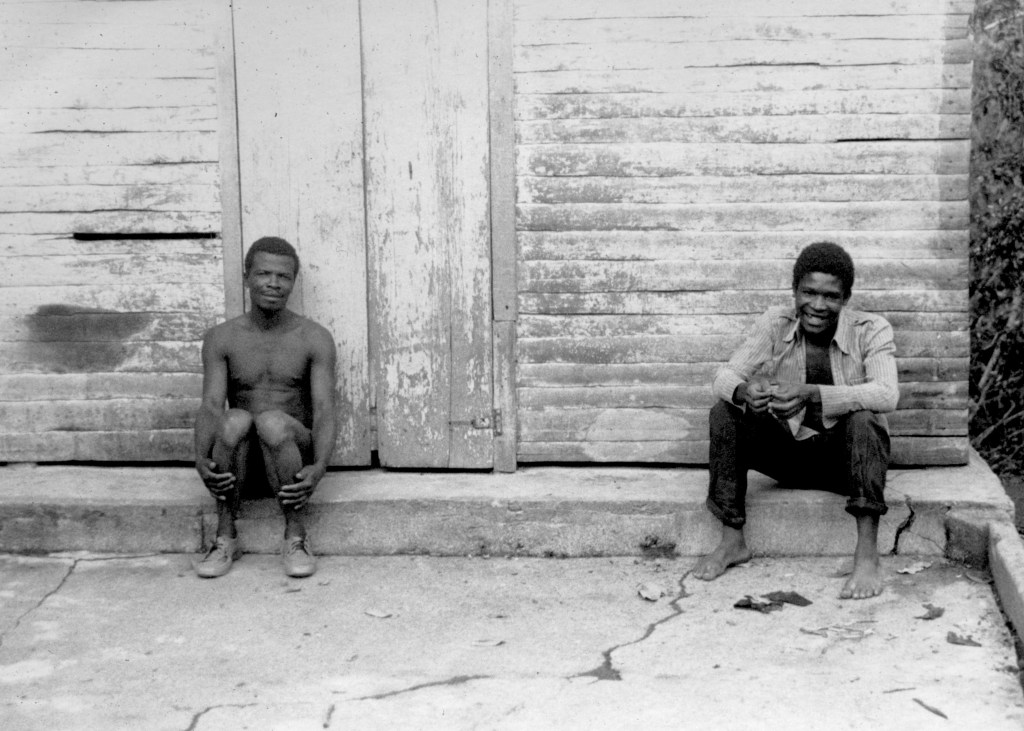
Haitian farm-workers that I met in 1987 in the mountains above San Cristóbal, Dominican Republic.

Cops, robbers and intervention talk in Haiti

by Jim Hodgson

A few nights ago, I watched the British actress Joanna Lumley in conversation with a group of homeless 14- and 15-year-old boys in Port-au-Prince. This was a scene in her 2019 documentary, “Hidden Caribbean,” about her travels in Cuba and Haiti.

I found myself thinking about similar conversations that I have had with teens in Mexico, Haiti, El Salvador and elsewhere: What about the gangs?

“They defend us,” said the teenage son of a woman I knew in La Estación, a neighbourhood where the train station used to be and near where I lived in Cuernavaca, Mexico, in the late ’90s. 

Global Initiative Against Transnational Organized Crime report, Gangs of Haiti. And headlines about gang violence from Alterpresse, an excellent alternative media site in Port-au-Prince. 

I’m not an expert on the sociology of gangs, but it seems to me that for unschooled, unemployed adolescent youth, they might provide a sense of team and friendship that in other places would be provided through schools, organized sports and other activities. And no doubt, there are people who manipulate younger people into activities to “defend” their barrio, and those then become fronts for extortion, drug-trafficking and kidnapping. (You can read more about the sociology of gangs of Haiti here and here.)

Criminal gangs are blamed for extreme levels of violence in and around Port-au-Prince, the Haitian capital. Their actions become justification for calls from the United Nations, Human Rights Watch and others for an international intervention – this time with police forces.

A “robust use of force” by a multinational police deployment is required to restore order in Haiti and to disarm the gangs, UN secretary general Antonio Guterres said in a report to the Security Council Aug. 15. Such a force may be led by Kenya, and also involve police forces from several Caribbean nations.

“The longer that we wait and don’t have this response, we’re going to see more Haitians being killed, raped and kidnapped, and more people suffering without enough to eat,” said Ida Sawyer of Human Rights Watch a few days earlier.

Headlines and photos from Mexico’s La Jornada daily newspaper: “Gangs control 80% of Port-au-Prince;” “200,000 displaced.”

By all accounts, the situation in Port-au-Prince is dire. On Aug. 17, Haitian aid groups backed by the International Rescue Committee (IRC) said they were temporarily shutting down operations, including some mobile health clinics, in the face of violence. Over the previous weekend, according to the UN, nearly 5,000 people fled their homes from areas around Carrefour Feuilles, Port-au-Prince. They are added to about 200,000 people displaced from their homes so far this year.

And more than 350 people are said to have been killed in lynchings by vigilantes since April.

You might think it’s progress that international actors are talking about police interventions rather than full-out military interventions after those have already failed in Haiti more than once. But decades of financial support and training of Haitian police (much of both coming from Canadafailed to overcome corruption and incompetence. 

Much of this could have been avoided. Three years ago, a viable set of proposals emerged from a coalition of civil society groups – the Montana Accord, named for the hotel where their accord was signed. They offered a “passarelle” or series of steps for an interim government as a way to move to new elections. If the imperial powers – Canada, the US and France – had backed those proposals instead of Ariel Henry (the unelected “prime minister”) things might be different today. 

Beyond the external powers, part of the problem is that the six richest families in Haiti don’t give a damn about the people or the violence, and prefer the current mess to a stronger and more effective state. 

Recent headlines about the crisis in Haiti; a statement by the United National Antiwar Coalition (UNAC) condemning calls for armed intervention.

For now, the civil society groups continue to insist that theirs is the best way forward. There are various tables of negotiations to try to find a way forward. Some involve members of the Montana group and the acting prime minister. 

I think too that, for the sake of peace, the gang leaders, who perceive themselves as defenders of their communities, may need to be reckoned with as political actors, not mere criminals. In July, Tom Hagan, a U.S. Catholic priest, said he had worked out an agreement with four gang leaders in the Cité Soleil neighbourhood. They committed themselves “before God” to “work to put an end to the violence and to bring peace to all peoples.” In the past, bishops have enabled similar agreements in El Salvador and in Guerrero state, Mexico.

I made my first visit to Haiti in 1984, when the dictator Jean-Claude Duvalier was still in power, and I’ve been back countless times since then. High points for me were in August 1987, when a massive popular movement seemed capable of wresting power from the military, and in December 1990 with the election of Jean-Bertrand Aristide as president. What gives me hope is still the capacity of Haitian popular movements – workers, farmers, women, students – to organise and re-organise themselves for change, small and large.

What’s going on now in Haiti is a tragic mess that could have been prevented with some courage and imagination from the international community. In the first year or so after the 2010 earthquake, it seemed to me that the UN, foreign and Haitian NGOs, and the government of René Préval were working together toward a Haitian state that would be strong enough to deliver health, education, transportation, security, even land reform and other public services. But that was not the outcome sought by the United States and Haitian elites.