In Colombia, those who believe in peace with justice rejoice

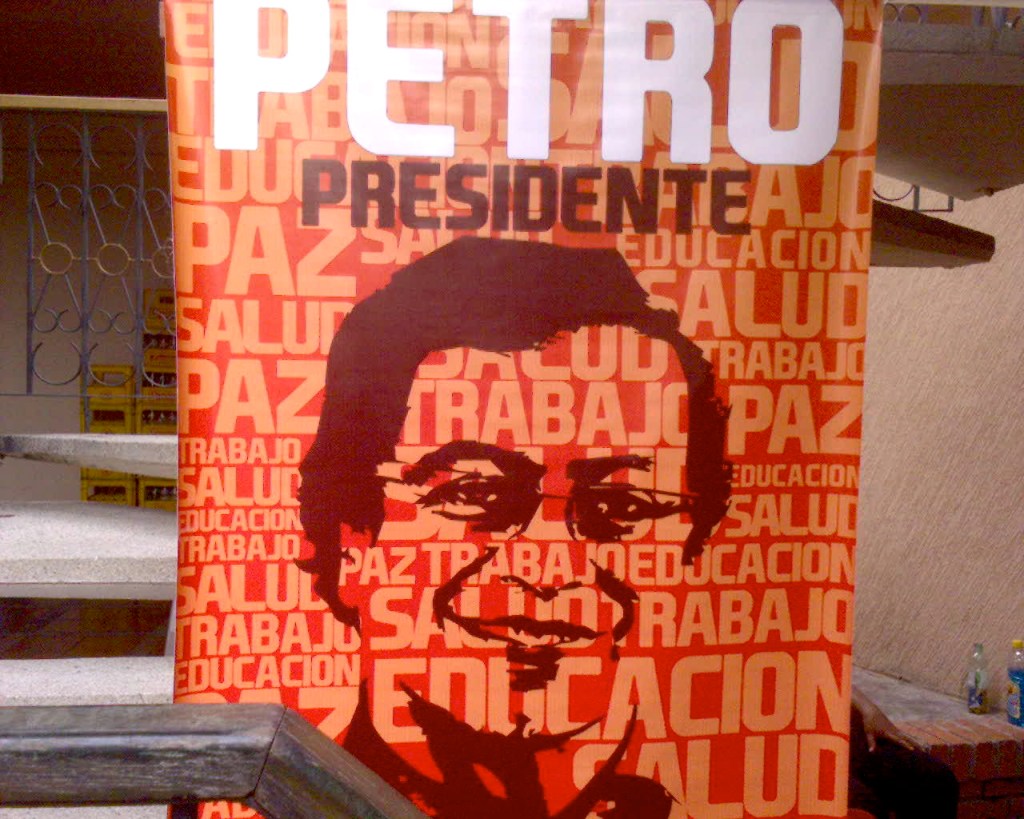
A Gustavo Petro campaign poster from 2010.

On a winter evening about 20 years ago – I am sorry that I cannot be more precise – Bill Fairbairn and I met in Toronto with a Colombian congressman and one of his aides. Bill worked for the Inter-Church Committee on Human Rights in Latin America (ICCHRLA), and I served on its board. And I can’t remember if this meeting was before or after mid-2001 when the work of ICCHRLA was folded (partially) into KAIROS. We were in what I think we used to call the Blue Room of Deer Park United Church in Toronto where the offices of ICCHRLA and later KAIROS were located.

I do remember the congressman, Gustavo Petro, and his earnest search for international allies in the struggle to end Colombia’s civil war and to obtain a measure of social justice to the oppressed majority.

Two decades later, Petro is weeks away from being sworn in as Colombia’s first president from a party of the left. His victory results from the mobilization of young and new voters from parts of Colombia that are always ignored, especially the Caribbean and Pacific coasts. 

Celebrating victory (left); voters from the margins propelled Petro to power.

A large measure of credit goes to his running mate, the environmental activist and lawyer Francia Márquez, 40. She will become the country’s first Afro-Colombian to hold executive office. This election was the first time voter turnout topped 60 per cent, according to the International Institute for Democracy and Electoral Assistance (IDEA).

I met Petro again in August 2004 in Caracas, Venezuela. We were staying in the same hotel and both of us were observers of a referendum that opponents hoped would remove President Hugo Chávez from power. During Petro’s three campaigns to become president, along with his congressional and senate races, and the 2011 drive that made him mayor of Bogotá, right-wing politicians tagged him as castrochavista (as if that were a bad thing). They decried his youthful involvement in the M-19 guerrillas. They had made peace with the government in 1990. Petro, unlike many former fighters who laid down their weapons, survived the waves of selective assassinations that sought to eliminate them from political life.

Victory this past Sunday by Gustavo Petro, 62, in Colombia’s presidential election offers hope for reviving a peace process stalled these past four years by President Iván Duque, protegé of former president Álvaro Uribe – the fiercest guardian of the ways that things have always been done by those with power in Colombia.
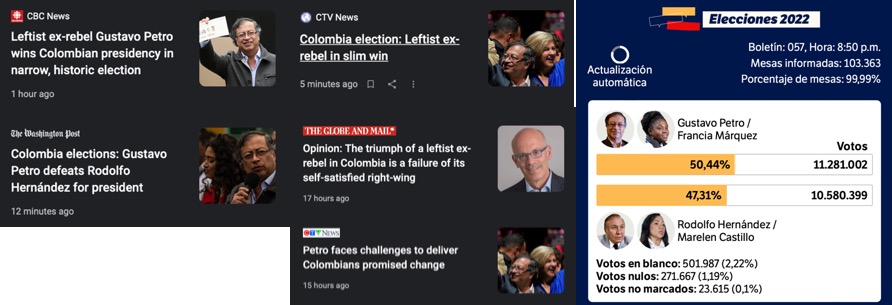
Petro defeated Rodolfo Hernández, a millionaire conservative who was frequently compared to Donald Trump.

This election (like recent ones in Chile, Honduras and Peru) is also firm rejection of Canadian and U.S. foreign policy that for the past 20 years has paid lip service to the search for peace, but always protected the interests of those who control land and natural resources. Before Conservative Prime Minister Stephen Harper won his majority in Parliament in 2011, Canada negotiated a free trade agreement with Colombia that as a sop to the Liberal party contained a mechanism for a toothless human rights impact assessment. Colombia was also the key regional ally in setting up the “Lima Group,” the attempt by Washington and Ottawa to isolate Venezuela when most members of the Organization of American States refused to play along.

After the victories by Hugo Chávez in December 1998 in Venezuela and Luiz Inácio (Lula) da Silva in Brazil in 2002, some of us starting talking about a “pink tide” sweeping across Latin America (forgetting perhaps that tides also recede). Now the tide is back, this time stronger than before. In Brazil, Lula is again leading the polls in anticipation of the election later this year.

The road ahead for Petro will be difficult, just as it has been for Pedro Castillo in Peru since his victory a year ago. The opposition will set traps and take advantage of every misstep. In this third attempt to win power, Petro proposed pension, tax, health and agricultural reforms. He would change how Colombia fights drug cartels and start new talks with remaining guerrilla fighters. But his coalition has only about 15 per cent of the seats in Congress, which will force him to make deals, limit some reforms or abandon others. Parts of the U.S. government (military and intelligence agencies) will not be friendly, and Canada (because of influence by resource-extraction companies) may not be either.

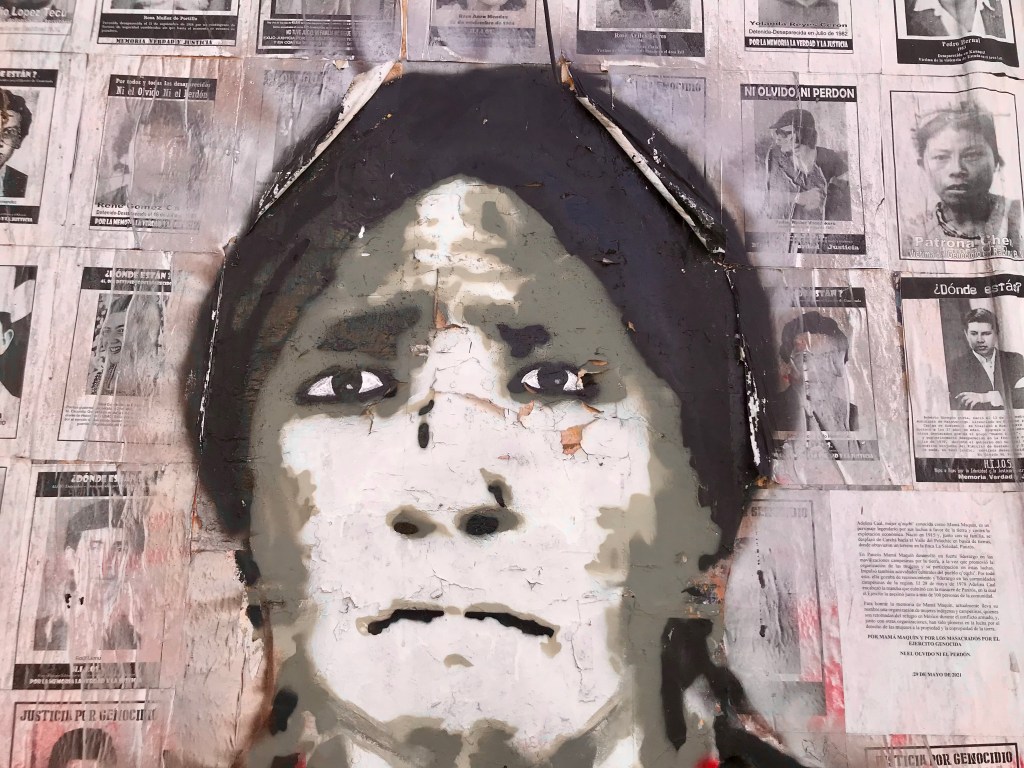
¿Dónde están? Saturday in Guatemala City

As I prepare for a journey with friends to an area that was afflicted by the violence and repression in Guatemala’s long civil war, I’ve been walking a lot in the capital city – and taking some photos.
Reminders of the war are everywhere.
One of the places I pass frequently is the ruined building shown above. It’s at 7ª Avenida and 4ª  Calle in Zona 2, a kilometre or so north of the city’s main plaza. I don’t know what the building was used for (and if I ever learn, I’ll correct this post), but today it is plastered with posters about the murdered and the disappeared. I found other posters on 6ª Avenida just a few blocks away. Here below are some stories that I have been able to piece together that will give you a sense of what Guatemalans faced in those horrific years.
Adelina Caal, a Kekchi woman known as Mamá Maquín, was legendary for her struggles for the land and against economic exploitation. She was born in 1915, and together with her family moved from Carchá to the Polochic River valley in search of land. They obtained a piece of land on a farm called La Soledad, Panzós.
At Panzós, Mamá Maquín developed strong leadership in rural mobilizations for access to land, while promoting the organization and participation of women. She also promoted cultural activities of the Kekchi people. For all this, she enjoyed recognition and leadership in the campesino communities of the region. On May 29, 1978 Adelina Caal led the march that culminated in the Panzós massacre. 
The Panzós massacre was the machine-gunning of Kekchi Indigenous people carried out on May 29, 1978, by members of the Guatemalan Armed Forces. Including Mamá Maquín, at least 53 men, women and children died – the message in the photo above says 100 – and another 47 were wounded.
To honour the memory of Mama Maquín, an organization of Indigenous and campesina women bears her name. They had returned from refuge in Mexico during the armed conflict, and, together with other organizations, have been pioneers in the fight for women’s right to ownership and co-ownership of land.

The large poster on the left shows Marco Antonio Molina Theissen. He was 14 years old when he was taken from his family’s home on October 6, 1981. He is one about 5,000 children who are among the 50,000 people who were disappeared in the years of conflict: those in addition to the 200,000 killed. About a week before Marco Antonio disappeared, his sister Emma Guadalupe – a member of a labour-focused youth organization – had been detained. After beatings, sexual assaults, interrogations and torture, she escaped from the military base in Quetzaltenango where she had been held. The forced disappearance of Marco Antonio is considered a reprisal for Emma’s escape and for the family’s political activity. 
The large poster on the right shows Jorge Alberto Rosal Paz y Paz, a 28-year-old agronomist in the eastern department of Zacapa. On Aug. 12, 1983, he was driving between the cities of Zacapa and Teculután when he was stopped by men in an army jeep. Though dressed in civilian clothing, witnesses said they were soldiers because of the jeep and the heavy weapons they were carrying. 
This is Gustavo Adolfo Meza Soberanis, medical doctor and surgeon, member of the Organización del Pueblo en Armas (ORPA), kidnapped by the army in Ciudad Nueva, Zona 2, on September 7, 1983. His is one of the cases recorded by the army in its infamous “Diario Militar,” which also shows that he was executed on February 7, 1984. But there is no indication of what was done with the body. Hence the question, ¿Dónde estás? Where are you?

Fanning the fires of hope in Chiapas, still

There was one time when I was glad to see the riot place arrive: Sunday afternoon, February 19, 1995 in San Cristóbal de Las Casas, Chiapas. 

For more than a week, Maya Indigenous people of the Chiapas highlands had protected their cathedral, the seat of Bishop Samuel Ruiz. On that Sunday afternoon, the feared attack had become real as a larger group of about 400 “auténticos coletos” (denoting descendants of the European settlers in the city) hurled stones: the settlers saw the Indigenous people as interlopers, the ones who had no business in the heart of their city.

The defenders stood three deep in scraggly lines surrounding the cathedral. They held flowers. Men, women and children, old and young, Indigenous and Mestizo, Mexican and foreign, held marigolds, lilies and carnations and wore white ribbons across their chests as they faced the attack. They endured the attack, holding blankets over their heads and trying to duck the stones. The woman next to me whispered prayers and repeatedly blessed the rock-throwers: “God, forgive them.”

The mob tried for more than an hour to storm into the cathedral and the diocesan office next to it. Finally, the riot squad arrived and traced a line between the two groups. The people on the steps cheered; the mob dispersed. In the meantime, at least five people, including two reporters, had been injured. 

For 10 days, ever since Mexican President Ernesto Zedillo pledged to capture the leaders of the rebel Zapatista army (EZLN), the people of this diocese had maintained a vigil around the cathedral and diocesan office. That building also housed the National Mediation Commission (CONAI), chaired by Bishop Ruiz and in session at the time of the attack.

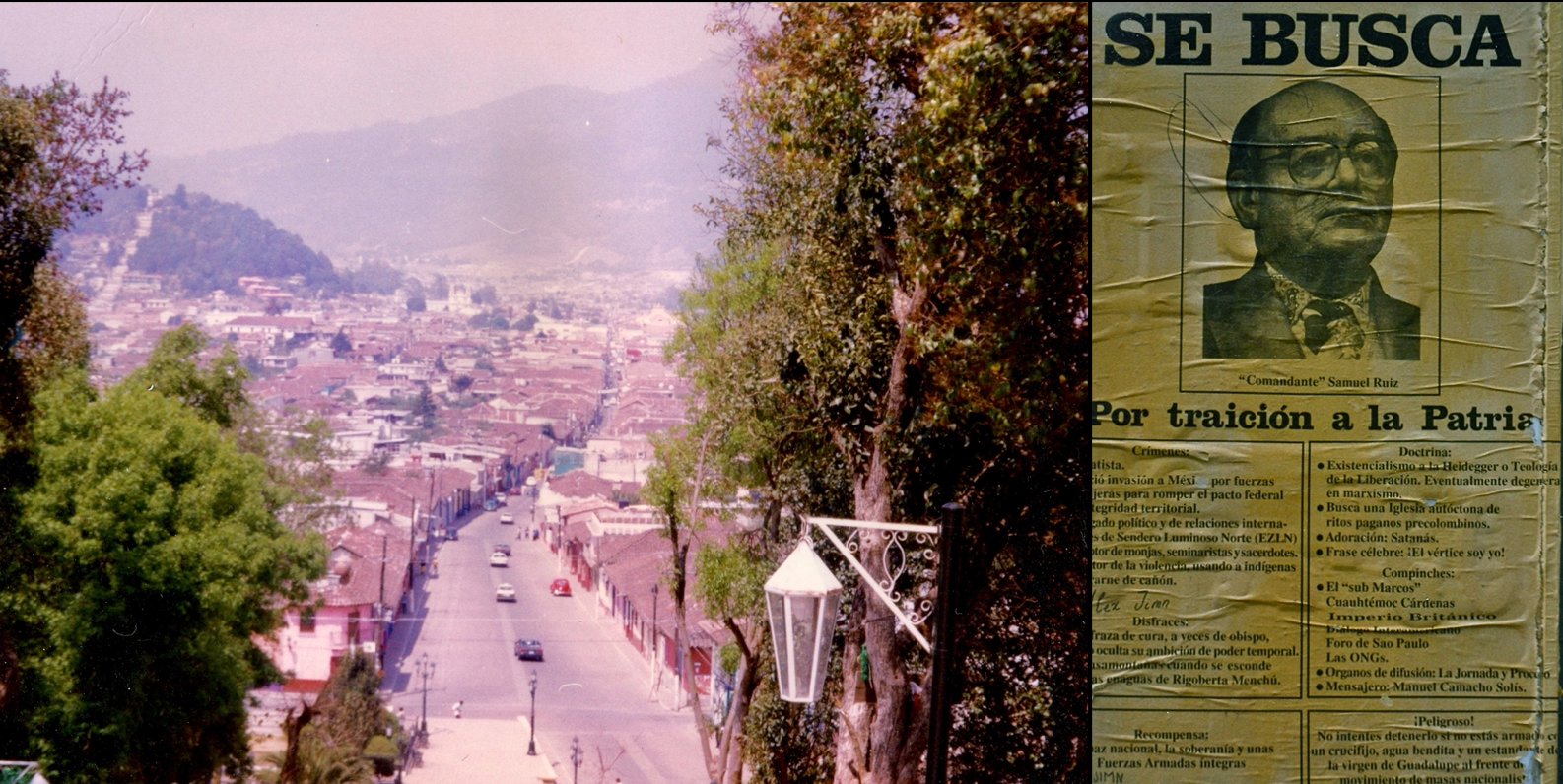
Left: a view of San Cristóbal de Las Casas. Right: a “wanted” poster that describes Bishop Ruiz variously as a traitor, existentialist, liberation theologian and Marxist – typical of the charges laid against him by his opponents over many years.

For more than a year, Ruiz had been at the centre of ecclesial and political controversies over his decades-long advocacy for and with Indigenous and impoverished people in Chiapas and his role as a mediator between the government and the Zapatistas. The EZLN uprising had begun on January 1, 1994, the day that the North America Free Trade Agreement (NAFTA) came into effect.

Zedillo failed to capture Zapatista leaders, but instead arrested people who worked for community development organizations (notably Jorge Santiago of DESMI, Economic and Social Development of Mexican Indigenous Peoples). His army also achieved what it considered to be better strategic positions near the Zapatista communities. 

Over the subsequent year, CONAI’s mediation work continued and bore fruit: on February 16, 1996, the government and EZLN representatives signed an Agreement on Indigenous Culture and Rights in San Andrés Sakamch’en. It was not a comprehensive peace deal, but rather the first step in a planned process to address Indigenous rights in Chiapas and beyond. “It was the first time in Mexican history that the state had sat down with Indigenous people to hear their demands,” wrote La Jornada columnist Magdalena Gómez recently. Later that year, the National Indigenous Congress (CNI) was created and continues its work today.

But from the government side, nothing happened! The first agreement has not been implemented; worse, the government negotiators essentially sabotaged a second round that was to address issues of democracy and justice, leading the EZLN to suspend the dialogue on September 4, 1996. It has not been renewed. The EZLN continues to press its cause in multiple public fora in Mexico and far beyond, and the communities persist in building a fairly successful example of Indigenous autonomy. 

Sadly, even the somewhat more progressive government of Andrés Manuel López Obrador, in power now for more than three years, has failed to move beyond what Gómez called “recycled, low-intensity, neo-Indigenous” policies of individual support and mega-projects without reference to the San Andrés Accords. 

A year ago, the Fray Bartolomé de Las Casas Human Rights Centre in San Cristóbal said the San Andrés Accords persist as a framework and reference for the people of Chiapas. “The people who struggle will continue to fan the fire of hope, and history will give an account of this, because despite the war of extermination, the construction of autonomy gives light and fire to women and men throughout the world.”

Parts of this post are adapted from two of my articles published in Catholic New Times, March 5 and 19, 1995.

“I give you a flower,” says a t-shirt from Yajalón, Chiapas.