In Haiti, once again: something must change

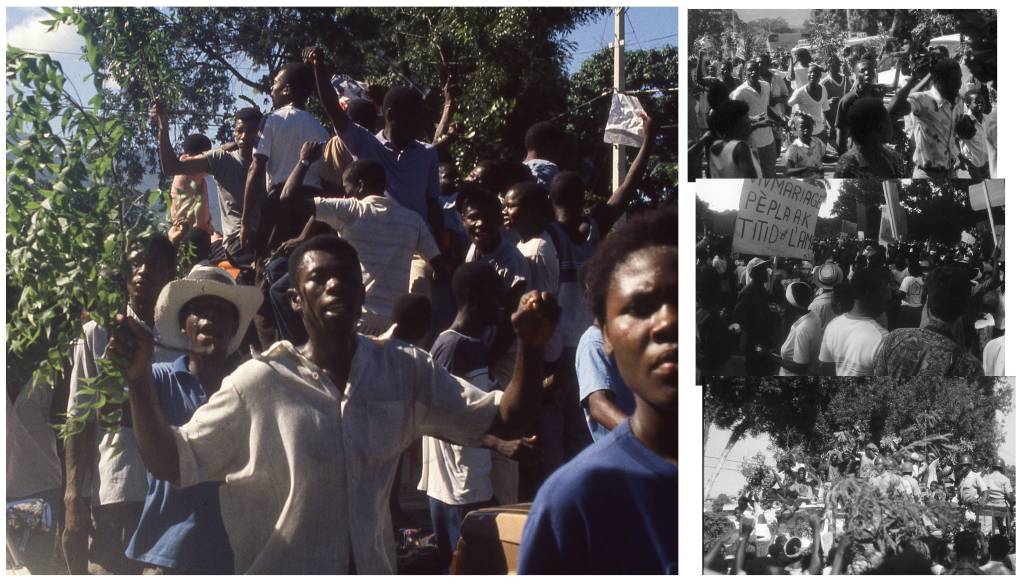
My first visit to Haiti was in March 1984 when Jean-Claude “Baby Doc” Duvalier was still in power. Less than two years later, in the face of widespread demonstrations, he fled. Six years of jostling for influence and power followed, and the voice of a young priest in the impoverished neighbourhoods around Port-au-Prince was heard. A movement, Lavalas, a flood propelled Father Jean-Bertrand Aristide into the presidency. These are some of my photos of the celebration.

A podcast that explores Christianity and the political left provoked me to think again about Haiti this week. On March 9, I was interviewed about events in Haiti for The Magnificast, a podcast produced by my friends Dean Detloff in Toronto and Matt Bernico in St. Louis. 

Right now, tens of thousands of people are marching in the streets of Port-au-Prince and other cities. They want to bring down the president, bring about a new interim government that would lead a process of constitutional reform, and organize new elections.

This time, however, they’re backed by a range of people and organizations that have not stood together since 1990 (Haiti’s first free election): churches, trade unions, community groups, students and teachers, the political left and centre.

The Magnificast has been a great space for me to think with others about complex events in Venezuela,Bolivia and now Haiti. The title is adapted from Mary’s song of praise, The Magnificat::

God has brought down the powerful from their thrones,
    and lifted up the lowly;

God has filled the hungry with good things,
    and sent the rich away empty.

Luke 1:52

On March 8, a group of civil society organizations sent a letter to Prime Minister Justin Trudeau, calling for an end to Canada’s support for Haiti’s president, whose term of office has ended. Initiators of the letter were members of Concertation pour Haïti (CPH), a coalition of Quebec-based solidarity groups working in Haiti and individuals who support solidarity with Haiti. Members include The United Church of Canada (through its francophone ministries together with global partnership staff) and Development and Peace.

The letter calls on Canada, the United Nations and others to “consider transitional alternatives, without external interference, proposed by the various sectors of the opposition and civil society instead of blindly supporting the government of Jovenel Moïse.”

Over the past two years, Haitian organizations have proposed various ways forward. A transitional government should have taken office on Feb. 7, 2021, the date that the president’s term ended. The letter explains the next steps:

“A new government, accompanied by a transitional body, should hold office for at least two years. In addition, it would be established according to a specific institutional procedure, determined in a concerted manner within civil society and the opposition, which would ensure its limited term and its independence. The goal is to work toward the adoption of a new constitution in accordance with the wishes of the Haitian people, to prepare new elections, to adopt a plan to alleviate the population’s misery, to restore order in the public administration and to reinstate the judicial system.”

A day after the CPH letter, the Catholic religious communities that are part of the Haitian Religious Conference (CHR), used the occasion of the anniversary of Pope John Paul II’s visit to Haiti on March 9, 1983—three years before the end of the dictatorship of Jean-Claude “Baby Doc” Duvalier—to renew his call for change. “Il faut que quelque chose change ici,” the pope said, adding that impoverished people must recover hope. As he left, he encouraged unity: “Têt ansanm,” he said in Kreyol. All together.

“Thirty-eight long years after that visit by the pope,” states the CRH letter, “the seeds of death now seem to outgrow the seeds of life. The country is dying, insecurity is rampant, the poor cannot go on, the population is in a disarray that borders on despair, and the country is no longer ruled. We are both witnesses to and victims of too much crime, too much injustice, and too much inequality.”

So, what gives?

Some forces resist change. Haiti’s six richest families, together with a few thousand wealthy enablers, have shown through the past 40 years that they will resist any change whatsoever. And that class is well-connected to corporations and centres of power elsewhere. The United States, as elsewhere in Latin America, is arbiter of what can be done. It may have shifted from the Cold War-view that saw the Duvalier regime as a buttress against communism. The presidency of Bill Clinton in the 1990s imposed a developmentalist approach: Haiti would be a nation of cheap-labour assembly plants. 

Since 2011, in the presidencies of Michel Martelly and Jovenel Moïse, the United States and the local elites have finally had the presidents they wanted: men close to the business sector and close ties in the United States.

Photo: Le Safimag

But Haitians have other ideas. A few months after the 2010 earthquake, I was in Haiti with colleagues from The United Church of Canada. Among the people we met was Jesi Chancy-Manigat, a member of the coordinating committee of the National Feminist Platform. She was worried about the relief effort: “We are in danger of missing an opportunity.” It’s not enough, she added, just to consult with the president of Haiti. Civil society needed to be involved: citizens, organizations, women, workers, farmers, professionals.

Yes, the opportunity was missed, and Jesi, sadly, did not live long enough to attain the changes she wanted: she died from cancer in 2013 at the age of 57.

But she taught us a few things that those of us working for change now might keep in mind. First, listen to what Haitians say about themselves. Jesi introduced us to the work of the Kay Famn (House of Women) organization. In 2010, Kay Famn insisted that the country can be and must be rebuilt.

To rebuild the country is:

  • To divorce ourselves from the practices of theft, corruption, dirty politics, and irresponsibility—where an executive or a Parliament can assume the right to ignore laws and rules.
  • To have authentic dialogue with the people.
  • To end the immense disorder that surrounds us: political disorder that prevents us from building a real democracy; electoral disorder that shackles the enjoyment of the rights of citizens; disorder in public administration, management of territory, justice, economy, education and health; disorder with respect to fundamental human rights, especially the rights to food, health care and housing.
  • To re-deal the cards so that the state serves the common good, and so that people receive services and can produce and improve their well-being.
  • To construct a system of social protection that permits action for the most vulnerable sectors: families headed by single women, those living with handicaps, those with low incomes, orphaned children, the elderly who have no resources.
  • To commit ourselves to a path that moves us away from dependence on the exterior so that Haitians may take decisions according to national interest.

The demands today are not different from 38 years ago or 11 years ago. Yet, the people persist. And yes, we support their struggle.


More resources

An article in English by Marc-Arthur Fils-Aimé of the Karl Lévêque Cultural Institute (ICKL) and the Alternative Development Platform (PAPDA)

Position paper by the Jesuits of Haiti on the current crisis

“The Millionaires Of Haiti” Podcast
One boat, one storm? Some youthful inspirations for mutual support

News reports last week said that levels of hunger in Central America have almost quadrupled in the past four years, a consequence of the economic crisis caused by COVID-19 and years of extreme climate events. 

That news set me to thinking about that comforting notion that the pandemic has somehow placed us all in the same boat—and then as well to the reactions to it: we may be in the same storm, but we’re in different boats. 

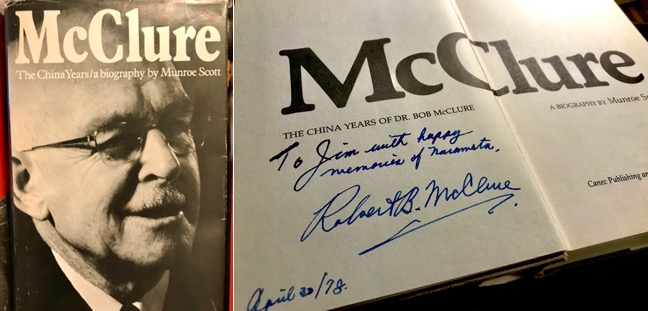
I first encountered the metaphor of a lifeboat to represent all of humanity when I was very young, perhaps 12 years old. My parents thought it was important that we hear a presentation by Dr. Robert McClure, the renowned medical missionary who was serving as Moderator of The United Church of Canada (1968-71). He was best known for his years of service in China in the decades before the triumph of the revolution in 1949, but he served after that in many parts of the world. 

The auditorium of Kelowna’s First United Church was full, and we sat near the back. My memory is that Dr. McClure used the technology of the time, an overhead projector, and that one of the images was a simple line drawing of people in a boat. Most of them were at one end of the boat, and the boat looked like it was about to capsize. On the other hand, it may be that his words enabled me to make in my mind a drawing of the boat that he described. His point was about global distribution of resources. Some of us have too much; others nothing at all. It is one boat one planet: your stuff won’t save you.

Not quite a decade later, I met Dr. McClure again. We were both at the United Church’s Naramata Centre at the end of April 1978. 

And, surprise, I found my notes of the event. He was in Naramata to speak at a United Church men’s conference; I was there with a very ecumenical group of about 40 youth that was attached to the Kamloops Okanagan Presbytery, and with which I stayed connected over several years during breaks from my studies in Ottawa. I had not remembered this, but my notes say that our resource person for the weekend was Gary Paterson, then the minister of the United Church congregation in Winfield, BC; decades later he too would be a Moderator. And it was Gary who introduced Dr. McClure to our group in a Saturday afternoon gathering in the upper room of a building called The Loft.

He began by “taking us” in a Concorde super-sonic jet, six-and-a-half-hours from London to Singapore. “Our world isn’t shrinking. It’s shrunk, and will continue to do so.” He spoke for about 35 minutes, and concluded: “Canada is your blessing. Now: what will you do with it?”

In between, he told us of his life in Toronto, where he lived on the 19th floor of an apartment building. He told us of the rules designed for safe living: you are not to talk to your neighbours; walk only in well-lit areas, etc. 

Then he spoke of the river people of Sarawak (a Malaysian state on north coast of northern Borneo). “They live in long houses, like an apartment building turned on its side.” The long houses were divided into small apartments, side-by-side, each family having a part that was its own. “They’ve been there for 3,000 years,” he said. “They adopted this system of mutual support.” The apartments were joined together by a long, covered verandah over the river. “Neighbours are close and friends are forever.”

He offered an example. “My hospital was near the river mouth. A woman came down—a week-long journey in each direction—for a hysterectomy. I asked her, ‘Where are your children? How could you leave your children?’ ‘Oh, but doctor,’ she said, ‘we’re long-house people. The neighbours will care for them while I’m gone. Next month when my neighbour comes down, I’ll care for her children. We’re long-house people.’”

That’s mutual support. “When you’re invited to a wedding in Borneo, it’s a commitment for you too. You pledge to see that Joe and Sally will stay together, and when problems arise, you go see Joe and tell him to get his act together, and you can bet Sally will be told something by the women. One marriage in a thousand breaks down. That’s mutual support.”

He talked about the role of youth in other countries that he had visited. Read 42 years later, some of his examples of youthful collaboration seem debateable—Singapore in the years when Lee Kuan Yew exercised firm control—but the point was that governments should trust youth with more responsibility for positive social change, and that youth should take advantage of the responsibility they have now.

Twice, then, I was inspired by McClure to think of issues in their global dimensions. In subsequent years, I learned more about him and about China and about the role of Canadian missionaries there. 

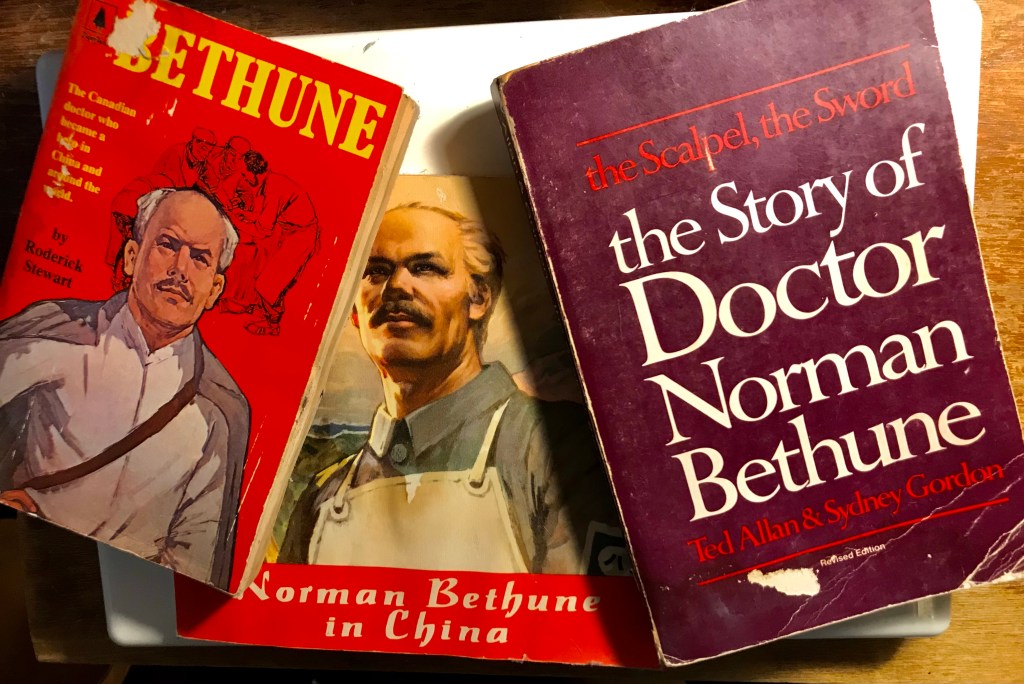
Dr. McClure is sometimes held in tension with the life and witness of Canadian supporters of the Chinese Revolution, including Rev. James Endicott, a United Church missionary, and Dr. Norman Bethune (son of a Presbyterian minister) who died in 1939 while serving as a battlefield surgeon with one of Mao Zedong’s revolutionary armies. 

While I tend to the Endicott and Bethune sides of those political and theological reflections, I also celebrate McClure’s choice to live most of his life among the impoverished and marginalized peoples of the Earth, and his challenge to the rest of us to use our blessings to care for each other and the planet.

As I was putting together these notes about my memories of Dr. McClure, I was invited by a friend to see actors in a Zoom reading of a new play, China 1938, by Diane Forrest held March 8. Forrest is a writer and editor long involved in Alumnae Theatre’s new play development group and is also co-author with McClure of a 1988 volume, Vintage McClure. The play tells the story of the single encounter between McClure and Bethune in China in 1938, and is told from the perspective of the one woman who knows what happened: McClure’s widow, Amy. This play is also an inspiration, and I hope that (after the pandemic), it gets a full stage treatment.

Sustainable development, religious freedom, and LGBTI rights

Oct. 5, 2018

During my visit to Buenos Aires, I found myself in a public conversation about religious freedom. This is a topic that I usually avoid, knowing that I get angry, especially at those Christians who reduce religious freedom to their own will to discriminate against others with whom they disagree or of whom they disapprove. To me, freedom of religion is like freedom of speech: to be upheld until it imposes itself on the rights of others to be who they are, or when it becomes a threat to our personal security.

For those of us who identify ourselves anywhere in the 2SLBGTIQ+ acronym, freedom from religious fundamentalism and specifically from promotion of homophobia and transphobia is vital. We live in a time when some politicians turn gender justice against women and sexual minorities to win support from religious fundamentalists.

I was attending an inter-faith forum on sustainable development, one of several events leading up to the meeting in Buenos Aires Nov. 30-Dec. 1 of the G20 group of countries.

Having sat through an hour of praise for religious freedom, vitality, and the role of religion in achieving the Sustainable Development Goals—without any of the panelists saying anything about victims of religious fundamentalism—I rose to my feet. I was cautious, and tried to outline a different approach.Instead of blaming the speakers or making the issue about myself, I pointed to the creation in 2016 of Global Affairs Canada’s Office of Human Rights, Freedom and Inclusion as a good example of a different approach.*

To me—and this is what I said to the panelists—the greatest value of the new office is that it places religious leaders in a space with people who are too often targeted because of their race, national origin, sexual orientation, or gender identity or expression. I asked how the panelists viewed religious freedom in the context of other freedoms and rights.

In response, Dr. Ahmed Shaheed, UN special rapporteur for freedom of religion or belief, said religious freedom cannot be upheld in ways that undermine the rights of others. He insisted on equality. Another panelist, Elder Todd Cristofferson of the Church of Latter Day Saints’ Quorum of 12 Apostles, spoke in terms of “fairness to all”—a pleasant surprise to me. Rabbi David Silverstein—religious freedom ambassador under President Barack Obama—spoke of the rights of groups not to be discriminated against, and said limits on religious freedom are appropriate.

This exchange took place in the plenary of the interfaith summit. We then moved into four parallel sessions, and the one that I attended was on Human Rights, Faith and Sustainable Development. Many of those who had been in the plenary also attended this session, including Dr. Shaheed. And here I learned a few things.

Faith for Rights

Maybe everyone else already knows about the work of the UN Office of the High Commissioner for Human Rights (OHCHR) on “Faith for Rights,” the Rabat Plan of Action and the Beirut Declaration, but I didn’t know. OHCHR staffer Michael Wiener walked us through them.

In 2012, section 36 of the Rabat Plan of Action laid out some of religious leaders’ core responsibilities against incitement to hatred:

  1. refrain from using messages of intolerance or expressions which may incite violence, hostility or discrimination
  2. speak out firmly and promptly against intolerance, discriminatory stereotyping and instances of hate speech
  3. be clear that violence can never be tolerated as a response to incitement to hatred: there is no justification for violent retaliation.

This is not white-washing, insisted Mr. Wiener: faith-based actors can do good or bad. His role is to support faith leaders in positive action for rights. There are also 18 commitments adopted by faith-based actors in the 2017 Faith for Rights Beirut Declaration.

These include pledges to ensure non-discrimination and gender equality. They use religious texts and UN declarations to prohibit so-called honour crimes and female genital mutilation, and to call for an end to blasphemy laws and use of the notion of “state religion” to discriminate against individuals or groups. They set out to “de-mystify” or take away the impression that faith is against human rights. They re-affirm humanitarian aid principles of conduct, including that aid cannot be used to promote religion—which would be tantamount to coercion. Faith groups stand up for the rights of all minorities. Faith for Rights is an umbrella to bring them together, and proposes concrete projects to implement the commitments.

Mr. Wiener said that Dr. Shaheed (the UN Special Rapporteur for Freedom of Religion or Belief, sitting in the audience in this session), has described the Beirut commitments as “soft law standards.” They are not formally adopted by states (yet), but by using them, over time they become norms. Along with the official UN languages, nine other translations have been made: for example, Turkish and Greek for use in Cyprus; Serb and Albanian for use in the Balkan region, etc. They have been turned into tweets and given artistic expression in different places.

In our work to overcome religion-based homophobia and transphobia, honour crimes and female genital mutilation, blasphemy laws and anti-sodomy laws, we can use those publicly-stated commitments to remind those who would promote hatred and exclusion that other faith leaders have taken a different stance, and have UN backing.

* An example of how the government of Canada talks about religious freedom and LGBTI rights. Matt DeCourcey, Parliamentary Secretary to the Minister of Foreign Affairs of Canada, at the Ministerial on Advancing Religious Freedom in July 2018 in Washington: “We believe in fostering greater inclusion and equity for every person, including all faith and belief communities, women and children, Indigenous people, members of the LGBTI community, minority groups, and others who are often marginalized in society.… Since March 2017, Canada has been a member of the International Partnership on Religion and Sustainable Development where we are working with others to harness the potential positive impact of religion in sustainable development and explore the critical intersections between religion, development and gender equality –in an effort to ensure that no one is left behind.”

More information about LGBTI rights globally:

Dignity Network Canada: Since 2016, The United Church of Canada and Affirm United/S’Affirmer Ensemble have participated in the Dignity Network of NGOs, human rights groups and others that are committed to defend LGBTI rights globally and to press the Canadian government to do more.

Rainbow Faith and Freedom is a global movement that confronts religious-based LGBTI discrimination and improves the human and equality rights of LGBTI people everywhere.