The church, systemic injustice, social sin and the “doctrine of discovery”

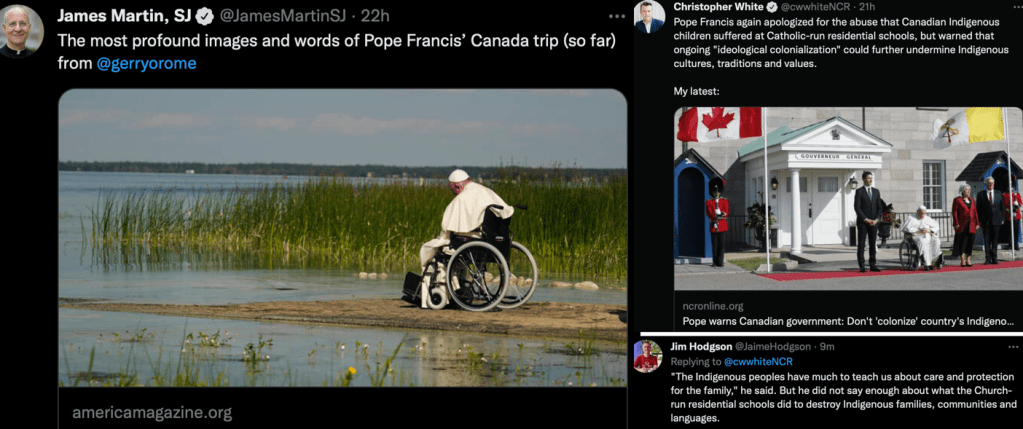
Left: America magazine, July 28. Right: CBC News, July 30.

by Jim Hodgson

Many people who heard the apologies offered by Pope Francis in Canada were disappointed that the apologies were worded in ways that expressed regret for the actions of certain people or “local Catholic institutions” – as if religious orders like the Oblates and Jesuits are not themselves global organizations.

Building on existing teaching, the apologies offered by Pope Francis could have gone further. 

As my personal penitential pilgrimage continued, I came across a forceful definition of “social sin” – relevant because of the Catholic Church’s reluctance to say something definitive, like: “the church erred,” rather than just saying, “I’m sorry.”

The Compendium of the Social Doctrine of the Church (2004), in paragraph 119, describes social sin this way: “The consequences of sin perpetuate the structures of sin…. These are obstacles and conditioning that go well beyond the actions and brief life span of the individual, and interfere also in the process of the development of peoples, the delay and slow pace of which must be judged in this light.”

The entire colonial project, including the residential schools, is grotesque interference in the “development of peoples.” (That phrase echoes the name of an influential 1967 encyclical by Paul VI, Populorum Progressio, inspirational to the creation of the many Catholic development organizations an in the formation of people like your scribe.)

Away back in 1984, Pope John Paul II and the bishops of the Dominican Republic were anticipating a grand celebration to be held in 1992 to mark the “discovery and evangelization of the New World” on the “Fifth Centenary” of the arrival of Christopher Columbus in the Americas. 
I was present on Oct. 12, 1984, in a sports stadium in Santo Domingo when John Paul defended the church’s role in the European conquest. Even then, his words shocked and angered me. A “black reading” of history, he said, had focused attention on the violent and exploitive aspects of the time which followed what he repeatedly called “the discovery” of the Americas. 
Protest from within the church and across the hemisphere, especially from Indigenous and African-Americans, was immediate. By the time the 1992 events unfolded, John Paul came back to Santo Domingo to open a meeting of Latin American bishops (CELAM), but scaled back his participation in government-led celebrations.

He met with Indigenous and African American groups, and local media reported that he apologised. But careful reading of the texts show no apologies. To Indigenous people, he said: “There must be recognition of the abuses committed due to a lack of love on the part of some individuals who did not see their Indigenous brothers and sisters as children of God.” To African Americans, he repeated words he had used earlier in 1992 at Gorée, Senegal: “How can we forget the human lives destroyed by slavery? In all truth, this sin of man against man, of man against God, must be confessed.”
Right: I read everything I could about these debates in the mid-80s and early 90s. Part of my collection!

Pope Francis should also have addressed the “Doctrine of Discovery.” Thomas Reese, a Jesuit priest who works with the Religion News Service, wrote after the visit that the pope’s remarks in a news conference during the flight back to Rome revealed that he had not been properly briefed for the visit. Francis said he had not thought to use the term “genocide” to describe the effects of the Indian residential schools system, but agreed that it was “true.”

And he said he was confused by the phrase “doctrine of discovery.” He should have been briefed and been prepared to address the issue, persistently raised by Indigenous people because of the lasting legacy of 15th-century papal teaching. Even if those teachings were abrogated by Pope Paul III’s edict in 1537, their accumulated impact influenced U.S. and Canadian law and government policy. The TRC Call to Action 45 rejects the doctrine of discovery and calls for a new Royal Proclamation of Reconciliation to be issued by the Crown that fully honours Nation-to-Nation principles.

To be fair, the doctrine-of-discovery phrase is not used as commonly in Latin America as in North America to describe the complicity of church and state in the subjection of the Indigenous peoples of the hemisphere. It doesn’t appear, for example, in a volume edited by philosopher-historian Enrique DusselThe Church in Latin America, 1492-1992 (Orbis, 1992) – although the various papal bulls (edicts) that gave rise to the concept are described. 

In my experience, what is talked about more are impacts of colonialism, the role of the colonial state in managing Christian missions (royal patronage, power to appoint bishops, etc.), and resistance exemplified by (among others) a 1511 homily by Antonio de Montesinos to settlers in Santo Domingo (“Tell me, by what right or justice do you hold these Indians in such cruel and horrible slavery?”) or the first bishop of Chiapas, Bartolomé de Las Casas, who argued for decades on behalf of Indigenous peoples. Indeed, much of what we know about the impact of the colonialism on the original peoples of the Americas in the 16th century is from what he wrote in his History of the Indies, published in 1561. In his long life, he was able to correct errors: among them, failure to denounce the enslavement of Africans. He later advocated that all slavery be abolished.

In Dussel’s introduction, he describes “the church of the poor” as already distinct from both the colonial church and the church of the criollos (descendants of Europeans born in the Americas). “There was not a single year in the seventeenth century that did not see a rebellion of natives, blacks or mestizos….” (p.7). The criollo-led independence movements of the early nineteenth century did not advance their liberation, and resistance continues to this day.

Next: Santo Domingo in October 1992: 500 years of resistance

Canada’s residential schools and my own “penitential pilgrimage”

by Jim Hodgson

Through the six days of the pope’s “Penitential Pilgrimage,” I mostly refrained from comment about the visit. It was best, I felt, that people hear the voices of residential school survivors and other Indigenous people, along with the voice of Pope Francis. I made my own penitential pilgrimage, albeit without travelling far. I am humbled as always by the voices of survivors and their families.

Folks who know me know that I have deep roots in two churches: the Roman Catholic Church and The United Church of Canada. As time goes on, I feel ever more disinclined to choose between them. I stand among them with others as an ecumenical Christian, and among other believers and all people of good will as we discern good ways forward together.

Here begins a three-part series of reflections (accompanied by many links to other articles and documents) from my virtual pilgrimage. Some of what follows is drawn from events of those late July days and other parts come from my reporting of four of Pope John Paul II’s visits (Canada in 1984, the Dominican Republic in 1984 and 1992, and Mexico in 1999), as well as my life as a pilgrim working and travelling between Canada, Latin America and the Caribbean since 1983.

Top left: Remembering the names of some of those who died as a consequence of church-run residential schools. At different moments, Cindy Blackstock, the Gitskan activist and director of the First Nations Child and Family Caring Society of Canada, and Mary Simon, Canada’s Governor General, took issue with Pope Francis and his language of reconciliation as gift or grace that seemed to fall short of calling offenders to hard work, truth-telling and understanding.

In my nomadic childhood (which involved sojourns in three provinces before I was four and in yet another after I turned ten), we would occasionally visit relatives in Wetaskwin and Camrose, driving north on Highway 2A through Maskwacis – known in those days to us settler folk as Hobbema. This was in the 1960s and early 70s, and we hadn’t a clue about the Ermineskin Indian Residential School (ERS) that operated there from 1895 to 1975.

I began my virtual pilgrimage by learning more about the school. Many students were from the Ermineskin Cree Nation, and students came as well from the other three Maskwacis bands: Samson Cree Nation, Louis Bull Tribe and Montana First Nation – and from farther away too. ERS was one of the largest residential schools in Canada. In 1956, enrolment peaked at 263 students. 

It was begun by two religious communities: the Oblates of Mary Immaculate (OMI) and the Sisters of the Assumption of the Blessed Virgin (SASV). The sisters left in 1934, and the Oblates gave up management of the school in 1955 and of the student residence in 1969 when the federal government took over the entire complex. 

The National Centre for Truth and Reconciliation has compiled stories of what went on there. 

Left: the pope at Lac-Ste-Anne, the traditional pilgrimage site west of Edmonton. Right: greetings at the Governor-General’s residence at the Citadelle de Québec. Catholic media tended to look positively at the pontiff’s apologies, but others were sceptical or dismissive because of what was omitted: acceptance of institutional responsibility.
Left: Murray Sinclair, former head of the Truth and Reconciliation Commission. Right: Mi’kmaq lawyer and professor Pam Palmatar rejected the Maskwacis apology because it omitted the church’s complicity and cover-up of the sexual abuse of thousands of Indigenous children and its role in genocide.
Headlines after the Maskwacis apology, and an excerpt from a commentary by Tanya Talaga.
I was blessed to attend the presentation in Ottawa in 2015 of the Truth and Reconciliation Commission’s final report and Calls to Action, and so I knew from the stories of survivors that days would come when stories would be believed, truth emerge, and cemeteries uncovered.
On May 28, 2021, the report came that 215 graves of children had been found on the grounds of the Kamloops Indian Residential School. I knew two men, leaders respectively in the Syilx and Nlaka’pamux nations, who survived their attendance at that school and who guided me in the late 1970s into good ways of listening to Indigenous peoples and hearing their stories.

One of the leaders whose words seemed to press my conscience was Natan Obed, the leader of the Inuit Tapiriit Kanatami – the political organization that represents 65,000 Inuit people across Inuit Nunangat (lands and waters in regions known as the Nunavut territory, Nunavik in northern Québec, Nunatsiavut in Labrador, and the Inuvialuit Settlement Region in NWT). In a conversation with Tanya Talaga, he said, “I may have been naive to think that the institution could come here and apologize in the fullest capacity it possibly can, without the accompanying religious element that ultimately is at odds with the very purpose of the visit.” (I was disappointed that the pope did not immerse himself more fully in Indigenous ceremony; instead, Indigenous people were again immersed in Catholic ceremony. I was appalled by the use of Latin in the mass at the Commonwealth Stadium: a friend said it seemed like conservatives in the church had set out to “sabotage” the pope’s visit.)

After hearing the apology in Maskwacis, Obed told a television reporter that one of the challenges for Indigenous people has been precisely where to seek justice among the religious orders and congregations, bishops and their dioceses, the Canadian Conference of Catholic Bishops (CCCB), and the Vatican.

I understand that from outside the Catholic Church, it looks monolithic and pyramidal. And as you contend with it, you come to understand that a variety of perspectives and relative levels of autonomy co-exist among the “Catholic entities” (the phrase used during the residential schools settlement negotiations among churches and government). According to the CCCB, about 16 of 70 Catholic dioceses, as well as three dozen Catholic religious communities, were associated with residential schools.

This has resulted in several different apologies from the Catholic entities (dating back to 1991) and diverse responses to demands for release of documents. This is also why it was necessary for the pope, who represents the unity of the church, to apologise here. (Apologies from other churches and governments are listed here.)

Left: Natan Obed greets Pope Francis on his arrival in Edmonton on July 24. “The solidarity we have as intergenerational survivors remains central to the ability for us to work on these issues together,” he told Tanya Talaga. Later in Quebec City, the pope amplified his apology by apologizing for sexual abuse by priests. And the Canadian government finally acceded to demands that it seek the extradition from France of Johannes Rivoire, a 93-year-old former priest who has been charged with sexual abuse in Nunavut.

Next: The church, systemic injustice, social sin and the “doctrine of discovery”

On murder and a birthday cake: Reflections on Colombia’s search for peace with justice

In human rights work, one’s first duty is to those who are harmed. But once in a while, one of the murderers says something that seizes attention as it reveals again the full banality of evil.

On July 19 in northern Colombia, the former professional solider Álex José Mercado asked forgiveness from a young woman for the murder of her father, saying: “The day that he was turned over to me (for killing), he had gone out to get a cake for your birthday.” In another moment, he said that he was not worthy to ask forgiveness from family members, but could only ask for pardon from God. “I lent myself to murder innocent people,” he said. He was 19 at the time at the time of his crimes.

This occurred during a hearing in Valledupar of Colombia’s Special Jurisdiction for Peace (referred to in Spanish as JEP). It’s the transitional tribunal that was set up to prosecute the perpetrators of crimes committed during six decades of armed conflict between the FARC-EP guerrilla fighters and the Colombian state. This hearing focused on the  falsos positivos, the false positives, that occurred just in the northern departments of Cesar and Guajira. In the country as a whole, Colombia’s armed forces kidnapped more than 6,000 young men, murdered them, dressed them as guerrillas, and then tried to pass them off “successes” in its war on “terrorism.”

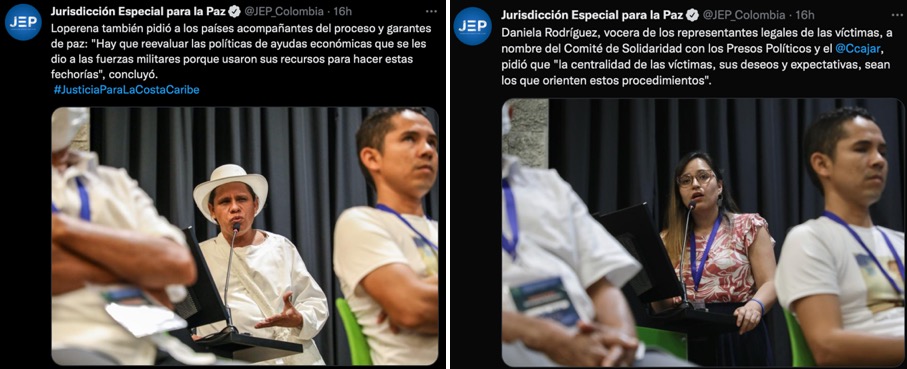
Others spoke for the victims: 

Left: Pedro Loperena, representing the Wiwa Indigenous people, said: “The economic aid policies of those who gave funds to the military forces must also be re-evaluated, because those resources were used to carry out these misdeeds.” Right: Daniela Rodríguez, spokesperson for the legal representatives of the victims and in the name of the Political Prisoners Solidarity Committee and the José Alvear Restrepo Lawyers’ Collective (CCAJAR), asked that the “centrality of the victims, their desires and expectations, be drives these proceedings.”

When he spoke about aid to the Colombian military, Loperena was polite and understated the problem:

This chart from U.S. civil society organizations shows more than two decades of U.S. aid to Colombia.

Over decades, the U.S. and Colombian governments have successively painted the war as: first, a war against communism; then, a war against drugs; and now, a war against terrorism. But the war in Colombia had its roots in the same struggle that has gone on in Latin America since the time of the European Conquest: the struggle by small farmers, Indigenous people and urban workers for land, social justice and basic human rights.

In the face of a peace process that has had limited support (and sometimes overt opposition) from the Colombian state, headed these past four years by Ivan Duque, that these tribunals continue to function is a triumph

One of the hardest parts of achieving a peace agreement between the Colombian state and the FARC guerrillas was to find language about how to manage crimes committed by state and non-state actors during the conflict. The two sides began negotiating in Havana in November 2012. The agreement on transitional justice and reparations was achieved in 2015 and the full peace accord signed in December 2016. The former adversaries agreed to a form of transitional justice, creating special tribunals to judge crimes committed by both members of the FARC and by state agents. 

It is not an amnesty, despite former president Álvaro Uribe’s characterization of the accord. In fact, that was what was avoided. Under international law that has come into force since the South African transition from apartheid to democracy in 1994, a full amnesty would not be legal. 

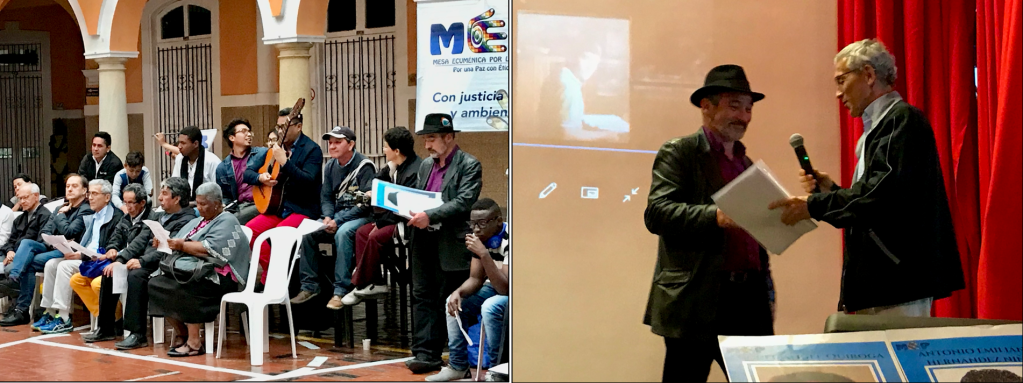
In November 2019, the Mesa Ecuménica por la Paz (Ecumenical Table for Peace) presented its report, “Blood of Martyrs, Seeds of Liberation,” to the chair of Colombia’s Truth Commission, Fr. Francisco de Roux SJ. In presenting the report, Omar Fernández acknowledged that it was not possible to encompass all of the many Christian martyrs of this long war: the team focused on those whose pastoral work represented the Church of the Poor.

Another triumph in recent weeks is the publication June 28 of the report of Colombia’s Truth Commission. Speaking July 14 to the United Nations Security Council, commission president Fr. Francisco de Roux said  that Colombia has demonstrated that those wounded by war can come together to build peace, happiness and “produce a tomorrow where there is hope”.  Over the last four years, the Commission has heard from more than 30,000 individuals and bodies and reviewed over 1,000 reports from victimized communities. He urged  the international community to give Colombia “nothing for war.”

Top of the list of recent triumphs is, of course, is the election of a new president, Gustavo Petro, and vice-president, Francia Márquez. Like the truth commission, Petro has criticized the U.S.-led war on drugs. The truth commission has urged Petro to lead a global conversation on changing drug policies, with a focus on regulation over criminalization.

Petro and Márquez will take office on Aug. 7, and already there is talk of capital flight – in effect, a boycott of Colombia by rich investors, including Colombians who already have one foot in Miami. The road ahead – ending the alliances of military forces with paramilitary death squads and drug-traffickers, ending the practice of assassinating leaders of social movements (at least 145 in 2021), protecting rain forests and reducing the grotesque gaps between wealth and poverty – will be difficult as evidenced by this long (and nevertheless incomplete) list of U.S.-sponsored coups and invasions launched against left leaders in Latin America.