Neo-colonial inertia and development plans for Central America

The shopping mall model of development (Honduras, 2009)

In October 2008, in a classroom in Ciudad Juárez—one of the most violent cities on the planet but on the border with the richest country—an international ecumenical group considered the latest official development plan for Mexico and Central America.* 

After hearing from Raúl Moreno, an economist from El Salvador long active in the Hemispheric Social Alliance of groups that questioned free trade and other top-down, capital-intensive development schemes, I wrote in a report:

“When you look at the extreme violence occurring in Juárez, the de-population of rural Mexico, the official development plans in Central America (and consequent dislocation of rural populations), and the extreme violence carried out in Colombia to drive rural populations from their land, you come away with the impression of a development model that has been continuously applied since the days of the “wild, wild west” in the United States. The model is now extended all the way to Colombia and beyond: drive Indigenous peoples on to ever more marginal lands; destroy small farmers; insert mines and hydro-electric projects where convenient to the interests of large capital; and reward allies by granting them the lands of the displaced.”

I suppose it’s progress of a sort that the masters now see the need to incorporate ecological goals into their development plans.

But these plans have at their core a neoliberal notion of development: cut protection for workers, reinforce free trade agreements, and protect private-sector investment. 

The latest plan, promoted by President Joe Biden, Vice-President Kamala Harris and the leaders of Guatemala, Honduras and El Salvador, does not correspond to the real needs and aspirations of the people: land redistribution, legal reform, ecological justice, human rights, and for Indigenous peoples: full implementation of free, prior and informed consent.

On Monday, April 26, the same day that Harris held a video conference with Guatemalan President Alejandro Giammattei, the progressive Mexican daily newspaper La Jornada questioned the U.S. approach. During the U.S.-led Earth Day summit that was held a few days earlier, Mexican President Andrés Manuel López Obrador proposed extending a Mexican government agricultural support program to Guatemala, Honduras and El Salvador—with U.S. financial support. 

The program, Sembrando Vida (Sowing Life), has been running in Mexico for two years and is intended to generate jobs in the small-farming sector, reactivate the economy in areas affected by out-migration, and overcome deforestation. “The plan seeks to overcome social exclusion and the poverty that afflicts 61 per cent of the rural population.” It includes focus on ejidos and other community-controlled farms overlooked or attacked by successive neoliberal governments in power between 1988 and 2018 in Mexico.

In her meeting with Giammattei, the Vice-president Harris announced $310 million in U.S. government support for humanitarian relief and to address food insecurity in Guatemala, Honduras and El Salvador. This is in addition to $4 billion announced by President Biden on the day of his inauguration that is intended to “address the root causes of migration” from Central America.

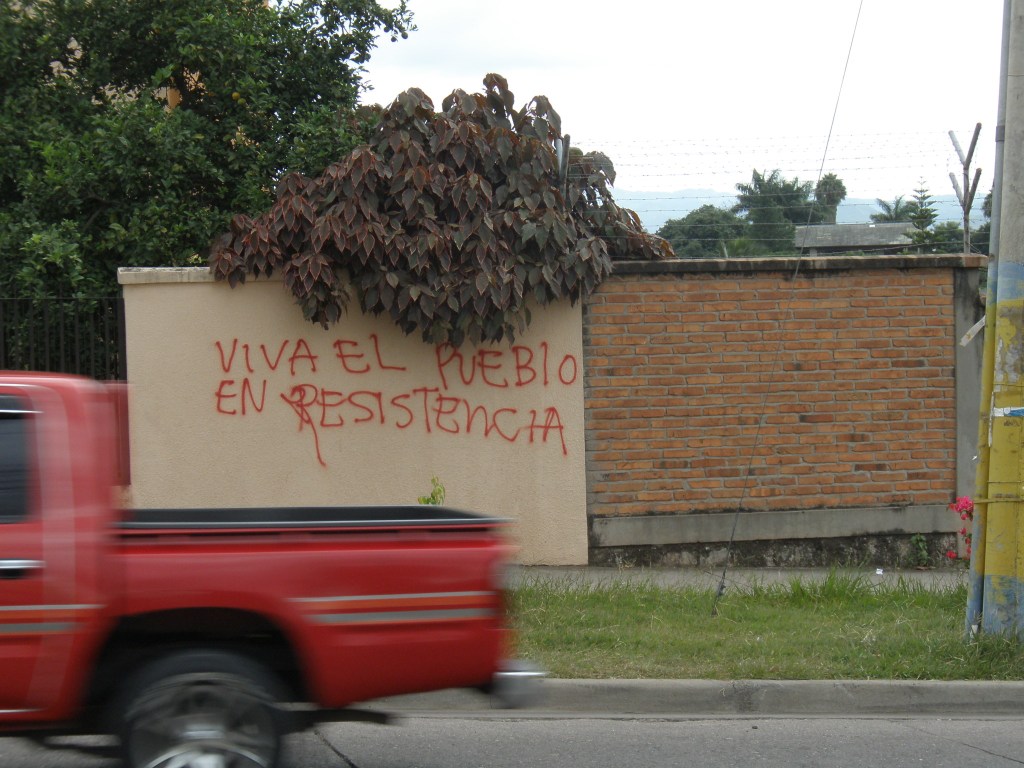
Graffiti in Honduras, 2009: “Long live the people in resistance.”

“Without strong collective action, this will mean MORE money for militarization and neoliberal economic policies that will continue to displace people from their lands and communities,” said a statement from the Committee in Solidarity with the People of El Salvador (CISPES). CISPES, joined by other solidarity and religious groups, demanded an end to U.S. police and military assistance in El Salvador, Honduras and Guatemala, and an end to development policies that “promote climate change, privatize natural resources and public services, violate workers’ rights and destroy Indigenous and communal lands.”

One of the last people I met before the pandemic lockdown began in mid-March 2020 was Giovanni Batz (G’io B’atz), a U.S.-Guatemalan researcher. He was in Toronto for a two-day conference about Central American migrants and refugees at York University. In this essay, he denounces the latest U.S. plan and explains why it will fail. By supporting further militarization and neoliberal development in Central America, the United States contributes to displacement. “When discussing climate change, hunger, and poverty as causes of migration,” he writes, “land redistribution, reform, and rights must be discussed as solutions.” 

La Jornada’s editorial noted that Biden-Harris roll-out is through a series of bilateral meetings. “The White House has not accepted multilateral treatment of human displacement and the environmental crisis, the newspaper said. 

It reflects the historic preference of the White House to negotiate individually with each country, a terrain in which the superpower can more easily impose its terms and conditions. As it confronts the migration issue, we hope that the Democratic administration will go beyond the colonial inertia that shapes every foreign policy action from a position of advantage over and against the other, and that it will recognize that behind the migration flows there are economic and social components apart from climate change which must, nevertheless, be confronted with the same urgency as global warming.

* Plan Puebla Panamá had just given way that year to the Proyecto Mesoamérica (the Project for the Integration and Development of Mesoamerica), which would later become the Comprehensive Development Plan and then the Comprehensive Regional Protection and Solutions Framework (MIRPS).

Migration and the development prescription: Let’s do better

A new president is in office in Washington. For the sake of immigrants, LGBTIQ people, women, and racialized and religious minorities, one cannot help but be glad of this change, and of the opportunities that are re-opened for people who were excluded or attacked during his predecessor’s term. 

But once again, the notion of development is again prescribed as a remedy for whatever it is that drives migrants—notably and urgently, those from Central America—towards the southern border of the United States. 

On his first day in office, President Joseph Biden’s administration promised to invest $4 billion in the region to address issues of security and employment. A new immigration reform bill, the U.S. Citizenship Act of 2021, was introduced. Aid and investment from the United States, it is hoped, will encourage people to stay home.

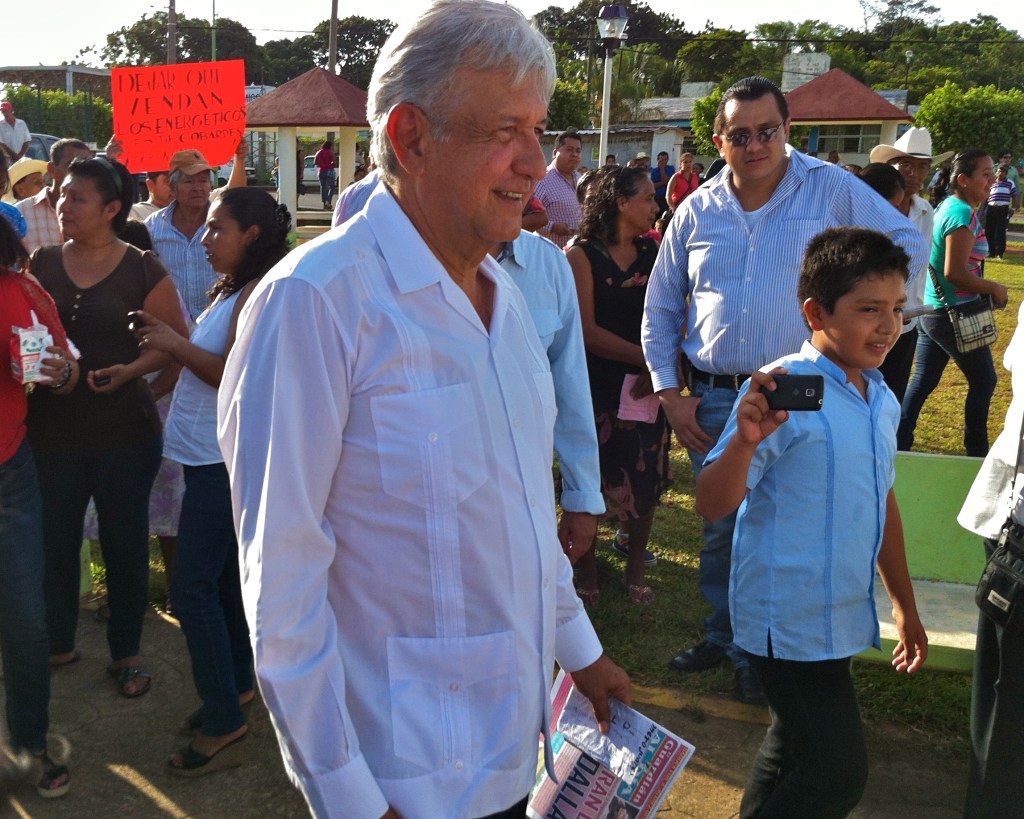
President Andrés Manuel López Obrador (Jim Hodgson photo)

Two days later, Mexican President Andrés Manuel López Obrador, spoke with Mr. Biden and concurred. “We believe that the causes of the migration phenomenon must receive attention. People do not abandon their families, their towns, their cultures, out of pleasure. They do it because of need. We want migration to be optional, not forced, that all the people of the Central American nations and our own have options, that they be able to get ahead where they were born, where their families are, where their cultures are. And for that, development cooperation is very important.”

With history as a guide, however, we can see some problems with the prescription. Two decades ago, another new president of Mexico, Vicente Fox, launched the Plan Puebla Panamá for regional economic development. The name has changed several times since then, depending on which countries were in and which were excluded because their citizens had made electoral choices that were unacceptable to donors. Airports were expanded, highways widened, mines dug and hydro-electric dams built, but still, people left by the thousands, tens of thousands, especially from Guatemala, Honduras and El Salvador. 

Those large-scale projects enable the rich, expanding the divide between rich and poor within the region and indeed, everywhere. And no one is acknowledging that among the root causes are wounds left from US-sponsored coups and civil wars, along with deportations of alleged criminals into unstable systems—or rather, into systems whose only sector capable of their social integration is the criminal one.

We know what to do differently. Development assistance should always be focused on building “economies of solidarity”—innovative agriculture that respects ecology, local markets, cooperatives and credit unions, leadership by women, full consultation with communities and civil society organizations. Indigenous people and farmers should never be driven from their land by transnational corporations—a key consequence of a generation of free trade agreements in Mexico, Central America and Colombia and driver of migration—but rather trade and investment should benefit all people.

With this post (during International Development Week), I am reviving a blog I that I used while I worked with The United Church of Canada as its Latin America/Caribbean program coordinator. Please look here for more information about me.

What kind of development?

(Sept. 4, 2011)

Javier Sicilia (Proceso, 2011)

In 2011, a Mexican poet, journalist and social activist found himself leading a new social movement that found ready followers across Mexico. Javier Sicilia dared to protest the murder of his son Juan Francisco at the hands of a drug gang, and to link the death to the way the Mexican government carries out the so-called “War on Drugs.”

Although we lived in the same city, Cuernavaca, during the late 90s and to some extent moved in similar circles of people of faith concerned about human rights and social justice, I don’t recall that I ever met him. But I read his weekly columns in Proceso, Mexico’s leading national newsmagazine. Sicilia drew deeply from the best of Catholic social teaching and from the wisdom of the Zapatista Indigenous rebels in Chiapas to condemn globalized capitalism. For Sicilia, the problem today is not just capitalism or even the rule by wealthy elites in most countries. These are problems that have been obvious for centuries.

By the early 1980s, it was possible to discern a new and harsher form of capitalism, one that came to be called “neo-liberal economic globalization” (or more often simply either neo-liberalism or globalization).

Do we err in promoting development?

Sicilia also asserts that we who question neo-liberal capitalism and its free market model of development err in using the same terms as those who have provoked and maintain extreme poverty.

Among those who influenced Sicilia’s ways of thinking and acting was Ivan Illich, an Austrian priest and educator who was profoundly suspicious of church hierarchies and of formal education. Illich (who also lived at least part-time in Cuernavaca until his death in 2002) wrote that the contemporary concept of development was born from U.S. President Harry Truman’s 1949 inauguration speech. Truman announced a program of technical assistance to under-developed countries that was called “Point Four.”

Until then, according to Illich, “we only used the term [development] to refer to animal or plant species, the value of real estate or geometrical surfaces. And, in less than a generation, we were inundated with diverse theories about development.”

Adoption of these models, Illich argued, gradually destroyed local and subsistence economies, replacing them with export-oriented market economies and industrialization. Illich’s essay “Vernacular Values” is in a 1981 book called Shadow Work. The text can be found on many internet sites, including here. (Comments on development are in his “1st part.”)

When we talk about development, let’s be clear that we are talking about something other than approaches that not only damage local communities, but imperil the whole Earth.