Dismantling USAID: Yes, No, Maybe?

In late 1980, more than a year after the triumph of the Sandinista Revolution, the administration of President Jimmy Carter was still funding infrastructure in Nicaragua through USAID. By November 1984, with President Ronald Reagan’s “Contra War” well underway, your future bloguista was amused by this left-over sign at a road rebuilt near Matagalpa.

by Jim Hodgson

Back on launch day of Trump 2.0, the president issued an executive order that suspended international aid programs for 90 days, including those of the U.S. Agency for International Development (USAID).

The move came with a lot of over-the-top rhetoric and outright lies: that USAID spent “$100 million on condoms to Hamas” and that it “bankrolled” the Politico digital news company. “It’s been run by a bunch of radical lunatics. And we’re getting them out,” Trump told reporters on the evening of Feb. 2.

There are, of course, dozens of issues about which to criticize the Trump regime. But this is a blog that sets out to unwrap development issues, so let’s get into it.

Congress established USAID in 1961 to bring together programs that were administering foreign aid. Focusing on long-term social and economic development, USAID disbursed about $72 billion in 2023, less than 1% of the U.S. annual budget. It is one of the largest aid agencies in the world. 

You’ll remember, of course, that the United Nations target for spending on Official Development Assistance is 0.7 per cent of gross domestic product. Only five countries meet or exceed that goal: Norway, Luxembourg, Sweden, Germany and Denmark. In 2023, Canada contributed 0.37 per cent of GDP; the United States contributed just 0.24 per cent, seventh lowest among 31 OECD countries

Trump’s order, carried out by his government efficiency hatchet-man, Elon Musk, chopped humanitarian programs around the world: famine relief in war zones; programs to stall malaria in 22 African nations; vaccinations in vulnerable areas; and access to medications by people living with HIV and AIDS. Several U.S. government websites also removed resources on HIV. (That also happened when Trump first took office in 2017).
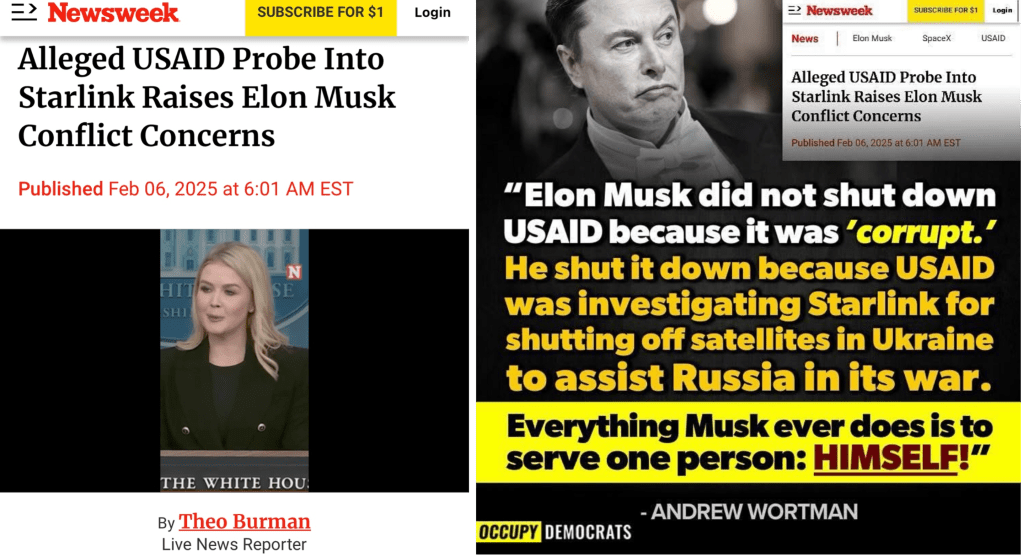
Newsweek reported Feb. 6 that just months before Musk shut down USAID, the agency was investigating its relationship with Musk’s Starlink satellite company.

In days since the order, enough voices were raised in alarm to get funding for HIV and other essential medicines restored—though it wasn’t clear if that included preventative drugs like PrEP. For more than 20 years, PEPFAR (the President’s Emergency Plan for AIDS Relief) worked within and alongside the Global Fund to Fight AIDS, TB and Malaria and the Joint United Nations Program on HIV/AIDS (UNAIDS).

Also, a federal judge on Feb. 7 temporarily blocked the administration from placing 2,200 USAID employees on paid leave, siding with workers who argued Trump and Musk lack the authority to immediately dismantle an agency created by congressional legislation.

The Trump regime blames “migrants” for much of what supposedly ails the United States, but in this time of unparalleled worldwide migration of people, the USAID cuts hit the United Nations High Commissioner for Refugees and the International Organization for Migration (IOM)—two agencies that are critical in managing and measuring the flows of people.

No one should argue against humanitarian aid, although Musk and Republican members of congress who see empathy as a character flaw will do so. In a world still suffering from massive inequality, such aid is urgently needed. The U.S. Christian magazine Sojourners offered a strong defence of the humanitarian work of USAID.

What happens after the 90-day review? My guess is that some functions will be folded into the State Department and thus more susceptible to narrow political goals, like subversion of other countries’ governments. I feel badly for beneficiaries of the humanitarian programs and for many well-intentioned employees; not so much for the vast array of U.S.-based independent contractors who get rich from the misery of others.

Sheinbaum: “It’s better they close it”
As noted above, USAID was created in 1961—just two years after the triumph of the Cuban Revolution. There was no artifice: USAID was to counter the influence of Soviet Union. In recent years, USAID has been at the heart of U.S. challenges to the growing influence of China, which has a successful “Belt and Road” foreign aid program of its own.
My venerable Mac laptop computer tells me that I have 226 files that mention USAID. Almost all of the documents are about the ways that USAID is used as an instrument of U.S. foreign policy, especially its work alongside other U.S. institutions that promote—or subvert—democracy in other countries: the National Endowment for Democracy (NED), the International Republican Institute, the National Democratic Institute for International Affairs and even the Central Intelligence Agency.

USAID even had an Office of Transition Initiatives (OTI) that gained infamy in 2014 over its covert “Cuban Twitter” (ZunZuneo) social media program that was aimed at overthrowing the Cuban government was revealed by Associated Press. 
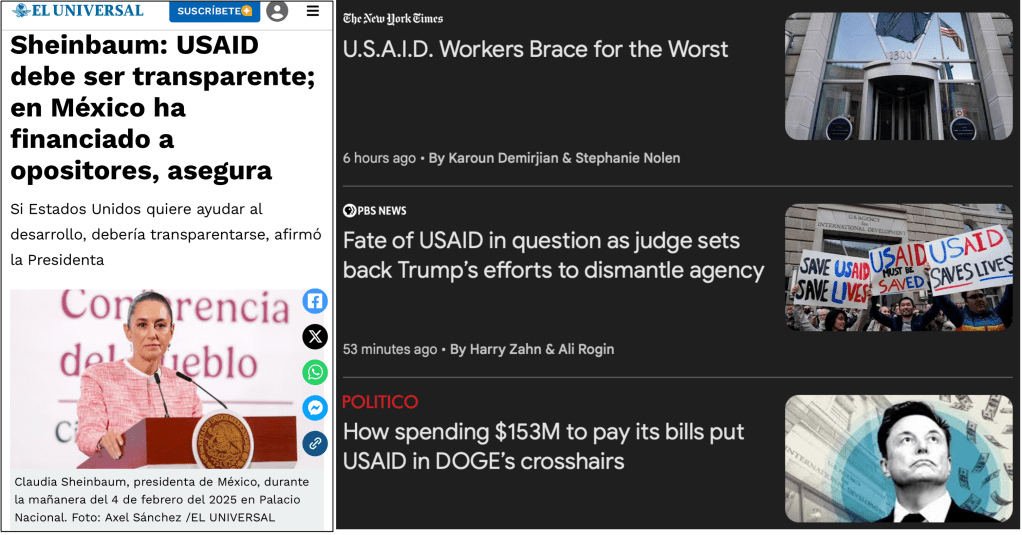
Sheinbaum (left): USAID must be transparent; in Mexico, it has funded the opposition. Right: USAID still in the headlines Feb. 8.

In her morning news conference on Feb. 4, Mexican President Claudia Sheinbaum, breaking away from the dispute over tariffs, lashed out at the overt political activity of USAID. “This agency has funded research projects and groups opposed to the government. That’s the case with Mexico.”
She mentioned an organization that she called, “Mexicans for Corruption.” (She was only half-joking: it’s Mexicans against Corruption. The group actively opposed her predecessor Andrés Manuel López Obrador’s effort to reform the judicial system, and it had support from USAID.) 
“And how is it that they get involved in politics, those agencies that are about aid. In that sense, if the United States wants to help with development, it should be transparent,” she continued.  “The truth is that there are so many things USAID does that in truth it is better they close it.”
In a similar vein, Colombian President Gustavo Petro said some U.S. help is not welcome and has to go. “Hundreds of immigration officials who guard our borders were paid by the United States. This aid is poison,” he said during a Feb. 3 cabinet meeting. “That should never be allowed. We are going to pay with our money.” In 2024, the agency paid nearly $385 million to Colombia.

Haïti chérie

Which brings me to Haiti, a country whose heartbreak I know well. For more than 45 years, it has been particularly afflicted by HIV and AIDS. The ongoing political crisis, worsened by uncontrolled activity by criminal gangs, continues to hamper relief efforts including support to people living with HIV and AIDS

Repeated U.S. interventions have made things worse. From 2011, with the presidencies of Michel Martellyand Jovenel Moïse and then the unelected leadership of Prime Minister Ariel Henry through early 2024, the United States and the local elites had the leaders they wanted: men close to the business sector who had close ties in the United States.

That fruitless model was finally shoved aside last June 11 with the installation of a transitional council (CPT). It’s wobbly but hope persists that it can finally organize new elections that produce leaders that Haitians want. A truth commission and an electoral council have been named.

In the meantime, the problem of gang violence is being addressed (though ineffectively) with the addition of the Multinational Security Support Mission (known as MMAS), led by police from Kenya and bolstered with police from El Salvador and Guatemala. Despite UN backing and many promises, it is underfunded and understaffed.

Feb. 4: U.S. aid to the security mission is frozen. Feb. 6: aid is renewed

A new blow came Feb. 4 when the UN announced that the shutdown of USAID meant funds for the MMAS were frozen. But two days later, U.S. Secretary of State Marco Rubio announced that MMAS would be protected despite the USAID cut, adding to speculation that Rubio, Musk and Trump are not all operating from the same playbook.

In the wake of the axing of USAID, the best piece that I have read about its activities in Haiti is by a long-time observer, Jake Johnston of the Center for Economic Policy and Research (CEPR). At the end of a Feb. 4 essay about the agency’s work in Haiti, he writes:

The term “aid” encompasses many different things: humanitarian assistance and development programming, contracts and grants, support to local organizations and multimillion dollar contracts to DC-area firms. 

There are many parts of the US foreign aid industry that can and should be stopped or significantly reformed. But that doesn’t mean that shutting down USAID, or making its assistance even more overtly political by placing it under the umbrella of the State Department, is going to be a good thing, either in the short or long term. 

The reality is that, where foreign assistance is least effective, it is largely because it is designed to promote US interests rather than address the needs of those ostensibly on the receiving end. The changes announced by the Trump administration are not likely to truly disrupt US soft power abroad. If anything, it will make political interventionism an even more explicit aim of US foreign assistance.
Summit of the Americas: U.S. can’t break old habits

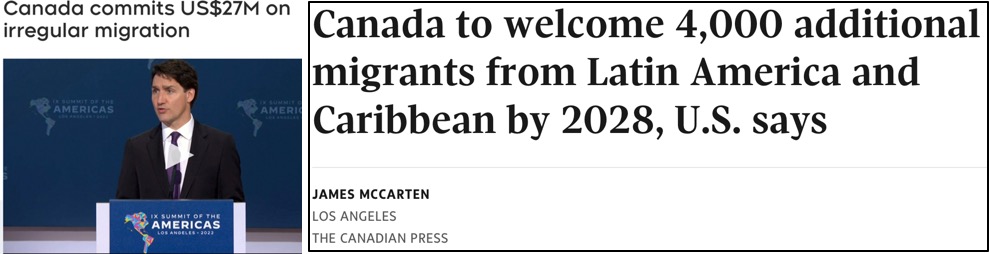
That the White House announced Canada’s planned response to the flow of refugees in Central America said a lot to me about the way the Biden administration mishandled the Summit of the Americas, held in Los Angeles last week.

Canada will welcome 4,000 additional migrants from Latin America and the Caribbean, the White House announced on June 10. That number is insignificant compared to the size of the challenge: 

  • Mexico reported apprehending 307,679 undocumented migrants in 2021. About one-third were deported; another third sought asylum in Mexico. The main countries of origin of those apprehended were Honduras (41%), Guatemala (26%), El Salvador (8%), Haiti (6%), Brazil (5%), Nicaragua (5%), Cuba (2%), and Venezuela (1%). None of the leaders of Mexico, Honduras, Guatemala or El Salvador chose to attend the summit – and Nicaragua, Cuba and Venezuela were told by Biden not to come. It’s hard to solve problems when you’re not talking to people who can do something about them.
  • As of February in the United States, about 164,000 (Reuters) or “just under 179,000” (Axios) migrants are currently in alternatives-to-detention programs managed by Immigration and Customs Enforcement  (ICE). This is “roughly double the total on Sept. 30, 2020, before Biden took office,” Reuters reported, and doesn’t include dependents – or the people actually held in detention.

The White House announcement of Canada’s support included commitments from other countries on migration issues, and was reported by Canadian Press in an article widely shared in Canadian media (CBC, CTV, the Globe and Mail, among others).

“The agreement also includes a pre-existing Canadian commitment to bring in an additional 50,000 agricultural workers this year from Mexico, Guatemala and the Caribbean.” (Those are temporary workers whose rights are limited.)

To its credit, the government (via the Prime Minister’s Office, not Global Affairs Canada) also announced an additional $118 million for “progressive initiatives” aimed at improving the lives of people where they already live in Latin America and the Caribbean. That includes $67.9 million to promote gender equality; $31.5 million in health and pandemic response spending; $17.3 million on democratic governance and $1.6 million for digital access and anti-disinformation measures. It will also spend $26.9 million to address “irregular migration and forced displacement” in the hemisphere.

Washington “still trying to dictate” to neighbours

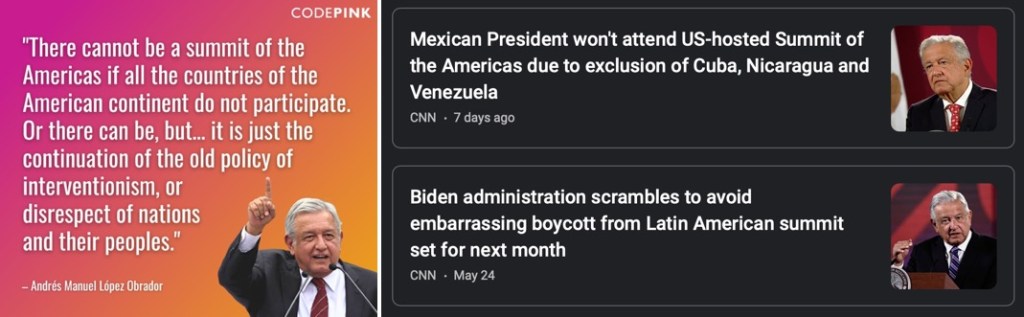
But it was the exclusions and boycotts that drew most attention. Because Venezuela, Cuba and Nicaragua were excluded by the host country, Mexico, Honduras, Bolivia and some Caribbean leaders chose to stay away. Leaders of Guatemala and El Salvador did not attend because of issues with U.S. treatment of allegations of corruption and abuses of human rights in their countries. In the end only about 20 of potentially 35 heads of state or government attended.

Apparently modelling the art of understatement, Reuters reported: “Hosting the Summit of the Americas in Los Angeles, Biden sought to assure the assembled leaders about his administration’s commitment to the region despite nagging concerns that Washington, at times, is still trying to dictate to its poorer southern neighbours.”

The presence of the unelected prime minister of Haiti, Ariel Henry, drew fire. During a panel discussion on “journalistic freedom,” U.S. Secretary of State Antony Blinken had the good grace to seem embarrassed when challenged over Henry’s presence. As Alterpresse pointed out, “not only does Henry govern without a mandate in violation of the Haitian Constitution, he is also implicated in serious crimes, including the death of a Haitian journalist in February 2022 by Haitian police.” (Two other journalists had been killed in January in a gang attack.)

In the tradition of each Summit of the Americas (including the teargas summit in Quebec City in 2001), a People’s Summit was held, gathering more than 250 community organizations, social movements, trade unions and other progressive groups. “In the ‘richest country in the world,’ 140 million live in or near poverty. The US government is addicted to militarism and war and will spend over $800 billion in 2022, on death and destruction,” said the final declaration. “Instead of preparing for war, society must be organized to meet human needs. We want a future without evictions, police violence and mass incarceration, deportations, sanctions, and blockades. We say: no more!”

What is to be done? Tolstoy, Lenin, John the Baptist and recent elections

Xiomara Castro, president-elect in Honduras. Right: “Long live the People in Resistance” – post coup graffiti.

Soon after my return to Canada from my first visit to the Dominican Republic in 1983, I saw Peter Weir’s brilliant film, In a Year of Living Dangerously. As a socialist option in Indonesia collapses through local intrigue and U.S. intervention, Linda Hunt’s character, Billy Kwan, asks obsessively: “What is to be done?”

In the wake of my encounters with Haitian cane-cutters and Dominican and Haitian activists, it became my question too.

Billy Kwan’s question alludes to Lenin’s 1902 manifesto that called for a new vanguard organization that would be dedicated to taking power. Lenin took his title from two earlier works by Russian authors. In 1863, Nicholas Chernyshevsky issued a manifesto that imagined a new social order. Twenty years later, Leo Tolstoy took the same title to offer a vision of the renewal of individual moral responsibility.

But the question actually comes from the Bible. In Luke 3:10—part of the lectionary readings in many churches this Sunday, Dec. 5, the second Sunday of Advent—the people ask John the Baptist: “What are we to do?” And John answered, “If you have two coats, give one to the person who has none; and if you have food, do the same.” 

Later, in Luke 12:16-21, the question appears in Jesus’ story about the rich fool: “There was a rich man and his land had produced a good harvest. He thought: ‘What shall I do? For I am short of room to store my harvest.’So this is what he planned: ‘I will pull down my barns and build bigger ones to store all this grain, which is my wealth. Then I may say to myself: My friend, you have a lot of good things put by for many years. Rest, eat, drink and enjoy yourself.’ But God said to him: ‘You fool! This very night your life will be taken from you; tell me who shall get all you have put aside?’ This is the lot of the one who stores up riches instead of amassing for God.”

Life is too short for the poor to wait for wealth to trickle across the greatest breach between rich and poor that this planet has ever known. While some of us in the North think we have the luxury of sitting back to see how things go—except that climate change seems to have finally got our attention—the impoverished must always take risks and try something new.

Since the election of Salvador Allende in Chile in 1970 and despite the coup led by Gen. Augusto Pinochet three years later, the left in power in Latin America has tried to govern according to the rules of liberal democracy, arguably without sufficient regard for the roles of money, foreign interference and private media companies.

Confronted by poverty, after “lost decades” of development, social movements in Latin America began to develop alternative policy approaches in the 1990s. Smart politicians paid attention and in one country after another—imperfectly, with lots of mistakes—the “formal democracies” of old began to be transformed.

That “pink wave” did not last. A military coups in Honduras and Bolivia, parliamentary coups (or “lawfare”) in Paraguay and Brazil, devastating impacts of U.S.-led (backed by Canada) sanctions in Venezuela, the power of money in Ecuador and petty corruption all weakened the drive for lasting change.

Left and centre: Chile’s election pits Gabriel Boric against José Antonio Kast. Right: the party of Nicolás Maduro won most regional elections in Venezuela. (Images from Página 12, Argentina)

A second progressive wave?

In October 2020, voters in Bolivia restored the “Movement for Socialism” (MAS) party to power just a year after the coup. In June, voters in Peru elected a rural teacher, Pedro Castillo, to be their president. In November, Venezuela’s ruling PSUV party won almost all state-governor races. Later in November, voters in Honduras chose Xiomara Castro, whose husband Mel Zelaya had been overthrown in a coup backed by the United States and Canada in 2009, to be their new president. 

The next test comes in Chile on Dec. 19, when a Pinochet-loyalist, José Antonio Kast, faces a centre-left candidate, Gabriel Boric, in a second-round run-off vote.

No country is the same as another, and specific issues pertain to each of the elections noted above. But the big loser in most of these votes is the United States, together with ever more deferential Canada. Latin Americans are again choosing leaders who do not have the interests of the United States at heart.