A new president is in office in Washington. For the sake of immigrants, LGBTIQ people, women, and racialized and religious minorities, one cannot help but be glad of this change, and of the opportunities that are re-opened for people who were excluded or attacked during his predecessor’s term.
But once again, the notion of development is again prescribed as a remedy for whatever it is that drives migrants—notably and urgently, those from Central America—towards the southern border of the United States.
On his first day in office, President Joseph Biden’s administration promised to invest $4 billion in the region to address issues of security and employment. A new immigration reform bill, the U.S. Citizenship Act of 2021, was introduced. Aid and investment from the United States, it is hoped, will encourage people to stay home.
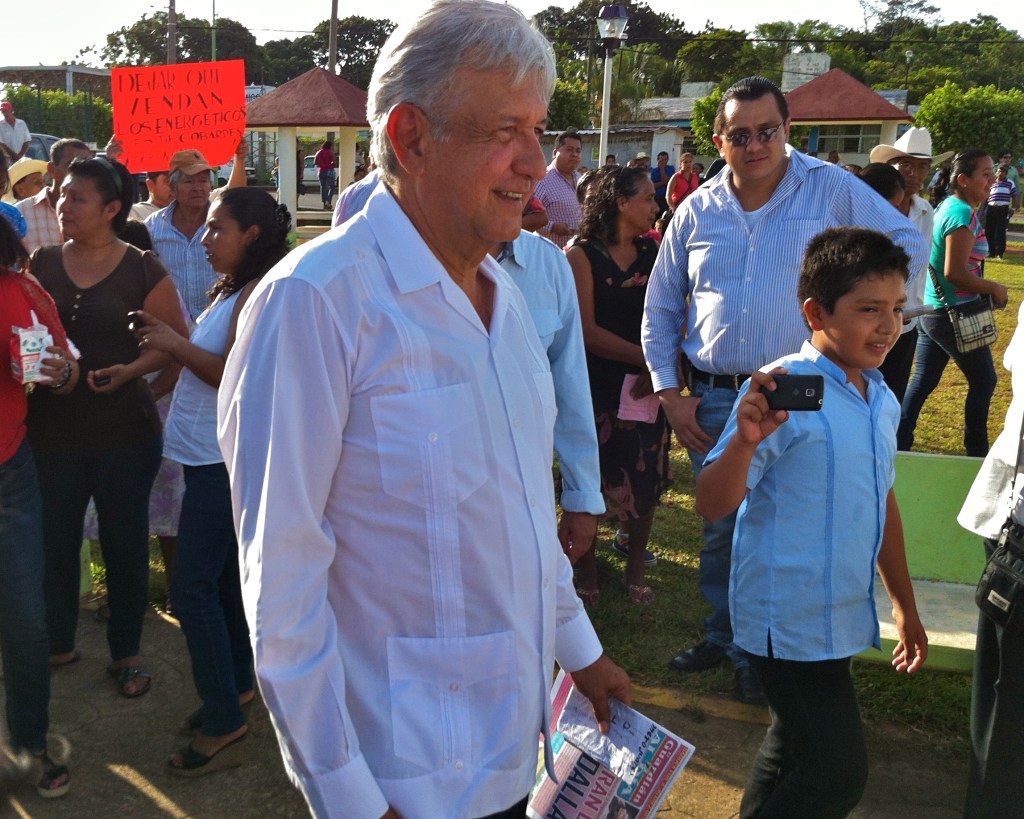
President Andrés Manuel López Obrador (Jim Hodgson photo)
Two days later, Mexican President Andrés Manuel López Obrador,spoke with Mr. Biden and concurred. “We believe that the causes of the migration phenomenon must receive attention. People do not abandon their families, their towns, their cultures, out of pleasure. They do it because of need. We want migration to be optional, not forced, that all the people of the Central American nations and our own have options, that they be able to get ahead where they were born, where their families are, where their cultures are. And for that, development cooperation is very important.”
With history as a guide, however, we can see some problems with the prescription. Two decades ago, another new president of Mexico, Vicente Fox, launched the Plan Puebla Panamá for regional economic development. The name has changed several times since then, depending on which countries were in and which were excluded because their citizens had made electoral choices that were unacceptable to donors. Airports were expanded, highways widened, mines dug and hydro-electric dams built, but still, people left by the thousands, tens of thousands, especially from Guatemala, Honduras and El Salvador.
Those large-scale projects enable the rich, expanding the divide between rich and poor within the region and indeed, everywhere. And no one is acknowledging that among the root causes are wounds left from US-sponsored coups and civil wars, along with deportations of alleged criminals into unstable systems—or rather, into systems whose only sector capable of their social integration is the criminal one.
We know what to do differently. Development assistance should always be focused on building “economies of solidarity”—innovative agriculture that respects ecology, local markets, cooperatives and credit unions, leadership by women, full consultation with communities and civil society organizations. Indigenous people and farmers should never be driven from their land by transnational corporations—a key consequence of a generation of free trade agreements in Mexico, Central America and Colombia and driver of migration—but rather trade and investment should benefit all people.
With this post (during International Development Week), I am reviving a blog I that I used while I worked with The United Church of Canada as its Latin America/Caribbean program coordinator. Please look here for more information about me.
Panel on human rights, faith and sustainable development
This year marked the 70th anniversary of the Universal Declaration of Human Rights. In their final declaration, the religious leaders who attended the recent G20 Interfaith Forum in Buenos Aires noted the religious “inspiration and moral teachings of the religions” in the Declaration, and they re-affirmed their commitment to defend human rights. They also expressed concern for the course of globalization that has produced new forms of slavery, and rejected all forms of human trafficking.
The global partnership program of The United Church of Canada supports the work of CREAS, a centre that provides training and support to faith-based organizations (FBOs) across Latin America and the Caribbean. Like other ecumenical initiatives that we support—from the World Council of Churches to KAIROS—CREAS engages with political and economic systems to open space for discussion of ethical values.
During the G20 Interfaith Forum panel on religious liberty, Elena López Ruf (at left, in photo above), the religion and development program manager at CREAS, said her organization works with others on sustainable development goals (SDGs) to bring perspectives that reflect moral and ethical values to that common agenda. These, she said, are centred on the human person and, as the SDGs proclaim, are to ensure that “no one is left behind.”
In a subsequent panel on human rights, faith and sustainable development, Elena and two colleagues from the Argentina office of the UN Development Program described how they work together and with others to achieve SDG 17 (“partnerships for the goals”). This is a process to work among FBOs to exert influence on implementation of all the goals. FBOs bring an ethical dimension to the SDGs, and recognition of the role of religious organizations in development. Such recognition is now greater than before, Elena said. “Development is not just economic; it is integral and multi-dimensional, including religion,” she added.
During the period after World War II, as the concept and structures of international development were being created, global leaders may have thought religion would simply disappear as education improved and secularism took hold. In a sense, the UNDP work with CREAS in Argentina is a kind of pilot project of how UNDP can work with FBOs in ways that measure results of proposals, actions and projects. Marcos Lópes of the Christian Aid office in Brazil said this is “not just green-washing,” but is rather “promoting a new future.” Elena noted some historic elements—some as recent as Pope Francis’ encyclical Laudate Si’ (May 2015). The encyclical speaks of integral development, though not explicitly of the SDGs that were launched a few months later.
This discourse about religion and development reflects what I heard a year ago in Geneva at an ecumenical gathering on diakonia and sustainable development. And I think it’s good that FBOs press governments harder on ethical dimensions of development—including human trafficking, impacts of climate change, mass migration, gross inequality, and gender justice.
Multilateral systems of development, human rights, under threat
But I worry sometimes that the cost of access to such tables is dilution of the justice messages. The times we live in require prophetic voices.
Together with the human rights declaration, the notion of international development was born in the late 1940s as nations re-ordered their relationships in the wake of the two disastrous world wars. They created new institutions to shape political and economic relations, and to bring the global “south” (or “third world,” we used to say) into this new order.
In June, when Canadian foreign minister Chrystia Freeland received an award as diplomat of the year, she talked about a “rules-based” international order that was under threat from what she called “authoritarianism.”
We may differ about which rules—trade rules, for example, are made for corporations, not for people’s well-being or the environment. The authoritarians she mentioned most often were leaders of Russia and (incorrectly, I believe) Venezuela. But I think she was also levelling criticism at the right-wing populists who are taking over in the United States, Philippines, Turkey, Colombia—and more locally, in Ontario and now Quebec. In Brazil, perhaps the worst of them all may win power in an election at the end of October.
“The truth is that authoritarianism is on the march—and it is time for liberal democracy to fight back,” said Freeland.
Part of the problem is that liberals (and social democrats) seem to forget the struggle to win rights from the old land-owning elites, even while it’s the spiritual heirs of the old elites who are winning power today.
A few days after the G20 forum, during a round-table meeting of CREAS with its global partners, a panel tried to address the issues of this “epoch-changing” time. We celebrated proposals to address issues and systems. It’s not that we’re doing nothing. But we need to “cut the distances not only between our projects and communities and partners, but also between countries and communities and religions.”
In our times, we all face the same perils. We must continue to build alliances North and South for, in the words of Pope Francis, the benefit of “the poor and the Earth, our common home.”
During my visit to Buenos Aires, I found myself in a public conversation about religious freedom. This is a topic that I usually avoid, knowing that I get angry, especially at those Christians who reduce religious freedom to their own will to discriminate against others with whom they disagree or of whom they disapprove. To me, freedom of religion is like freedom of speech: to be upheld until it imposes itself on the rights of others to be who they are, or when it becomes a threat to our personal security.
For those of us who identify ourselves anywhere in the 2SLBGTIQ+ acronym, freedom from religious fundamentalism and specifically from promotion of homophobia and transphobia is vital. We live in a time when some politicians turn gender justice against women and sexual minorities to win support from religious fundamentalists.
Having sat through an hour of praise for religious freedom, vitality, and the role of religion in achieving the Sustainable Development Goals—without any of the panelists saying anything about victims of religious fundamentalism—I rose to my feet. I was cautious, and tried to outline a different approach.Instead of blaming the speakers or making the issue about myself, I pointed to the creation in 2016 of Global Affairs Canada’s Office of Human Rights, Freedom and Inclusion as a good example of a different approach.*
To me—and this is what I said to the panelists—the greatest value of the new office is that it places religious leaders in a space with people who are too often targeted because of their race, national origin, sexual orientation, or gender identity or expression. I asked how the panelists viewed religious freedom in the context of other freedoms and rights.
In response, Dr. Ahmed Shaheed, UN special rapporteur for freedom of religion or belief, said religious freedom cannot be upheld in ways that undermine the rights of others. He insisted on equality. Another panelist, Elder Todd Cristofferson of the Church of Latter Day Saints’ Quorum of 12 Apostles, spoke in terms of “fairness to all”—a pleasant surprise to me. Rabbi David Silverstein—religious freedom ambassador under President Barack Obama—spoke of the rights of groups not to be discriminated against, and said limits on religious freedom are appropriate.
This exchange took place in the plenary of the interfaith summit. We then moved into four parallel sessions, and the one that I attended was on Human Rights, Faith and Sustainable Development. Many of those who had been in the plenary also attended this session, including Dr. Shaheed. And here I learned a few things.
Faith for Rights
Maybe everyone else already knows about the work of the UN Office of the High Commissioner for Human Rights (OHCHR) on “Faith for Rights,” the Rabat Plan of Action and the Beirut Declaration, but I didn’t know. OHCHR staffer Michael Wiener walked us through them.
In 2012, section 36 of the Rabat Plan of Action laid out some of religious leaders’ core responsibilities against incitement to hatred:
refrain from using messages of intolerance or expressions which may incite violence, hostility or discrimination
speak out firmly and promptly against intolerance, discriminatory stereotyping and instances of hate speech
be clear that violence can never be tolerated as a response to incitement to hatred: there is no justification for violent retaliation.
This is not white-washing, insisted Mr. Wiener: faith-based actors can do good or bad. His role is to support faith leaders in positive action for rights. There are also 18 commitments adopted by faith-based actors in the 2017 Faith for Rights Beirut Declaration.
These include pledges to ensure non-discrimination and gender equality. They use religious texts and UN declarations to prohibit so-called honour crimes and female genital mutilation, and to call for an end to blasphemy laws and use of the notion of “state religion” to discriminate against individuals or groups. They set out to “de-mystify” or take away the impression that faith is against human rights. They re-affirm humanitarian aid principles of conduct, including that aid cannot be used to promote religion—which would be tantamount to coercion. Faith groups stand up for the rights of all minorities. Faith for Rights is an umbrella to bring them together, and proposes concrete projects to implement the commitments.
Mr. Wiener said that Dr. Shaheed (the UN Special Rapporteur for Freedom of Religion or Belief, sitting in the audience in this session), has described the Beirut commitments as “soft law standards.” They are not formally adopted by states (yet), but by using them, over time they become norms. Along with the official UN languages, nine other translations have been made: for example, Turkish and Greek for use in Cyprus; Serb and Albanian for use in the Balkan region, etc. They have been turned into tweets and given artistic expression in different places.
In our work to overcome religion-based homophobia and transphobia, honour crimes and female genital mutilation, blasphemy laws and anti-sodomy laws, we can use those publicly-stated commitments to remind those who would promote hatred and exclusion that other faith leaders have taken a different stance, and have UN backing.
* An example of how the government of Canada talks about religious freedom and LGBTI rights. Matt DeCourcey, Parliamentary Secretary to the Minister of Foreign Affairs of Canada, at the Ministerial on Advancing Religious Freedom in July 2018 in Washington: “We believe in fostering greater inclusion and equity for every person, including all faith and belief communities, women and children, Indigenous people, members of the LGBTI community, minority groups, and others who are often marginalized in society.… Since March 2017, Canada has been a member of the International Partnership on Religion and Sustainable Development where we are working with others to harness the potential positive impact of religion in sustainable development and explore the critical intersections between religion, development and gender equality –in an effort to ensure that no one is left behind.”
More information about LGBTI rights globally:
Dignity Network Canada: Since 2016, The United Church of Canada and Affirm United/S’Affirmer Ensemble have participated in the Dignity Network of NGOs, human rights groups and others that are committed to defend LGBTI rights globally and to press the Canadian government to do more.
Rainbow Faith and Freedom is a global movement that confronts religious-based LGBTI discrimination and improves the human and equality rights of LGBTI people everywhere.



 Unwrapping Development