Debt crisis again provokes “deprivation and misery” in Global South

Asia Debt Monitor, April 2023 

by Jim Hodgson

Forty years ago, I spent five weeks of July and August in the Dominican Republic, learning from families, churches and unions about the ways people confronted their impoverishment. The people that I met taught me about long-haul, multi-generational struggle and solidarity.

Soon after that visit, protests in the D.R., Egypt and Peru erupted against conditions imposed by the International Monetary Fund (IMF) and foreign banks. The issue then – and again now – was how to cope with national debt, budget deficits, and rising interest rates.

The 1984 debt crisis: “Dominicans pay in blood”

You are plunging Global South countries into a greater debt debacle that will cause more deprivation and misery,” wrote the Asian Peoples’ Movement on Debt and Development (APMDD) to leaders of the G7 rich countries on the eve of their mid-May summit in Hiroshima, Japan. Countries as diverse as Argentina, Pakistan, Sri Lanka and Zambia have confronted large debt and harsh repayment conditions in recent months. (Zambia has reached an agreement with lenders to restructure $6.3 billion of debt.)

This month, new reports from two United Nations agencies provide warnings and suggest some solutions to the weight imposed by banks and Global North governments on the people of the Global South.

The UN Development Program (UNDP) said 165 million people were forced into poverty between 2020 to 2023 as debt servicing pushed aside expenditures for  social protection, health and education. All of these additionally impoverished people poor live in low- and lower-middle-income economies, with the most-impoverished 20 per cent in low-income countries suffering the most with incomes in 2023 still below the pre-pandemic levels. Their governments cannot do more to assist because of conditions attached to debt repayment plans.

The UN Conference on Trade and Development (UNCTAD) said that public debt has increased faster in developing countries compared to developed countries over the past decade. “When developing countries borrow money, they have to pay much higher interest rates compared to developed countries, even without considering the costs of exchange rate fluctuations. Countries in Africa borrow on average at rates that are four times higher than those of the United States and even eight times higher than those of Germany.”

UNCTAD reports that 3.3 billion people live in countries were interest payments on debts are greater than spending for education and health care. An editorial in Mexico City’s La Jornada daily newspaper recalled thatUN Secretary General Antonio Guterres has denounced this injustice as “systemic failure.”

In a second editorial a day later, La Jornada noted the impact of Global South debt on efforts to confront the climate emergency. “In 2015, the 10 per cent of the world’s wealthiest people were responsible for half of the greenhouse gas emissions, and only one per cent were responsible for 15 per cent of those emissions. The most impoverished half of the people of the Earth generated only seven per cent of the emissions, but it is they who are most affected by climate change, higher food prices and even the destruction of their homes in severe weather events. The countries whose transnational corporations devastate the environment of the Global South with their unceasing extraction of natural resources close their doors to migrants and condemn them to remain in regions that have become uninhabitable because of the actions of those corporations.”

Historically, the ways that the IMF, banks and Global North governments have contended with debt crises have been to use them as opportunities to push neoliberal development models: free trade, extractivism, privatisation of state-owned companies and services, low-wage factory jobs and export-focused agriculture. And they avoid conversations about debt cancellation and reparations for colonialism and slavery.

APMDD and other Global South movements propose different approaches. In the letter cited above, APMDD urged G7 governments to: 

  1. Cancel the debt for countries in need, including public debts of a questionable and fraudulent nature that violated human rights and contributed to exacerbating the climate crisis.
  2. Support the elimination of IMF surcharges, which penalizes the most debt-distressed countries and further erodes the capacity of developing countries to respond to urgent social needs. 
  3. Enact/strengthen national legislation to require the participation of private creditors in debt relief, which is a key element in any serious wide scale debt reduction or restructuring effort. 
  4. Immediately deliver new, additional and non-debt creating climate finance for adaptation, mitigation and loss and damage, much more than the unfulfilled $100 billion/year pledge, to adequately meet the needs of the Global South. 

Once in a while, cracks appear in the wall of Global North indifference. In June, French President Emmanuel Macron convened a summit to reach a new “global pact” to finance the fight against poverty and human-induced climate change. I’ll share some outcomes in coming days.

Womin is a network of women’s organisations across Africa that proposes cancellation of African debt and ecofeminist alternatives to extractives models of development.

Talking about peace when there is no peace*

Jim Hodgson, May 23, 2023

Peace is a pre-condition for any possibility of transforming the global economy for the sake of humanity and the Earth – or, more modestly, achieving those elusive Sustainable Development Goals by 2030.

In the weeks after Russia’s invasion of Ukraine, I added my voice to those of others who pleaded for peace talks. In recent weeks, new efforts from church leaders and global South political leaders are underway to bring the sides together. But peace initiatives are either ignored or disdained by most media and “Western” leaders.

Headlines and images from Mexico’s La Jornada and Argentina’s Página 12 newspapers. On the left, Lula asks that a new Cold War between China and the United States be avoided and defends the use for currencies other than the U.S. dollar for international trade. On the right, from top: Zelensky asks for support from G7 powers; G7 leaders create new sanctions against Russia and debated in Hiroshima the nuclear arsenals of other countries; The Vatican makes its peace effort official so as to end the war in Ukraine.

Case in point: the participation at the recent G7 meeting in Hiroshima of Brazilian President Luiz Inácio “Lula” da Silva and Indian Prime Minister Narendra ModiFinancial Times dismissed Lula and Modi as Russian President Vladimir “Putin’s apologists.” Their participation was eclipsed by that of Ukrainian President Volodymyr Zelensky, who did meet with Modi, but blamed scheduling conflicts for not meeting Lula – and then joked with reporters that Lula was more disappointed than he was. 

Well, yes. Lula’s interest in peace has everything to do with funds diverted to war and away from efforts for authentic development that could help alleviate the other crises of climate change and migration. (Lula also said that Zelensky did not show up for a meeting they had scheduled.)

In Hiroshima,  Lula criticized the division (or re-division) of countries into two antagonistic blocs and abandonment of a multipolar world that seemed to be emerging in the wake of the pre-1991 Cold War.

Meanwhile, South African President Cyril Ramaphosa was not even invited. But he and other African leaders are involved in a peace initiative to end the war in Ukraine. In a news conference May 17, he said he had had “separate telephone calls” with Putin and Zelensky over the weekend, where he presented an initiative drawn up by Zambia, Senegal, the Republic of Congo, Uganda, Egypt and South Africa. Leaders of the six countries say they plan to travel to Russia and Ukraine “as soon as is possible.”

In his weekly newsletter on May 15, Ramaphosa said South Africa would not be drawn “into a contest between global powers” despite having faced “extraordinary pressure” to do so.

“We do not accept that our non-aligned position favours Russia above other countries. Nor do we accept that it should imperil our relations with other countries,” Ramaphosa said.

During the same week, Chinese envoy Li Hui visited Moscow, his first stop in a European tour that would also take him to Kyiv, to develop a 12-point plan proposed by Beijing on the first anniversary of the Russian invasion. 

Last September, Mexican President Andrés Manuel López Obrador called for establishment of a Commission for Dialogue and Peace that would facilitate the search for a solution through negotiations. 

Nobody has a “magical formula to achieve peace,” writes Juan Pablo DuchLa Jornada’s Moscow correspondent. “But [proponents of peace] hope that Russia and Ukraine would establish a ceasefire and sit down to negotiate their conditions with the objective of putting an end to the bloodshed and devastation. All that is lacking is that Moscow and Kiev by open to making concessions – the first not wanting to cede Ukrainians regions already annexed and the latter refusing to lose territory – but without concessions, it does not seem possible to open a path toward peace in a war that, say what you will, only brings calamities.”

WCC delegation with Ukrainian church leaders in Kyiv on May 11 (WCC photo); Patriarch Kirill with WCC general secretary in Moscow on May 17 (ROC photo).

Meanwhile, the World Council of Church and Pope Francis have both renewed their efforts for peace. 

In mid-May, a delegation led by WCC general secretary Jerry Pillay visited church and government leaders in Kyiv and Moscow. In Kyiv, the WCC delegation met with senior leaders of both the Ukrainian Orthodox Church and the Orthodox Church of Ukraine, two churches whose dispute has intensified since the Russian invasion. In Moscow, they met with Patriarch Kirill, head of the Russian Orthodox Church and widely viewed as a supporter of President Putin.

For his part, Pope Francis has given Italian Cardinal Matteo Zuppi the task of leading a mission in hopes it can “ease tensions” in the Ukraine war and lead to a path of peace. The pope has said has said he would go to Kyiv if such a journey would help bring peace, but said that could happen only if he could also visit Moscow.

* The phrase “peace, peace, when there is no peace” is found in Jeremiah 6:14 and later at 8:11. It is also found in Ezekiel 13:10 and 16. The direct criticism is of those who build flimsy walls and smear them with whitewash: a makeshift solution to a problem. The metaphor then and now is points to poor leadership. In our time, we can think of leaders who promise that war will lead to peace. “They have treated the wounds of my people carelessly,” writes the prophet Jeremiah, “saying ‘peace, peace,’ when there is no peace.”

War Never Again – Westerplatte, Gdansk, Poland (site of the first battle of World War II in 1939).

Haiti: another military intervention looms large

by Jim Hodgson

Haitians (whose own proposals for building a better country are persistently ignored) once again face an illegitimate government, one that has proposed a foreign intervention force to quell gang violence and to keep itself in power. 

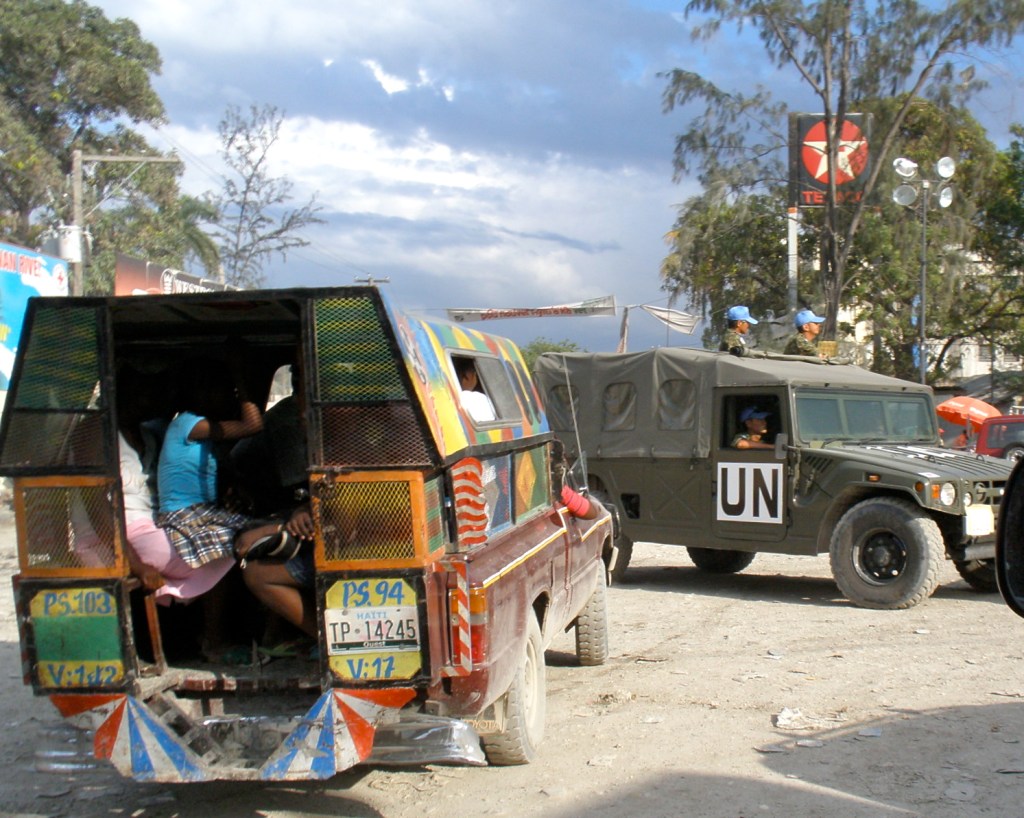
Haiti and the UN: another crossroads. Photo: Jim Hodgson, April 14, 2010, Port-au-Prince.

In reporting by many journalists from the global north, popular protest against the government, increased fuel prices, corruption and intervention is blended with reports of actions by the street gangs.

On Friday, Oct. 21, the UN Security Council approved its resolution authorizing a foreign military intervention and imposing sanctions on only one of Haiti’s gang leaders. (One might ask: when do gang leaders travel? Where do they go? Which banks do they use? Who sells them their weapons?)

The new intervention propositions emerged from the UN general secretary and Haiti’s “interim” prime minister: as if such interventions had worked in 1915, 1994, or 2004 to resolve the problems of people impoverished by the same imperial powers who are now invited to return.

Those powers misunderstand the present crisis. They can’t tell the difference between protest against the unelected government of Prime Minister Ariel Henry and the criminal activity of gangs. On Oct. 15, the United States and Canada delivered armoured vehicles for use by Haitian police.

Worse, the great powers continue to ignore the specific civil society proposals for a way forward that are contained in the “Montana Accord”  (named for the hotel where the group met). The group told a visiting U.S. delegation that it opposes foreign military intervention.

Cholera – never really eliminated after being brought to Haiti by support staff to soldiers in a previous UN force – is back. There are proposals to bring vaccines, but Haiti was able to deliver COVID vaccines to just a few more than three per cent of the population. Only 41 per cent of Haitian children are vaccinated against measles and 51 per cent are fully vaccinated against polio. Effective management of the cholera outbreak would require some sort of humanitarian truce, and that would require negotiations with the gang leaders – pretty much anathema to the imperial powers who seem more inclined to use force.

The current debates over the legitimacy of the government, possibilities for new elections, getting back on track with humanitarian aid and a reasonable development agenda are addressed in a new letter to U.S. President Joe Biden by four U.S. senators and nine members of the House of Representatives.

Recalling “decades of US meddling in Haiti’s internal affairs,” the group lauded the Montana Accord, which proposes a transition period that will ultimately result in elections, adding:

“None of these weighty issues can be addressed effectively in isolation. Neither free and fair elections, nor effective delivery of humanitarian assistance, are possible until the violence is quelled. Yet the Haitian police conspire with the gangs, and past U.S. efforts to build a professional, accountable police force have failed. The violence can only be quelled by Haitian authorities acting consistently with the rule of law through impartial judicial processes.”

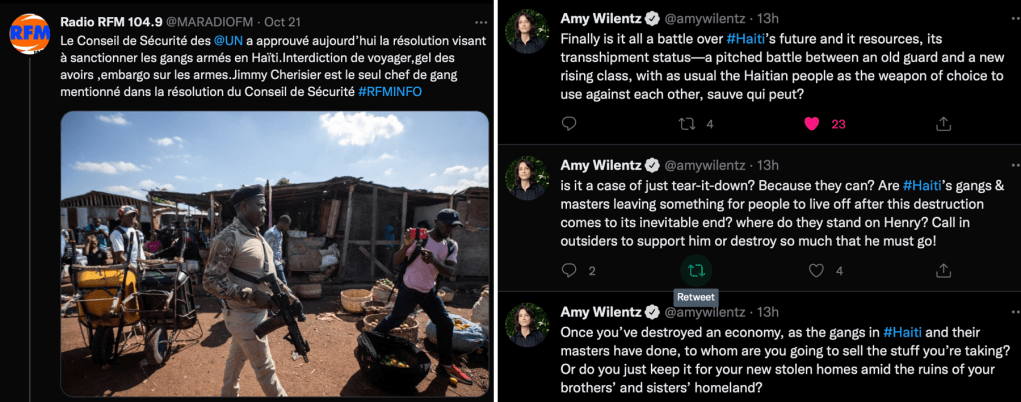
News of the UN Security Council resolution (left); earlier, Amy Wilentz, a noted U.S. writer on Haitian events, expressed her doubts about intervention proposals.

I’ll share a short reading list with you:

Edwidge Danticat (my favourite Haitian writer) in The New Yorker: “The Fight for Haiti’s Future.” The United States and its allies should withdraw their support support for Henry and the Parti Haïtien Tèt Kale (P.H.T.K.), the Haitian Bald-Head Party. “During the Party’s decade in power, Haitians have consistently taken to the streets to protest against P.H.T.K. leaders’ ineffectiveness and corruption, and to demand accountability for the funds misused, misappropriated, and pilfered through Venezuela’s oil-purchasing program, Petrocaribe. Accountability never came.”

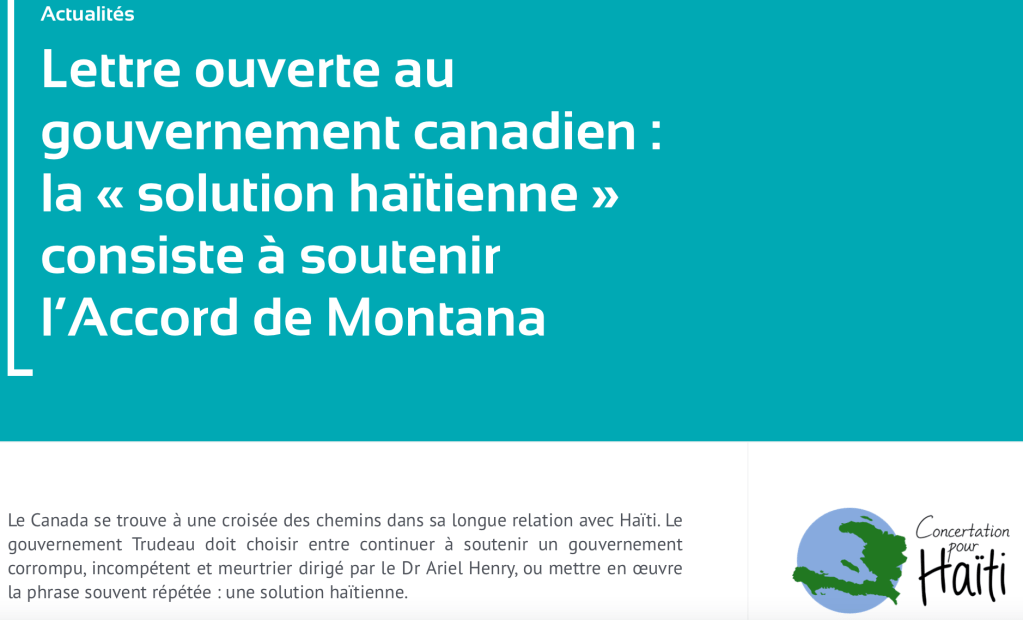
If you read French and would welcome regular updates on what is going on in Haiti, I would encourage you to sign up for Info-Haïti. This is the monthly bulletin of Concertation pour Haïti, a Montreal-based coalition of civil society organizations. Write to: communications@aqoci.qc.ca or follow the Concertation on Twitter at: @haiti_pour. 

On Oct. 20, members of the Concertation produced their own letter to the government of Canada with recommendations for a way forward. “Canada must now stop supporting the government of Ariel Henry and put its full weight behind this coalition, which offers the only viable proposal for a transition that would allow Haitians to organize free and fair elections. To continue to support the current Prime Minister is to condemn the country to corruption, impunity, the continued domination of gangs, and ever-worsening food insecurity.”

A former U.S. ambassador to Haiti, Dan Foote, has warned that if the U.S. moves forward with the UN plan to send armed forces into Haiti, the result will be a predictable catastrophe.

And The New York Times has managed to produce pretty useful lesson plans for teachers about Haitian history and culture.