Fifty years of A Theology of Liberation

Jim Hodgson

My background is in journalism (not theology), but I made a sort of career at the intersections of journalism, religion and Latin America. I have been close to conversations about and actions deriving from liberation theology for about 40 years. I am a follower of Jesus formed in liberation theologies that I learned alongside sugar-cane cutters, Indigenous communities, queer and trans people—folks who struggle for liberation the world over. Theirs are the stories I try to share.

Liberation theology is a method of doing theology, not a topic, Elsa Támez has said. It begins with a situation of repression and God’s call to transform that situation. Theology then is a reflection on God’s action in history. In the mid-1980s, however, Pope John Paul II and his head of the Congregation for the Doctrine of the Faith, Cardinal Joseph Ratzinger (later Pope Benedict XVI), made liberation theology a topic of heated debate. As a young journalist, I covered that debate (see the items at the bottom of this post), but over time, I concentrated more on the stories of the people who worked for change.

This year, we celebrate the publication 50 years ago of Teología de la Liberación, Perspectivas, the book that brought together a series of reflections on the practice of ministry, or the praxis of liberation, among the impoverished people of Latin America. The English translation, A Theology of Liberation (Orbis), appeared two years later. His second chapter is a critique of what was wrong with development in Latin America in the 1960s that remains valid today.
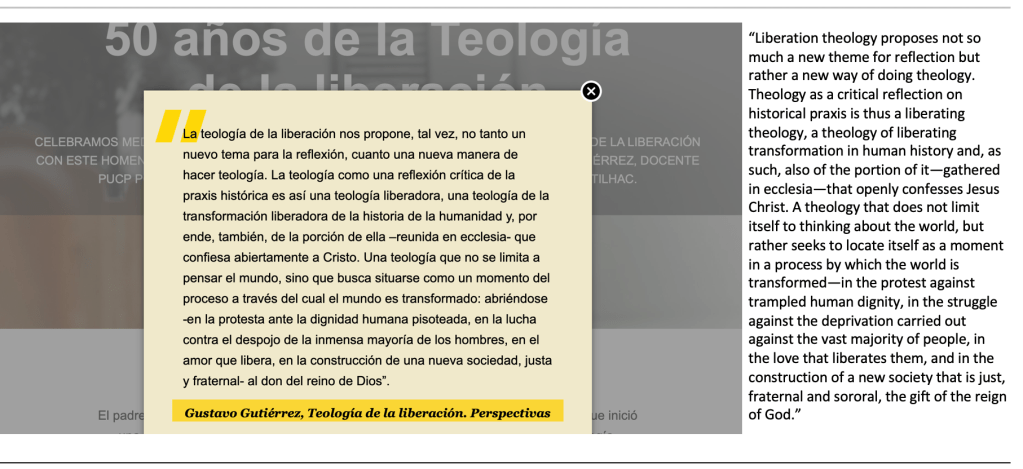
Image from the tribute to Gutiérrez on the website of the Pontificia Universidad Católica del Perú (PUCP).

The book’s author, the Peruvian priest Gustavo Gutiérrez, had been sharing his perspectives in conferences since the mid-60s, including in the summer of 1967 at the Faculty of Theology at the Université de Montréal.

He was never alone in those reflections, and others were working in similar or parallel veins. The African-American theologian James H. Cone published A Black Theology of Liberation in 1970 (Orbis). In Cuba during the 1960s, Sergio Arce developed a “theology in revolution,” which was about God in human history, especially in the revolution against poverty, exclusion and imperialism. In the 1960s and 70s, priests and other people of faith organized in new ways: Priests for the Third World in Argentina, the National Organization for Social Integration (ONIS) in Peru, the Golcanda group in Colombia, Christians for Socialism in Chile during the time of Salvador Allende.

Other contextual theologies emerged—Indigenous, feminist, womanist, queer, Minjung in South Korea—along with a wide spectrum of criticism, much of it helpful in adding “new subjects” that Gutiérrez had overlooked. But sometimes, the criticism was led directly to the persecution of the “church of the poor” and to countless murders and other violations of human rights. After the assassination in San Salvador in 1989 of six Jesuit priests, their housekeeper and her daughter, proponents of liberation theology spoke instead of Latin American theology, a situation that persisted until the election of Pope Francis in 2013.

From top left: Enrique Dussel, Elsa Támez, Frei Betto and Leonardo Boff. 
Bottom left: Chung Hyun Kyung, Miguel Concha. 
Dussel, born in Argentina and living in Mexico, is a philosopher and historian. Támez, born in Mexico, works with the Latin American Biblical University in Costa Rica and with Indigenus biblical translators. Frei Betto is best known for exploring political implications of liberation theology, and Boff is a leading proponent of ecological perspectives in theology: they are shown during a presentation at the first World Forum on Theology and Liberation, held in days ahead of the World Social Forum in Porto Alegre in January 2005.
In ecumenical circles, Chung is remembered for sparking good debate over Christian relations with other religions during and after the Canberra Assembly of the World Council of Churches in 1993. Concha is shown during a news conference by social movements during Pope John Paul II’s visit to Mexico City in 1999. Jim Hodgson photos.

Miguel Concha, a Mexican priest of the Dominican religious order and columnist at La Jornada, wrote on the occasion of the 40th anniversary of first publication of Gutiérrez’s book:

“Liberation theology is not limited to helping the poor individually. Nor is it reformist, trying to improve a situation but leaving intact the types of social relations and basic structures of an unjust society. Beyond moving ethically in the face of collective misery, it considers impoverished people to be subjects of their own liberation, valuing in them their awareness of their rights and capacity for resistance, organization and transformation of their situation.”

In these 50 years, I think the formal presentation of Gutiérrez’s method has become melded in our imaginations with other processes: 

  • the outcomes of the II Vatican Council and several meetings of Latin American bishops (CELAM), especially the articulation of the church’s “preferential option for the poor” at the CELAM conferences in Medellín in 1968 and in Puebla in 1979; 
  • the pastoral action of certain church leaders (Sergio Mendes Arceo, Hélder Câmara, Oscar Romero, Samuel Ruíz, the Argentinean Methodist Federico Pagura, among many others), whether they identified explicitly with liberation theology or not; 
  • a mix of popular education and base Christian community experiences; and the political action of movements like the Sandinista Front In Nicaragua in the 70s and 80s, or that which propelled Jean-Bertrand Aristide to the presidency of Haiti in 1990 and again in 2000.

During the last week of October, Fr. Gustavo, now 93 years of age, joined with scores of scholars and faithful for an online seminar to mark the anniversary. Videos of the presentations can be viewed (in Spanish) on the Facebook site of the Instituto Bartolomé de Las Casas.

I am appending here below parts of some to the articles I wrote in the mid-80s about the debates over liberation theology.
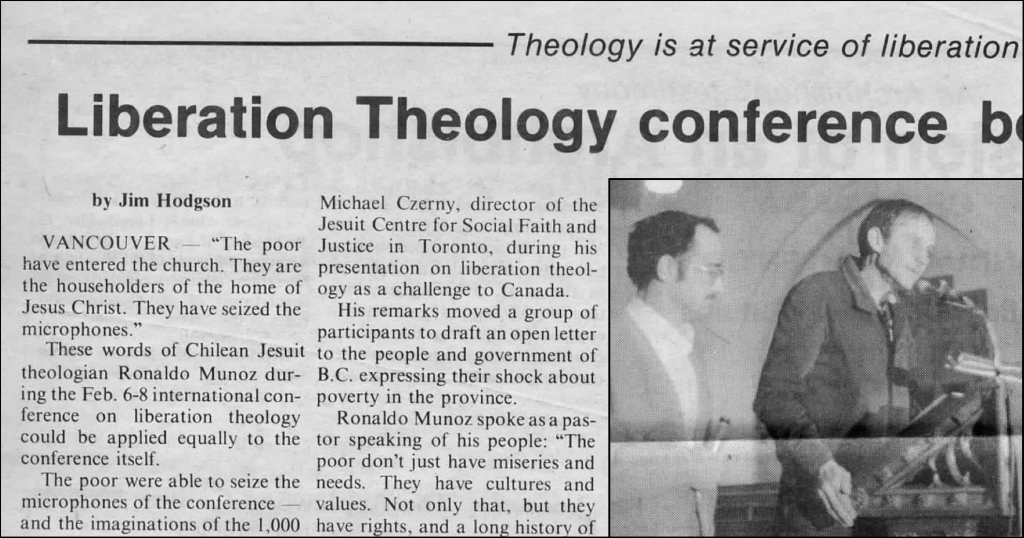
A thousand people attended a conference on liberation theology held at Simon Fraser University in February 1986. Among the speakers were Jesuit Fr. Michael Czerny (now a cardinal of the Roman Catholic Church) and Fr. Ronaldo Muñoz (not a Jesuit, but rather a priest of the Sacred Heart in Chile, who died in 2009). Muñoz said: “Liberation theology is telling of our experience of God in the context of our commitment to the struggle of the people: God in history, God in the Bible, in Jesus, in those who have been humiliated. The theologies of theologians, books, speeches, conferences in Vancouver, are in second place. Liberation theology seeks to be at the service of this struggle, this history of faith.”

Hélder Câmara (1909–1999) was the archbishop of Olinda and Recife, serving from 1964 to 1985. At the invitation of Youth Corps, a ministry of the archdiocese of Toronto, he participated events – “Circus of the Heart” and “Stories of the Heart” – in Toronto in 1985 and 1986. 
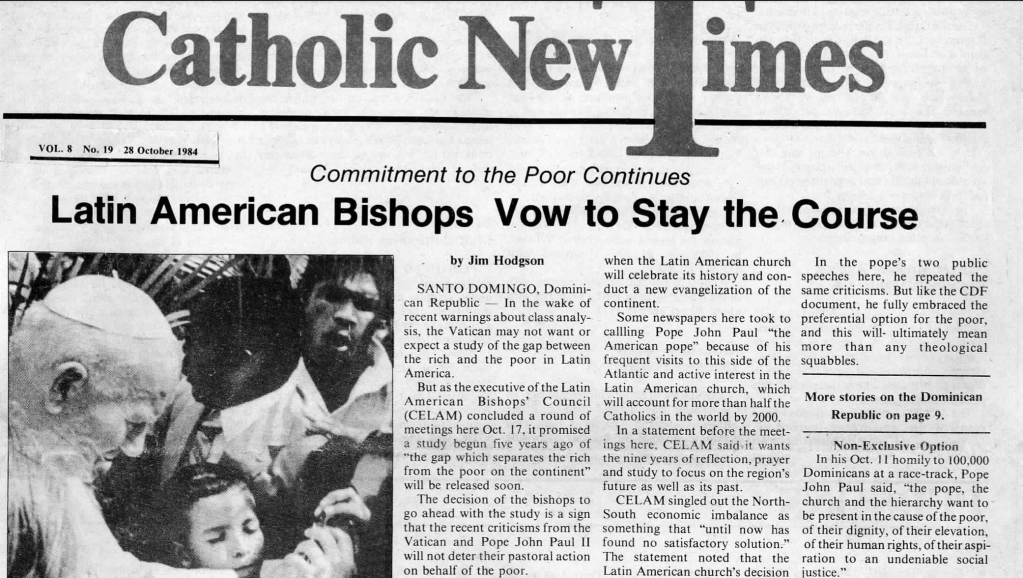
My first time “inside” the media bubble of accredited journalists on a papal visit. I remember the Vatican correspondents didn’t like me being on “their” bus around the Santo Domingo venues. Penny Lernoux (Cry of the People, 1980), Latin America correspondent of the National Catholic Reporter, took me under her wing to meetings with several of the more progressive Latin American bishops.

When elites see their wealth threatened, they move heaven and earth

On Nov. 11, 1979, San Salvador’s Archbishop Oscar Romero preached on Mark 12:38-44, The Widow’s Offering: Jesus watched the crowd putting money into the treasury. Many rich people put in large sums. A poor widow came and put in two small copper coins, which are worth a penny. Then he called his disciples and said to them, “Truly I tell you, this poor widow has put in more than all those who are contributing to the treasury. For all of them have contributed out of their abundance; but she out of her poverty has put in everything she had, all she had to live on.” 

Colombia’s president sends more troops to Cali to try to quell a month of protests. The British magazine The Economist invites a resurgence of U.S. imperialism to thwart the Mexican president’s option for the poor. The six-decade-long U.S. blockade of Cuba is so severe that the country cannot obtain sufficient syringes to protect its population with the vaccines it has developed.

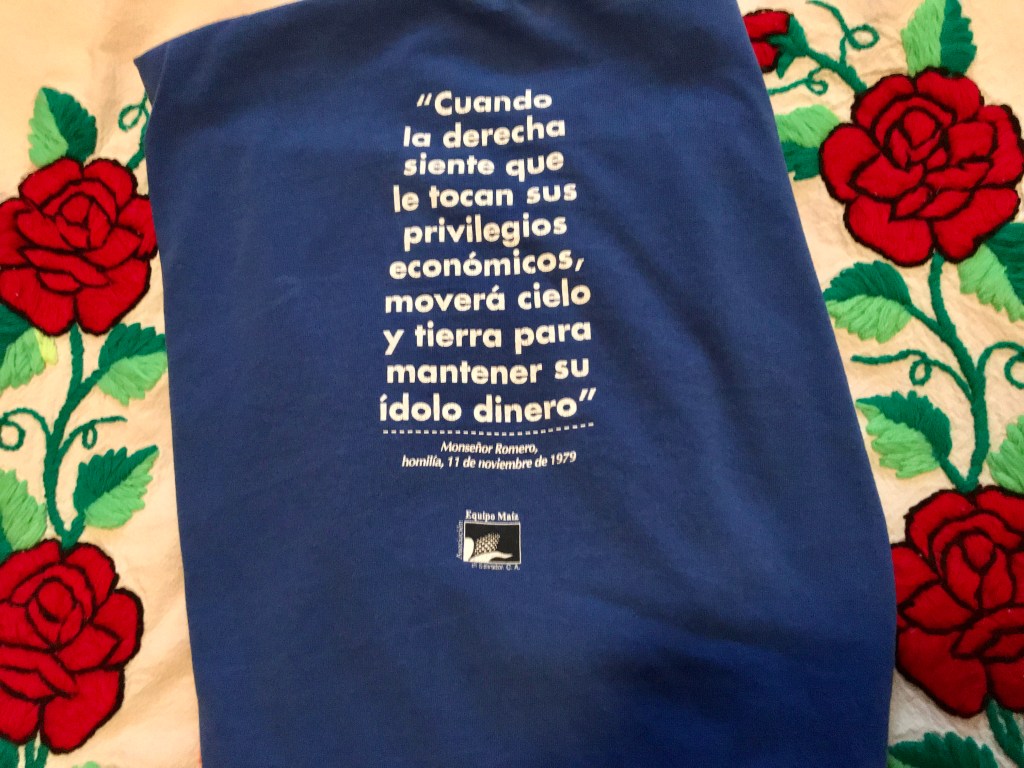
And I think of the words of St. Oscar Romero on Nov. 11, 1979, when he offered a warning about money when it becomes an idol:

It’s natural that when the right feels that their economic privileges are being threatened, they will move heaven and earth in order to maintain their idol of wealth.

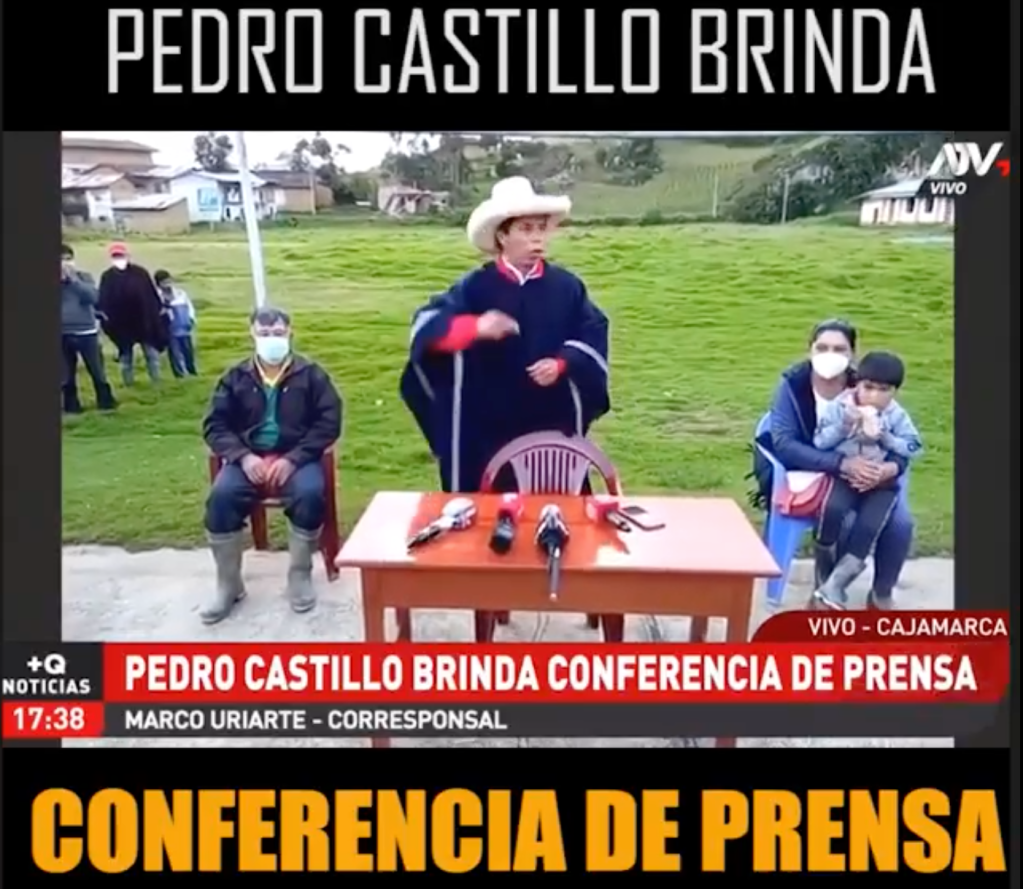
Next Sunday, June 6, Mexicans and Peruvians head to the polls. In Mexico, these mid-term elections—the national legislature and many state and local races—are marred by violence: at least 35 candidates of various parties have been murdered. In Peru, it’s the second round of voting to elect a new president: from the left, Pedro Castillo stands a reasonable chance of defeating Keiko Fujimori, despite her powerful, rich supporters.

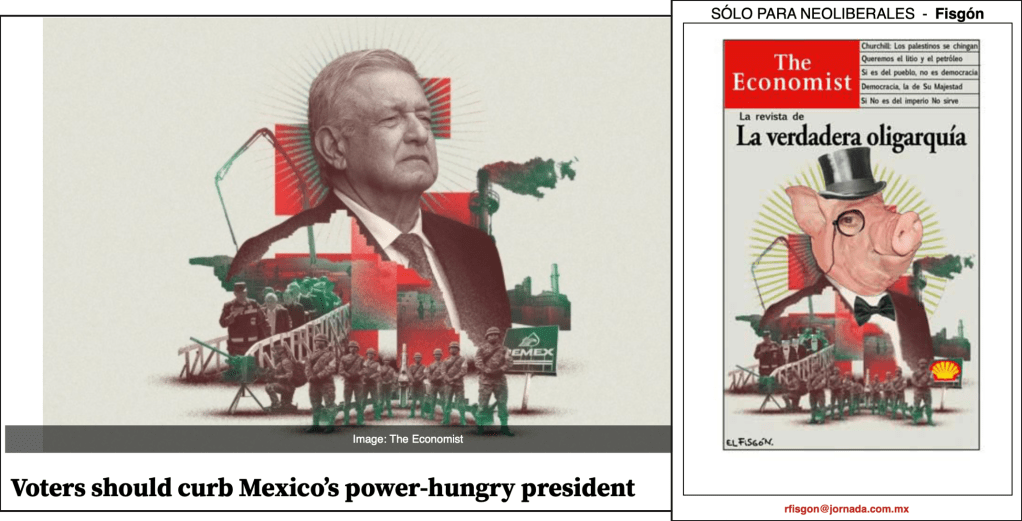
The Economist’s attack on Mexican President Andrés Manuel López Obrador (known by his initials as AMLO) in startling. There are reasonable grounds to debate this policy (the pandemic response) or that development plan (the tourist train in the Yucatán peninsula that is opposed by Indigenous people in the region), but The Economist argues that he is a populist comparable to Brazil’s Jair Bolsonaro, and that democracy is threatened:

Mr. López Obrador divides Mexicans into two groups: “the people”, by which he means those who support him; and the elite, whom he denounces, often by name, as crooks and traitors who are to blame for all Mexico’s problems. He says he is building a more authentic democracy. 

Left: Cartoon by Israel Vargas, The Economist, May 27, 2021. Right: cartoon by El Fisgón, La Jornada, May 29, 2021. (“The Economist: The magazine of the True Oligarchy.”)

It then goes further, suggesting that the United States get involved in Mexico’s internal affairs:

The United States needs to pay attention. Donald Trump did not care about Mexican democracy. President Joe Biden should make clear that he does. He must be tactful: Mexicans are understandably allergic to being pushed around by their big neighbour. But America ought not to turn a blind eye to creeping authoritarianism in its backyard. As well as sending vaccines, unconditionally, Mr. Biden should send quiet warnings.

So, what is a populist anyway? 

A Venezuelan friend who lives in Costa Rica, José Amesty, says populism is a term used by elites when they do not understand what is going on. I would refine that slightly and suggest that it is a term used by elites and technocrats to describe political movements that reject their narrow economic priorities—maintaining their own privileges—by putting social goals first. 

Amesty cites AMLO: “supporting the poor, supporting elderly adults, supporting youth: if that is to be populist, then add me to the list.” AMLO stands in the tradition of Lázaro Cárdenas, the revolutionary Mexican president who in the 1930s led a land reform that put half of the farming land in the hands of local community councils (ejidos) and who nationalized the petroleum industry.

Populism is one of the least useful terms in our political lexicon. I think we’re clearer when we use tags that are generally understood: left (social democrat, socialist, communist), centre (liberal), or right (conservative, traditional, elitist, militarist). Better yet: actually describe the content of political platforms. What does this candidate stand for? With whom do they stand? 

The government of Iván Duque in Colombia and the candidacy of Fujimori in Peru are projections of traditional elites trying to hold on to their power and economic privileges against diverse social and political movements that would empower people who have usually been locked out of power: the rural and urban poor, Indigenous and descendants of Africans, women and LGBTI people. 

In that sense, democracy in Latin America is not so much being threatened as it is still being invented.

Peru’s election: a battle between “rich and poor, master and slave”

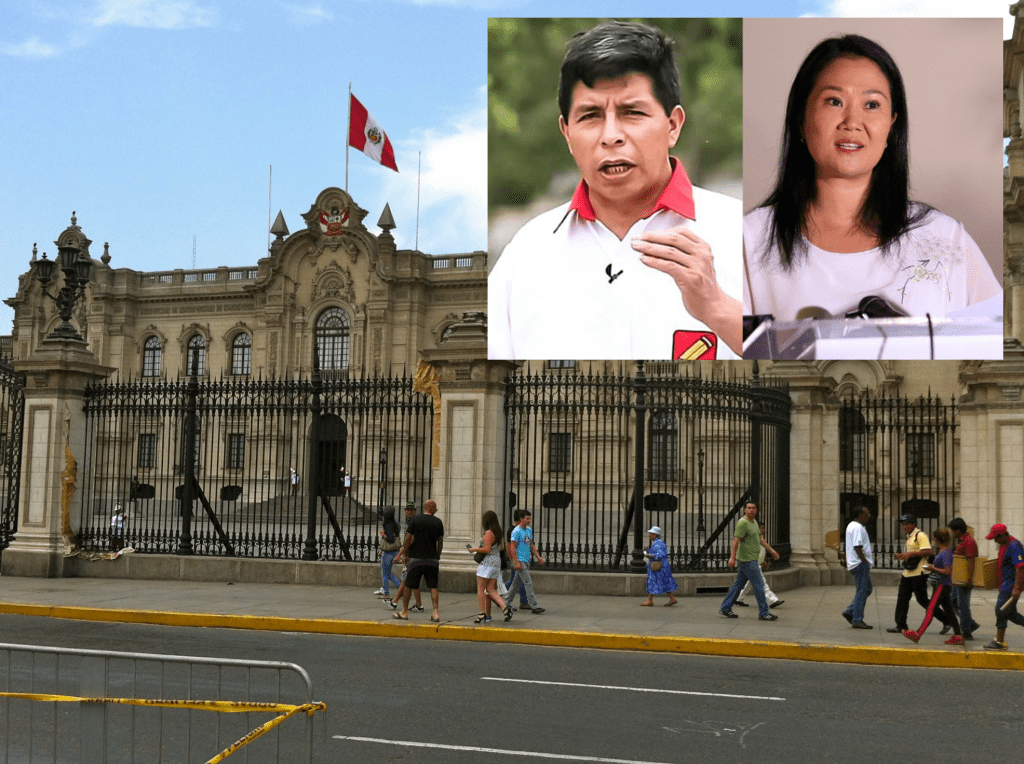
The government palace in Lima. Inset: Pedro Castillo and Keiko Fujimori

On June 6, Peruvians will choose between Pedro Castillo, a rural teacher described in mainstream media as “far left,” and Keiko Fujimori, described in mainstream media as “market friendly.” Those tags obscure deeper truths about the political moment.

A day after first-round results of the presidential election gave Peruvians a choice between these political opposites for the second round, I asked my Facebook friends what they thought. Several responded, and I have been learning.

First lesson came in a message from a friend: an Indigenous woman who is a medical doctor serving communities high in the Andes and far from Lima. 

“What happened in Peru is that, in the midst of this pandemic that further deepened the injustice and the inequities in health, education, access to work and extreme poverty: as always, Lima, the capital, only saw its own context. It had no interest in the regions and their right to decide by whom they should be government. For this reason, they were surprised when the teacher, Pedro Castillo, led the voting and passed to the second round. He is someone they treat as a nobody, who in social media they insult because he is part of Perú profundo (deep Peru), where every day survival is a challenge, not just because of Covid, but also because of hunger and unemployment. 

“There were other options, but as a people, we know those who give flowery and beautiful speeches but then in real life reject us, when they use our culture that they have learned about through books without feeling respect for us and connection with our land and spirituality, our Pachamama and Apus. I think this is a good time for someone who is like the majority of Peruvians to assume the leadership of our country, just as our brother Evo Morales did in Bolivia. Perhaps we will make a mistake, but I think that after so many years of being pushed aside and made invisible in our own land, we have the right. I hope that I have been able to express the feeling of a great many of my sisters and brothers.

“My people are suffering a lot. They don’t have masks. They don’t have water to wash their hands. They get sick and die alone. But in the midst of all of this, they are in solidarity, they care for their elders. These are my people and ojalá (I hope) they have the chance to be heard and taken into account.”

Second lesson came from several friends, either writing directly to me or posting in social media. Be cautious about media coverage. Fujimori, appearing on the final ballot for the third time, is well-known. She is the daughter of a former president who is in prison for corruption; she faces her own criminal charges related to money-laundering and irregular campaign contributions arising from her time in Congress.

Castillo, as someone whom the media have ignored, is harder to get to know. The Bolivian news service Kawsachun translated one of his speeches into English so that you can read his own words as you watch the video. Here, Castillo himself excoriates the media: 

“I want to denounce publicly those media outlets with national coverage that twist reality. Those outlets that do what they want and defend the oligarchy, but they forget about the people who have no bread, no education, no healthcare. They forget about those who demand their rights and ask for justice. That’s why we’re here, if we have to give our lives for a better country then we’ll do it with dignity. We won’t back down.”

Fujimori and mainstream media decry Castillo, tagging him as a Communist and worse, a supporter of the old Sendero Luminoso (Shining Path) guerrilla movement. It’s a false claim, given that he was part of the ronderos campesinos, rural patrols that were key to defeating Sendero.

In many communities today, the ronderos protect collectively-held land and the rights of the Indigenous and peasant farmers who live there. Their role is constitutionally-protected and built into municipal structures. Moreover, the state is required to attend to people in their language and people are recognized as having rights to their ethnic and cultural identities. The ronderos are also responsible for administration of communal justice. Some of the women’s groups I know train the ronderos so that they will bring a gender justice perspective to their work, so as to protect the rights of women.

Castillo is a rural teacher in the city of Chota in the Cajamarca region, 600 km north of Lima. An organizer in the teachers’ union, he was one of the leaders of a 2017 strike by teachers that sought to defend their employment rights and increase salaries. The academic Roger Merino writes that Castillo’s “left” might be more the classic trade union left—and certainly an emphasis on issues confronting urban and rural workers would be a step forward—and not the multi-sectoral left that has won power (and lost it) in many Latin American countries in the past two decades.

Farms in Peru’s Sacred Valley, high in the Andes

Castillo campaigned on the slogan, “no more poverty in a rich country.”  He has won the support of Veronika Mendoza, who represented a more broadly inclusive left, and he will need to build bridges with social movements of environmentalists, women, LGBTI people and Indigenous peoples. He has promised to re-write Alberto Fujimori’s 1993 constitution (which favours private enterprise and restricts the role of the state), improve the quality of Peru’s media through regulation, and increase public spending on health and education. Like many Peruvian families, his is religiously diverse: he is Catholic and his wife and children are part of the Nazarene Church. 

Keiko Fujimori, on the other hand, would not hesitate to break with democratic commitments or institutions. She is favoured by the business elites who warn of capital flight. Writing for the ALAI news service, Jesús Ospina Salinas says Peru’s current polarization comes from those who have no interest in “reducing inequalities, and who would continue a model that only brings short-term economic gains, but not structural ones that are sought and needed by the poor. The campaign of fear will not cease.”

“This is a battle between the rich and the poor, the struggle between the… master and the slave,” Castillo has said. With three weeks and one more debate before the election, the rich, who control most media, are doing all they can to catch up in opinion polls.