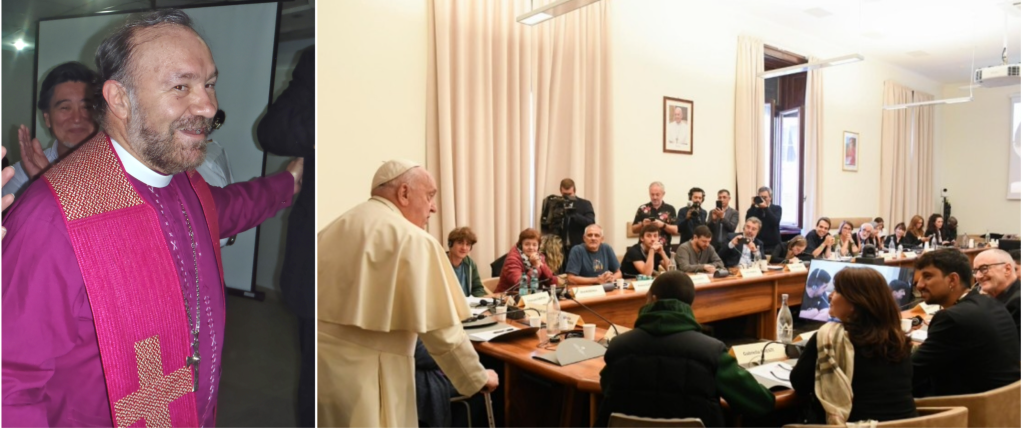
On this Earth Day, I want to share with you a reflection by Bishop Francisco Duque of the Anglican Church in Colombia. I worked with him in a larger team in one period (already a dozen years or more ago) of ecumenical efforts for peace with justice in Colombia.
Indeed, it was during that work that I stood with friends in a coffee shop in Bogotá and watched news of the election of the archbishop of Buenos Aires, Jorge Mario Bergoglio, as pope on March 13, 2013. I did not rejoice. All that I knew of Bergoglio was that he had opposed several of the initiatives of the governments of Néstor Kirchner and Cristina Fernández as it expanded sex education in public schools and legalized same-sex marriage in 2010.
Images of St. Francis. Left: preaching to the birds. Right: “Make me an instrument of your peace / Bless your people, Lord” is one I saw in Real de Catorce, San Luis de Potosí, in October 2024.
But Pope Francis surprised me: first by choosing to be known by the name Francis, signalling he would follow St. Francis of Assisi, long admired for his inspiration to contemporary ecological commitment and for initiating dialogue with Muslim leaders during Christian Europe’s “crusades” in the Middle East. And then he surprised me again with steps that showed respect for LGBTQIA+ people: first, “Who am I to judge?”, and later with his openness to diverse voices heard through synods, his advocacy for peace, the rights of migrants and debt forgiveness. I can only wish he had done more with regard to the rights of women and pray that his successor can go further.
In Canada, Pope Francis will undoubtedly be remembered most for his “penitential pilgrimage” and encounters with Indigenous peoples in 2022. Despite resistance from most of Canada’s Catholic bishops, he came, offered a (not fully accepted) apology, and gave truth and reconciliation efforts a dramatic push forward in public awareness.
But I think his lasting global legacy will be his way of holding faithful action for social justice and action for ecological justice together coherently. Here’s what Bishop Duque had to say.
Left: Bishop Duque at a Methodist assembly in Medellín in 2012. Right: Pope Francis meets representatives of social movements in 2024.
Francis, pope of Amazonia and our common home
Francisco Duque
The world mourns the loss of a spiritual leader who transcended borders, creeds and generations. Pope Francis not only was the first Latin American pontiff. He was, above all, the pope of the Amazon and caretaker of our Common Home. His legacy, immense and profoundly humanist, will remain inscribed in the planet’s memory as a prophetic voice that urges us to hear the clamour of the earth and the cry of the poor as a single call.
From the time of the publication of his encyclical Laudato Si’ in 2015, Pope Francis illuminated the ways of global ecological awareness. With valiant and committed language, he denounced the structural causes of environmental collapse, unlimited resource extraction, climate injustice and indifference toward the suffering of communities that are most vulnerable, especially those who live in the lungs of the world: tropical forests, the Amazon in particular.
His spiritual leadership was also political and ethical. He convened scientists, Indigenous leaders, activists and religious authorities from around the world to make a new pact between humanity and nature. He promoted an integral ecology that did not separate the environment from the social. He recognized in Indigenous peoples that they are millennial guardians of wisdom. His encouragement of the Synod of the Amazon in 2019 marked a before and after: Amazonia was heard in the heart of the Vatican, not as a forgotten periphery but as a vital centre for the future of the planet.
From the Inter-Religious Initiative for the Tropical Forests (IRI-Colombia), we hold up a prayer of gratitude and hope. Gratitude for his strong words, for his planetary vision, for having returned to the faith its active dimension of protection of creation. Hope because the fertile seeds he planted will continue to bear fruit in the struggles of those who do not resign ourselves to ecocide or silence in the face of injustice.
Pope Francis leaves us a road map for humanity. There will not be peace without environmental justice. There will be no future without forests. There will be no reconciliation without a deep ecological conversion. His legacy challenges governments, businesses, religions and people. His voice remains alive, inspiring a global inter-religious movement that is committed to life. In these days of farewell, we echo his own question, charged with urgency and tenderness:
“What kind of world do we want to leave to those who come after us, to children who are now growing up?” (LS 160).?”
Thank you, Pope Francis, for reminding us that care for Amazonia is an act of faith, love and justice.
The office of El Salvador’s Attorney General has decided to appeal the acquittal Oct. 18 of five community leaders, a move quickly rejected by their community and by Salvadoran and global organizations that have worked in solidarity for more than two decades to reject a proposed gold mine that threatened water resources.
Images: ACAFREMIN (the Central American Alliance Against Mining) and CISPES (Committee in Solidarity with the People of El Salvador)
The office of El Salvador’s Attorney General has decided to appeal the acquittal Oct. 18 of five community leaders, a move quickly rejected by their community and by Salvadoran and global organizations that have worked in solidarity for more than two decades to reject a proposed gold mine that threatened water resources.
Leonel Herrera, a journalist covering the case for Diario Co Latino, calls the decision to appeal “reprehensible.” Authorities should use their time and resources “to investigate true war crimes, beginning with the massacres committed against Santa Marta which took the lives of hundreds of civilians—mostly women, the elderly and children.”
This was never a true criminal case, Herrera added, but rather “a spurious accusation invented to persecute a group of former guerrilla fighters not for war crimes, but rather for what they do now: care for the water, protect the ecosystem and attain the continuity of lives gravely threatened by the possible re-activation of mining projects.”
We reject the appeal of the Attorney General’s Office and demand that the acquittal of our environmental leaders be upheld
The Attorney General’s Office (FGR) remains determined to prevent legality and justice from prevailing for the community leaders of Santa Marta and ADES, who were definitively acquitted last October 18 by the Sentencing Court of Sensuntepeque, Cabañas. For this reason, an appeal has been filed before the Criminal Chamber of Cojutepeque. Despite multiple calls to respect the acquittal of the environmental activists of Cabañas, the Prosecutor’s Office seeks to reverse Sentencing Court’s ruling, which is in accordance with the law and congruent with the principles of due process. The appeal is characterized by a lack of valid legal argumentation and by the disrespectful way in which the representatives of the Prosecutor’s Office refer to the honorable sentencing judges. In this sense, we ask the magistrates of the Criminal Chamber of Cojutepeque not to admit the appeal and to ratify the decision of the Sentencing Court of Sensuntepeque, which has acted independently, in accordance with the law and without being pressured by extrajudicial factors that conspire to condemn the defenders of water, the environment and life threatened by the possible reactivation of mining. In this regard, it is worth remembering that the ruling of the Sensuntepeque Sentencing Court responds to the mandate of the Cojutepeque Criminal Chamber, which on two occasions transferred the decision of whether or not the alleged acts constituted crimes against humanity or war crimes to the Sensuntepeque Sentencing Court. In accordance with this mandate, the sentencing judges analyzed the case and unanimously determined that the alleged crimes presented by the prosecution did not meet the definition of a crime against humanity or a war crime, as established in the Rome Statute and the Geneva Conventions, respectively. Therefore, they ruled that the criminal action was inadmissible due to the statute of limitations of the alleged crimes and decreed a definitive dismissal for the defendants. We alert the country and the world of this attempt by the Salvadoran Attorney General’s Office to continue using the judicial system to persecute environmental activism and manipulate restorative and transitional justice to criminalize environmental defenders who warn about the serious dangers of mining extractivism.
Definitive freedom for the community leaders of Santa Marta and ADES! Yes to Life, No to Mining!
It’s a chaotic scene this noon hour outside the courthouse in Sensuntepeque after the not-guilty verdict today in the case of the “Santa Marta 5.” There will be time for analysis in days and weeks ahead but for the moment, I hope you can share my joy and that of countless good friends–compañerxs de lucha over many years–at news of this verdict.
Thank you to ALL who have accompanied the people of Cabañas in their defense of the water, against the mining project and for the freedom of five compañeros unjustly arrested and made to suffer. International allies will remain attentive.
“No Crime to Pursue”: International Organizations Applaud Salvadoran Tribunal Ruling that the Five Salvadoran Water Defenders Are Innocent of the False Charges against Them
The five prominent Water Defenders who faced politically-motivated charges are heroes of El Salvador — and they should never have been arrested.
San Salvador and Washington, D.C. – On October 18, the presiding tribunal in the Salvadoran trial of five leading Salvadoran Water Defenders ruled that all five are completely innocent of the two sham charges of murder and illicit association that were laid against them.
“We call on the Attorney General’s office not to appeal this decision in order to ensure the definite freedom of our compañeros as soon as possible,” the Economic and Social Development Association of Santa Marta (ADES), whose leading members were among those on trial, stated. “Rather than insisting on prolonging this process any further, the Attorney General’s office should apologize to the five and to the community, and should dedicate themselves to investigating the real war crimes, starting with the massacres that were committed against Santa Marta and other communities.” ADES held a press conference outside the courthouse and will release a more detailed statement later today.
In response to the verdict, an international coalition of 14 groups (listed at bottom) led by International Allies against Mining in El Salvador released the following statement:
The five prominent community leaders known as the “Santa Marta 5,” Miguel Ángel Gámez, Alejandro Laínez García, Pedro Antonio Rivas Laínez, Antonio Pacheco, and Saúl Agustín Rivas Ortega, were all instrumental in the successful campaign to save El Salvador’s rivers from the threat of gold mining. With a unanimous vote in El Salvador’s National Assembly in March 2017, El Salvador became the first nation on earth to ban all metallic mining.
Since the arrest of the five water defenders in January 2023 on politically-motivated charges, prominent organizations and individuals have led a national and international campaign spanning 31 countries demanding that the bogus charges be dropped and denouncing the political motivations behind their detention given the lack of evidence presented by the Salvadoran Attorney General’s office.
Beyond the lack of evidence, the Salvadoran Attorney General’s pursuit of this case has dealt a serious blow to the Salvadoran government’s credibility, belying its claim that it remains a democracy and that it holds no political prisoners. The unceasing and courageous pressure from grassroots organizations in El Salvador – in concert with international solidarity – may have worked in favor of the Water Defenders today, but hundreds of political opponents, labor leaders and human rights defenders remain imprisoned. The community-led movement of water defenders still stands strong in the face of future attempts to undermine land and water protections for communities in El Salvador.
Our organizations support the call by Salvadoran civil society groups that the Salvadoran Attorney General should apologize to the five defendants, whose health has suffered greatly over the past 21 months that they have stood accused of and imprisoned on false charges, and to the Santa Marta community, which suffered from genuine military atrocities during the Salvadoran Civil War in 1980-1992.
As highlighted in a crucial fact-finding January 2024 report, the national and international campaigns have also condemned the criminalization of environmental defenders, the lack of legal rights and due process under the current “state of exception” imposed by the Salvadoran government, and have warned about the intention of the Salvadoran government to reverse the historic 2017 nationwide ban on metals mining.
The five Water Defenders should never have been charged, and the Salvadoran government’s willingness to pursue these accusations despite their clear innocence signals a worrying willingness to persecute the movement that these five water defenders represent. We call on the Salvadoran government to forgo future sham prosecutions and uphold the democratic rule of law in future pursuit of true justice.
An international observer delegation made up of academics and lawyers from Canada, the United States, and Mexico observed the trial and noted several transgressions by the Salvadoran Attorney General’s lawyers during the proceedings. Not only did they violate the tribunal’s gag order, by recklessly exposing the identities of witnesses and observers, they exhibited “overly aggressive behavior” toward witnesses.
The international solidarity movement supports the call by Salvadoran civil society and human rights organizations to end the ongoing “state of exception” in El Salvador, to release thousands of people who have been unjustly imprisoned, and to ensure that the historic 2017 nationwide ban on metallic mining remains in place.
“We applaud this verdict as a signal that justice must prevail in El Salvador. The five prominent Water Defenders who faced politically-motivated charges are heroes of El Salvador — and they never should have been arrested in the first place,” said John Cavanagh, Senior Advisor at the Institute for Policy Studies. “These charges were clearly politically motivated, and through them, the Salvadoran attorney general displayed a stunning lack of respect for human rights and the environment in El Salvador. But the fight is not over – we have to ensure that the persecution of these community and environmental movement leaders does not continue and that they and others will be able to continue their important work safely. Pursuing this trial from the start still signals a willingness by the Salvadoran government to reverse the protections guaranteed by the historic 2017 mining ban.”
“We are grateful to the hundreds of national and international civil society organizations who worked tirelessly for more than 20 months to denounce this injustice. A guilty ruling would have been a death sentence for our compañeros, as the inhumane conditions of Salvadoran jails have become a death trap for people of advanced age who suffer from chronic health conditions,” said Vidalina Morales, president of The Economic and Social Development Association of Santa Marta (ADES). “We urge the Attorney General not to appeal this decision to the higher courts, but we are ready to go to the international human rights system if necessary to defend their innocence and their life.”
“As we have said, the absolution of our environmental defenders was the only legal and just outcome. This ruling also upholds the interests and well-being of the country,” Morales continued. “We recognize the professionalism, the independence and the courage of the judges of the Sentencing Tribunal of Sensuntepeque, who correctly applied the law and have not yielded to the extrajudicial pressures and interests that conspired to invent this case.”
“We applaud the verdict. It is an important victory for environmental justice and human rights,” said Viviana Herrera, Latin America Program Coordinator at MiningWatch Canada. “We join Salvadoran civil society, particularly environmental organizations such as ADES, who have worked hard on the case, and hope it will set a precedent for any future case of water defenders facing politically motivated prosecution in El Salvador”.
“Through unity, conviction, and courage – and with overwhelming international support – the Salvadoran popular movement halted a grave injustice today,” said Alexis Stoumbelis, organizational director at the Committee in Solidarity with the People of El Salvador (CISPES). “It should not have taken twenty months of a massive national and international campaign to free these community leaders when there was no evidence that a crime had ever occurred – and everyone knew it. That is why international organizations and governments must also join the call for freedom and justice for the dozens of union leaders, land defenders, and community leaders who denounced attacks on their rights and democracy who are now in jail, facing trumped up charges, or in exile, and for the tens of thousands who have been arbitrarily detained under the state of exception. Their lives are in jeopardy every day they remain in prison.”
This statement is endorsed by the following 14 organizations: International Allies against Mining in El Salvador, Americas Policy Group/Groupe d’orientation politique pour les Amériques (APG-GOPA), the Central American Alliance on Mining (ACAFREMIN), Committee in Solidarity with the People of El Salvador (CISPES), Common Frontiers, CoDevelopment Canada, the Institute for Policy Studies Trade and Mining Project, InterPares, MiningWatch Canada, Pax Christi International, the SHARE Foundation, Sisters of Mercy of the Americas – Justice Team, The United Church of Canada, and the Washington Ethical Society.
Press contacts:
John Cavanagh, Institute for Policy Studies: johnc@ips-dc.org, +1 (202) 297-4823
Pedro Cabezas, Central American Alliance against Mining (ACAFREMIN) and International Allies Against Mining in El Salvador: stopesmining@gmail.com, + (503) 7498-4423
Alexis Stoumbelis, Committee in Solidarity with the People of El Salvador (CISPES), alexis@cispes.org +1 (202) 521-2510 ext. 205
Olivia Alperstein, Institute for Policy Studies: olivia@ips-dc.org, +1 (202) 704-9011