Talking about peace when there is no peace*

Jim Hodgson, May 23, 2023

Peace is a pre-condition for any possibility of transforming the global economy for the sake of humanity and the Earth – or, more modestly, achieving those elusive Sustainable Development Goals by 2030.

In the weeks after Russia’s invasion of Ukraine, I added my voice to those of others who pleaded for peace talks. In recent weeks, new efforts from church leaders and global South political leaders are underway to bring the sides together. But peace initiatives are either ignored or disdained by most media and “Western” leaders.

Headlines and images from Mexico’s La Jornada and Argentina’s Página 12 newspapers. On the left, Lula asks that a new Cold War between China and the United States be avoided and defends the use for currencies other than the U.S. dollar for international trade. On the right, from top: Zelensky asks for support from G7 powers; G7 leaders create new sanctions against Russia and debated in Hiroshima the nuclear arsenals of other countries; The Vatican makes its peace effort official so as to end the war in Ukraine.

Case in point: the participation at the recent G7 meeting in Hiroshima of Brazilian President Luiz Inácio “Lula” da Silva and Indian Prime Minister Narendra ModiFinancial Times dismissed Lula and Modi as Russian President Vladimir “Putin’s apologists.” Their participation was eclipsed by that of Ukrainian President Volodymyr Zelensky, who did meet with Modi, but blamed scheduling conflicts for not meeting Lula – and then joked with reporters that Lula was more disappointed than he was. 

Well, yes. Lula’s interest in peace has everything to do with funds diverted to war and away from efforts for authentic development that could help alleviate the other crises of climate change and migration. (Lula also said that Zelensky did not show up for a meeting they had scheduled.)

In Hiroshima,  Lula criticized the division (or re-division) of countries into two antagonistic blocs and abandonment of a multipolar world that seemed to be emerging in the wake of the pre-1991 Cold War.

Meanwhile, South African President Cyril Ramaphosa was not even invited. But he and other African leaders are involved in a peace initiative to end the war in Ukraine. In a news conference May 17, he said he had had “separate telephone calls” with Putin and Zelensky over the weekend, where he presented an initiative drawn up by Zambia, Senegal, the Republic of Congo, Uganda, Egypt and South Africa. Leaders of the six countries say they plan to travel to Russia and Ukraine “as soon as is possible.”

In his weekly newsletter on May 15, Ramaphosa said South Africa would not be drawn “into a contest between global powers” despite having faced “extraordinary pressure” to do so.

“We do not accept that our non-aligned position favours Russia above other countries. Nor do we accept that it should imperil our relations with other countries,” Ramaphosa said.

During the same week, Chinese envoy Li Hui visited Moscow, his first stop in a European tour that would also take him to Kyiv, to develop a 12-point plan proposed by Beijing on the first anniversary of the Russian invasion. 

Last September, Mexican President Andrés Manuel López Obrador called for establishment of a Commission for Dialogue and Peace that would facilitate the search for a solution through negotiations. 

Nobody has a “magical formula to achieve peace,” writes Juan Pablo DuchLa Jornada’s Moscow correspondent. “But [proponents of peace] hope that Russia and Ukraine would establish a ceasefire and sit down to negotiate their conditions with the objective of putting an end to the bloodshed and devastation. All that is lacking is that Moscow and Kiev by open to making concessions – the first not wanting to cede Ukrainians regions already annexed and the latter refusing to lose territory – but without concessions, it does not seem possible to open a path toward peace in a war that, say what you will, only brings calamities.”

WCC delegation with Ukrainian church leaders in Kyiv on May 11 (WCC photo); Patriarch Kirill with WCC general secretary in Moscow on May 17 (ROC photo).

Meanwhile, the World Council of Church and Pope Francis have both renewed their efforts for peace. 

In mid-May, a delegation led by WCC general secretary Jerry Pillay visited church and government leaders in Kyiv and Moscow. In Kyiv, the WCC delegation met with senior leaders of both the Ukrainian Orthodox Church and the Orthodox Church of Ukraine, two churches whose dispute has intensified since the Russian invasion. In Moscow, they met with Patriarch Kirill, head of the Russian Orthodox Church and widely viewed as a supporter of President Putin.

For his part, Pope Francis has given Italian Cardinal Matteo Zuppi the task of leading a mission in hopes it can “ease tensions” in the Ukraine war and lead to a path of peace. The pope has said has said he would go to Kyiv if such a journey would help bring peace, but said that could happen only if he could also visit Moscow.

* The phrase “peace, peace, when there is no peace” is found in Jeremiah 6:14 and later at 8:11. It is also found in Ezekiel 13:10 and 16. The direct criticism is of those who build flimsy walls and smear them with whitewash: a makeshift solution to a problem. The metaphor then and now is points to poor leadership. In our time, we can think of leaders who promise that war will lead to peace. “They have treated the wounds of my people carelessly,” writes the prophet Jeremiah, “saying ‘peace, peace,’ when there is no peace.”

War Never Again – Westerplatte, Gdansk, Poland (site of the first battle of World War II in 1939).

Global inequality prompts call for new UN conference on Financing for Development

Jim Hodgson

The massive tragedies provoked by Russia’s invasion of Ukraine have pushed all other news to the margins. But urgent challenges remain: 

  • climate change – extreme  weather events will only increase (even as some politicians demand more oil and gas production)
  • vaccine apartheid – the global North continues to hog the means to stop the spread, while ignoring risks posed by new variants
  • debt-loads sustained by the most impoverished countries have risen as health and other emergency costs increased 

This week, civil society organizations around the world are calling for renewed conversation about Financing for Development (FfD). For all of its flaws (including the Security Council veto held by each of the 1945-era global powers), the United Nations is still a space where on some topics at least, countries can gather as equals.

The UN Conference on Financing for Development “remains the only place where developing countries are at the table with equal voice and vote on issues of global finance and development.”  

In the face of the power accrued to international financial institutions (IFIs, including the World Bank), developing countries and civil society organizations are demanding a fourth global conference, sometimes referring to “FfD4.”

“The FfD process is unique, as it is the only truly democratic space where global economic governance is addressed, while having the issues of climate change, inequalities and human rights at its core,” say the organizations pressing for a new global conference.

“FfD4 should ensure democratization of global economic governance, recognizing the right of every country to be at the decision-making table, and not only those with concentrated power or resources.”

“Globalizing the Fullness of Life”

Twenty years ago, in Monterrey, Mexico, the first International Conference on Financing for Development happened in Monterrey, Mexico. 

Some of the participants in the 2002 ecumenical pre-event in Monterrey.

Concerned that whatever goals we had for the “development of peoples” (a phrase offered by Pope Paul VI in his encyclical Populorum Progressio in 1967) were being sacrificed by corporate-led globalization, I attended an ecumenical pre-event that was organized by the Council of Latin American Churches (CLAI). Some participants stayed on for the UN event.

My own presentation focused on good experiences I had had in Canada and Mexico of church collaboration in ecumenical and multi-sector coalitions, encouraging participants to join with others beyond their Protestant churches to achieve goals of economic justice.Our closing declaration said participants were motivated to speak out because:

“Poverty, exclusion, misery, unemployment, underemployment, labour instability, the bankruptcy of small and medium-sized businesses, and the deterioration of the environment, have reached an unsustainable limit.” 

We then affirmed several proposals and ethical principles:

  • The market must not define the life projects of our countries. 
  • All economic growth must have the objective of improving the conditions of all of all of society, without exclusions.  
  • Globalization must be regulated with clear and just rules. This implies:
    • Strengthening participatory democracy in decision-making.
    • Creating mechanisms for control and arbitration at the national level that promote codes of conduct to regulate investments, capital flows and loans. 
    • Creating an international arbitration agency and mechanisms for the cancellation of foreign debt.
    • Reforming the international financial architecture, transforming its institutions and revising its mandates, methodologies and decision-making processes. 
  • The urgent need to cancel the debt of our peoples, so as to provide sustainable social development. But we firmly sustain that the roots of the debt be investigated, and that the creditors and debtors in the North and in the South who irresponsibly contracted these debts be made to pay them.
  • The need to amplify the access to information and technology by our developing countries. 

Our declaration closed with a call on “the powers of this world” to “place the market and the international financial system at the service of all people.” We added: “We affirm that the Reign of God is justice and that the blessing of the creator will be with those who hear the cry of the people.” 

One of the documents that inspired the World Council of Churches to participate in the Monterrey conference was “Justice, the heart of the matter,” prepared two years earlier by staff of the Canadian Ecumenical Coalition for Economic Justice (ECEJ) – one of the predecessors of KAIROS.

Debt, vaccines, climate: from “blah-blah” to meaningful change on a global scale

This year, global network of organisations (including KAIROS Canada) sponsored Global Days of Action for Justice and Debt Cancellation during the last two weeks of October to focus attention on the intersections of debt, climate and pandemic.

In the wake of G20 summit in Rome and as the global climate meeting in Glasgow gets underway, those of us who hold out hope for an international system that can produce meaningful change are disappointed by failures both on debt cancellation and vaccine distribution—and working for better results on climate issues.

“Political games while the world burns” was the assessment by the European Network on Debt and Development (Eurodad) after the annual meetings Oct. 11-17 of the World Bank and International Monetary Fund.

Back in April 2020, when pandemic lockdowns still were a novelty, the G20 announced a debt service suspension initiative (DSSI). But the Jubilee Debt Campaign says that the DSSI has suspended less than a quarter of debt payments for a very limited group of 46 countries.

Tim Jones, Head of Policy at Jubilee Debt Campaign, said: “The failure to make banks, hedge funds and oil traders take part in the G20’s flagship debt suspension scheme has made a mockery of this initiative. Tens of billions of dollars have flooded out of lower income countries at a time when they were desperately needed to protect lives and livelihoods.”

The campaign also cited research showing that 34 countries spend five times more on debt payments than climate change mitigation or adaptation.

Vaccine sharing

Meanwhile, about 82 countries cannot meet the World Health Organization (WHO) target of 40 per cent Covid-19 vaccination coverage by end of the current year. The global vaccine-sharing arrangement known as COVAX has delivered only about 400 million doses to about 140 low- and middle-income countries.

On Oct. 28, WHO and other aid groups called on the G20 to fund a new, a U.S. $23.4 billion plan to bring vaccines, tests and drugs to impoverished countries in the next year.

During the G20 summit in Rome two days later, Canada announced it will donate 10 million Moderna vaccines and deliver 200 million doses by the end of next year. The new promise comes despite abject failure of the last set of promises: Canada delivered only 3 million doses out of a planned 40.7 million does announced at the G7 summit last June.

On average, the G20 countries have vaccinated about 55 per cent of their eligible populations, reported The Globe and Mail. Globally, the figure is 38 per cent, and in Africa, only seven per cent.

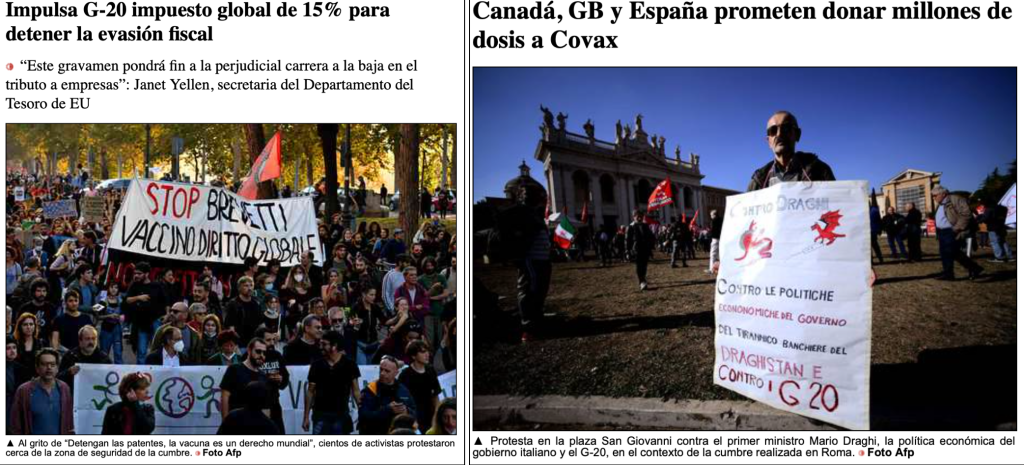
Today in La Jornada, Mexico City: Headlines acknowledge an agreement to impose a 15-per-cent global tax on transnational corporations and new promises to donate vaccines. Photos show protests. Carrying signs that condemned “profiting from the pandemic” (left), protesters in Rome drew attention to vaccine nationalism and called for an end to patent protection for vaccines: “a global right.” And (right) protesting economic policies of the Italian government and G20.

Sharing costs of climate change

A day before being shuffled out his job as Canada’s environment minister, Jonathan Wilkinson joined German and British counterparts in a news conference Oct. 25 to announce “significant progress” in getting commitments from rich countries to boost financing for climate change adaptation and mitigation in the developing world. 

At the Copenhagen summit 12 years ago, wealthy countries pledged channel U.S. $100 billion each year to fund this effort. That level was never achieved.

The plan announced by Wilkinson, together with Germany’s Jochen Flasbarth and the U.K.’s Alok Sharma—the COP26 president-designate—would see U.S. $500 billion flow over the five years 2021-25.

Access to climate finance has been a critical issue for many developing countries, and failure to meet past goals had become “a matter of trust,” the ministers said.

A report posted on the COP26 presidency’s website does not show the commitments of individual countries, noting, for example, that the Biden administration in Washington “will work closely with Congress” to achieve U.S. commitments.Moreover, about 70 per cent of the funds would be in the form of loans, not grants, and part of the funding would come too from the private sector.


Equitable financing—based on recognition that the wealthy countries foster an economic system that uses carbon-intensive technology to exploit of the planet’s resources—is part of the challenge everyone on the planet faces as the Glasgow COP gets underway.

But underlying the struggles over who pays is the issue of holding to the 2015 Paris commitment to limit the carbon-induced temperature rise to 1.5 degrees above pre-industrial levels. As “environmental icon” David Suzuki said on CBC Radio this morning, if we love our children and grand-children—and if we love participating with all of this planet’s life and generosity—we’ll stop adding more carbon to the atmosphere.

Many of Canada’s faith-based organizations have come together in an initiative called For the Love of Creation to mobilize education, reflection, action and advocacy for climate justice. The United Church of Canada has shared its accredited status at the COP with other members, and together they formed an ecumenical delegation to work “virtually” at the summit. You can follow the delegation’s activities at COP26 by following #FLCCOP26, #UCCanCOP26 on Facebook and Instagram.