After UN Security Council calls for vaccine equity, WHO pushes for action on patents

In a rare show of unanimity, the UN Security Council approved a resolution Feb. 26 that encouraged Covid-19 vaccine equity and called for a “sustained humanitarian pause” to local conflicts.

Speaking with journalists afterwards, World Health Organization (WHO) chief Tedros Ghebreyesus argued that more could be done.

“I understand full well that all governments have an obligation to protect their own people. But the best way to do that is by suppressing the virus everywhere at the same time,” said Ghebreyesus.

“Now is the time to use every tool to scale up production, including licensing and technology transfer, and where necessary, intellectual property waivers. If not now, then when?”

The WHO leader’s words add weight to calls inside the World Trade Organisation (WTO)—calls that are already supported by about 100 countries—for a waiver from certain provisions of patent rules to allow greater production of vaccines. 

Given that Canada is not yet among the countries supporting the waivers, Canadians are invited to sign a petition to the House of Commons in support of the proposal.

Together with calls within the G20 nations and the International Monetary Fund (IMF) to release $3 trillion of global reserve funds (“Special Drawing Rights”) to support crisis response and recovery efforts in developing countries, action in the WTO on patents represent the two largest challenges to “standard operating procedures” in the IMF and WTO seen in many years.

We’ve done this before

These systems have been challenged before. In the IMF’s case, it was the demand for debt relief by so-called “highly-indebted poor countries” in the 1980s and 1990s that inspired massive Jubilee campaigns in many countries, including Canada. Now, more than 215 groups from around the world have sent an open letter to G20 Finance Ministers and the IMF calling for a quick allocation of global reserve funds – Special Drawing Rights – to support developing countries’ global coronavirus crisis responses and recovery efforts.
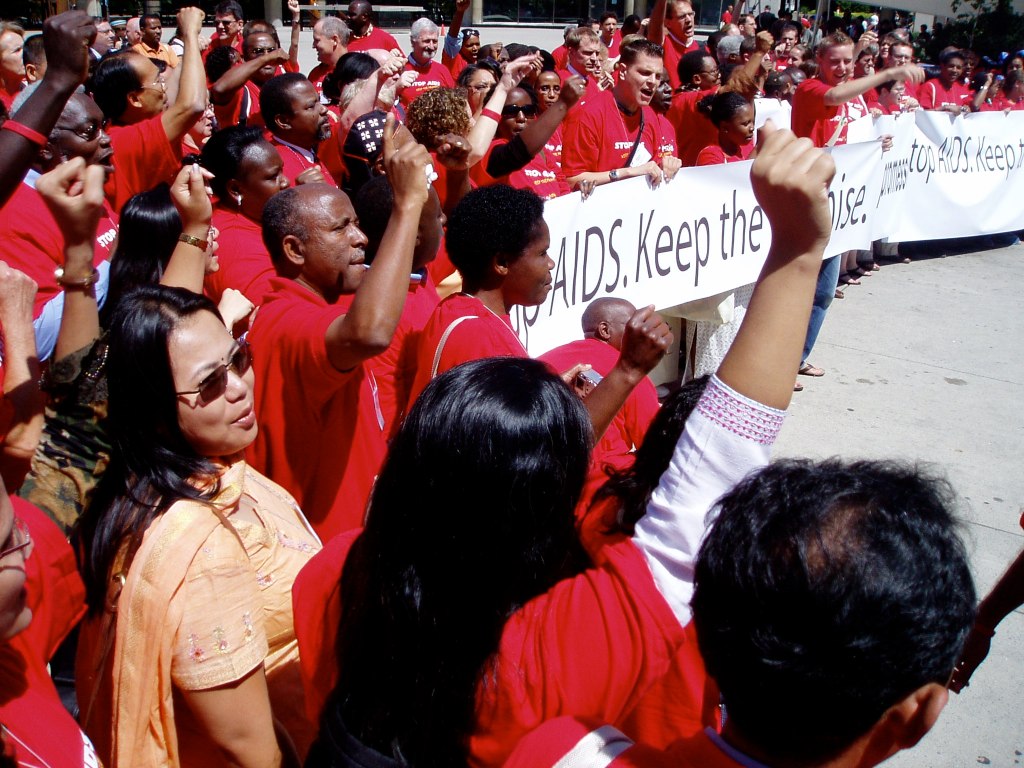
“Stop AIDS! Keep The Promise!” was the cry outside the International AIDS Conference in Toronto in 2006. (Jim Hodgson photo)

With the WTO, it was the need to ease patent protection so as to produce less costly generic versions of medicines used to treat HIV and AIDS. Again, efforts were broadly supported by churches and NGOs around the world. Eventually, in at least partial responses, less-costly generics and the Global Fund to Fight AIDS, Tuberculosis and Malaria helped save lives in many countries.

Vaccine Equity

The WHO has long called upon rich countries to ensure that vaccines are shared equitably. The global organisation is one of the leaders of COVAX, a program that aims to supply 1.3 billion vaccine doses to low- and middle-income countries this year. But so far, COVAX has had a slow roll-out.

The British-drafted resolution in the Security Council, co-sponsored by 112 countries, recognized the importance of extensive use of vaccines in this pandemic time as a “global public good for health.” It emphasised the need to develop international partnerships to scale-up manufacturing and distribution capacities.

Further, the Council requested the Secretary-General to provide a full assessment of the impediments to vaccine access in the pandemic response. It said it would review situations brought to its attention by the Secretary-General where hostilities and armed group activities are impeding COVID‑19 vaccination and to consider what further measures may be necessary to ensure such impediments are removed, and hostilities paused to enable vaccination.

It emphasized the urgent need for “solidarity, equity and efficacy,” inviting donation of vaccine doses from developed economies and all those in a position to do so to low- and middle-income countries and other countries in need, particularly through the COVAX facility.

These are complex initiatives but they—together with action for patent and debt relief, and additional funds for vaccines and other public health need—are essential for overcoming the global pandemic and for the reconstruction that will follow.

People in Canada are also invited to sign a petition to ensure full access to Covid-19 vaccines by all migrants regardless of immigration status. See the Vaccines For All petition here.
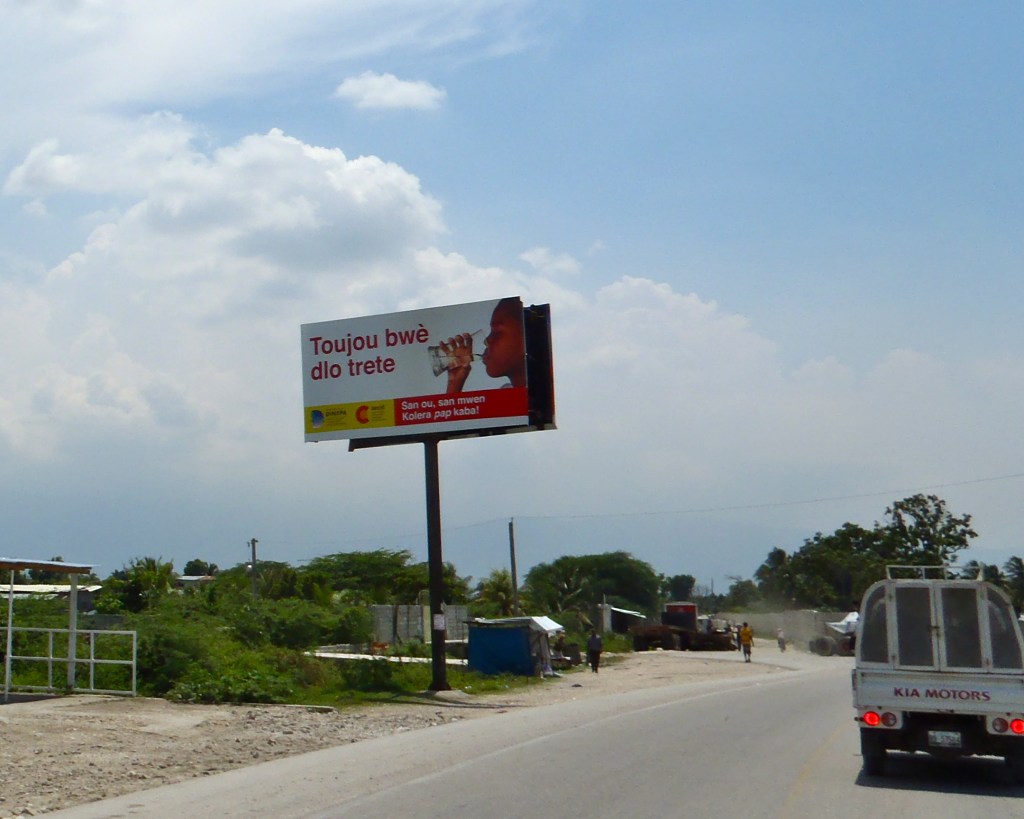
Systemic issues that pandemic recovery efforts fail to address

“Always drink treated water” (Haiti, 2011)

In September 2015, without so much as a look over their shoulders at past development successes and failures, 193 world leaders committed themselves to 17 sustainable development goals (SDGs) that were intended to achieve three great things over the next 15 years:

  • End extreme poverty
  • Fight inequality and injustice
  • Fix climate change

I support the goals. Who but the most reactionary would not? And I believe that the United Nations is vital for nation-states to work out common approaches to global problems. 

But my experience tells me that governments usually fail to cough up the money required for effective Official Development Assistance (ODA). It also seems to me that extreme poverty, inequality and injustice cannot be eliminated, or climate change fixed, without significant systemic changes to the global economy: the power of transnational corporations and their investors must be curbed.

A bit more than five years later—and a year into the global Covid-19 pandemic—the SDGs are in peril. Worse: good will is evaporating as the wealth gap spreads wider and rich countries grab the vaccines.

By Feb. 10, more than three-quarters of vaccinations had occurred in 10 of the world’s richest countries, while nearly 130 countries had yet to administer a single dose. In January, Oxfam reported the world’s 10 richest men had seen their wealth increase by US$540 billion during the pandemic, “while billions of people are struggling amid the worst job crisis in over 90 years”—a situation, Oxfam said, that seems poised to get worse. “Unless rising inequality is tackled, half a billion more people could be living in poverty on less than $5.50 a day in 2030, than at the start of the pandemic.”

In this context—even while critics like me might argue over details of the SDGs—it was heartening this International Development Week (ending today) to see that Cooperation Canada and its members (development and humanitarian relief agencies) are calling on Canada to increase ODA commitments to ensure a global recovery from the pandemic.

“This is an absolutely critical time. It’s not a time for Canada to be withdrawing from the world. It’s quite the opposite,” said Nicolas Moyer, CEO of Cooperation Canada. Speaking to Radio Canada International, he added: “There are huge pressures not only on global progress but our own values. Democratic values are under threat, human rights are under threat as they haven’t been before.”

Canada should invest at least one per cent of its domestic Covid-19 response in additional international assistance funds in its upcoming 2021 federal budget and years to come, Moyer said. Cooperation Canada’s recent report, In This Together: A Case for Canada’s Global Engagement, details the impact of Covid-19 on vulnerable people around the world.

Canada’s contribution to international assistance of $6.2 billion in 2018-19 is equivalent to just 0.27 per cent of the gross national income (GNI), well below international commitment of 0.7 per cent—and below the contributions of peer countries.

Last year, Prime Minister Justin Trudeau announced $865 million for vaccine purchases and Covid-19 treatments in low- and middle-income countries. He also gave International Development Minister Karina Gould a renewed mandate to do more to support developing countries “on their economic recoveries and resilience.”

In December, Gould announced a $485-million increase in Canada’s $5.9-billion overseas development assistance budget. The money was earmarked for new international efforts to ensure the equitable distribution of Covid-19 vaccines to poor countries.

She added that Canada “would absolutely be donating any excess capacity” of vaccines to poorer countries. But vaccines alone won’t heal the damages of the pandemic which, in less than a year, erased a decade of progress in improving the livelihoods of the world’s most impoverished people, especially children.

“What we’re talking about in international development is a decade of lost gains,” Gould said in an interview with The Canadian Press.

Canada is also one of the top donors to the COVAX Advance Market Commitment (AMC) Facility. The COVAX program is aiming to provide 1.3 billion vaccine doses to 92 lower-income countries by the end of this year. But it remains underfunded and is still seeking billions of dollars to meet its goals, the Globe and Mail reported Feb. 3.

Canada is also supporting the Global Fund work to overcome Covid-19 with testing kits and reinforced health systems, while sustaining gains made against HIV-AIDS, tuberculosis and malaria.

But here’s where we come to those tough, systemic issues that SDGs and current pandemic efforts fail to address. Patent rules need to be relaxed. Most of the new vaccines were developed and produced after heavy infusions of public subsidies, and those big companies are holding tight to their patents.

This happened too in the struggle to provide HIV and AIDS treatments globally. After years of pressure (including the Beads of Hope advocacy campaign of The United Church of Canada in the early 2000s), less-costly generics and the Global Fund eventually helped save lives.

Dr. Anthony Fauci is among those who are calling for “cooperation from the pharmaceutical companies” to allow “relaxation” of their patents. 

About 100 countries are supporting a proposal at the World Trade Organization (WTO), led by South Africa and India, to allow a temporary waiver of intellectual property rules for vaccines and other COVID-19 products during the pandemic. The African Union has joined the calls.

But Canada and other wealthy countries have so far refused to support the plan, the Globe and Mail reported on Feb. 12. Canadian officials say they “will continue to engage” with supporters of the waiver plan ahead of a Feb. 23 meeting of the WTO.

Meanwhile, vaccines from China, Russia and Cuba are gaining credibility and will become more broadly available in developing countries. In a time when the United States wants to recover influence lost during the relatively-isolationist years of Donald Trump’s administration, it would seem some opportunities are being missed here—for the sake of globalized corporate capitalism. The Anglican archbishop of Cape Town, Thabo Cecil Makgoba, argues that President Joe Biden should use the wealth and power of the United States to see that South Africa and other countries that desperately need an effective coronavirus vaccine have access to it.

Another approach—The People’s Vaccine—is proposed by  a coalition of organisations including Amnesty International, Oxfam, Public Citizen and UNAIDS, among others.

Churches, development and the crisis in the multilateral system

Oct. 21, 2018

Panel on human rights, faith and sustainable development

This year marked the 70th anniversary of the Universal Declaration of Human Rights. In their final declaration, the religious leaders who attended the recent G20 Interfaith Forum in Buenos Aires noted the religious “inspiration and moral teachings of the religions” in the Declaration, and they re-affirmed their commitment to defend human rights. They also expressed concern for the course of globalization that has produced new forms of slavery, and rejected all forms of human trafficking.

The global partnership program of The United Church of Canada supports the work of CREAS, a centre that provides training and support to faith-based organizations (FBOs) across Latin America and the Caribbean. Like other ecumenical initiatives that we support—from the World Council of Churches to KAIROS—CREAS engages with political and economic systems to open space for discussion of ethical values.

During the G20 Interfaith Forum panel on religious liberty, Elena López Ruf (at left, in photo above), the religion and development program manager at CREAS, said her organization works with others on sustainable development goals (SDGs) to bring perspectives that reflect moral and ethical values to that common agenda. These, she said, are centred on the human person and, as the SDGs proclaim, are to ensure that “no one is left behind.”

In a subsequent panel on human rights, faith and sustainable development, Elena and two colleagues from the Argentina office of the UN Development Program described how they work together and with others to achieve SDG 17 (“partnerships for the goals”). This is a process to work among FBOs to exert influence on implementation of all the goals. FBOs bring an ethical dimension to the SDGs, and recognition of the role of religious organizations in development. Such recognition is now greater than before, Elena said. “Development is not just economic; it is integral and multi-dimensional, including religion,” she added.

During the period after World War II, as the concept and structures of international development were being created, global leaders may have thought religion would simply disappear as education improved and secularism took hold. In a sense, the UNDP work with CREAS in Argentina is a kind of pilot project of how UNDP can work with FBOs in ways that measure results of proposals, actions and projects. Marcos Lópes of the Christian Aid office in Brazil said this is “not just green-washing,” but is rather “promoting a new future.” Elena noted some historic elements—some as recent as Pope Francis’ encyclical Laudate Si’ (May 2015). The encyclical speaks of integral development, though not explicitly of the SDGs that were launched a few months later.

This discourse about religion and development reflects what I heard a year ago in Geneva at an ecumenical gathering on diakonia and sustainable development. And I think it’s good that FBOs press governments harder on ethical dimensions of development—including human trafficking, impacts of climate change, mass migration, gross inequality, and gender justice.

Multilateral systems of development, human rights, under threat

But I worry sometimes that the cost of access to such tables is dilution of the justice messages. The times we live in require prophetic voices.

Together with the human rights declaration, the notion of international development was born in the late 1940s as nations re-ordered their relationships in the wake of the two disastrous world wars. They created new institutions to shape political and economic relations, and to bring the global “south” (or “third world,” we used to say) into this new order.

In June, when Canadian foreign minister Chrystia Freeland received an award as diplomat of the year, she talked about a “rules-based” international order that was under threat from what she called “authoritarianism.”

We may differ about which rules—trade rules, for example, are made for corporations, not for people’s well-being or the environment. The authoritarians she mentioned most often were leaders of Russia and (incorrectly, I believe) Venezuela. But I think she was also levelling criticism at the right-wing populists who are taking over in the United States, Philippines, Turkey, Colombia—and more locally, in Ontario and now Quebec. In Brazil, perhaps the worst of them all may win power in an election at the end of October.

“The truth is that authoritarianism is on the march—and it is time for liberal democracy to fight back,” said Freeland.

Part of the problem is that liberals (and social democrats) seem to forget the struggle to win rights from the old land-owning elites, even while it’s the spiritual heirs of the old elites who are winning power today.

A few days after the G20 forum, during a round-table meeting of CREAS with its global partners, a panel tried to address the issues of this “epoch-changing” time. We celebrated proposals to address issues and systems. It’s not that we’re doing nothing. But we need to “cut the distances not only between our projects and communities and partners, but also between countries and communities and religions.”

In our times, we all face the same perils. We must continue to build alliances North and South for, in the words of Pope Francis, the benefit of “the poor and the Earth, our common home.”