Systemic failure of global finance demands system change

by Jim Hodgson

If, as UN secretary general Antonio Guterres has said, the excessive debts of impoverished countries represent a “systemic failure,” then the solution would be reform of the system.

And so, for at least five decades, UN agencies, development NGOs and global justice activists like me have talked about a “New International Economic Order” (NIEO) or reform of the “international financial architecture.”

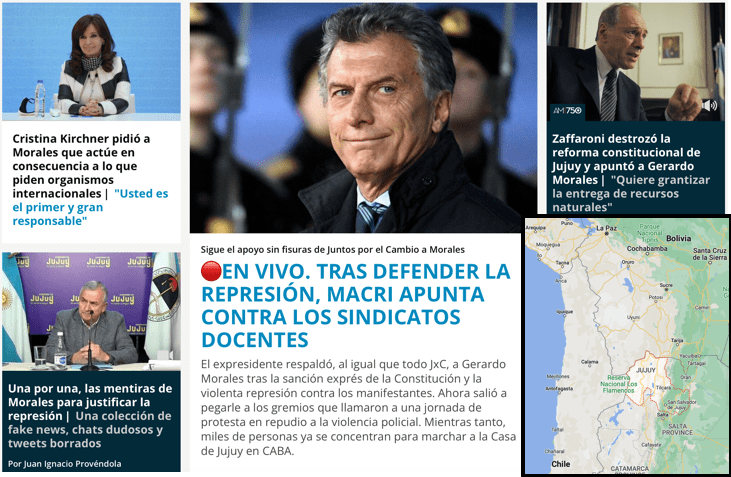
Left: media coverage of the summit was mixed; right: Prime Minister Mia Mottley of Barbados at the UN climate conference in Glasgow, 2021.

The latest tilt at the windmill of reform came in June from French President Emmanuel Macron working together with Barbados Prime Minister Mia Mottley. They invited world leaders to Paris June 22-23 to come up with a new “global pact” to fund the struggle to overcome poverty and human-caused climate change.

“What is required of us now is absolute transformation – and not reform – of our institutions,” said Mottley in her opening address. Mottley had earlier worked with other Global South nations to propose what is called the Bridgetown Initiative – a plan for changes to governance, policy and practice of North-controlled international financial institutions.

What followed, however, showed a “wide chasm” between what the Global South needs and what the Global North is willing to concede, said Iolanda Fresnillo, policy and advocacy manager for debt justice at Eurodad, an NGO focussing on debt and development.

Images from the first years of our new millennium: a Lula campaign billboard in Brazil; a mural in Buenos Aires protesting the 2001-02 economic crisis.

Brazilian President Luiz Inácio (Lula) da Silva, insisted that leaders address global inequality. 

“It is not possible that, in a meeting between presidents of important countries, the word inequality does not appear: wage inequality, racial inequality, gender inequality, inequality in education, inequality in health. In other words, we are in an increasingly unequal world, and wealth is increasingly concentrated in the hands of fewer people, and poverty is increasingly concentrated in the hands of more people.”

With changes to taxation and provision of pensions, Brazil had lifted 36 million people out of poverty by 2010, he said. But after Jair Bolsonaro left office, 33 million were once again in poverty. Lula pledged to take steps again to improve the lot of the impoverished, to overcome deforestation in the Amazon and other forest regions of Brazil, and to collaborate with other governments for the sake of forests, climate and equity.

This August, Brazil will host a meeting of South American countries that share the Amazon basin. It’s a step toward 2025, when the Brazilian state of Pará will be the seat of that year’s climate negotiations, COP 30. Pará is where the Amazon River reaches the Atlantic Ocean.

But Lula also decried the ineffectiveness of global institutions that cannot enforce climate action and that represent the world as it existed in the late 1940s. “We cannot continue with institutions that work in the wrong way,” he said.

Western leaders “snub” Macron summit

Other than Macron, German Chancellor Olaf Scholz was the only G7 leader to attend. Canada was represented by then-International Development Minister Harjit Sajjan. (Sajjan was moved away from the development portfolio in the July 26 cabinet shuffle and replaced by Ahmed Hussen.)

But one searches in vain to find media commentary on Sajjan’s participation, and must turn instead to a government news release to find out what he said or did:

“While at the summit, Minister Sajjan participated in several high-level events, including an event on the key challenges, opportunities and tools required to achieve a new feminist financial architecture, as well as an event on increasing global investment in education to catalyze sustainable development. He also took part in a discussion on improving access to financing for Small Island Developing States (SIDS) through the Bridgetown Initiative and the Multidimensional Vulnerability Index. This discussion was particularly important to the Minister given his role of small states champion under the UN-Commonwealth Joint Advocacy Strategy for Small States. The Minister emphasized his commitment to amplifying the priorities of SIDS and helping to find solutions that work for them, particularly on climate vulnerabilities.”

Sajjan also announced that that Canada will invest $50 million in something called the BlueOrchard Latin America and the Caribbean Gender, Diversity, and Inclusion Fund “to increase access to financing for women, Indigenous peoples, Afro-Descendants and other underserved groups in Latin America and the Caribbean.”

BlueOrchard, the government news release explains, is “a member of the Schroders Group” and “a pioneer in the growing field of impact investing.” (Impact investing is defined elsewhere as an extension of socially responsible investing, and “goes a step further” by actively seeking investments that can create a significant impact.)

After a bit of digging, one learns that BlueOrchard Finance is a Swiss-based investment company that has been working in Latin America since 2007. It specializes in microfinance. “The strategy has financed 400,000 micro-entrepreneurs across 13 countries” in Latin America and the Caribbean. in 2019, BlueOrchard had about $3.5 billion in assets under management.

This is not the same as cooperatives, credit unions or even the microcredit “economy of solidarity”-style initiatives with which I have been involved in Haiti, Cuba, Guatemala and El Salvador. And it’s not about systemic change. 

“Feminist financial architecture” and other good intentions aside, Canada and the other wealthy nations are part of a continuing failure to finance the fight against impoverishment and climate change. 
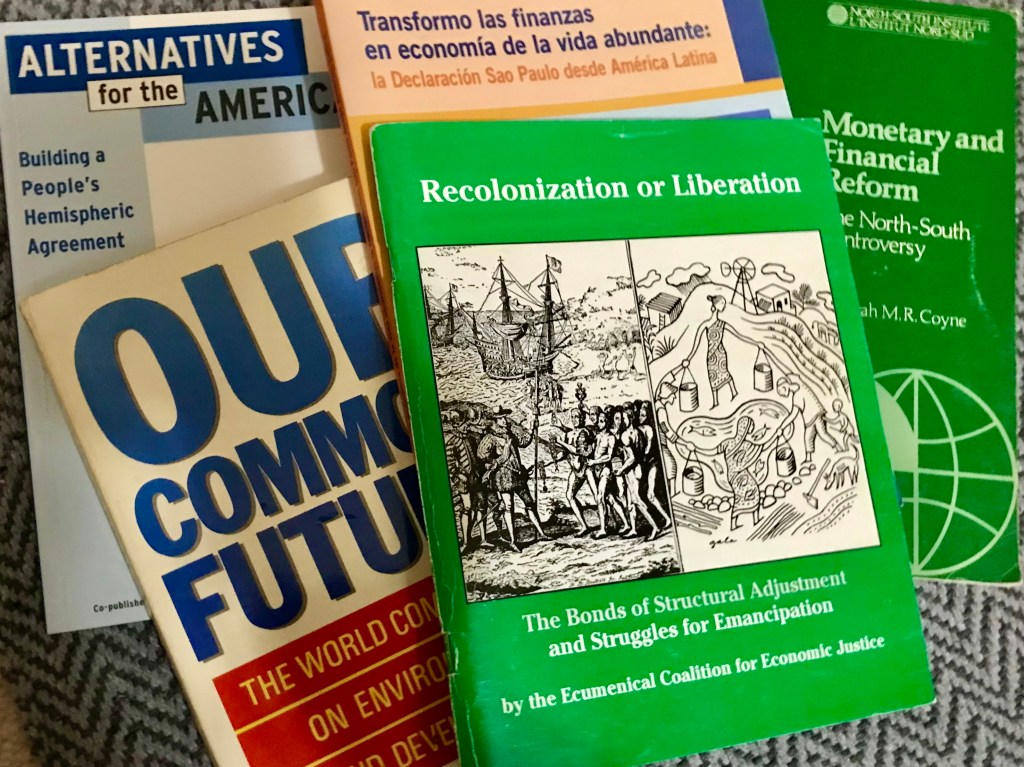
Some among us have proposed changes to the global financial architecture for a very long time….

A post-script. Global South leaders do not see issues in the same way that their Global North counterparts see them. In Brussels a few weeks after the Paris summit, European Union leaders held their first meeting with Latin American leaders in eight years. While the EU pressed for more support for Ukraine, Latin Americans led by Lula pressed for dialogue and questioned new European demands ahead of a potential new trade deal. In the end, the joint statement could only say that the ongoing war is causing immense human suffering and increasing the global economy’s real vulnerabilities.
Jujuy, Argentina: “Despite pain and loss, the people always win”

by Jim Hodgson

In Jujuy, northwest Argentina, a struggle is playing out that shows how right-wing political forces repeatedly apply repression to hold on to power even as democratic space continues to open across most of Latin America.

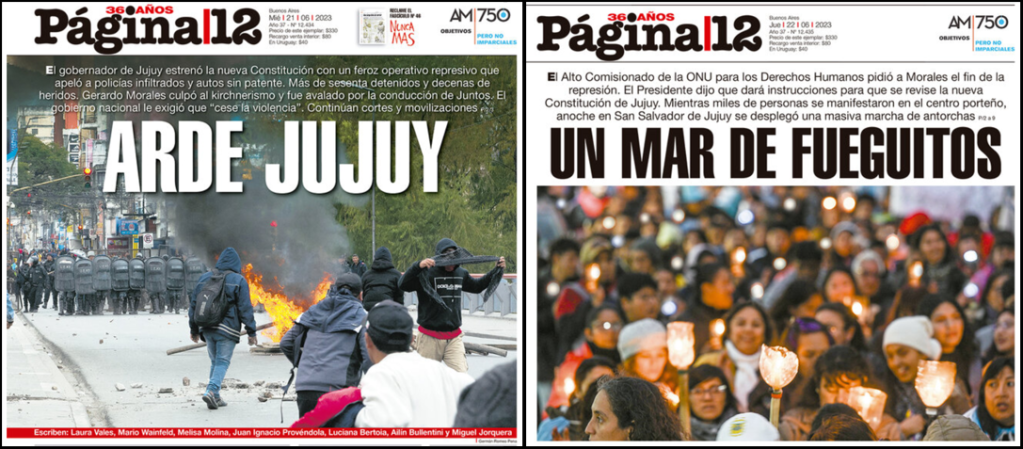
Front pages June 21 and 22 of a Buenos Aires daily, Página 12: “Jujuy burns” and “A sea of candles”

The most recent flare came after teachers went on strike to press their demand for salary increases amidst Argentina’s 114-per-cent inflation rate. Jujuy provincial governor Gerardo Morales responded by rushing through changes to the province’s constitution that restrict freedoms of assembly, protest and speech. The constitutional changes came without approval of the province’s Indigenous peoples.

 “We have received reports of events that could constitute an improper use of force against individuals in the context of the demonstrations,” said Jan Jarab of the South America regional office of the United Nations’ High Commissioner for Human Rights. In a letter addressed to the governor, he also questioned “the handling of the recent demonstrations by the security forces, as well as about some of the provisions of the approved provincial constitutional reform text.”

“Despite pain and loss, the people always win.” Canadian trade unions, solidarity groups and Common Frontiers joined together June 22 to send a message of solidarity.

Amnesty International also denounced those changes, and called for on the Jujuy government to cease the “excessive use of force against those exercising their right to peaceful protest, which has resulted in hundreds of people being injured in recent days.”

President Alberto Fernández responded to the continued unrest in Jujuy by saying he will seek to have the reforms to the provincial constitution struck down as unconstitutional.

Morales has used excessive measures before, notably in the case of Indigenous leader Milagro Sala, imprisoned since Jan. 16, 2016, after a protest. Sala is leader of the Movimiento Tupac Amaru, and led the creation of “workers’ neighbourhoods” that allowed workers to live for the first time in houses that they owned and to have access to schools and health centres.

Página 12 headlines describe different positions on the Jujuy conflict. Inset (bottom right): map showing the location of Jujuy in northwest Argentina.

The drama in Jujuy plays out against the backdrop of Argentina’s volatile political calendar. The two-term Jujuy governor is the presidential candidate of one of the conservative parties, the Unión Civic Radical (UCR). The UCR is part of the centre-right coalition, Juntos por el Cambio “Together for Change”) which also includes former president Mauricio Macri. 

That coalition, however, is fractured now by the emergence of Javier Milei, a libertarian economist, as a candidate who has drawn support from the right and from sectors of the centre-left dissatisfied with the current administration of Fernández and his vice-president, Cristina Fernández de Kirchner (triple-digit inflation and a deteriorating economic situation).

Primary elections will be held on Aug. 13 for parties that opt to choose candidates by that system. The general election is to be held Oct. 22, and a presidential run-off would follow Nov. 19 if necessary.

In a move that surprised many observers, the president and vice-president and other leaders of their Unión por la Patria (UP) coalition came together June 23 to back a single candidate and slate headed by Economy Minister Sergio Massa.

Along with the national political context, a second factor driving the repression is the presence of lithium in Jujuy (which borders the lithium-producing regions of northern Chile and southern Bolivia). Lithium is used in batteries for electronic vehicles. 

A recent visit to the region by film-maker James Cameron was manipulated by Jujuy’s governor to give a positive spin to lithium mining operations undertaken despite Indigenous opposition.

Cameron, the director of Avatar and Titanic, said later: “Ironically, the outcome of this is that I am now aware of the problem and we will now assist through my foundation with the issue of Indigenous rights with respect to lithium extraction.”

A third factor in the present conflict is the region’s history of 480 years of colonial exploitation and Indigenous resistance

A recent statement by archeologists and anthropologists declares their solidarity with the Indigenous people of Jujuy. “And without community territory, rights to the land and the possibility of social protest against diversion from that vision, there is no equality, inter-culturality, or social peace.”

Talking about peace when there is no peace*

Jim Hodgson, May 23, 2023

Peace is a pre-condition for any possibility of transforming the global economy for the sake of humanity and the Earth – or, more modestly, achieving those elusive Sustainable Development Goals by 2030.

In the weeks after Russia’s invasion of Ukraine, I added my voice to those of others who pleaded for peace talks. In recent weeks, new efforts from church leaders and global South political leaders are underway to bring the sides together. But peace initiatives are either ignored or disdained by most media and “Western” leaders.

Headlines and images from Mexico’s La Jornada and Argentina’s Página 12 newspapers. On the left, Lula asks that a new Cold War between China and the United States be avoided and defends the use for currencies other than the U.S. dollar for international trade. On the right, from top: Zelensky asks for support from G7 powers; G7 leaders create new sanctions against Russia and debated in Hiroshima the nuclear arsenals of other countries; The Vatican makes its peace effort official so as to end the war in Ukraine.

Case in point: the participation at the recent G7 meeting in Hiroshima of Brazilian President Luiz Inácio “Lula” da Silva and Indian Prime Minister Narendra ModiFinancial Times dismissed Lula and Modi as Russian President Vladimir “Putin’s apologists.” Their participation was eclipsed by that of Ukrainian President Volodymyr Zelensky, who did meet with Modi, but blamed scheduling conflicts for not meeting Lula – and then joked with reporters that Lula was more disappointed than he was. 

Well, yes. Lula’s interest in peace has everything to do with funds diverted to war and away from efforts for authentic development that could help alleviate the other crises of climate change and migration. (Lula also said that Zelensky did not show up for a meeting they had scheduled.)

In Hiroshima,  Lula criticized the division (or re-division) of countries into two antagonistic blocs and abandonment of a multipolar world that seemed to be emerging in the wake of the pre-1991 Cold War.

Meanwhile, South African President Cyril Ramaphosa was not even invited. But he and other African leaders are involved in a peace initiative to end the war in Ukraine. In a news conference May 17, he said he had had “separate telephone calls” with Putin and Zelensky over the weekend, where he presented an initiative drawn up by Zambia, Senegal, the Republic of Congo, Uganda, Egypt and South Africa. Leaders of the six countries say they plan to travel to Russia and Ukraine “as soon as is possible.”

In his weekly newsletter on May 15, Ramaphosa said South Africa would not be drawn “into a contest between global powers” despite having faced “extraordinary pressure” to do so.

“We do not accept that our non-aligned position favours Russia above other countries. Nor do we accept that it should imperil our relations with other countries,” Ramaphosa said.

During the same week, Chinese envoy Li Hui visited Moscow, his first stop in a European tour that would also take him to Kyiv, to develop a 12-point plan proposed by Beijing on the first anniversary of the Russian invasion. 

Last September, Mexican President Andrés Manuel López Obrador called for establishment of a Commission for Dialogue and Peace that would facilitate the search for a solution through negotiations. 

Nobody has a “magical formula to achieve peace,” writes Juan Pablo DuchLa Jornada’s Moscow correspondent. “But [proponents of peace] hope that Russia and Ukraine would establish a ceasefire and sit down to negotiate their conditions with the objective of putting an end to the bloodshed and devastation. All that is lacking is that Moscow and Kiev by open to making concessions – the first not wanting to cede Ukrainians regions already annexed and the latter refusing to lose territory – but without concessions, it does not seem possible to open a path toward peace in a war that, say what you will, only brings calamities.”

WCC delegation with Ukrainian church leaders in Kyiv on May 11 (WCC photo); Patriarch Kirill with WCC general secretary in Moscow on May 17 (ROC photo).

Meanwhile, the World Council of Church and Pope Francis have both renewed their efforts for peace. 

In mid-May, a delegation led by WCC general secretary Jerry Pillay visited church and government leaders in Kyiv and Moscow. In Kyiv, the WCC delegation met with senior leaders of both the Ukrainian Orthodox Church and the Orthodox Church of Ukraine, two churches whose dispute has intensified since the Russian invasion. In Moscow, they met with Patriarch Kirill, head of the Russian Orthodox Church and widely viewed as a supporter of President Putin.

For his part, Pope Francis has given Italian Cardinal Matteo Zuppi the task of leading a mission in hopes it can “ease tensions” in the Ukraine war and lead to a path of peace. The pope has said has said he would go to Kyiv if such a journey would help bring peace, but said that could happen only if he could also visit Moscow.

* The phrase “peace, peace, when there is no peace” is found in Jeremiah 6:14 and later at 8:11. It is also found in Ezekiel 13:10 and 16. The direct criticism is of those who build flimsy walls and smear them with whitewash: a makeshift solution to a problem. The metaphor then and now is points to poor leadership. In our time, we can think of leaders who promise that war will lead to peace. “They have treated the wounds of my people carelessly,” writes the prophet Jeremiah, “saying ‘peace, peace,’ when there is no peace.”

War Never Again – Westerplatte, Gdansk, Poland (site of the first battle of World War II in 1939).