A faith that does justice

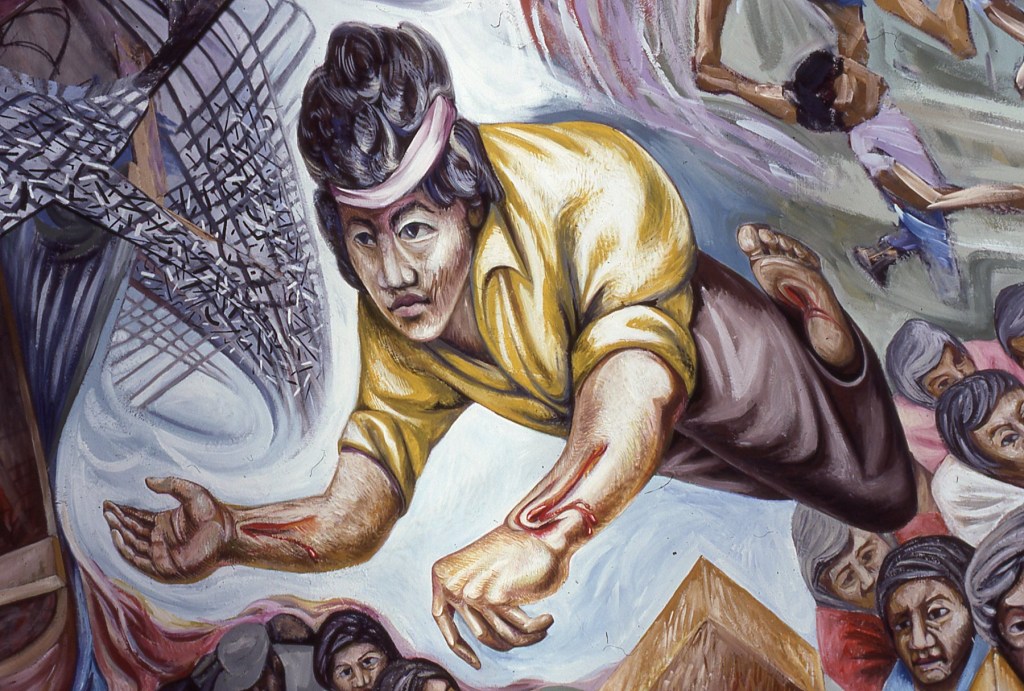
The Risen Christ: Detail from the central mural of the Iglesia Santa Maria de los Angeles en el Barrio Riguero, Managua (Jim Hodgson, 1984)

Things that have been different in the past can be different again in the future.

If, like me, you are distressed by actions of religious extremists and their allies among Canada’s bishops against global partners of the Canadian Catholic Organization for Development and Peace (D&P), then it is useful to remember how some forward-looking people were inspired by the Second Vatican Council and by social and political change in the global South to create the organization back in the 1960s.

Today I share with you the text of an interview I did in February 1989 with Bill Smith, a Scarboro Missions priest who had just finished 15 years of service as D&P’s Central America project officer. Bill died less than three months later, just after arriving in Brazil. 

I share Bill’s words to me that day in Montreal 32 years ago as a sign of what has been possible, and of what can be possible yet again. 

The interview was published in Scarboro Missions magazine, September 1989, pp. 4-7.

Bill: I was 50 years old last November, so I begin by saying this is quite a remarkable phenomenon to have lived so long in a world where the majority of people do not even attain early adolescence. It is not at all remarkable in the North American continent but it is very remarkable if set in the framework of what we traditionally refer to as the Third World.

To place in context where I am and the journey that I have made, we would have to go back almost 30 years to Vatican II. A revolutionary process was underway in Christianity by the early 1960s. Women and men in the Church had become identified and involved in life and death struggles of primarily peasant farm peoples with whom they had been working, and with the struggles of oppressed people. Out of this context emerges later on in history what they refer to as the theology of liberation. This theology denounces injustice and announces that the gospel is involved in bringing about change and justice. Vatican II was a moment in this century when the Catholic church which over a period of hundreds of years had distanced itself from the radical message of the gospel, got in touch with its roots again, and that has made a profound change throughout Christianity and throughout secular society as well. It certainly made a profound change in myself.

The articulation of that “new vision” of society and the now famous encyclical of Paul VI, The Progress of Peoples, state that the Church does not have economic answers, nor does the church have any particular model of society, but only suggests that men and women working together must build a society based on the logic of the poor majority. There was also the serious question of the absolute right to private property on which our North American society is based.

We witness this radical change in the thinking and the living of the gospel message because the Catholic Church is no long a white, middle-class Western and European church but is a peripheral church made up of men and women who are not attached to the status-quo of the present economic system that we see primarily in the West called Capitalism, but who are looking for and demanding, in the name of their faith, a radical change in the structures of society.

So today, I no long think that mission is primarily the proclamation of a message that is assented to in faith, but today it is an evangelization based on a faith that does justice. So mission is no longer considered as only the work of missionaries, who leave their country to proclaim the gospel in distant lands.

When I first went to Brazil, I thought that mission would be working in the Amazon. But what I had originally thought, in my simplicity, that there were frontiers and barriers between countries, was again part of a mythology. I discovered that there was a social, economic and ecological vision of men and women that was being imposed by the powerful over the weak. I have also witnessed a church that has done a self-critique and had realized that it does not own the gospel, and does not own the historical Jesus. I have seen the Magnificat lived in the sense of the ‘great’ being questioned and pushed to the wall by the ‘small’ who have been lifted up. I think that is amply illustrated in the case of Nicaragua and El Salvador. Despite literally millions of dollars per day being put into machines of death, the men and women of Nicaragua and El Salvador are building a society precisely that comes out of this new awareness of social justice. These are poor people, suffering people, who are the victims of an unjust and aggressive war. 

A different era of North-South cooperation: Bishop Bernard Hubert, Longueuil;  Fr. Bill Smith, SFM; Bishop Remi de Roo, Victoria; Cardinal Paulo Evaristo Arns, São Paulo.

I would say that the major changes that I discovered in working in Central America over the last few years has been primarily a tremendous awareness of people, of men and women and peasant farmers who are capable of seeing very clearly what is going on. Where is the creativity taking place in the world today? Men and women in the Third World see clearly and understand that there is a structure that has been put in place. And that poor housing and lack of schools and lack of health facilities and lack of education is no indication of any kind of inferiority. But it is a provoked phenomenon. It is something that is determined. What I get very excited about is this tremendous creativity where poor people are looking a life and asking, Why can’t everybody have a decent life? Why can’t we build an economy in which people don’t have to be destroyed through pesticides? Why can we not build a society where justice applies to all, and where women are not chattels and objects but full human beings with all the rights that men have? And why cannot religion, instead of being something that suffocates and destroys creativity, be the source of new energy, integration and wholesomeness?

Growth takes place when people begin to come to grips with the real issues in society, when we get beyond the guilt of feeling responsible for what has happened in the Third World, to where we feel we are co-responsible for transforming our Third World here in Canada and all the other Third Worlds. People are coming together and trying to understand, moving beyond mythology to an understanding of society. That is what I see having happened in this period for the past 30 years.

I think that Development and Peace has fundamentally held on to this meaning of the encyclical The Progress of Peoples and realized quite prophetically that social change is fundamentally all about empowering people and not about technology or funds or even personnel, that transformation takes place when people begin to come together and share. Solidarity, so beautifully stated in Nicaragua, is the tenderness of peoples. So that if you are going to have social change then you have to have the empowerment of people who are going to bring about change.

Q: Who are the major actors to bring about change in society in Central America?

It is the majority of people who are the peasant farmers. Women and men involved in alternate forms of education for the ordinary people, since to be ‘educated’ has been primarily reserved to the elite. What Development and Peace does, and I think does well and with a great deal of respect is to accompany groups, communities and other popular organizations in Central America who are involved in the very democratic process of resolving their own problems through new forms of popular education. So we don’t tell them what to do. They present projects to Development and Peace for financial help. So that is one leg. Development and Peace walks on two legs. Its other leg is here in Canada because it has to be involved in what is happening here. If you are not, what kind of credibility can you have by being in another country? Thus, Development and Peace has to conscientize or educate us Canadians here in Canada. This happens by bringing peoples, spokespersons, men and women to be with us. It is those two legs or accompaniments that make for an exciting development journey.

We must note, however, that the people in the Third World are no longer talking about development. They are talking about liberation and they are talking about liberation in a broader context—social, economic, political and religious liberation. And so the evangelist goes out and ends up being evangelized. The teacher becomes the student. The Third World peoples do need us as we need them to walk together, to listen to each other, to be strengthened, to be empowered mutually, to bring about precisely this vast change that we need in our own Canadian society. St. Augustine says Hope had two beautiful daughters: one of them called Anger because of the way things are and the other called Courage to work to change things, to bring about change.

That is what I have learned, what the Third World has taught me, and I would hope that at the end of all of this, if indeed there are any titles left to be handed out, I and others would be entitled to the name Companion. I think that is what Development and Peace is, I think that is what Scarboro is and it is something that I aspire to as well.

Q: What did you do in Central America?

I was a bridge, a contact between farmers’ groups, unions, women’s groups, health groups, popular education groups, human rights groups and Canadians. Solidarity has to be personalized. I mean people have to sit down and break bread together. That is what Companion means, and that is when Jesus was recognized on the road to Emmaus. He walked with them, he talked with them but it was when they broke bread they knew Him.

What is important is the quality of life here and in the Third World and the exchanges and dialogue that takes place. I carry in my heart so many wonderful people and I think that is what is important. So much so that now I can go back to Brazil in a totally renewed, energized way and do exactly the same thing. Nothing but to be present, which is to accompany, and to come back to my own people once in a while and say, “You know folks there are really doing some tremendous things right now,” in São Paulo or wherever it is one happens to be.

Q: What were some of the successes you experienced?

Well, I think that the beautiful successes are the struggles of the people in Guatemala, people in El Salvador and in Nicaragua, people who have been faithful to their commitment to bring about social justice. Part of the work, it seems to me, is to bring people to another level of awareness that life is precious and that there are things that we can do. We are not helpless. Also at home, to denounce the violations of human rights; to open our borders to receive people who are driven from their homes; to be courageous enough to denounce international terrorism; to be courageous enough to make available sources of information so as to counter the lies that are put forward in the press. The important thing, I’ve learned, is that we are not helpless. And as Nicaraguans have taught us, those who struggle never die. They are always present. We will be remembered because we are part of a process. A process that did not begin with us, a process that does not end with us. The responsibility we have is handing on that mandate to others.

Q: What do you think Canadians can learn from your experience?

That we are not to be paralyzed or overcome with guilty but we must begin to work here. It is to the degree that we are involved in our own community here in Canada that we can understand what other people are doing. There is communion that is possible. We can understand each other because we have had the same experience. There is, and very much so, a new awareness and commitment in Canada to come to grips with the real issues in society, to repair the damage that has been done. So there is a great deal of hope, that is what’s so exciting.
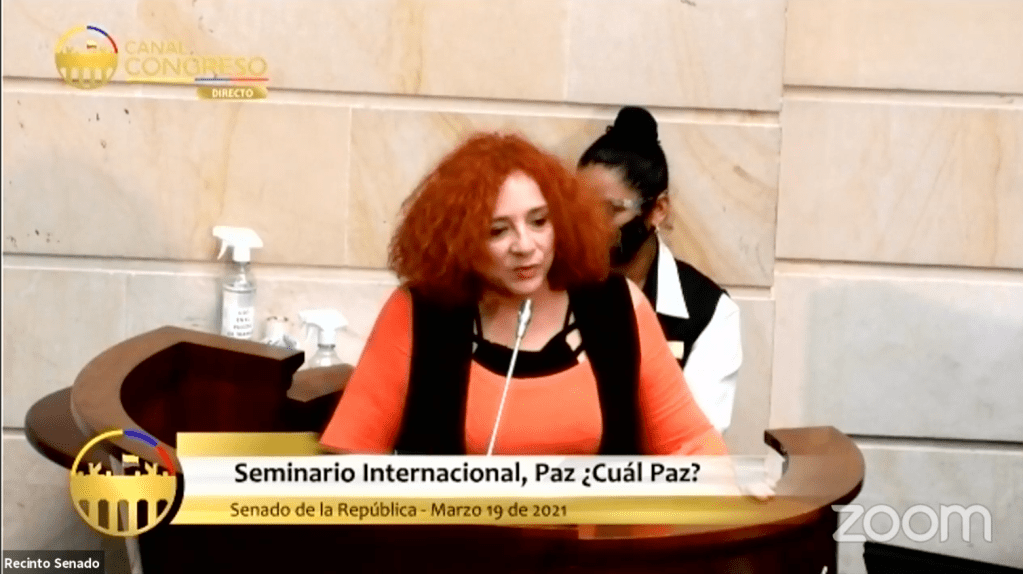
Colombians ask: “Peace? What peace?”

Lilia Solano, a human rights defender who was one of the organisers of Peace, What Peace?

In recent days, I participated in a zoom-based conference with the Peace Commission of Colombia’s Senate. Since a peace agreement between the Colombian government and the largest guerrilla army, the FARC, was signed in 2016, implementation has not gone well.

By the end of 2020, at least 238 former fighters had been murdered—victims of targeted assassinations.

Meanwhile, the UN Office of the High Commissioner for Human Rights has documented more than 400 slayings of human rights defenders since 2016, of which 108 happened in 2019 and 53 in 2020. Human rights defenders include community, small-farmer, women, LGBTI, Indigenous, and Afro-Colombian leaders as well as activists for the rights of victims and their families.

My own presentation followed those of some of my friends and heroes: 

  • Former Senator Piedad Córdoba, who led efforts to free people who had been captured by the FARC in years before the peace accords
  • The Portuguese activist Boaventura de Sousa Santos, who said that “what has prevailed until now is neoliberal peace” that only opens space for transnational corporations. What has to change are the conditions that led young people to join the guerrillas.
  • From ecumenical colleagues came the reminder that the struggle for peace with justice must be global. Rudelmar Bueno de Faria of the ACT Alliance noted the role of religion in the conflict in Colombia, warning that history will not forgive those who have “played with the peace processes.”

In my remarks, I went a bit further regarding the questionable role of religious organizations in the search for peace.

I was at the marvellous ecumenical seminary in Matanzas, Cuba, in October 2016, when news came that a referendum to approve Colombia’s peace agreement had failed. It was quickly understood that fundamentalist Christians had intervened in the public debate, and rallied their bases to vote no by arguing that the peace agreement promoted “gender ideology” and would destroy the family. In reality, the FARC rebel army had acknowledged its crimes against women and LGBTI people, and apologized. Both sides pledged to do better on gender justice and the rights of LGBTI people.

For me, having worked with faith-based organisations in Colombia and their allies abroad since 1993, the vote result and the reality that some Christians worked against peace, was a disappointment. I had seen people like Lilia Solano (pictured above), a Mennonite who works among human rights NGOs and in Colombia’s legislative branch, and Fr. Javier Giraldo, the Jesuit human rights defender and founder of the Inter-Ecclesial Commission for Justice and Peace, risk their lives for peace. I thought of friends who are leaders of the Methodist, Presbyterian, Episcopal, Lutheran and Mennonite Churches and Roman Catholic religious communities who would share my disappointment, together with people in organisations like the DiPaz inter-church peace coalition, the Mesa Ecuménica por la Paz, and the popular educators and trainers of community journalists at CEPALC.

Their persistent witness guided me when I spoke the next morning to people who were gathered at the seminary to celebrate its 70th anniversary and to consider the future of ecumenical theological education in Latin America and the Caribbean, I said it seemed to me that the voices of moderate or progressive Christians were marginalised or discounted in a climate of fear generated by the shrill voices of the Christian right and their political backers. That day in Cuba, I said:

“A good theological education, offers ways to read the bible, to interpret scripture, to understand the limits church authority in civil society. In a good theological school, one learns to use the Bible to interpret the Bible, to use the texts that we have of the teachings of Jesus about the love of God and of neighbour so as to understand other parts of the bible. Without good theological education—and, by extension, good Christian education within the churches—the public square is surrendered to the most retrograde and hate-filled voices of Christian fundamentalism, empty of love and forgiveness.”

My remarks Thursday, March 18, to the Colombian Senate’s peace conference took up similar themes.

“This increase of inequality and violence contrasts with the experience of churches and social movements that uphold fullness of life and defend the dignity of women and LGBTI people. They create spaces for mutual listening, weaving networks and planting seeds of peace and justice as they raise their voices for a world of greater solidarity.

“Those of us who are too often the objects—and victims—of hate speech need your voices, you artisans of peace, and of religious leaders who promote an understanding of Christianity that is inclusive and respectful of diversity, who promote contextual and liberation theologies, who can join dialogue over differences and are reflections of the reality in which we live: who speak, in the end, of the love that should exist among all of us

“In place of fear and prejudice, let us build alliances of solidarity across all borders.”

In Haiti, once again: something must change

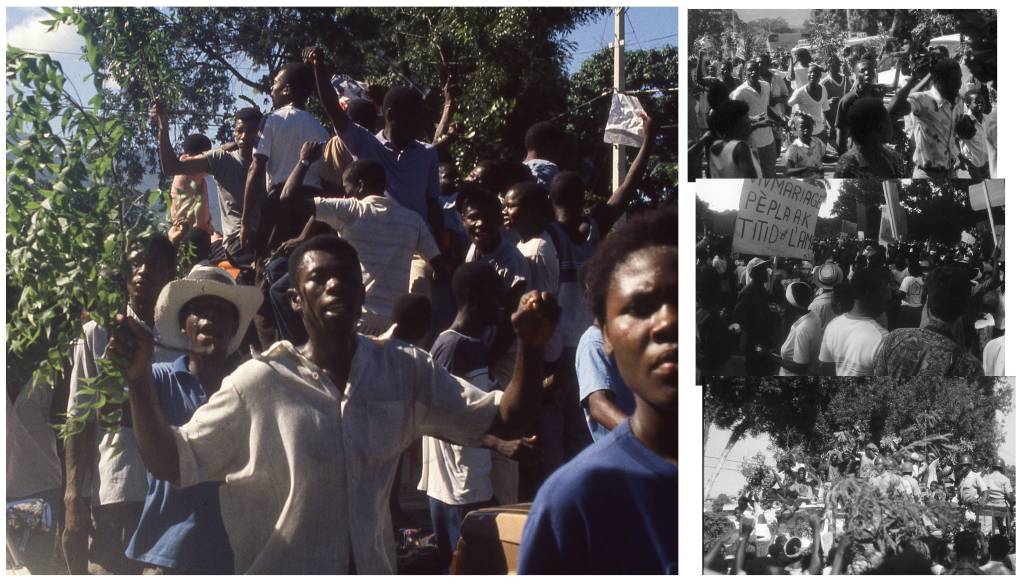
My first visit to Haiti was in March 1984 when Jean-Claude “Baby Doc” Duvalier was still in power. Less than two years later, in the face of widespread demonstrations, he fled. Six years of jostling for influence and power followed, and the voice of a young priest in the impoverished neighbourhoods around Port-au-Prince was heard. A movement, Lavalas, a flood propelled Father Jean-Bertrand Aristide into the presidency. These are some of my photos of the celebration.

A podcast that explores Christianity and the political left provoked me to think again about Haiti this week. On March 9, I was interviewed about events in Haiti for The Magnificast, a podcast produced by my friends Dean Detloff in Toronto and Matt Bernico in St. Louis. 

Right now, tens of thousands of people are marching in the streets of Port-au-Prince and other cities. They want to bring down the president, bring about a new interim government that would lead a process of constitutional reform, and organize new elections.

This time, however, they’re backed by a range of people and organizations that have not stood together since 1990 (Haiti’s first free election): churches, trade unions, community groups, students and teachers, the political left and centre.

The Magnificast has been a great space for me to think with others about complex events in Venezuela,Bolivia and now Haiti. The title is adapted from Mary’s song of praise, The Magnificat::

God has brought down the powerful from their thrones,
    and lifted up the lowly;

God has filled the hungry with good things,
    and sent the rich away empty.

Luke 1:52

On March 8, a group of civil society organizations sent a letter to Prime Minister Justin Trudeau, calling for an end to Canada’s support for Haiti’s president, whose term of office has ended. Initiators of the letter were members of Concertation pour Haïti (CPH), a coalition of Quebec-based solidarity groups working in Haiti and individuals who support solidarity with Haiti. Members include The United Church of Canada (through its francophone ministries together with global partnership staff) and Development and Peace.

The letter calls on Canada, the United Nations and others to “consider transitional alternatives, without external interference, proposed by the various sectors of the opposition and civil society instead of blindly supporting the government of Jovenel Moïse.”

Over the past two years, Haitian organizations have proposed various ways forward. A transitional government should have taken office on Feb. 7, 2021, the date that the president’s term ended. The letter explains the next steps:

“A new government, accompanied by a transitional body, should hold office for at least two years. In addition, it would be established according to a specific institutional procedure, determined in a concerted manner within civil society and the opposition, which would ensure its limited term and its independence. The goal is to work toward the adoption of a new constitution in accordance with the wishes of the Haitian people, to prepare new elections, to adopt a plan to alleviate the population’s misery, to restore order in the public administration and to reinstate the judicial system.”

A day after the CPH letter, the Catholic religious communities that are part of the Haitian Religious Conference (CHR), used the occasion of the anniversary of Pope John Paul II’s visit to Haiti on March 9, 1983—three years before the end of the dictatorship of Jean-Claude “Baby Doc” Duvalier—to renew his call for change. “Il faut que quelque chose change ici,” the pope said, adding that impoverished people must recover hope. As he left, he encouraged unity: “Têt ansanm,” he said in Kreyol. All together.

“Thirty-eight long years after that visit by the pope,” states the CRH letter, “the seeds of death now seem to outgrow the seeds of life. The country is dying, insecurity is rampant, the poor cannot go on, the population is in a disarray that borders on despair, and the country is no longer ruled. We are both witnesses to and victims of too much crime, too much injustice, and too much inequality.”

So, what gives?

Some forces resist change. Haiti’s six richest families, together with a few thousand wealthy enablers, have shown through the past 40 years that they will resist any change whatsoever. And that class is well-connected to corporations and centres of power elsewhere. The United States, as elsewhere in Latin America, is arbiter of what can be done. It may have shifted from the Cold War-view that saw the Duvalier regime as a buttress against communism. The presidency of Bill Clinton in the 1990s imposed a developmentalist approach: Haiti would be a nation of cheap-labour assembly plants. 

Since 2011, in the presidencies of Michel Martelly and Jovenel Moïse, the United States and the local elites have finally had the presidents they wanted: men close to the business sector and close ties in the United States.

Photo: Le Safimag

But Haitians have other ideas. A few months after the 2010 earthquake, I was in Haiti with colleagues from The United Church of Canada. Among the people we met was Jesi Chancy-Manigat, a member of the coordinating committee of the National Feminist Platform. She was worried about the relief effort: “We are in danger of missing an opportunity.” It’s not enough, she added, just to consult with the president of Haiti. Civil society needed to be involved: citizens, organizations, women, workers, farmers, professionals.

Yes, the opportunity was missed, and Jesi, sadly, did not live long enough to attain the changes she wanted: she died from cancer in 2013 at the age of 57.

But she taught us a few things that those of us working for change now might keep in mind. First, listen to what Haitians say about themselves. Jesi introduced us to the work of the Kay Famn (House of Women) organization. In 2010, Kay Famn insisted that the country can be and must be rebuilt.

To rebuild the country is:

  • To divorce ourselves from the practices of theft, corruption, dirty politics, and irresponsibility—where an executive or a Parliament can assume the right to ignore laws and rules.
  • To have authentic dialogue with the people.
  • To end the immense disorder that surrounds us: political disorder that prevents us from building a real democracy; electoral disorder that shackles the enjoyment of the rights of citizens; disorder in public administration, management of territory, justice, economy, education and health; disorder with respect to fundamental human rights, especially the rights to food, health care and housing.
  • To re-deal the cards so that the state serves the common good, and so that people receive services and can produce and improve their well-being.
  • To construct a system of social protection that permits action for the most vulnerable sectors: families headed by single women, those living with handicaps, those with low incomes, orphaned children, the elderly who have no resources.
  • To commit ourselves to a path that moves us away from dependence on the exterior so that Haitians may take decisions according to national interest.

The demands today are not different from 38 years ago or 11 years ago. Yet, the people persist. And yes, we support their struggle.


More resources

An article in English by Marc-Arthur Fils-Aimé of the Karl Lévêque Cultural Institute (ICKL) and the Alternative Development Platform (PAPDA)

Position paper by the Jesuits of Haiti on the current crisis

“The Millionaires Of Haiti” Podcast