Facing failure and dreaming different dreams

(Sept. 23, 2011)

To confront climate change and to ensure there is food for all, those of us who live in wealthier countries must be prepared to accept change.

“You have an interest to protect your lifestyle,” Father Rex Reyes told a United Church of Canada meeting recently. “Our interest is to protect our lives.” Reyes is an Episcopal priest and Indigenous leader who serves as general secretary of the National Council of Churches of the Philippines.

In a 1991 encyclical, Centesimus Annus, Pope John Paul II made the point in these words: Change is needed “in order to limit the waste of environmental and human resources, thus enabling every individual, and all the peoples of the earth to have a sufficient share of those resources.”

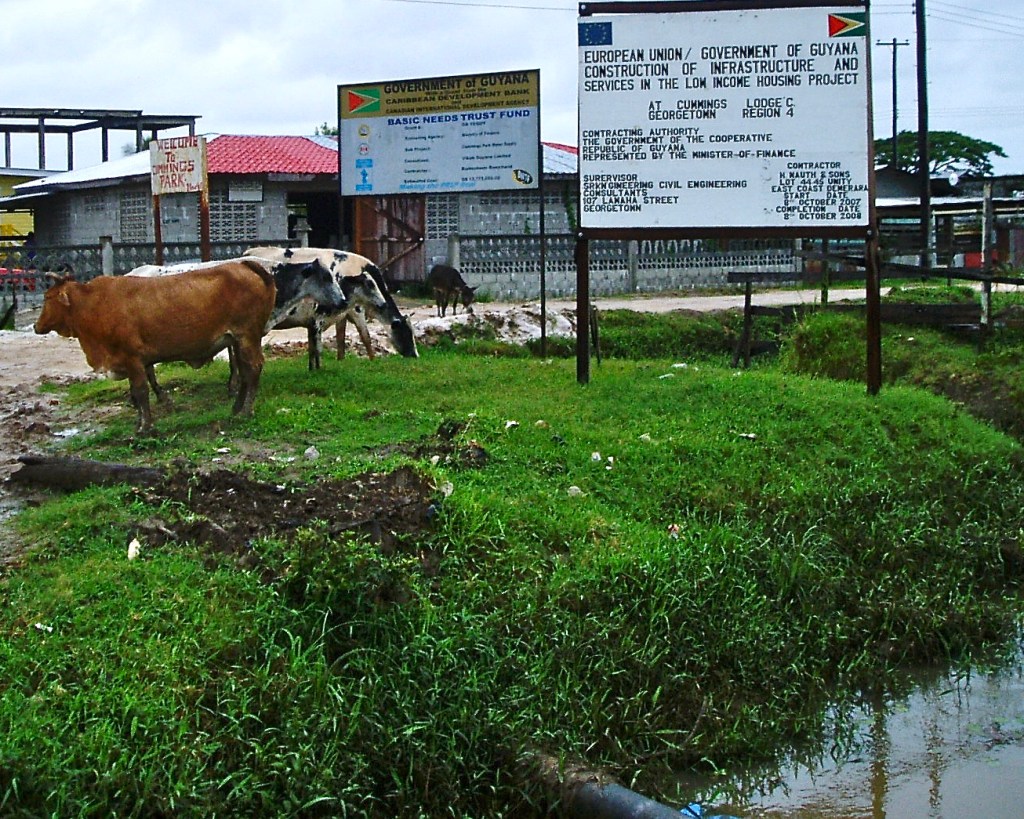
Signs announce European Union project funding on the edge of Georgetown, Guyana (2008)

These messages, rarely heard in Canada’s comfortable pews and board rooms, are heard in rough-hewn pews in churches from Mozambique to Mexico. Impoverished people do not speak of conditions in wealthier countries in order to absolve themselves of responsibility. On the contrary, they insist on making their contribution at tables traditionally dominated by those who have the money.

Food at the centre of agriculture and daily life 

“Christians should consider the failure of decades of development to date,” wrote Cameroonian theologian Jean-Marc Éla about 20 years ago.

They should “design a model of life that leaves room in our daily work for whatever may create a different future. Otherwise we are setting aside our century and our historical role, and irrevocably contributing to the coming of death.” (His essay, “The Granary is Empty,” was published by Orbis in Liberation Theology: An Introductory Reader.)

Éla advocated a “ministry of the granary” by Christians that would once again put food at the centre of agriculture and daily life, rather than export crops like peanuts, cocoa and cotton. “Death is already appearing here and there in the turns of daily life, as it does wherever cotton drives away millet.”

Over and against any ministry of the granary is set a wide range of economic interests. Governments, including that of Canada, offer advice to potential investors.

Development, instead of becoming Pope Paul VI’s “new name for peace,” is too often another name for unrestrained capitalism. With technology and the unyielding power of the financial institutions, the market is prescribed as the development norm for all other nations.

Neo-liberals, development and solidarity

(Sept. 19, 2011)

I identify with an approach to development that emerges from social movements and emphasizes community participation and political engagement for health, education, employment, democracy, ecology and respect for diversity. In Latin America today, this approach is gaining ground.

Another approach (sometimes called neo-liberalism) facilitates the advance of globalized capitalism. It focuses strongly on infrastructure, industrialization and export-oriented market economies. An example is the Mesoamerican Integration and Development Project, a basket of initiatives commonly called Plan Puebla-Panama.

From the neo-liberal side in recent years, two books caught my attention.

In 2009, former Goldman Sachs investment banker Dambisa Moyo offered a sloppy rant called Dead Aid that became popular with ideologues who see no useful role for governments (except when they bail out errant bankers). In ways not helpful to her cause, Moyo conflates all kinds of development and loan packages into what she calls “aid.”

If she were only talking about the mega-scale World Bank or International Monetary Fund style of “aid,” we might find some common ground. But she does not distinguish between funding for mega-projects and aid that is delivered through non-governmental organizations, or between pre and post Cold War eras, or military aid and other kinds of aid.

Shrimp and other fishing boats at the pier in Bilwi (Puerto Cabezas), Nicaragua (2002)

In the book’s second half, Moyo dips into a grab-bag of ideas promoted by conservatives as solutions for developing countries.

  • Reduced trade barriers to improve access to northern markets by southern farmers—okay, but no mention is made of the differences between small-holder farmers and industrial-scale farming: if you attack small farmers, as in Mexico and Colombia, you get massive migration into cities and across borders and dependence on food imports.
  • Micro-credit—okay, but in the credit union/co-operative style of community development, not as training in capitalism.
  • “Property rights” that Moyo advocates so that poor people can have title to their homes and then use them as collateral in loans—but this requires land reform including urban land titles that the left always advocates and that the far right always blocks (and property rights must never be absolute, but always subject to consideration of the common good).

The Bottom Billion

More useful than Moyo is Paul Collier’s 2007 book, The Bottom Billion. While it is a conventional defence of growth as the way out, Collier’s precision about different approaches and particularly how most attention should be given to about 60 of the most impoverished countries merits consideration.

Even so, I would say that many countries that have supposedly escaped “the bottom billion” still maintain massive parts of their populations in conditions of extreme poverty (India, Brazil, Mexico, South Africa and perhaps China). The perspectives of social movements and NGOs give us insight into what happens to those who are marginalized within countries that seem to have escaped the bottom billion. Problems of governance, income distribution, natural resource management, and civil conflict continue even while macro-economic indicators show overall “improvement” in recent years.

But what if we take Collier at his word, and work in some North-South partnerships differently? Many countries are not mired in poverty in the way that they might once have been, but most people still face dramatic challenges. We work alongside partners who seek to address systemic justice questions in their countries just as we do in Canada.

Perhaps our discourse needs to shift a bit too. We’re not talking anymore about “third world” or even “five-sixths world,” but often about inequitable conditions within countries, including our own.

I like the trans-border coalition approach of groups like Common Frontiers and the World Social Forum: rather than blaming others for taking jobs, they build solidarity among, for example, energy or steel workers who face common challenges across borders—and sometimes the same employers.

In those countries that in Collier’s terms are “failing,” our work should strengthen civil society voices in the face of poverty reduction schemes imposed from outside that sometimes facilitate exploitation rather than human development.

Government funding for development

(Sept. 17, 2011)

In November 2009, Canada’s federal government rejected a funding request ban KAIROS, the ecumenical justice coalition comprised of Canadian church organisations.

Subsequent public debates about defence of the human rights of Palestinians, the shifting sands of CIDA priorities, and then about ethics in government—that infamous Bev Oda ^NOT—catapulted issues in relations between government and non-governmental organisations (NGOs) onto the front pages. Funding to other NGOs and to the Canadian Council for International Cooperation also ended.

Despite budget cuts, the churches and non-governmental organizations among which I have worked over these past decades will likely keep on doing what they do well: accompanying partner organizations around the world to advance human rights, community development and social and ecological justice. As the t-shirt proclaims, KAIROS is ^NOT going away.

KAIROS supporters join the G8/G20 protests in Toronto, June 26, 2010

Obviously, partnership work is easier when backed with public funds. Since the 1960s, all governments—except the current one—saw the value of working with other groups and have funded NGO development programs. It’s not that we feel a sense of entitlement, much less think that the state should fund the church. But NGOs, together with CIDA staff and elected officials, form a sort of community of development practitioners. Our experiences inform each other’s practice in the complex world of development assistance.

Sharp disagreements, healthy collaboration

Even in the midst of sharp disagreement over the years about matters such as tied aid and the growth of bureaucracy that administered Official Development Assistance (ODA), it has been possible to maintain healthy collaboration with the government. We work with government programs in support of partner goals that are aimed at improving the well-being of people and the Earth.

At the same time, we maintain a lively critique of the use and misuse of power. We watch the impacts of what is done in the name of “development” that is carried out only for the sake of wealth creation. We uphold ethical principles in government, and we bring partner perspectives to bear on decisions in Canada that affect their interests. Over these past decades, we have been pretty noisy in the face of onerous foreign debt, structural adjustment programs, resource extraction, climate change, and free trade deals that weaken governments and harm farmers and workers.

But there are other debates about development. From the right and the left, aid is sometimes assailed as ineffective (or worse). Whatever happens in the Canadian debates over financing for development, we still have to ask what might be wrong with development aid programs and what might be done differently.

While I am convinced that work at the modest scale carried out by most Canadian NGOs and by church partners around the world is effective and accomplishes its goals, criticism of some of the large-scale efforts—such as those of the international financial institutions like the World Bank—has some justification.