After UN Security Council calls for vaccine equity, WHO pushes for action on patents

In a rare show of unanimity, the UN Security Council approved a resolution Feb. 26 that encouraged Covid-19 vaccine equity and called for a “sustained humanitarian pause” to local conflicts.

Speaking with journalists afterwards, World Health Organization (WHO) chief Tedros Ghebreyesus argued that more could be done.

“I understand full well that all governments have an obligation to protect their own people. But the best way to do that is by suppressing the virus everywhere at the same time,” said Ghebreyesus.

“Now is the time to use every tool to scale up production, including licensing and technology transfer, and where necessary, intellectual property waivers. If not now, then when?”

The WHO leader’s words add weight to calls inside the World Trade Organisation (WTO)—calls that are already supported by about 100 countries—for a waiver from certain provisions of patent rules to allow greater production of vaccines. 

Given that Canada is not yet among the countries supporting the waivers, Canadians are invited to sign a petition to the House of Commons in support of the proposal.

Together with calls within the G20 nations and the International Monetary Fund (IMF) to release $3 trillion of global reserve funds (“Special Drawing Rights”) to support crisis response and recovery efforts in developing countries, action in the WTO on patents represent the two largest challenges to “standard operating procedures” in the IMF and WTO seen in many years.

We’ve done this before

These systems have been challenged before. In the IMF’s case, it was the demand for debt relief by so-called “highly-indebted poor countries” in the 1980s and 1990s that inspired massive Jubilee campaigns in many countries, including Canada. Now, more than 215 groups from around the world have sent an open letter to G20 Finance Ministers and the IMF calling for a quick allocation of global reserve funds – Special Drawing Rights – to support developing countries’ global coronavirus crisis responses and recovery efforts.
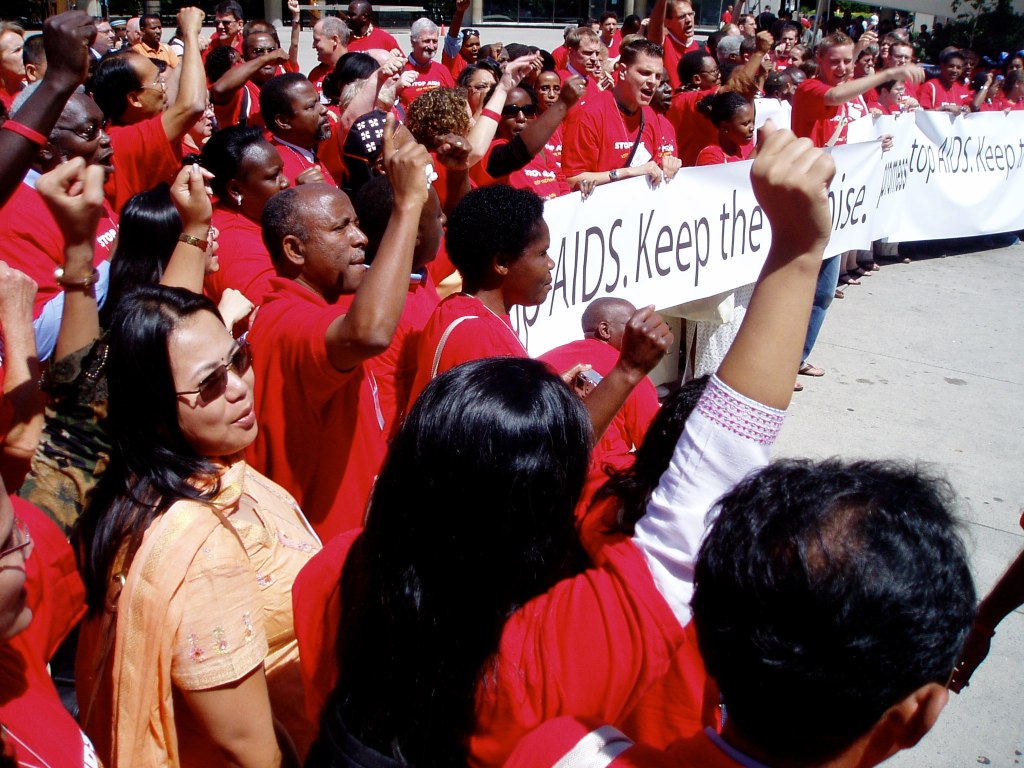
“Stop AIDS! Keep The Promise!” was the cry outside the International AIDS Conference in Toronto in 2006. (Jim Hodgson photo)

With the WTO, it was the need to ease patent protection so as to produce less costly generic versions of medicines used to treat HIV and AIDS. Again, efforts were broadly supported by churches and NGOs around the world. Eventually, in at least partial responses, less-costly generics and the Global Fund to Fight AIDS, Tuberculosis and Malaria helped save lives in many countries.

Vaccine Equity

The WHO has long called upon rich countries to ensure that vaccines are shared equitably. The global organisation is one of the leaders of COVAX, a program that aims to supply 1.3 billion vaccine doses to low- and middle-income countries this year. But so far, COVAX has had a slow roll-out.

The British-drafted resolution in the Security Council, co-sponsored by 112 countries, recognized the importance of extensive use of vaccines in this pandemic time as a “global public good for health.” It emphasised the need to develop international partnerships to scale-up manufacturing and distribution capacities.

Further, the Council requested the Secretary-General to provide a full assessment of the impediments to vaccine access in the pandemic response. It said it would review situations brought to its attention by the Secretary-General where hostilities and armed group activities are impeding COVID‑19 vaccination and to consider what further measures may be necessary to ensure such impediments are removed, and hostilities paused to enable vaccination.

It emphasized the urgent need for “solidarity, equity and efficacy,” inviting donation of vaccine doses from developed economies and all those in a position to do so to low- and middle-income countries and other countries in need, particularly through the COVAX facility.

These are complex initiatives but they—together with action for patent and debt relief, and additional funds for vaccines and other public health need—are essential for overcoming the global pandemic and for the reconstruction that will follow.

People in Canada are also invited to sign a petition to ensure full access to Covid-19 vaccines by all migrants regardless of immigration status. See the Vaccines For All petition here.
What does development mean?

Maybe you have already figured out the relationship between the word development and the idea of a closed envelope—something that needs to be opened up or unwrapped. De-enveloped, if you like. Inside the envelope, there must be something that already exists.

The Spanish word desarrollo is similar: unroll something to see what is inside. In Portuguese, desenvolvimento implies unwrapping.

After more than 20 years of work in support of development organizations and projects, and employment by at least two organizations that had included the word in their names, I finally got the point in 2007 when I got around to reading several books by Octavio Paz, including his classic, The Labyrinth of Solitude.

The word means the opposite of what a lot of people do in the name of development. Too often, we try to impose ideas and structures that come from some other place, and fail to see the values and systems that are already present among the people. Think of the European arrival in the Americas. Think of the resource extraction companies that refuse to consult—much less gain the consent of—the Indigenous communities whose land they seek to exploit.

Development Vision

Evo Morales, the former president of Bolivia, decried decades of misnamed development and vowed that his people will find solutions for the problems of health, education, employment, unequal distribution of resources, discrimination, migration, exercise of democracy, preservation of the environment and respect for cultural diversity.

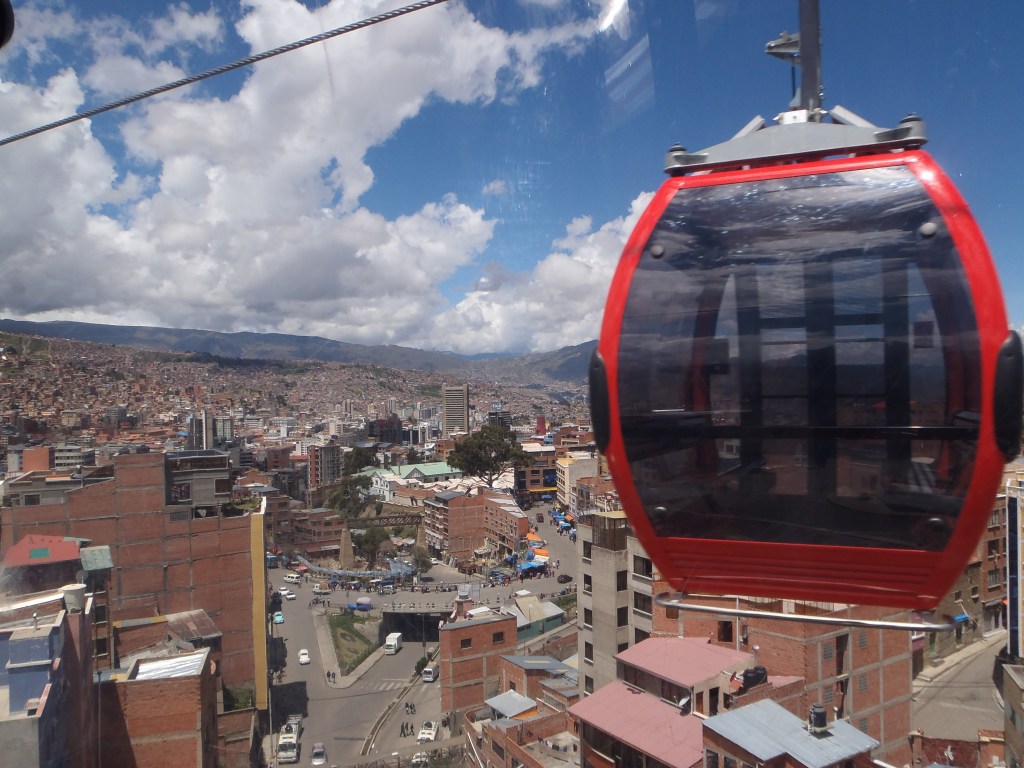
La Paz, Bolivia (2015)

Morales and others are critical of approaches that facilitate the advance of globalized capitalism led by giant corporations. Those approaches focus strongly on building infrastructure (roads, ports and canals) to support an export of raw materials or cheaply-produced manufactured goods. Most free trade agreements contain provisions that facilitate the movement and protection of capital investments—and that also inhibit government action to protect local economies, health systems and ecology. 

Thought of this way, we begin to see that the so-called “developed” countries of the global north have our development issues too. The much-reported water crisis in the city of Flint, Michigan, is a development failure. Why can’t a country that can deliver a cruise missile to a target in Yemen or Afghanistan get clean water to people’s homes? Canada’s inability to get clean water, quality education and decent health care to First Nations communities is also a development failure. But we can dig up one-eighth of the province of Alberta for a fossil fuel that will soon be superfluous, and expand a pipeline across British Columbia to get it to tidewater. A provincial government in Ontario begins to allow factories into the long-fought-for green space around greater Toronto: that’s a development issue too. In our different contexts, let us ask ourselves: what are our development priorities?

Facing failure and dreaming different dreams

(Sept. 23, 2011)

To confront climate change and to ensure there is food for all, those of us who live in wealthier countries must be prepared to accept change.

“You have an interest to protect your lifestyle,” Father Rex Reyes told a United Church of Canada meeting recently. “Our interest is to protect our lives.” Reyes is an Episcopal priest and Indigenous leader who serves as general secretary of the National Council of Churches of the Philippines.

In a 1991 encyclical, Centesimus Annus, Pope John Paul II made the point in these words: Change is needed “in order to limit the waste of environmental and human resources, thus enabling every individual, and all the peoples of the earth to have a sufficient share of those resources.”

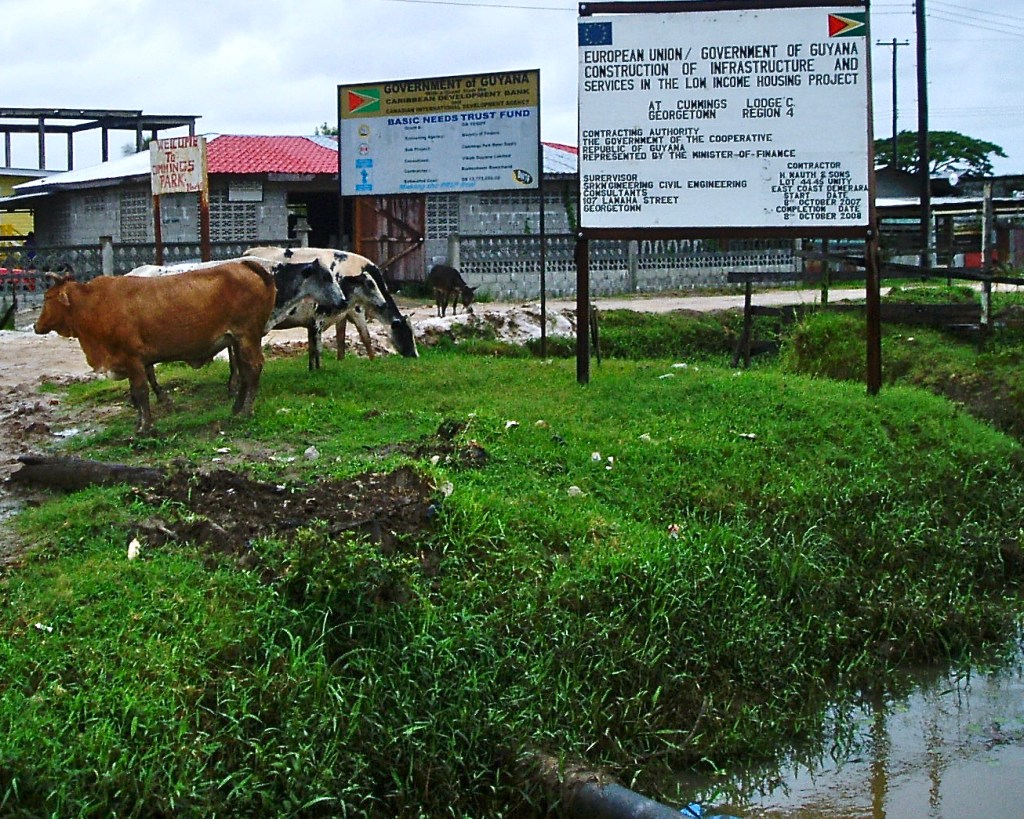
Signs announce European Union project funding on the edge of Georgetown, Guyana (2008)

These messages, rarely heard in Canada’s comfortable pews and board rooms, are heard in rough-hewn pews in churches from Mozambique to Mexico. Impoverished people do not speak of conditions in wealthier countries in order to absolve themselves of responsibility. On the contrary, they insist on making their contribution at tables traditionally dominated by those who have the money.

Food at the centre of agriculture and daily life 

“Christians should consider the failure of decades of development to date,” wrote Cameroonian theologian Jean-Marc Éla about 20 years ago.

They should “design a model of life that leaves room in our daily work for whatever may create a different future. Otherwise we are setting aside our century and our historical role, and irrevocably contributing to the coming of death.” (His essay, “The Granary is Empty,” was published by Orbis in Liberation Theology: An Introductory Reader.)

Éla advocated a “ministry of the granary” by Christians that would once again put food at the centre of agriculture and daily life, rather than export crops like peanuts, cocoa and cotton. “Death is already appearing here and there in the turns of daily life, as it does wherever cotton drives away millet.”

Over and against any ministry of the granary is set a wide range of economic interests. Governments, including that of Canada, offer advice to potential investors.

Development, instead of becoming Pope Paul VI’s “new name for peace,” is too often another name for unrestrained capitalism. With technology and the unyielding power of the financial institutions, the market is prescribed as the development norm for all other nations.