From Palenque, Chiapas, Latin American leaders call for migration solutions

In recent weeks, my partner and I took a long drive from British Columbia through the western United States and then almost the length of Mexico to arrive in Chiapas.

While people who migrate northwards either for seasonal work or for more permanent refuge from poverty, violence and impacts of climate change were on our minds and in the news, at least some of the people we met alongside us in gas stations and cafés were seasonal workers heading home for the winter. 

Migration, my friends, is normal. In southern Texas and northern Mexico, we encountered thousands of monarch butterflies as they headed for Michoacán. And here in Chiapas, the migratory birds are arriving daily.

At around the time of our trip, leaders of ten nations of Latin America and the Caribbean – frustrated by slow progress with the United States (and other northern countries) in advancing meaningful human development and managing the flow of people – gathered in the historic Maya city of Palenque, Chiapas, and proposed some ways forward.

Photo from the Office of the President of Mexico

Led by Mexico, the governments of Belize, Colombia, Costa Rica, Cuba, El Salvador, Haiti, Honduras, Panama and Venezuela signed the Palenque Declaration on Oct. 22 and called for solutions. (A representative of the newly-elected government in Guatemala also joined the talks.)

In the declaration, presented by the Mexican Foreign Minister, Alicia Bárcena, the leaders described several structural causes of migration: internally political, economic, social factors and the effects of climate change. But they also pointed to “external factors such as unilateral coercive measures of an indiscriminate nature – dictated from the United States – that negatively affect entire populations and, to a greater extent, the most vulnerable people and communities.”

They urged the United States to lift the sanctions imposed on Cuba and Venezuela that help drive the exodus. Such sanctions are against international law and, as the migration flow shows, they have impacts beyond the countries to which they are applied.

The document also proposed undertaking efforts to modify the financial architecture of debt; to close social gaps to as to reduce the impulse to migrate; push for measures aimed at increasing agricultural activity to promote food self-sufficiency in the region; and to promote intraregional trade and investment for socioeconomic development.

The signatory nations stressed that measures must be taken to confront transnational organized crime, human trafficking and corruption, as well as promote joint cooperation in security matters.

They called for destination countries to “adopt immigration policies and practices in line with the current reality of our region and abandon those that are inconsistent and selective, to avoid arbitrarily producing both ‘call effects’ and ‘deterrent effects’ – advantages given to certain countries for political reasons while nationals of other countries are blocked.

They encouraged destination countries to widen their regular migration pathways, with emphasis on labour mobility and promotion of re-integration and safe return of temporary workers to their homes.

The declaration makes special mention of Haiti, and called on nations to support efforts by the United Nations and others to re-establish conditions for human security so that the political, economic and social situation may be normalized, and to focus on sustainable development. (The presence of the Haitian president at the gathering angered some of the Haitian migrants camped out in the centre of Palenque, reported La Jornada.)
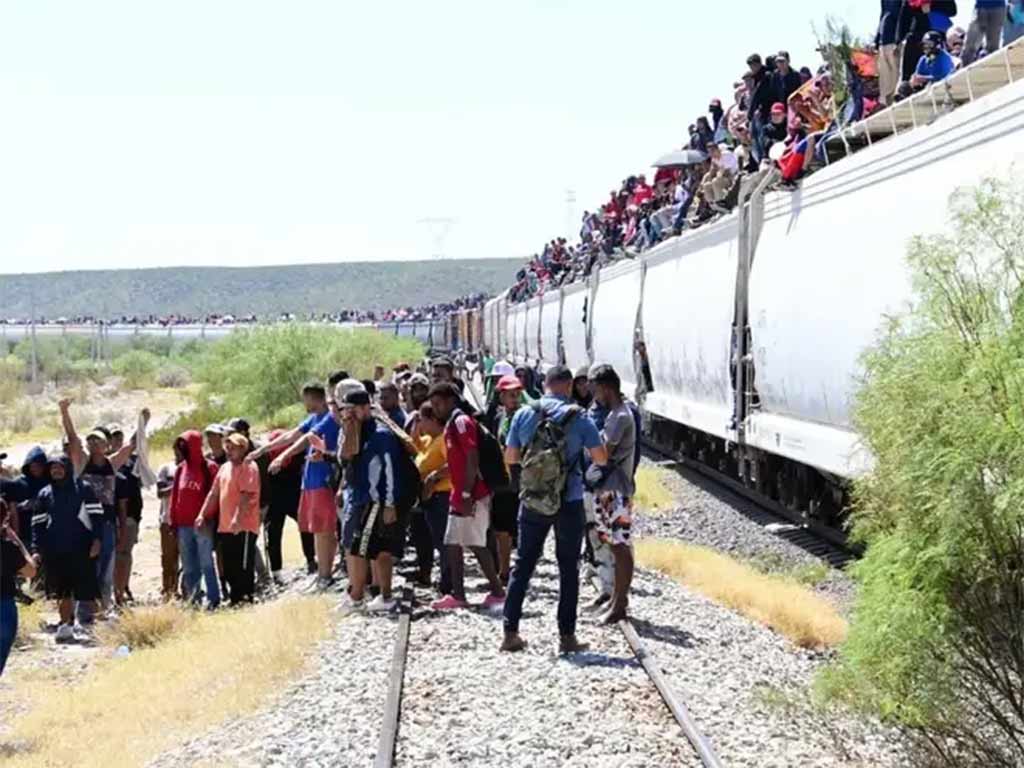
Undated photo from Prensa Latina.

The declaration’s emphasis on economic drivers of migration did not satisfy everyone. Eunice Rendón of the Mexican advocacy group Agenda Migrante told Courthouse News Service that while insecurity was mentioned as a factor driving migration, “it’s not one of the causes, it’s the principal cause,” Rendón said.

“People go because the gang members threaten to kill them, because they try to forcibly recruit them,” she said. (Some might argue that the lack of education and employment opportunities are drivers as well in recruitment for organized crime.)

Meanwhile, migration dramas continue. On Nov. 9, authorities reported that they found found 123 Central and South American migrants trapped in a trailer in Matehuala, San Luís Potosí (less than a week after we passed through there). And than 400,000 migrants have crossed the Darien Gap from Colombia into Panama in 2023, according to the Panamanian government, up from 250,000 in 2022.
In Colombia, those who believe in peace with justice rejoice

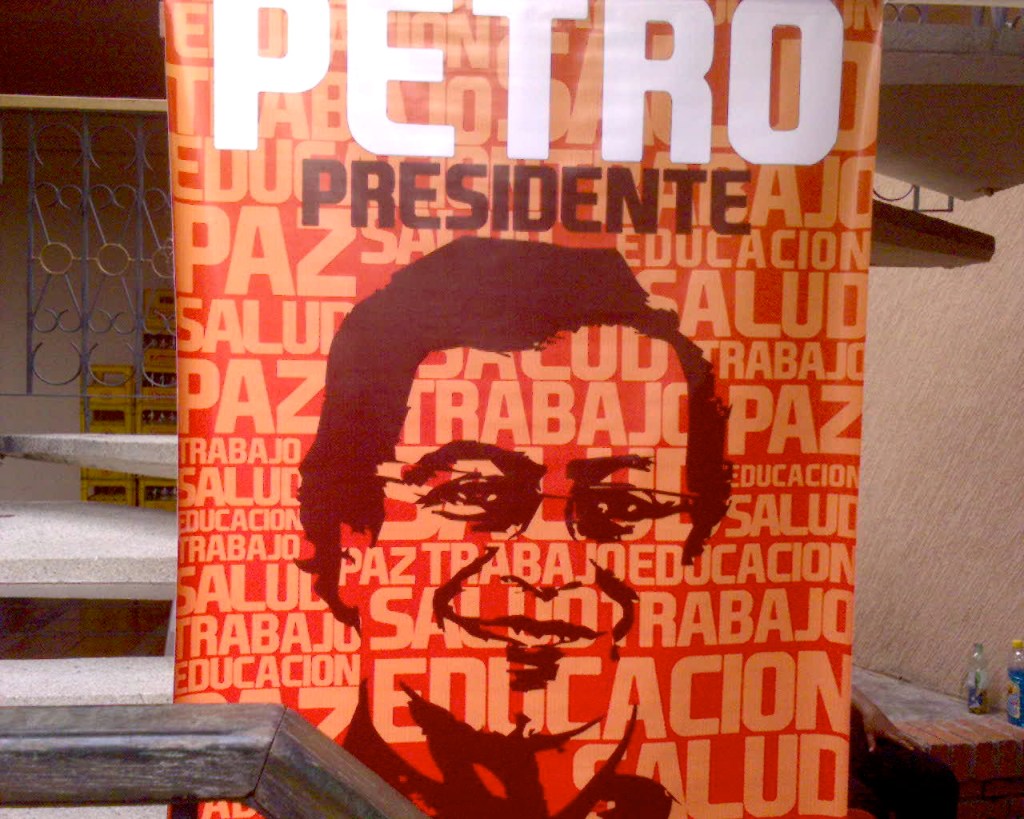
A Gustavo Petro campaign poster from 2010.

On a winter evening about 20 years ago – I am sorry that I cannot be more precise – Bill Fairbairn and I met in Toronto with a Colombian congressman and one of his aides. Bill worked for the Inter-Church Committee on Human Rights in Latin America (ICCHRLA), and I served on its board. And I can’t remember if this meeting was before or after mid-2001 when the work of ICCHRLA was folded (partially) into KAIROS. We were in what I think we used to call the Blue Room of Deer Park United Church in Toronto where the offices of ICCHRLA and later KAIROS were located.

I do remember the congressman, Gustavo Petro, and his earnest search for international allies in the struggle to end Colombia’s civil war and to obtain a measure of social justice to the oppressed majority.

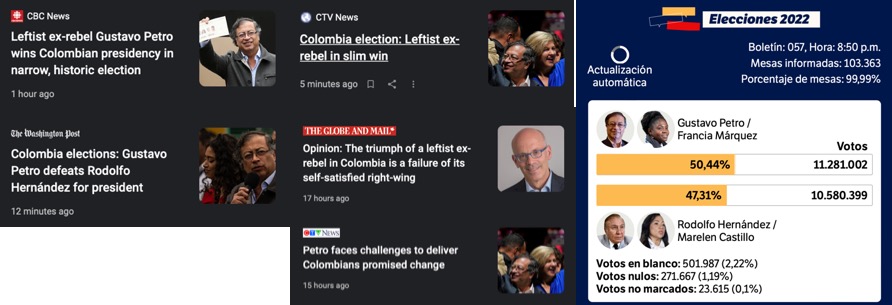
Two decades later, Petro is weeks away from being sworn in as Colombia’s first president from a party of the left. His victory results from the mobilization of young and new voters from parts of Colombia that are always ignored, especially the Caribbean and Pacific coasts. 

Celebrating victory (left); voters from the margins propelled Petro to power.

A large measure of credit goes to his running mate, the environmental activist and lawyer Francia Márquez, 40. She will become the country’s first Afro-Colombian to hold executive office. This election was the first time voter turnout topped 60 per cent, according to the International Institute for Democracy and Electoral Assistance (IDEA).

I met Petro again in August 2004 in Caracas, Venezuela. We were staying in the same hotel and both of us were observers of a referendum that opponents hoped would remove President Hugo Chávez from power. During Petro’s three campaigns to become president, along with his congressional and senate races, and the 2011 drive that made him mayor of Bogotá, right-wing politicians tagged him as castrochavista (as if that were a bad thing). They decried his youthful involvement in the M-19 guerrillas. They had made peace with the government in 1990. Petro, unlike many former fighters who laid down their weapons, survived the waves of selective assassinations that sought to eliminate them from political life.

Victory this past Sunday by Gustavo Petro, 62, in Colombia’s presidential election offers hope for reviving a peace process stalled these past four years by President Iván Duque, protegé of former president Álvaro Uribe – the fiercest guardian of the ways that things have always been done by those with power in Colombia.

Petro defeated Rodolfo Hernández, a millionaire conservative who was frequently compared to Donald Trump.

This election (like recent ones in Chile, Honduras and Peru) is also firm rejection of Canadian and U.S. foreign policy that for the past 20 years has paid lip service to the search for peace, but always protected the interests of those who control land and natural resources. Before Conservative Prime Minister Stephen Harper won his majority in Parliament in 2011, Canada negotiated a free trade agreement with Colombia that as a sop to the Liberal party contained a mechanism for a toothless human rights impact assessment. Colombia was also the key regional ally in setting up the “Lima Group,” the attempt by Washington and Ottawa to isolate Venezuela when most members of the Organization of American States refused to play along.

After the victories by Hugo Chávez in December 1998 in Venezuela and Luiz Inácio (Lula) da Silva in Brazil in 2002, some of us starting talking about a “pink tide” sweeping across Latin America (forgetting perhaps that tides also recede). Now the tide is back, this time stronger than before. In Brazil, Lula is again leading the polls in anticipation of the election later this year.

The road ahead for Petro will be difficult, just as it has been for Pedro Castillo in Peru since his victory a year ago. The opposition will set traps and take advantage of every misstep. In this third attempt to win power, Petro proposed pension, tax, health and agricultural reforms. He would change how Colombia fights drug cartels and start new talks with remaining guerrilla fighters. But his coalition has only about 15 per cent of the seats in Congress, which will force him to make deals, limit some reforms or abandon others. Parts of the U.S. government (military and intelligence agencies) will not be friendly, and Canada (because of influence by resource-extraction companies) may not be either.

What is to be done? Tolstoy, Lenin, John the Baptist and recent elections

Xiomara Castro, president-elect in Honduras. Right: “Long live the People in Resistance” – post coup graffiti.

Soon after my return to Canada from my first visit to the Dominican Republic in 1983, I saw Peter Weir’s brilliant film, In a Year of Living Dangerously. As a socialist option in Indonesia collapses through local intrigue and U.S. intervention, Linda Hunt’s character, Billy Kwan, asks obsessively: “What is to be done?”

In the wake of my encounters with Haitian cane-cutters and Dominican and Haitian activists, it became my question too.

Billy Kwan’s question alludes to Lenin’s 1902 manifesto that called for a new vanguard organization that would be dedicated to taking power. Lenin took his title from two earlier works by Russian authors. In 1863, Nicholas Chernyshevsky issued a manifesto that imagined a new social order. Twenty years later, Leo Tolstoy took the same title to offer a vision of the renewal of individual moral responsibility.

But the question actually comes from the Bible. In Luke 3:10—part of the lectionary readings in many churches this Sunday, Dec. 5, the second Sunday of Advent—the people ask John the Baptist: “What are we to do?” And John answered, “If you have two coats, give one to the person who has none; and if you have food, do the same.” 

Later, in Luke 12:16-21, the question appears in Jesus’ story about the rich fool: “There was a rich man and his land had produced a good harvest. He thought: ‘What shall I do? For I am short of room to store my harvest.’So this is what he planned: ‘I will pull down my barns and build bigger ones to store all this grain, which is my wealth. Then I may say to myself: My friend, you have a lot of good things put by for many years. Rest, eat, drink and enjoy yourself.’ But God said to him: ‘You fool! This very night your life will be taken from you; tell me who shall get all you have put aside?’ This is the lot of the one who stores up riches instead of amassing for God.”

Life is too short for the poor to wait for wealth to trickle across the greatest breach between rich and poor that this planet has ever known. While some of us in the North think we have the luxury of sitting back to see how things go—except that climate change seems to have finally got our attention—the impoverished must always take risks and try something new.

Since the election of Salvador Allende in Chile in 1970 and despite the coup led by Gen. Augusto Pinochet three years later, the left in power in Latin America has tried to govern according to the rules of liberal democracy, arguably without sufficient regard for the roles of money, foreign interference and private media companies.

Confronted by poverty, after “lost decades” of development, social movements in Latin America began to develop alternative policy approaches in the 1990s. Smart politicians paid attention and in one country after another—imperfectly, with lots of mistakes—the “formal democracies” of old began to be transformed.

That “pink wave” did not last. A military coups in Honduras and Bolivia, parliamentary coups (or “lawfare”) in Paraguay and Brazil, devastating impacts of U.S.-led (backed by Canada) sanctions in Venezuela, the power of money in Ecuador and petty corruption all weakened the drive for lasting change.

Left and centre: Chile’s election pits Gabriel Boric against José Antonio Kast. Right: the party of Nicolás Maduro won most regional elections in Venezuela. (Images from Página 12, Argentina)

A second progressive wave?

In October 2020, voters in Bolivia restored the “Movement for Socialism” (MAS) party to power just a year after the coup. In June, voters in Peru elected a rural teacher, Pedro Castillo, to be their president. In November, Venezuela’s ruling PSUV party won almost all state-governor races. Later in November, voters in Honduras chose Xiomara Castro, whose husband Mel Zelaya had been overthrown in a coup backed by the United States and Canada in 2009, to be their new president. 

The next test comes in Chile on Dec. 19, when a Pinochet-loyalist, José Antonio Kast, faces a centre-left candidate, Gabriel Boric, in a second-round run-off vote.

No country is the same as another, and specific issues pertain to each of the elections noted above. But the big loser in most of these votes is the United States, together with ever more deferential Canada. Latin Americans are again choosing leaders who do not have the interests of the United States at heart.