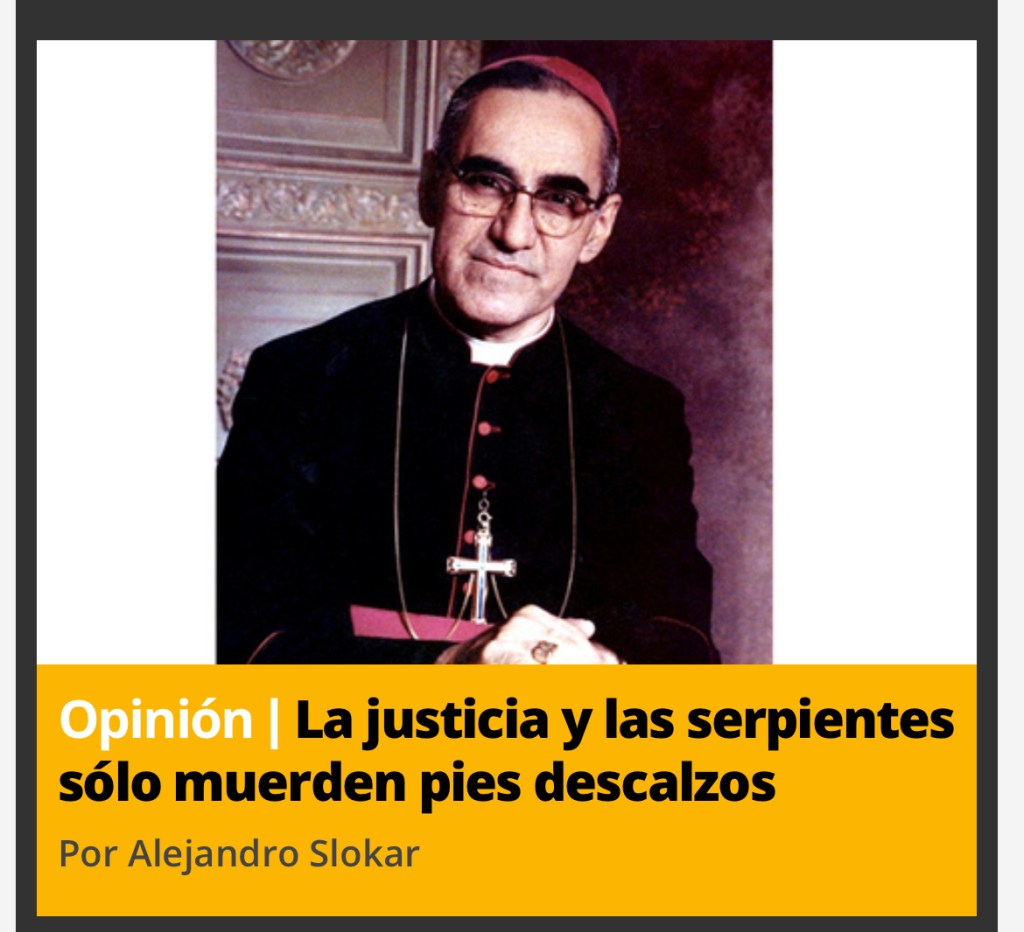
A headline and a photo in the Buenos Aires newspaper Página 12 caught my eye today. Together with a photo of Saint Óscar Romero was this phrase: “Justice and snakes only bite bare feet.” *
The writer, Alejandro Slokar, is a judge in Argentina’s federal court for appeals of criminal cases (Cámara Federal de Casación Penal). Here, he is writing about the International Day for the Right to the Truth Concerning Gross Human Rights Violations and the Dignity of Victims—or more simply, the Right to Truth Day, marked now every March 24.
March 24 is not only the date when we recall the martyrdom of San Salvador’s archbishop, the human rights defender Óscar Romero in 1980. It’s also when Argentineans recall the 1976 military coup that ushered in a “dirty war” against the popular movements of the impoverished—those with bare feet—along with trade unionists, journalists, writers, artists and human rights defenders. As many as 30,000 people were killed or disappeared over the next five years.
In El Salvador, about 80,000 people were killed or disappeared between 1979 and the end of the civil war in 1992. In both countries, as elsewhere across Latin America, movements to find the “historical truth.”
In recent weeks, families of people who disappeared during Mexico’s long “war on drugs” have drawn attention to a half-hectare farm in Teuchitlán, about 60 km west of Guadalajara in the state of Jalisco. The farm had been used to recruit new traffickers, but also to execute those who refused the cartel’s orders. State and federal authorities had known about the site since last September but did nothing to secure it or to identify human remains and other items found on the land. Predictably, state and federal authorities point fingers of blame at each other.
About 120,000 people have gone missing in Mexico since 2006 when then-President Felipe Calderón launched a military-led offensive against the drug cartels in an attempt to curb their violent turf wars. Instead, the violence became worse. And Calderón’s security chief, Genaro García Luna, was convicted in October in a U.S. court for his deep ties to the Sinaloa cartel.
Among the disappeared (still) are 43 students from a training school for rural teachers in Ayotzinapa, Guerrero state, taken in 2014.
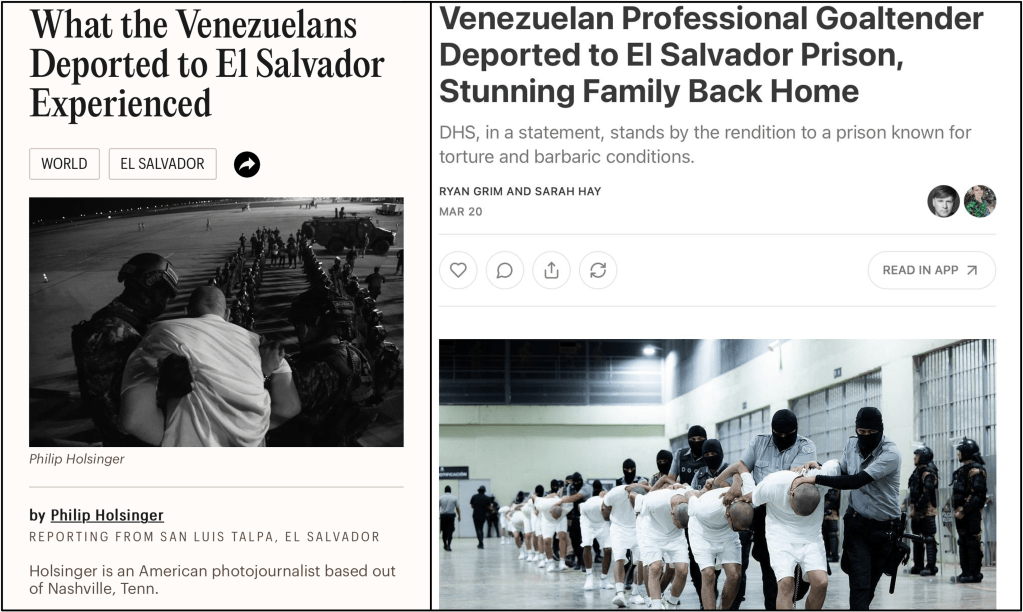
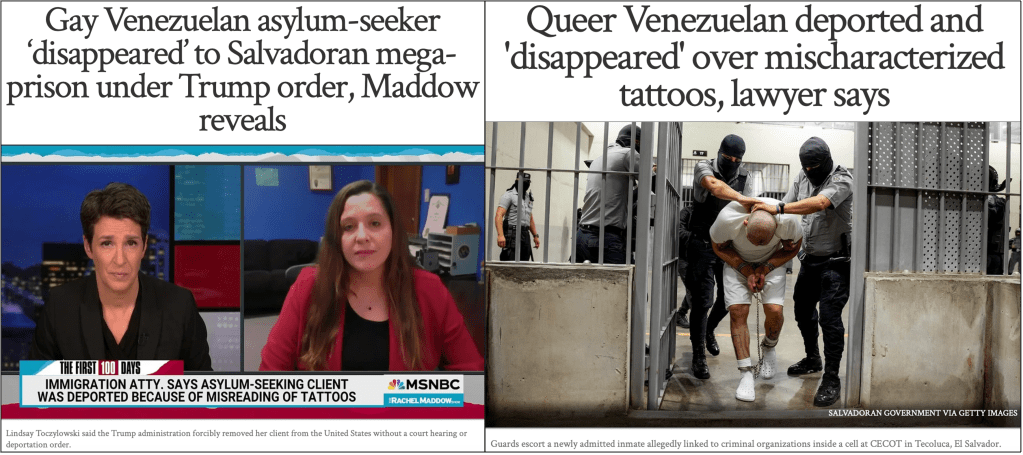
The “right to truth” cannot only be about historical cases. It must be the demand now in the case of the young men taken by the Trump regime and dumped into El Salvador’s infamous Terrorism Confinement Centre (CECOT). Certainly, some of the 238 Venezuelans may be criminals who were members of the “Tren de Aragua” gang but, as stories leak out, it’s clear that some of those deported were never accused, much less tried or convicted, of any crime.
TIME magazine published a stunning photo essay about the deportations. The photojournalist, Philip Holsinger, included this description of one of his encounters: “One young man sobbed when a guard pushed him to the floor. He said, ‘I’m not a gang member.I’m gay. I’m a barber.’ I believed him. But maybe it’s only because he didn’t look like what I had expected—he wasn’t a tattooed monster.”
Drop Site News reported that another deportee was a Venezuelan professional soccer player and youth soccer coach with no criminal record. “The family only discovered that their loved one, Jerce Reyes Barrios, had been sent to El Salvador when they saw him in viral videos posted by the Trump administration, in which it celebrated what it said was the mass deportation of violent members of the Venezuelan gang Tren de Aragua.”
The LGBTQIA+ Advocate magazine shared reporting on PBS by Rachel Maddow about a gay makeup artist who was among the deported prisoners—forcibly removed from the United States without a court hearing or deportation order.
Those stories, combined with reports of detentions of visa holders and other visitors, and harassment of legal residents and citizens, suggest that what happened in Argentina and El Salvador has begun in the United States. Can paramilitary death squads be far behind?
Writing of historical events and of the present-day right-wing populist regimes of Nayib Bukele in El Salvador and Javier Milei in Argentina, Slokar’s article argued that such abuses derive from the “neocolonial models”—European feudalism—applied in throughout the Americas. “While those responsible die in their beds without sanction, the consequences are almost infinite, farce and tragedy at the same time, and expressed in the inhumane neoliberal experiment that laughs at the Constitution, bitcoin, extractivism and punitive demagoguery that converge in the present.”
* The quote is variously attributed to both Óscar Romero and to the Uruguayan journalist Eduardo Galeano. It may be that Galeano was quoting Romero, but I cannot find the original source: just partial citations.
In late 1980, more than a year after the triumph of the Sandinista Revolution, the administration of President Jimmy Carter was still funding infrastructure in Nicaragua through USAID. By November 1984, with President Ronald Reagan’s “Contra War” well underway, your future bloguista was amused by this left-over sign at a road rebuilt near Matagalpa.
by Jim Hodgson
Back on launch day of Trump 2.0, the president issued an executive order that suspended international aid programs for 90 days, including those of the U.S. Agency for International Development (USAID).
The move came with a lot of over-the-top rhetoric and outright lies: that USAID spent “$100 million on condoms to Hamas” and that it “bankrolled” the Politico digital news company. “It’s been run by a bunch of radical lunatics. And we’re getting them out,” Trump told reporters on the evening of Feb. 2.
There are, of course, dozens of issues about which to criticize the Trump regime. But this is a blog that sets out to unwrap development issues, so let’s get into it.
Congress established USAID in 1961 to bring together programs that were administering foreign aid. Focusing on long-term social and economic development, USAID disbursed about $72 billion in 2023, less than 1% of the U.S. annual budget. It is one of the largest aid agencies in the world.
You’ll remember, of course, that the United Nations target for spending on Official Development Assistance is 0.7 per cent of gross domestic product. Only five countries meet or exceed that goal: Norway, Luxembourg, Sweden, Germany and Denmark. In 2023, Canada contributed 0.37 per cent of GDP; the United States contributed just 0.24 per cent, seventh lowest among 31 OECD countries.
Trump’s order, carried out by his government efficiency hatchet-man, Elon Musk, chopped humanitarian programs around the world: famine relief in war zones; programs to stall malaria in 22 African nations; vaccinations in vulnerable areas; and access to medications by people living with HIV and AIDS. Several U.S. government websites also removed resources on HIV. (That also happened when Trump first took office in 2017).
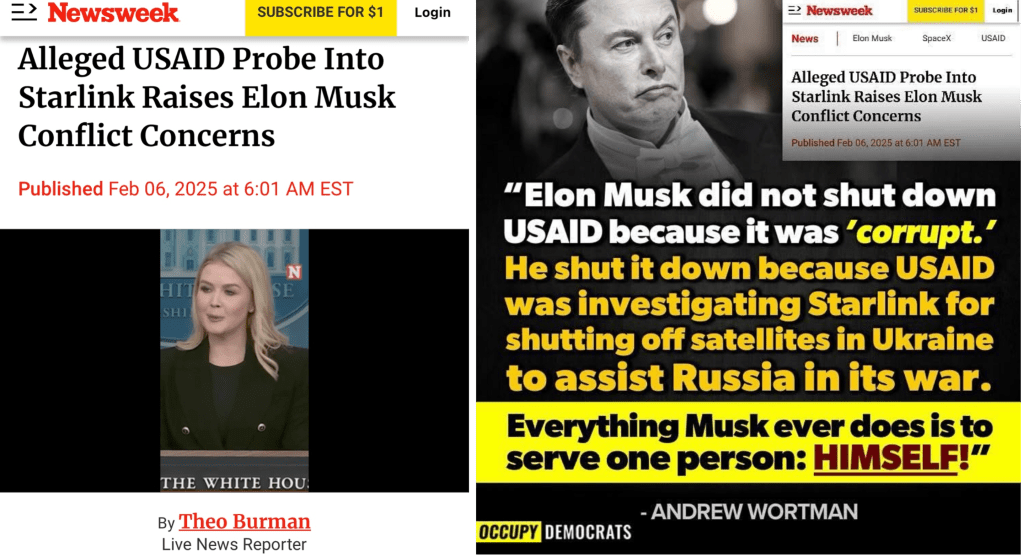
Newsweek reported Feb. 6 that just months before Musk shut down USAID, the agency was investigating its relationship with Musk’s Starlink satellite company.
In days since the order, enough voices were raised in alarm to get funding for HIV and other essential medicines restored—though it wasn’t clear if that included preventative drugs like PrEP. For more than 20 years, PEPFAR (the President’s Emergency Plan for AIDS Relief) worked within and alongside the Global Fund to Fight AIDS, TB and Malaria and the Joint United Nations Program on HIV/AIDS (UNAIDS).
Also, a federal judge on Feb. 7 temporarily blocked the administration from placing 2,200 USAID employees on paid leave, siding with workers who argued Trump and Musk lack the authority to immediately dismantle an agency created by congressional legislation.
The Trump regime blames “migrants” for much of what supposedly ails the United States, but in this time of unparalleled worldwide migration of people, the USAID cuts hit the United Nations High Commissioner for Refugees and the International Organization for Migration (IOM)—two agencies that are critical in managing and measuring the flows of people.
No one should argue against humanitarian aid, although Musk and Republican members of congress who see empathy as a character flaw will do so. In a world still suffering from massive inequality, such aid is urgently needed. The U.S. Christian magazine Sojourners offered a strong defence of the humanitarian work of USAID.
What happens after the 90-day review? My guess is that some functions will be folded into the State Department and thus more susceptible to narrow political goals, like subversion of other countries’ governments. I feel badly for beneficiaries of the humanitarian programs and for many well-intentioned employees; not so much for the vast array of U.S.-based independent contractors who get rich from the misery of others.
Sheinbaum: “It’s better they close it” As noted above, USAID was created in 1961—just two years after the triumph of the Cuban Revolution. There was no artifice: USAID was to counter the influence of Soviet Union. In recent years, USAID has been at the heart of U.S. challenges to the growing influence of China, which has a successful “Belt and Road” foreign aid program of its own. My venerable Mac laptop computer tells me that I have 226 files that mention USAID. Almost all of the documents are about the ways that USAID is used as an instrument of U.S. foreign policy, especially its work alongside other U.S. institutions that promote—or subvert—democracy in other countries: the National Endowment for Democracy (NED), the International Republican Institute, the National Democratic Institute for International Affairs and even the Central Intelligence Agency.
USAID even had an Office of Transition Initiatives (OTI) that gained infamy in 2014 over its covert “Cuban Twitter” (ZunZuneo) social media program that was aimed at overthrowing the Cuban government was revealed by Associated Press.
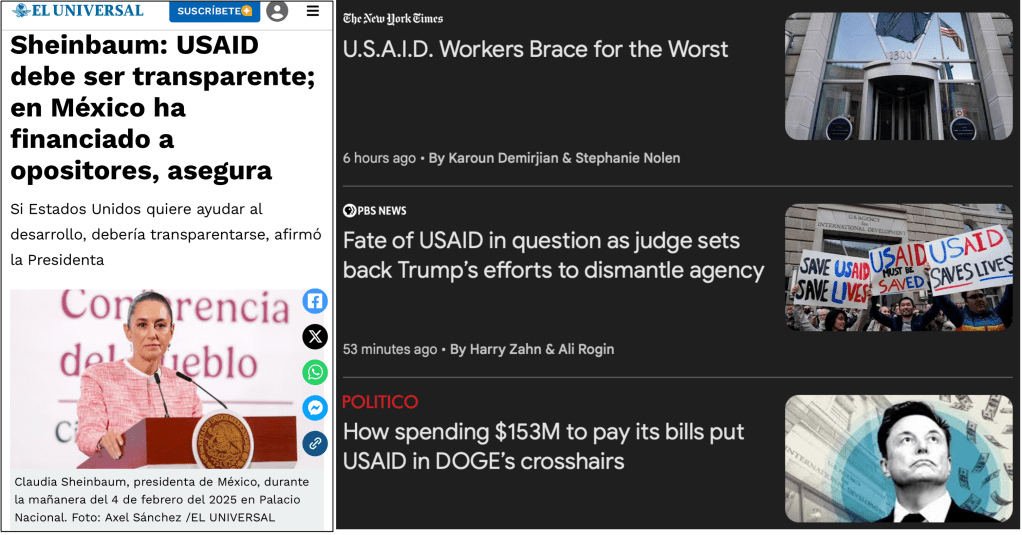
Sheinbaum (left): USAID must be transparent; in Mexico, it has funded the opposition. Right: USAID still in the headlines Feb. 8.
In her morning news conference on Feb. 4, Mexican President Claudia Sheinbaum, breaking away from the dispute over tariffs, lashed out at the overt political activity of USAID. “This agency has funded research projects and groups opposed to the government. That’s the case with Mexico.” She mentioned an organization that she called, “Mexicans for Corruption.” (She was only half-joking: it’s Mexicans against Corruption. The group actively opposed her predecessor Andrés Manuel López Obrador’s effort to reform the judicial system, and it had support from USAID.) “And how is it that they get involved in politics, those agencies that are about aid. In that sense, if the United States wants to help with development, it should be transparent,” she continued. “The truth is that there are so many things USAID does that in truth it is better they close it.” In a similar vein, Colombian President Gustavo Petro said some U.S. help is not welcome and has to go. “Hundreds of immigration officials who guard our borders were paid by the United States. This aid is poison,” he said during a Feb. 3 cabinet meeting. “That should never be allowed. We are going to pay with our money.” In 2024, the agency paid nearly $385 million to Colombia.
Haïti chérie
Which brings me to Haiti, a country whose heartbreak I know well. For more than 45 years, it has been particularly afflicted by HIV and AIDS. The ongoing political crisis, worsened by uncontrolled activity by criminal gangs, continues to hamper relief efforts including support to people living with HIV and AIDS.
Repeated U.S. interventions have made things worse. From 2011, with the presidencies of Michel Martellyand Jovenel Moïse and then the unelected leadership of Prime Minister Ariel Henry through early 2024, the United States and the local elites had the leaders they wanted: men close to the business sector who had close ties in the United States.
That fruitless model was finally shoved aside last June 11 with the installation of a transitional council (CPT). It’s wobbly but hope persists that it can finally organize new elections that produce leaders that Haitians want. A truth commission and an electoral council have been named.
In the meantime, the problem of gang violence is being addressed (though ineffectively) with the addition of the Multinational Security Support Mission (known as MMAS), led by police from Kenya and bolstered with police from El Salvador and Guatemala. Despite UN backing and many promises, it is underfunded and understaffed.
Feb. 4: U.S. aid to the security mission is frozen. Feb. 6: aid is renewed
A new blow came Feb. 4 when the UN announced that the shutdown of USAID meant funds for the MMAS were frozen. But two days later, U.S. Secretary of State Marco Rubio announced that MMAS would be protected despite the USAID cut, adding to speculation that Rubio, Musk and Trump are not all operating from the same playbook.
In the wake of the axing of USAID, the best piece that I have read about its activities in Haiti is by a long-time observer, Jake Johnston of the Center for Economic Policy and Research (CEPR). At the end of a Feb. 4 essay about the agency’s work in Haiti, he writes:
The term “aid” encompasses many different things: humanitarian assistance and development programming, contracts and grants, support to local organizations and multimillion dollar contracts to DC-area firms.
There are many parts of the US foreign aid industry that can and should be stopped or significantly reformed. But that doesn’t mean that shutting down USAID, or making its assistance even more overtly political by placing it under the umbrella of the State Department, is going to be a good thing, either in the short or long term.
The reality is that, where foreign assistance is least effective, it is largely because it is designed to promote US interests rather than address the needs of those ostensibly on the receiving end. The changes announced by the Trump administration are not likely to truly disrupt US soft power abroad. If anything, it will make political interventionism an even more explicit aim of US foreign assistance.
In the face of the flood of orders spewing from the White House since January 20, I feel compelled to attack all of them, everywhere, and all at once.
Today I am taking a deep breath to encourage you to take action in solidarity with Cuba. The item below focuses on what Canadians can do, but if you are in another country, please write to your government to encourage them to increase humanitarian aid to Cuba and not to be cowed by U.S. pressure.
A day before the new U.S. administration took power, I spoke about Cuba with my friends Dean Detloff and Matt Bernico for their Magnificast podcast. I feel now I was too optimistic, but have a listen. The image shows a bus given for use by churches and civil society organizations by Pastors for Peace.
Take Action for Cuba
You are invited to join other Canadians and Canadian international cooperation, trade, faith and civil society organizations to join forces in taking action in response to the economic hardships being faced by Cubans.
In the midst of the difficult political situation in the U.S. and the leadership transition in Canada, advocacy is still necessary.
Cuban partner organizations and recent visitors say conditions in Cuba today are much more difficult than in the early 1990s when the implosion of the Soviet Union led to a sharp deterioration in living standards. The pandemic shuttered the tourism industry, a main source of revenue used to acquire food, medicines and fuel from abroad. Cuba has also suffered a series of hurricanes, droughts and floods, leading to lost crops and food shortages. Energy shortages limit public transit and even the collection of garbage.
The Canadian government has responded to calls from civil society to increase humanitarian assistance but more is needed.
In 2024, Canada contributed $1.7 million in humanitarian assistance in response to several emergencies including Hurricanes Oscar and Rafael. Funds were shared via multilateral agencies including the World Food Program and UNICEF, along with NGOs including CARE Canada, the Canadian Red Cross and Humanity and Inclusion.
In his first days in office, the new US president has revoked revoked Biden’s measures to remove Cuba from the U.S. list of sponsors of terrorism. The difficulties of sending money and engaging in trade will continue.
2. Use the information provided in the Take Action and its demands to engage candidates in your riding. While the election period has not started yet, we know it’s coming.
3. Many Canadians are part of efforts to fill a container, carry a suitcase of medical supplies, are organizing a people-to-people delegations, or making a donation through a church, union, or humanitarian agency. Please tell your MP and other politician to raise the profile of the economic crisis in Cuba. Send them pictures, and post them on social media.
Thank you!
PS: Over the past two years, I have worked with my former colleagues at The United Church of Canada, other churches, several trade unions and international development organizations to draw attention to the impact of U.S. sanctions (“the blockade”) on the Cuban people. We hoped for more positive change from the Biden administration and of course feel disappointment that the new U.S. government has reverted to harsh measures. In these times, Canada must maintain its independent foreign policy and not cave to U.S. pressure.]





 Unwrapping Development