Canadian casualties as U.S. takes aim at Cuban businesses

by Jim Hodgson

Readers of this blog may find it odd that I am concerned about the fate of a Canadian mining company operating overseas, especially just days after a new report showed that U.S. sanctions have tripled Cuba’s infant mortality rate over the past seven years. (By the way, retired Latin American studies professor John Kirk of Dalhousie University have a new article about the impact of sanctions posted May 7 at rabble.ca.)

But Sherritt International Corp. had operated a nickel and cobalt mine in Holguín province as a joint venture with the Cuban state for more than 30 years, an arrangement that ensured Cubans shared the benefits of the mining operation. On May 7, as legal implications of new U.S. sanctions became clearer, Sherritt suspended its operations in Cuba.

In response to Sherritt’s announcement, the Canadian Network on Cuba (CNC) said the Canadian government must “take immediate and decisive action in defence of Canadian sovereignty, international law, and the right of Canadian companies to conduct lawful business free from foreign coercion and intimidation.”

CNC said President Donald Trump’s May 1 executive order “constitutes yet another illegal attempt to extend U.S. domestic law beyond its borders and impose Washington’s unilateral sanctions regime on the entire world. This represents not merely an attack on Cuba, but a direct assault on Canada’s sovereignty, on international trade law, and on the principle that no state has the right to dictate the economic relations of other nations.”

Further U.S. measures announced May 7 targeted Grupo de Administracion Empresarial S.A. (GAESA), partner of many foreign tourist operations, and Moa Nickel SA, the joint venture between Sherritt and Cuba’s state-owned nickel company.


The current escalation is rooted in the infamous Helms-Burton Act, passed by the U.S. Congress in 1996. The extraterritorial features of that law provoked anger in Canada and Europe, but those features were effectively waived by Presidents Bill Clinton, George W. Bush, and Barack Obama. In April 2019, Trump revived then. Canada’s then foreign minister, Chrystia Freeland, objected, saying Canada would “fully defend the interests of Canadians conducting legitimate trade and investment with Cuba.” She reminded Canadians that amendments in 1996 to Canada’s 1985 Foreign Extraterritorial Measures Act (FEMA) stipulate that any judgment issued under Helms-Burton “shall neither be recognized nor enforceable in any manner in Canada.”

CNC now poses the question: will the current government enforce FEMA? If the Canadian government fails to act now, FEMA becomes little more than a hollow gesture, and Canada effectively concedes that U.S. law supersedes Canadian law on Canadian soil. CNC argues that Ottawa must therefore:

  • Publicly denounce the Trump administration’s Executive Order as an illegal extraterritorial measure that violates international law and Canadian sovereignty;
  • Immediately invoke and enforce the Foreign Extraterritorial Measures Act to protect Canadian corporations operating lawfully in Cuba;
  • Provide legal, diplomatic, and financial protections to Canadian firms targeted by U.S. sanctions;
  • Coordinate with Mexico, the European Union, CARICOM nations, and other states opposing the blockade to resist Washington’s unlawful coercive measures; and
  • Reaffirm Canada’s longstanding opposition to the U.S. blockade and demand its complete and unconditional end.

Taken together, more than six decades of U.S. sanctions are described in Cuba as a blockade. The term is most apt now after more than three months of a U.S. blockade of fuel shipments from Venezuela and Mexico. The UN General Assembly has overwhelmingly condemned the U.S. blockade in annual votes for more than three decades. CNC adds:

“The blockade and its extraterritorial application violate the UN Charter, international law, freedom of navigation and trade, and the sovereign equality of states. Yet Washington continues to intensify this economic siege, now seeking to punish not only Cuba, but also Canadian companies, Canadian workers, and Canadian economic interests.”

The new U.S. sanctions follow a “long-standing policy and campaign of economic warfare, sabotage and destabilization aimed at strangling Cuba regardless of the collateral damage inflicted internationally,” says CNC. “Canada must choose whether it will defend its sovereignty and uphold international law, or whether it will permit itself to be subordinated to the extraterritorial dictates of a foreign power: whether to join empire or challenge it.”

Canada must reject U.S. coercion against Cuba and countries that would help

by Jim Hodgson

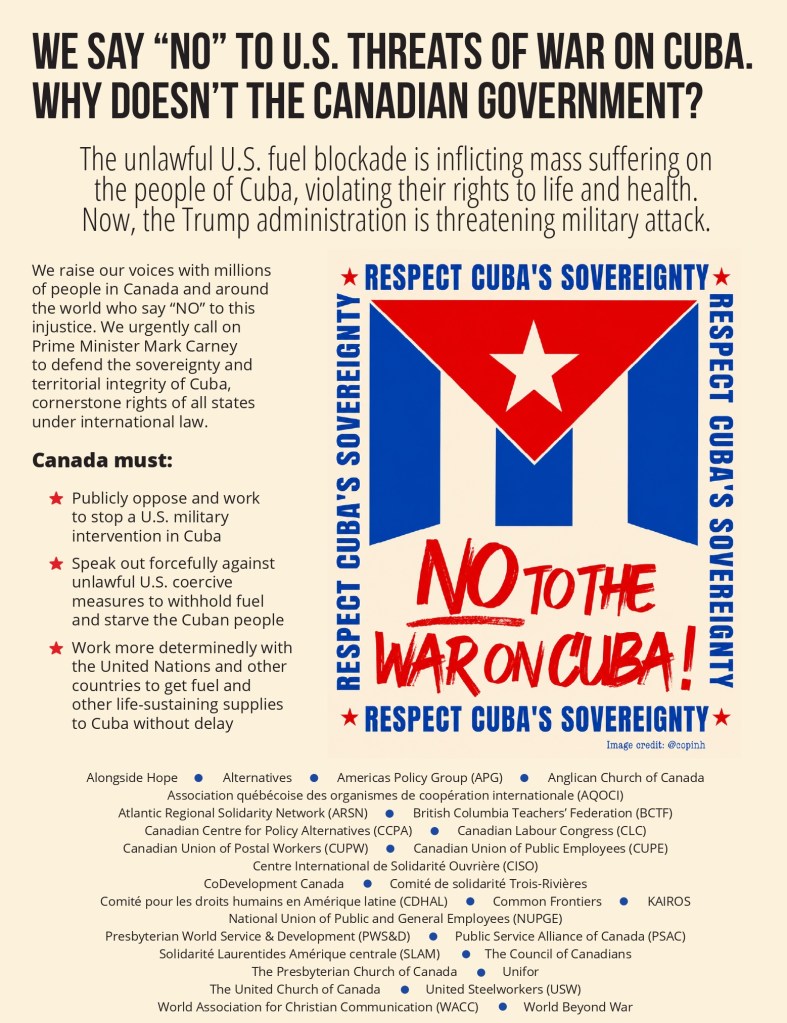
Canada must condemn the ongoing U.S. embargo against Cuba, say two coalitions of Canadian non-governmental organizations (including churches, trade unions, aid groups and human rights defenders).

The Americas Policy Group (APG) and Common Frontiers wrote Feb. 20 to Prime Minister Mark Carney,Foreign Minister Anita Anand, and Secretary of State (International Development) Randeep Sarai. Their letter condemned the new “coercive measures” – threats of higher tariffs – announced by the Trump administration that make it harder to get food, medicine and fuel.

Before I go too far into this, here’s an action you can take. (And thank you if you already did so!) The Canadian Network on Cuba has worked with MP Alexandre Boulerice to promote an important on-line petition to the members of Parliament. (Once you have signed, be sure to respond to an email asking you to confirm your signature.)

Text of the letter is available in EnglishFrench and Spanish.

The English version follows below: 

February 20, 2026

Re: CANADA MUST REJECT UNLAWFUL U.S. COERCIVE MEASURES TO WITHHOLD FUEL FROM CUBA AND EXPEDITE HUMANITARIAN ASSISTANCE

Dear Prime Minister Mark Carney, Foreign Affairs Minister Anita Anand and Secretary of State (International Development) Randeep Sarai:

The Americas Policy Group (APG) and Common Frontiers, coalitions formed by dozens of respected Canadian civil society organizations, are deeply concerned about the human rights impacts of a U.S. executive order imposing a fuel blockade on Cuba. We call on Canada to immediately reject this dangerous, coercive action which is incompatible with principles of sovereignty, non-intervention and self-determination, essential for a democratic, equitable and peaceful international order.

A month ago, our coalitions called on the Government of Canada to unequivocally condemn U.S. attacks and threats of intervention in Venezuela, Colombia, Mexico, and Cuba as violations of the United Nations Charter and longstanding international norms. We warned about the implications of U.S. security policy that promises to “reassert and enforce the Monroe Doctrine,” a doctrine used in the past to justify brutal interventions in Latin America and the Caribbean.

In October 2025, United Nations member states at the General Assembly voted for the 33rd consecutive time for an end to a decades-long U.S. embargo against Cuba, which has caused enormous hardship and scarcity for the Cuban people. This is reaching crisis proportions as a result of an executive order signed by President Trump on January 29 authorizing the imposition of trade tariffs on any country that directly or indirectly provides oil to Cuba.

UN human rights experts have stated “there is no right under international law to impose economic penalties on third States for engaging in lawful trade with another sovereign country.” The UN experts conclude that the imposition of a fuel blockade on Cuba is “a serious violation of international law and a grave threat to a democratic and equitable international order.”

Member organizations of the Americas Policy Group and Common Frontiers have a long history of cooperation with Cuban civil society organizations and are hearing from them about the impacts of blocking oil supplies to their country. Cuba is highly dependent on imported fuel for essential services, including electricity generation, hospitals, health services, water and sanitation, public transportation, food production and distribution. Moreover, Cuba has been experiencing a deepening socio-economic crisis due to a 60-year financial and trade blockade by the United States, as well as the impacts of increasing extreme weather events. U.S. unilateral measures of economic and political coercion deliberately seek to deepen the suffering of the Cuban people to force regime change. We condemn these measures in the strongest possible terms and are horrified by the collective punishment of the civilian population that we are witnessing.

As an illustration of the dire situation on the ground, the Secretary General of the Provincial Union of Public Administration Workers of Havana shared this message with us: “Our members are experiencing firsthand the effects of the measures taken to prevent fuel from entering the country. For example, our municipal services have been affected; services that are vital to the population like solid waste collection. Without fuel we have no way to collect the garbage. The population, along with municipal workers, are doing everything we can to prevent consequences such as an epidemic or the spread of diseases. We will not give up.”

The UN High Commissioner for Human Rights Volker Türk has sounded the alarm about other consequences and reiterated his call “to lift unilateral sectoral measures, given their broad and indiscriminate impact on the population.” As the High Commissioner has reported, intensive care units, emergency rooms, and ambulance services are compromised, as are the production, delivery, and storage of vaccines, blood products, and other temperature-sensitive medications. Power cuts are undermining access to safe water, sanitation, and hygiene. The fuel shortage has also disrupted the rationing system, the regulated basic food basket, and social protection networks, including school meals, maternity homes, and nursing homes. Vulnerable groups are disproportionately affected. The right to life and the ability to enjoy many other rights are in jeopardy.

Our coalitions are heartened by Canada’s long, highly respected history of independent foreign policy towards Cuba and uninterrupted diplomatic relations with the country since 1945. This includes the Foreign Extraterritorial Measures Act (FEMA), Canadian legislation that protects Canadian sovereignty and commercial interests from U.S. laws and policies that try to impose their jurisdiction inside Canada. We also welcome Canada’s past support for multilateral efforts to end the unjust U.S. economic embargo, such as repeated votes in the United Nations General Assembly condemning the blockade. We call for this principled stance to be upheld and strengthened.

Without delay, we urge the Government of Canada to:

  • Publicly and unequivocally condemn the ongoing U.S. trade embargo against Cuba, including coercive measures announced by the Trump administration that threaten access to the necessities of life: including food, medicine and fuel.
  • Reaffirm Canada’s commitment to the UN Charter, international law, and the human rights obligations Canada has willingly undertaken, including respect for sovereignty, self-determination and the rights to food, health, and wellbeing.
  • Deepen bilateral humanitarian cooperation with Cuba, including direct Canadian assistance to alleviate suffering among the civilian population.
  • Work with regional allies – including at the UN and in other spaces for multilateral action – to end the oil blockade and other punitive economic measures against Cuba, as well as to expand access to humanitarian supplies.
  • Reject all threats of intervention or coercion against countries in the Americas and promote peace, diplomacy, dialogue and regional stability, in accordance with Canada’s stated values and international obligations.

We welcome the opportunity to discuss our recommendations with you and stress that while humanitarian relief is urgently needed, access to fuel and respect for sovereignty are indispensable.

Sincerely,

Americas Policy Group Steering Committee

Common Frontiers Steering Committee

The Americas Policy Group (APG) is a national network of Canadian civil society organizations working for human rights and social and environmental justice in Latin America and the Caribbean. It brings together international development and humanitarian NGOs, human rights organizations, labour unions, faith-based and solidarity groups, and research institutions.

Common Frontiers is a national coalition composed of labour, environmental, faith based and social justice organizations focused on the Americas. We amplify the struggles of organizations and communities with which our members hold long-term relationships throughout the region, and who work to defend democracy, human rights, labour rights, strong public services and the environment.

“Aggressive” U.S. policy tightens the screws on Cuba’s people 

The White House has a new document on Cuba. To those of us who have been watching for a while, it seems more acute: it tightens the screws on a people already suffering severe effects—shortages of power, food, and medicine—provoked by the U.S. blockade.

Esteban Lazo, president of Cuba’s National People’s Power Assembly, called the statement aggressive and unjust.

The statement talks about freedom for the people, democracy, respect for human rights and human dignity, and protection for dissidents and “peaceful demonstrators.” But it also tightens restrictions on U.S. citizens who travel to Cuba. Academic travellers must “engage in a full-time program of activities that enhance contact with the Cuban people, improve civil society, and promote the independence of the people from the authorities.”

It limits how Cubans might seek asylum in the United States and how family members send money back home. It gives U.S. Secretary of State Marco Rubio (a second-generation Cuban-American) the power to identify any entity under the control of, or acting for or on behalf of Cuban companies, as well as to regulate their financial transactions.

It also specifies that that the Trump administration will oppose petitions before the United Nations and other international forums that demand the lifting of the embargo.

There’s a new list of “prohibited officials,” including ministers, deputy minister, members or employees of Cuba’s Parliament and Supreme Court and even the editors of Cuban state media organizations.

Who are they trying to deceive?” ask the editors of Granma, the newspaper of the Communist Party of Cuba, in a front-page article today. “All this has been suffered by the Cuban people for more than 60 years.”

In social media posts June 30, President Miguel Díaz-Canel said that the new U.S. policy statement “responds to narrow interests that are not representative of the majority in that country, and further reinforces the economic blockade.” The goal, he added, is to cause the greatest harm and suffering to the Cuban people. “The impact will be felt, but we will not be defeated.”

Two weeks earlier, Cuba’s Catholic bishops recognized the critical situation faced by the Cuban people. In a Message for the Jubilee Year, they described: “the avid search for essential goods, the prolonged lack of electricity, the growing emigration, the disillusion, the apathy due to the repetition of promises that never come to fruition… the sadness.” Among the victims of the crisis are: “the elderly, who are alone and abandoned… those who feel they can’t freely express their convictions,” as well as those who are living on the streets, eating from the garbage bins, suffering from addictions. “They’re resentful or broken, and becoming ever more violent… lacking love, and empty of hope.” They comprise an “uncertain future,” and not only in Cuba, but also for the world.

The bishops called on “everyone, but primarily those who hold higher responsibilities” to “create a climate without pressures nor internal or external restrictions” for the “changes that Cuba needs.” The use of “external” refers to the blockade and other measures of the U.S. government; the “internal” to the political actions of the Cuban government.

Trump and Rubio use sanctions and other measures to try to force regime change. They pay no heed to the needs of the Cuban people, but churches, unions and non-governmental organizations around the world continue to press for an end to the blockade and for increased humanitarian aid.