Labour, development NGOs demand Canada condemn U.S. boat attacks in Caribbean

By Jim Hodgson 

Canadians need to call on their government to speak out against illegal U.S. airstrikes on boats in the Caribbean and eastern Pacific, say two coalitions in which I have participated for nearly three decades. 
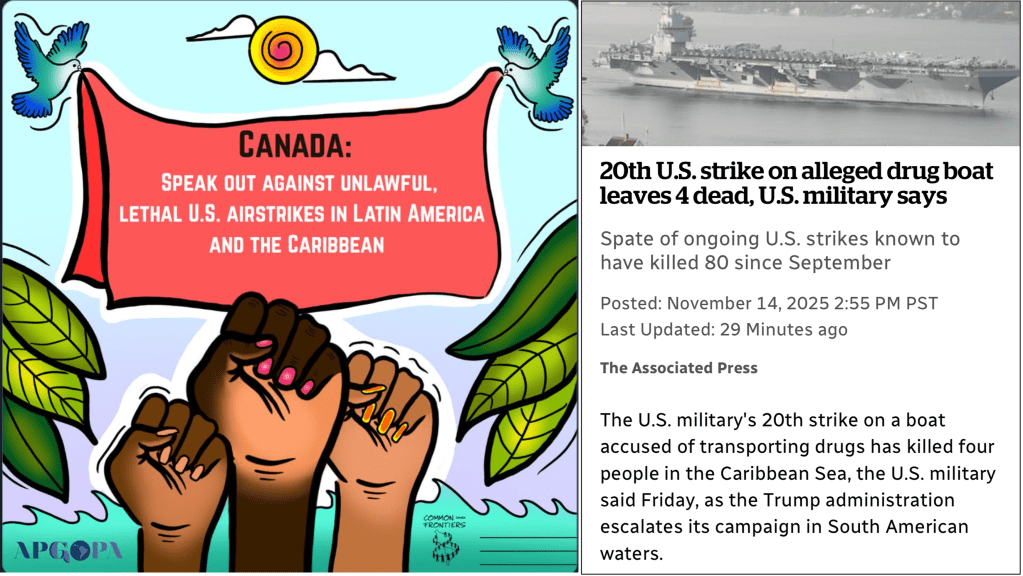
Left: Calling on Canadians to act (Artwork by Harmeet Rehal); Right: AP news story on the 20th boat strike carried out by the United States since September. Another attack was reported a day later.

Common Frontiers and the Americas Policy Group sent a letter Nov. 13 to Foreign Minister Anita Anand, Trade Minister Maninder Sidhu, and Defence Minister David McGinty urging Canada to: 

  • Speak out publicly and condemn the unlawful attacks and extrajudicial killings of civilians in the Caribbean and Pacific by the U.S. military;

  • Contribute to the promotion of peace and security in the region and join efforts to press the Trump administration to respect national sovereignty and uphold the rule of law;

  • Suspend participation in Operation CARIBBE to avoid the risk of Canadian complicity; and

  • Adhere to Canada’s obligations under the Arms Trade Treaty by removing regulatory exemptions that allow loopholes for the export of arms to the U.S. without oversight or human rights risk assessment.

Just a day earlier, Anand had told reporters that it was not her job to determine if the United States has breached international law when striking alleged drug boats in the Caribbean Sea. 

“As Canada’s foreign minister, I hold responsibility for Canada’s compliance with international law—we are always seeking to comply with international law,” Anand said. “Regarding the question that you asked, I would say it is within the purview of U.S. authorities to make that determination.”

Her comment was soundly criticized by international law experts, including Ketty Nivyabandi, secretary-general of Amnesty International Canada’s English section. She told Hill Times that international law only works if it is upheld by all states. 

“It is a collective responsibility to uphold international law. It is not up to a country to focus on itself and decide whether or not it is applying international law—in that case, nobody would,” she said. “What the United States is doing is truly making a mockery of international law. It is normalizing what are, in effect, extrajudicial killings.”

The attacks take place amidst months of arrests and deportations of Venezuelans in the United States; false allegations of Venezuelan state collusion with a criminal gang called Tren de Aragua; massive U.S. movement of troops and warships into the Caribbean; and conjecture about what the Trump regime intends to do. On Nov. 13, Defense Secretary Pete Hegseth posted on social media: “President Trump ordered action—and the Department of War is delivering. Today, I’m announcing Operation SOUTHERN SPEAR.”

Former CBC News correspondent Dan Rather cited the Washington Post in calling it the biggest military presence in the Caribbean in decades. And he added: 

… a curious build-up if the stated goal is simply drug interdiction. Another explanation would be Trump wagging the dog, creating a diversion by manufacturing a crisis that he can then fix and allowing him to flex and crow about taking down the leader of a small country. Or it could be just about commandeering Venezuela’s oil.

Here below, from the Venezuela Solidarity Network, are some reasons to help stop a potential U.S. war against Venezuela:

Please write to your own Member of Parliament to express your views.

Join actions across Canada for the No War on Venezuela Days of Action, November 15-23:

📍VANCOUVER, BC
Rally & Info Tabling
Friday, November 21, 5:00pm
Vancouver Art Gallery – Robson Street Side
Organized by Fire This Time Movement for Social Justice 

📍OTTAWA, ON
Saturday, November 22, 3:30pm
U.S. Embassy – York and Sussex
Organized by Alba Movimientos Ottawa

📍WINNIPEG, MB
Sunday, November 23, 1:00pm
River and Osborne
Sponsored by Peace Alliance Winnipeg, Manitoba-Cuba Solidarity Committee, United in Action, Communist Party of Canada – Manitoba & Araucaria

The Canada-Wide Peace and Justice Network (CWPJN) encourages members and all antiwar and peace organizations to register their actions at https://unac.notowar.net/no-war-on-venezuela-action-registration and with the CWPJN at canadapeaceandjustice@gmail.com
For updates visit: tinyurl.com/Hands-Off-Venezuela

“Security for whom?” asks KAIROS after Canada cuts foreign aid

by Jim Hodgson

Canada’s newest cuts to foreign aid spending follow cuts by other wealthy countries (most notably the elimination earlier this year of the U.S. Agency for International Development). Beyond immediate impacts, these cuts point to a reshaping of sixty years of international cooperation for development.

Over the next four years, Canada will chop $2.7 billion from its aid budget. At the same time, at the behest of the Trump regime next door, it will increase military spending with $81.8 billion over five years.

In June, Canada announced its commitment to increase military spending: CodePink, Development and Peace, and CBC headlines.

Few analysts bring together the issues of development assistance, militarism and climate justice the way that the ecumenical coalition KAIROS Canada has in its statement on the budget:

Canada needs to decide what role it wants to play in the world. These issues are inseparable: climate justice, Indigenous sovereignty, migrant justice, gender equality and peacebuilding rise or fall together — and Canada’s future depends on advancing them as one interconnected project of justice. 

KAIROS added that it is concerned by the prospect of a scaled-up military-industrial complex in Canada. “Even today, arms components made in Canada are used against civilians in Gaza and other conflict zones due to loopholes that allow them to flow indirectly through allies, helping to further entrench global insecurity.” (Canadian-built military surveillance and targeting equipment was used in at least two of the U.S. attacks on small ships in the Caribbean Sea, as reported recently by another Canadian ecumenical coalition, Project Ploughshares.)

KAIROS said the government “could have introduced a wealth tax to tackle the historic wealth gap and fund real climate action. It could have ended subsidies for fossil fuel corporations. Instead, it cut public services, forcing job losses that fall hardest on women, Indigenous Peoples and racialized communities,” as the Canadian Centre for Policy Alternatives warns.

While there are no actual projections yet of where the foreign aid cuts will hit, the budget statement cites Canada’s spending on global health programs as an example, saying this has “grown disproportionately” in comparison to other countries.

“Any reductions to Canada’s global health investments will have devastating consequences for women and children around the world, while threatening the health, security and prosperity of Canadians,” said Charmaine Crockett of the Canadian Partnership for Women and Children’s Health (CanWaCH) in a joint statement with Cooperation Canada. “Canada’s decades of leadership in global health have always been about investing in a safer, more equitable world, because we know that when we turn our back on the world’s most marginalized people, we all suffer.”

The cut to Canadian aid, elimination of USAID, and reduced spending announced by Britain, Germany, Netherlands and others means that in total, G7 countries are trimming their aid budgets by nearly one-third, the steepest reduction since 1960, according to the Globe and Mail

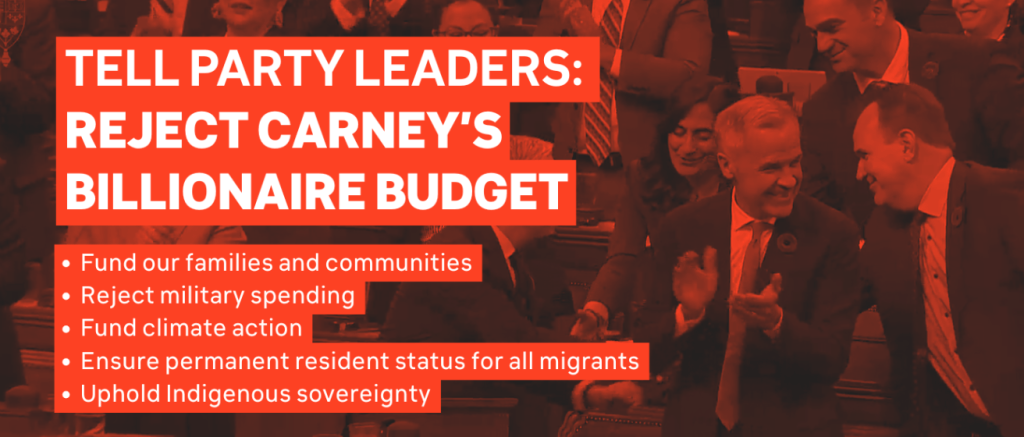
Several Canadian organizations (350.org Canada, World Beyond War, Migrant Rights Network, Council of Canadians, and the Canadian Association of Professional Employees) have come together in a letter-writing campaign to opposition leaders to encourage them to demand change before Parliament votes again on the budget.

Where to now with international development?

I want to share links to some articles that delve more deeply into the significance of what may become a shift away from a model in which rich countries of the Global North “donated” funds to impoverished countries of the Global South. The model has always been criticized as it promotes dependence and blocks systemic change. This is “big picture” stuff, very distant from issues of how to support refugees at border posts or funding for cooperative farming in Central America. (I am, as always, grateful to Brian Murphy for sharing these and other articles. You can follow him on Bluesky @murphyslog.bsky.social.)

First, “The end of the global aid industry,” by Zainab Usman. Usman proposes a focus on industrialization – what has worked for China and South Korea and is unfolding now in Vietnam and Thailand. Usman writes:

Part of the problem with the aid industry is that its benefits have been spread too thinly across a multitude of domains and not focused enough on productivity-enhancing sectors. To this end, advocates of global development should focus on enabling poorer countries to access cheap development financing for targeted investments in sectors that connect people, such as electricity, telecommunications, and mass transit. 

Second, “The geopolitics of international development (after foreign aid),” by Ken Opalo in An Africanist Perspective. Opalo examines a series of essays in Foreign Policy magazine’s Fall 2025 issue that all deal with development issues. Opalo sets his description of the decline of the foreign aid model in the context of a rising multipolarity that is matched by the “ongoing general decline of the authority and influence of Western states.”  

There’s no denying that the financial, intellectual, and institutional hegemony of Western countries significantly shaped development practice over the last 60 years. This era had both good and bad elements. The good elements included efforts to incentivize the modernization of economic management and policymaking in low-income countries (work that’s far from finished, and which has yielded some good results); while the bad elements included the fostering of aid dependence, cyclical faddism, reflexive policy extraversion, lack of elite ambition, and implicit support for a hierarchical world order that permanently placed low-income countries at the bottom of the global totem pole.

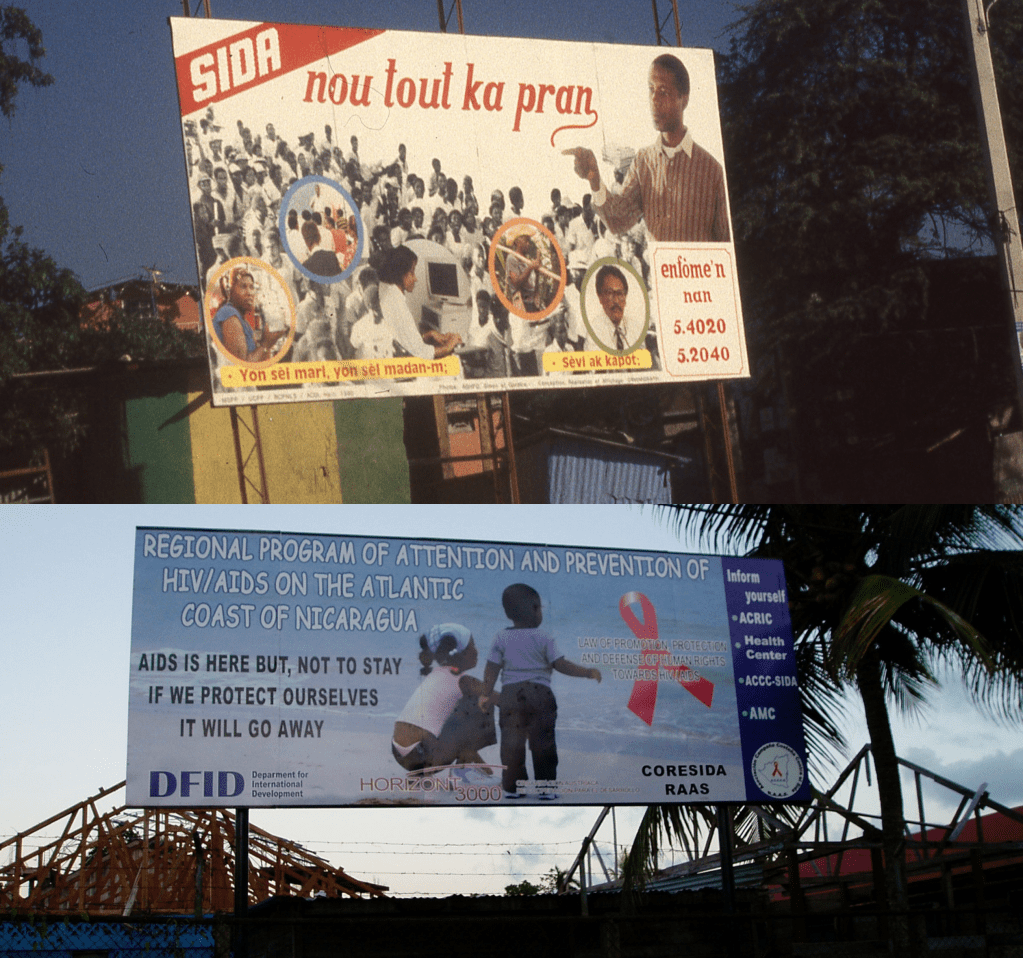
AIDS prevention education in decades past: Haiti in 1984 (top); Atlantic coast of Nicaragua in 2007 (below). Jim Hodgson photos.

Third, “Three ways to help the developing world survive the end of aid,” by Winnie Byanyima, Executive Director of UNAIDS, in The Guardian. Byanyima reminds us that developing countries are still drowning in debt and facing interest rates up to 12 times higher than wealthy countries. “Low- and middle-income countries now pay $4 to the richest in the global north for every $1 they receive in aid. Thirty-four of Africa’s 54 countries spend more on debt than on healthcare.” She adds:

  • Governments must relieve the “chokehold of sovereign debt.”
  • The richest need to pay their fair share: the wealth of billionaires soared by $2 trillion in 2024, but they paid an effective tax rate of just 0.3 per cent.
  • Governments need to treat lifesaving medicines not as commodities, but as global public goods. “This has been one of the great successes of the HIV response” (at least over the past 20 years, though not before—and threatened again with loss of U.S. funding this year).

Human rights, ecology, in the spotlight as Canada-Ecuador trade talks move forward

Behind all the bad-news headlines from Ecuador these days (political murdersgang violence, a government crackdown, a police raid on the Mexican embassy), Indigenous people and environmental groups continue to organize in opposition to resource extraction industries.

On April 21, they claimed victory when voters rejected two government proposals that would have fortified investments by transnational corporations and provided “flexibility” in their ways of contracting workers. Those victories, however, are overshadowed by approval of a range of security measures that, in turn, provoke greater concern about human rights under President Daniel Noboa.

Headlines in English about the April 21 referendum focused on President Noboa’s security agenda. La Jornada (Mexico) and TeleSUR (Venezuela) examined Noboa’s failure to advance his market-oriented economic agenda.

The proposals to expand public security that were approved include: involvement of the armed forces in fighting crime, increased penalties for serious crimes, the possibility of extradition of citizens to face charges in other countries, seizure of illicitly-obtained good, and restrictions on private ownership of weapons.

In contrast, the package of measures sought by corporations were rejected: international arbitration of investment and trade disputes, and a measure that would establish time-limited contracts and hourly-work—the “flexibility” to replace permanent, full-time jobs. 

Meanwhile, in the face of human rights and security concerns, Canada is pressing ahead with plans for a free trade agreement with the South American nation.

Canada’s objectives for negotiating this FTA look nice: “a modern, ambitious and inclusive trade agreement, reflecting the latest approaches, including in areas such as digital trade, trade and gender, environment and labour.” Mention is made of women, Indigenous peoples and labour rights.

But it is the experience of Indigenous people in Ecuador with Canadian mining companies and with the Chevron Texaco oil giant that drives opposition to free trade and one of its hallmarks: protection of foreign investors.

Canadians have seen the harmful effects of investor-state dispute settlement (ISDS) processes, both with corporate lawsuits against Canada and others involving Canadian companies overseas. (One of the latter with which I became very involved was that launched by mining companies against the government of El Salvador after it rejected an application to re-open a gold mine in Cabañas department. Salvadoran water defenders and their international allies won that fight, but such victories are rare—and our victory has provoked a cruel response by the present government.)

Stuart Trew of the Canadian Centre for Policy Alternatives (CCPA) points to a “litany of expensive and controversial ISDS awards against Ecuador involving natural resources” that led the former government of Rafael Correa to withdraw his country from ISDS processes. Constitutional reforms in 2008 include a ban on such arbitrations, and it was this article of the constitution that the Noboa government sought to amend in the referendum. 

Throughout the lead-up to the vote, the Union of People Affected by Texaco/Chevron Operations (UDAPT), the Indigenous and peasant movement led by the Confederation of Indigenous Nationalities of Ecuador (CONAIE), and others like Acción Ecológica campaigned to ensure the “no” vote.

On its website, Acción Ecológica maintains ongoing actions on mining, petroleum, protection of nature defenders, and free trade.

Christian Pino, a lawyer who specializes in investment law, welcomed the result, saying that approval of international arbitration of investment disputes would have benefited the transnationals and those Ecuadorans who hold their investments in offshore “fiscal paradises.”

I like to say that I have been fighting free trade since 1848, when Karl Marx and Friedrich Engels described it in The Communist Manifesto as “that single, unconscionable freedom” that drowns all others. But no: more like 1988, when Canadians gave Brian Mulroney a mandate to sign the first FTA with the United States, abandoning more than a century of caution in Canada-U.S. trade relations, transforming modes of production, and provoking the loss of more than 300,000 jobs

So this is not our first free trade fight or struggle to defend human and ecological rights in the face of resource extraction companies. As these FTA negotiations proceed, bear two things in mind: 

  • In the Harper years, when Canada was negotiating free trade with Colombia, we called for a “human rights impact assessment” (HRIA) but ended up with a fake mechanism that has failed to protect rights. 
  • We also pressed for a ombudsperson who could press for accountability by Canadian companies operating overseas so as to protect individuals and organizations who complain about abuses. But we ended up with a toothless office, the Canadian Ombudsperson for Responsible Enterprise (CORE), that has no investigatory power.

CCPA, together with MiningWatch Canada and Amnesty International, have amplified the concerns of Ecuadoran organizations and shared them with Canadian parliamentarians.

While any Canada-Ecuador FTA cannot now include ISDS, the deal could still exacerbate the human rights situation in Ecuador.

“Amnesty International Canada’s Human Rights Agenda for Canada calls for guarantees that no free trade agreement will advance without meaningful consultation with affected Indigenous Peoples and their organizations and their free, prior and informed consent. The organization is also calling for credible, independent human rights and environment impact assessment of any proposed trade agreement,” states an April 30 news release from the three Canadian organizations.

We can do better this time.

No Ecuador trade deal without human rights, consultation and consent

If you too wish to express your concern about Canada’s free trade plans for Ecuador, Amnesty International has set up a page from which you can send a message to Trade Minister Mary Ng telling Canada to put human rights and the environment first.