Canada has increased aid to Cuba, but it should also press Biden to ease sanctions

by Jim Hodgson

In these final months of his administration, Joe Biden could take some steps to at least temporarily ease hardship in Cuba and to complicate whatever his successor does. 

With power outages, hurricanes and then two earthquakes on Nov. 10 that measured 6.0 and 6.7, Cuba is having a hard year. And it comes on the heels of several hard years as measures by Donald Trump’s 2017-21 administration took hold—suspension of family remittances, restrictions on banks, among others—and with the decline of tourism revenue during and after the Covid pandemic.

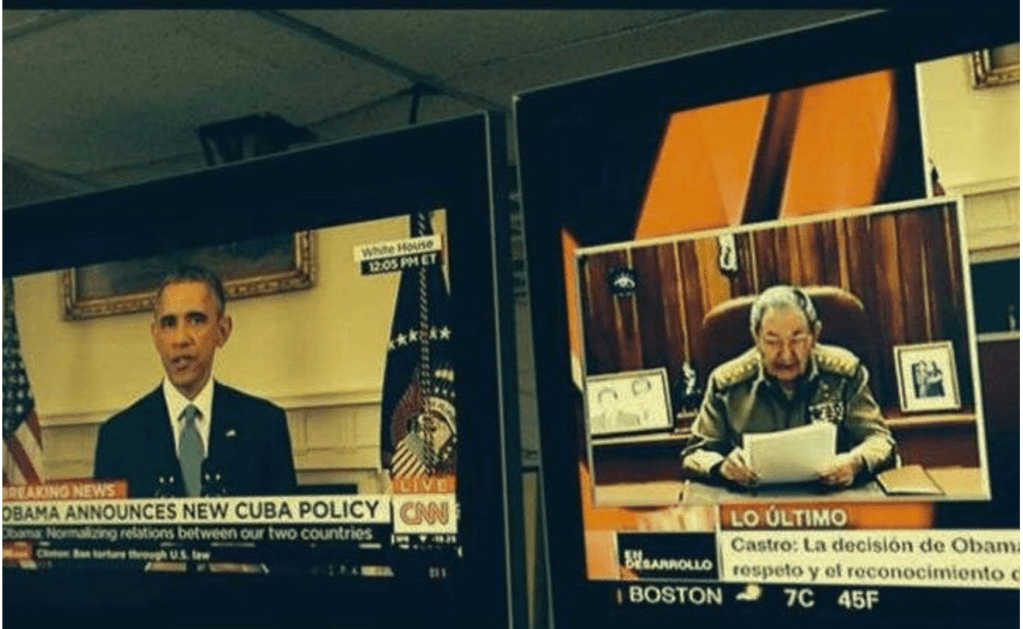
For almost two years, Canadian churches, trade unions and solidarity groups have called on the government of Canada to increase humanitarian aid to Cuba and to press the Biden administration to ease sanctions and to remove Cuba from its list of so-called “state sponsors of terrorism.” Their work complimented the work of U.S. and other international groups that sought to get Biden to at least bring the U.S. relationship back to where it was near the end of Barack Obama’s administration in 2017—before Trump made things worse. 

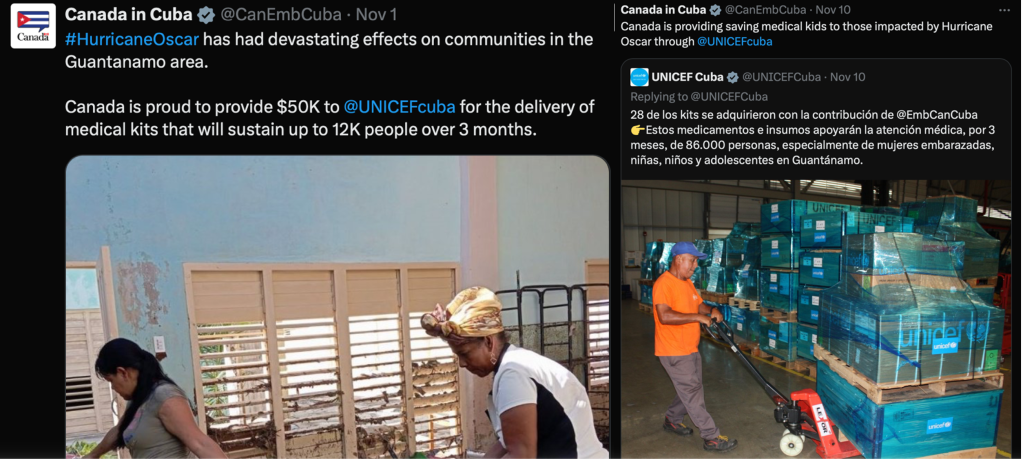
Canadian embassy Nov. 1 announcement of support to UNICEF’s delivery of medical kits in Guantánamo area, and a photo of delivery of 28 of the kits Nov. 10.

Now they’re asking for letters to be sent to Canadian politicians to press for more aid and for action with Biden on the sanctions. 

Here’s what Katrina vanden Heuvel had to say to Biden about Cuba after the U.S. election in The Nation

In another common-sense change that would undo decades of senseless policy, the president could also finally normalize relations with Cuba. That would mean the restoration of official diplomatic ties, removal of the island from the State Sponsors of Terrorism List, and honoring the 22 bilateral agreements signed during the Obama administration before being torn up by Trump. It would also mean lifting sanctions that have fuelled Cuba’s ongoing economic crisis, and providing robust aid to people beset by severe fuel shortages and food rationing. Closing Guantánamo Bay Naval Base and returning it to Cuba as a hospital would disassemble the starkest symbol of American domineering on the island. And though Trump will almost certainly seek to reverse any executive actions on Cuba, Biden could make that politically complicated by opening up private-sector investment there.

Here in Canada, we’ve had more success with our request for more aid. Canada announced Nov. 1 that it will provide $350,000 to Care Canada to provide water, sanitation, and hygiene services, and distribute relief supplies to 25,000 people for up to 6 months in Guantanamo, and for $50,000 to UNICEF-Cuba for delivery of medical kits that will sustain up to 12,000 people over three months. A further announcement that would bring aid up to $900,000 is expected soon.

Headlines Nov. 13 in the English-language version of Granma newspaper.

Now, with Trump set to take office on Jan. 20, the available window for Canada to press the Biden administration has become short.

What you can do:

Here’s a way that you can write to Canada’s foreign minister and other leaders to press for increased humanitarian aid and to press the U.S. government to ease sanctions and to remove Cuba from its list of “international sponsors of terrorism.”

Please act: https://petition.web.net/CanadaActNowOnCuba 

As you request more Canadian assistance, you may also wish in your letter to thank the government of Canada for its announcement Nov. 1 of $350,000 to Care Canada to provide water, sanitation, and hygiene services, and distribute relief supplies to 25,000 people for up to 6 months in Guantanamo, and for $50,000 to UNICEF-Cuba for delivery of medical kits that will sustain up to 12,000 people over three months.

United States takes modest step towards easing its long embargo against Cuba

By Jim Hodgson

A modest step forward in the long struggle to end the failed U.S. embargo came this week when the United States removed Cuba from its short list of countries it alleges are “not cooperating fully” in its fight against terrorism. “This move… could well be a prelude to the State Department reviewing Cuba’s designation as a state sponsor of terrorism,” William LeoGrande, a professor at Washington’s American University, told Reuters.

Left: Reuters coverage. Right: As reported by CubaDebate – “State Department recognises the lie, but does not remove Cuba from the list of state sponsors of terrorism.” President Miguel Diaz-Canel told interviewer Ignacio Ramonet that many of Cuba’s economic woes begin with the U.S. blockade, tightened in 2021 with “the inclusion of Cuba in a spurious list determined at will by the U.S. government of countries that supposedly support terrorism.”

Until this week, the administration of President Joe Biden had made only minor reforms—easing some restrictions on travel and family remittances in May 2022—but had scarcely budged from the harsh measures taken by his predecessor, Donald Trump, much less attaining Barack Obama’s level of engagement.

It was just days just before the end of Trump’s administration in January 2021 that Cuba was added to the list of “state sponsors of terrorism” (SST)—because Cuba was hosting peace talks between the Colombian government and one of the guerrilla armies, the Ejército de Liberación Nacional (ELN). Despite occasional setbacks, the Colombian peace process moves forward slowly.

Biden’s new move comes after three years of non-stop advocacy by churches and other non-governmental organizations to end the embargo and to have Cuba removed from the SST list.

Efforts by churches, unions and other groups are driven by a sharp deterioration of the Cuban economy that is partly a consequence of the SST and other measures as banks and other corporations fear running afoul of the U.S. measures. The economic downturn is also related to reduced tourist visits to the country during the Covid pandemic and Cuba’s abandonment of its former two-currency system (one tied to the U.S. dollar, and the other that effectively subsidized local transactions).

In April 2023, an informal alliance of more than 20 Canadian churches, trade unions, development agencies and community solidarity groups wrote to Foreign Affairs Minister Mélanie Joly and to then-International Development Minister Harjit Sajjan to express alarm at the “deterioration of the Cuban economy and consequent impacts on the Cuban people.”

They called on the government to press the United States to ease sanctions and to remove Cuba from the SST list. They also asked that Canada “scale up its efforts to provide immediate food, medicines, and medical supplies to Cuba” (whether directly with the Cuban state or via NGOs and multilateral organizations). 

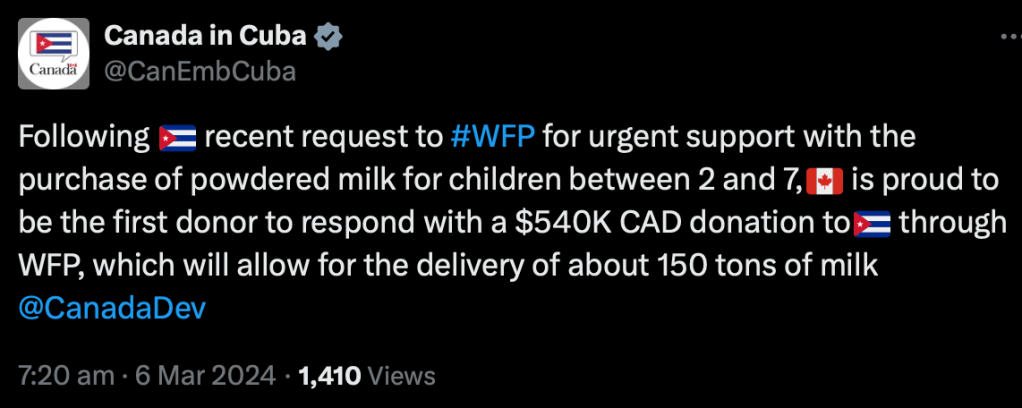
Canada has made some efforts, notably the announcement March 6 of a $540,000 contribution to the World Food Program to support provision of 150 tons of milk that will assist Cuban children. Canada’s response followed just two days after the Cuban government had made its first-ever request to WFP for food aid. Canada continues to fund the work of NGOs such as Oxfam and CARE Canada in Cuba.

The Canadian letter echoed earlier calls from Cuban and U.S. churches. In a joint letter sent Feb. 18, 2021, they asked Biden to to restore travel, remittances and trade with Cuba; to remove Cuba from the list of “state sponsors of terrorism;” to rescind Trump’s mandate to use extraterritorial provisions of the Helms-Burton law; and to rebuild U.S. diplomatic presence in Cuba. On March 13, 2023, more than 20 U.S. faith groups wrote to Biden to ask that Cuba be removed from the SST list.

The SST designation, along with Trump’s application of measures contained in the 1995 Helms-Burton Act, have extraterritorial impacts. Foreign-owned ships won’t dock in Cuba and foreign banks are reluctant to transfer funds for fear of running afoul of the U.S. laws. To understand better the impact of the SST in Cuba, please read a long report by the Washington Office on Latin America (WOLA).

The extraterritorial features of the Helms-Burton law provoked anger in Canada and Europe, but those features were effectively waived by Presidents Clinton, Bush and Obama. In April 2019, Trump revived them. Canada repeated its objection, and reminded Canadians that amendments in 1996 to Canada’s Foreign Extraterritorial Measures Act (FEMA) stipulate that any judgment issued under Helms-Burton “shall neither be recognized nor enforceable in any manner in Canada.”

But Canada, to my knowledge, has yet to say anything publicly about the SST list.

Meanwhile, churches, NGOs and solidarity groups continue to provide aid to Cuba, including in response to damage caused by Hurricane Ian in western Cuba in 2022 and after the oil storage facility fire in Matanzas in 2022. 

Vancouver-based CoDevelopment Canada is collecting material to send in a container to Cuban trade unions later this summer. 

The U.S. Cuba Normalization Coalition has a fact sheet about U.S.-backed attacks on Cuba. “Cuba has endured 64 years of a U.S. economic blockade.This intensified when President Trump unjustifiably put Cuba on a list of so-called State Sponsors of Terrorism (SSOT).President Biden has continued that listing. Companies worldwide that want to sell medicines or food to Cuba often can’t because their own bank refuses to accept Cuba’s payment under threat of enormous fines from the U.S.treasury for dealing with ‘terrorists’.”

Turning the world upside down: systemic change needed now

Photo: Granma.cu

by Jim Hodgson

In the face of deep inequality within and among the nations of the world, leaders of the so-called “less developed countries” find they must still appeal for basic fairness from their richer neighbours.

More than 75 years after the United Nations was formed, and almost that long since the first development programs were implemented (e.g., the Colombo Plan, 1950), and almost 60 years since the first gathering of the Group of 77 developing nations, leaders gathered last week in Havana and this week in New York to plead their case again.

Not that you would have read about the Havana meeting in mainstream media, but representatives from 114 countries attended the G77+China meeting in Havana. Among them were 30 heads of state or government, as well as senior officials from international organisations and agencies, including UN Secretary-General Antonio Guterres.

The meeting was held under the banner title, “Current development challenges: The role of science, technology and innovation,” but the talk was all about the systems of wealth and power that are rigged against developing countries.

In their final declaration Sept. 16, the G77 demanded fair “access to health-related measures, products and technologies” – a problem highlighted by “vaccine apartheid” during the Covid pandemic when richer countries had first access to vaccines. 

G77 called for an end to “existing disparities between developed and developing countries in terms of conditions, possibilities and capacities to produce new scientific and technological knowledge.”

They revived calls for a “new international economic order” and “new financial architecture,” including “through increasing the representation of developing countries in global decision and policy-making bodies which will contribute to enhance the capacities of developing countries to access and develop science, technology and innovation.”

Among the countries participating (including the host, Cuba) were several that have been harmed by sanctions that are usually imposed by wealthier countries to try to provoke changed behaviour by less powerful countries. Sanctions (referred to in the declaration with the UN Human Rights Council term “unilateral coercive measures”), together with external debt, inflation, displacement of peoples, inequality and “the adverse effects of climate change” are all among the “major challenges generated by the current unfair international economic order” and there is “no clear roadmap so far to address these global problems.”

Criticism of the existing international order carried over from the G77 meeting to the UN General Assembly, which met days later in New York.

“They don’t have the $100 billion to aid countries so that they can defend themselves against floods, storms and hurricanes,” said Colombian President Gustavo Petro, referring to the Loss and Damage Fund promoted at the COP climate negotiations to “new and additional” funding from donor nations.

Wars and climate change, he said, are related to that other unprecedented crisis: migration. “The exodus of people toward the north is measured with excessive precision in the size of the failure of governments. This past year has been a time of defeat for governments, of defeat for humanity.”

The political systems that we use to effect policy changes are failing to respond to the urgent needs of our time. Most politicians are beholden to the corporations and rich people who fund their political parties and perpetuate their hegemony. In four-to-six year electoral cycles, the deep changes needed to confront those problems are rarely undertaken. 

In Canada, think of the power that mining corporations have wielded to block meaningful investigation of human rights and environmental abuses by their subsidiaries overseas. Or the influence land speculators have over the Ontario government. Or the actions of oil, gas, coal and pipeline companies to stall meaningful action to cut greenhouse gas emissions. 

And then scale that up globally. Think of the ways pharmaceutical companies blocked access to HIV and AIDS medications until a global fund was found to pay them – and then pulled the same stunt over Covid vaccines. At the UN on Sept. 20, Guterres said time was running short for climate action thanks to the “naked greed” of fossil fuel interests.

What is delivered through Official Development Assistance and Sustainable Development Goals may be crumbs and band-aids. While necessary, those funds are not sufficient to counter instruments of power like corporations and their allies in the international financial institutions like the World Bank and the International Monetary Fund.

Political change is required to make the systems change.

As Xiomara Castro, president of Honduras, told the G77 in Havana: “The time has come to put an end to the backyards [using a U.S. term referring to its relationship to Latin America] because we are not pieces on a chessboard of those who are apologists for dependence. Our nations should not continue to suffer the mass privatization of their territories.”

Mafalda: But Liberty, you’ve put the map upside down!
Liberty: Upside down compared to what? Earth is in space where there is no up or down.
Liberty: That story that says the north has to be above is a psychological trick invented by those on the top to make those who are on the bottom continue to believe that we are the bottom. But, beginning today, conventional ideas are over!
Last panel, a voice: Where were you, Mafalda?
Mafalda: I don’t know, but a conventional idea has taken a blow.

(For that last line, Quino, the great Argentinian cartoonist who created Mafalda, wrote in the original Spanish version, “No lo sé, pero algo acaba de sanseacabarse” – the sense being that something has ended.)