The Monroe Doctrine never went away

by Jim Hodgson

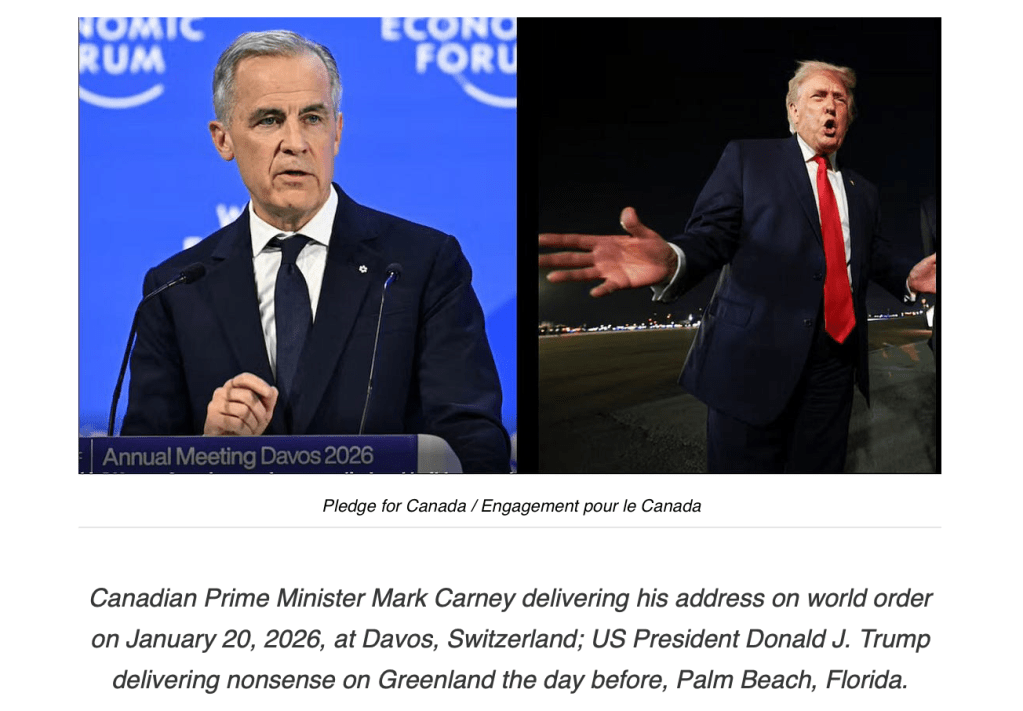
Beyond the constant babbling of That Man Next Door is a real plan for U.S. domination of the Americas. 

The Trump administration’s 2025 National Security Strategy (NSS) says it will discourage Latin America and Caribbean nations from working with each other and with countries from outside the hemisphere. Overtly racist and nationalist, it also presses European countries to take “primary responsibility” for their own defence.

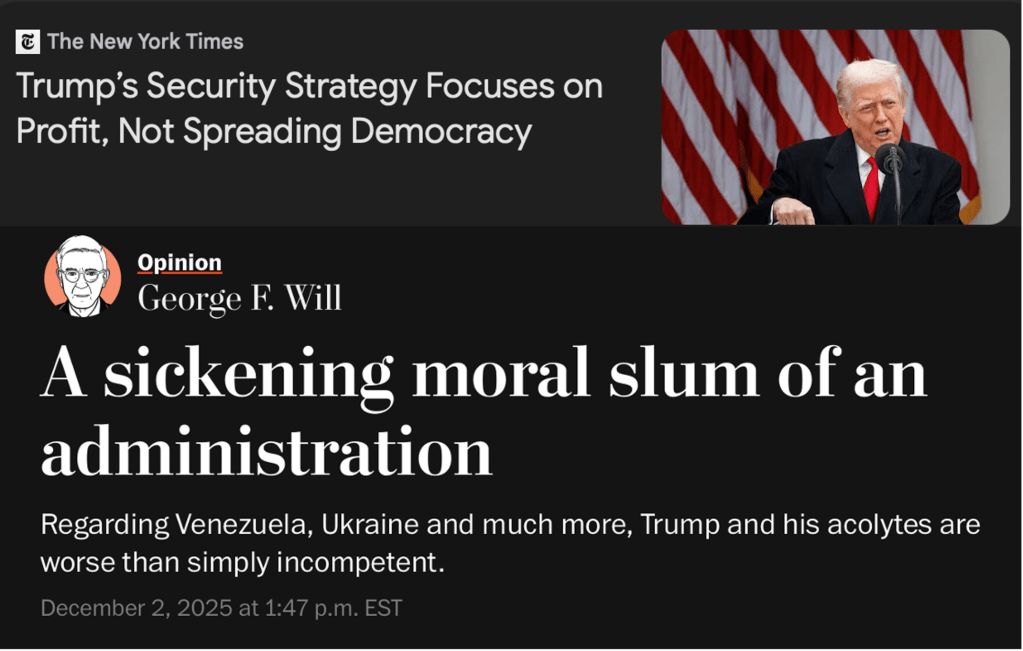
New York Times headlines in recent days.

The document was released Thursday night (Dec. 4) and neatly summarized Friday night (Dec. 5) by U.S. historian Heather Cox Richardson:

In place of the post–World War II rules-based international order, the Trump administration’s NSS commits the U.S. to a world divided into spheres of interest by dominant countries. It calls for the U.S. to dominate the Western Hemisphere through what it calls “commercial diplomacy,” using “tariffs and reciprocal trade agreements as powerful tools” and discouraging Latin American nations from working with other nations. 

“The United States must be preeminent in the Western Hemisphere as a condition of our security and prosperity,” it says, “a condition that allows us to assert ourselves confidently where and when we need to in the region.” …

It went on to make clear that this policy is a plan to help U.S. businesses take over Latin America and, perhaps, Canada. “The U.S. Government will identify strategic acquisition and investment opportunities for American companies in the region and present these opportunities for assessment by every U.S. Government financing program,” it said, “including but not limited to those within the Departments of State, War, and Energy; the Small Business Administration; the International Development Finance Corporation; the Export-Import Bank; and the Millennium Challenge Corporation.”

Should countries oppose such U.S. initiatives, it said, “[t]he United States must also resist and reverse measures such as targeted taxation, unfair regulation, and expropriation that disadvantage U.S. businesses.”

Think of it. The tariff fights with Canada, Mexico and Brazil. The stepped-up sanctions against Venezuela, Cuba and Nicaragua. The mass murders of alleged “drug-traffickers” by exploding their boats in the open sea. Overt threats of “land strikes” in Mexico, Colombia and Venezuela. Trump’s interventions in national elections in Argentina and, most recently, Honduras. These are all part of the same strategy for renewed U.S. dominance.

Resistance grows and is not futile.

I take my title today from the headline over La Jornada’s lead editorial Sunday, Dec. 7:  Monroe nunca se fue. Trump’s policy (“Donroe”) rejects the polite notion of a “good neighbour policy” towards Latin America and the Caribbean promoted after 1933 by Franklin D. Roosevelt and others. But that approach was betrayed repeatedly by presidents from both parties who involved themselves in coups in Guatemala, Brazil, Chile, Honduras and elsewhere, along with invasions of the Dominican Republic, Haiti, Grenada and Panama – and the wars in Central America in the 1980s and U.S. support for paramilitary death squads in Colombia.

The people of Honduras went to the polls Sunday, Nov. 30. Before the vote, Trump did two things: he pardoned former President Juan Orlando Hernández, convicted last year in the United States for trafficking cocaine; and he endorsed the candidate of Hernández’s National Party, Nasry Asfura (known as “Tito” or “Papi”). A week after the vote, Asfura is in what election officials called a “technical tie” with a slightly more centrist candidate, Salvador Nasralla of the Liberal Party. Those two parties represent different factions of Honduran family oligarchs. 

Whichever of them is ultimately declared the victor (a process that could take until Dec. 30), the ruling Libre party has been pushed aside. President Xiomara Castro had led the country for the past four years; her party’s candidate, Rixi Moncada, has only about 20 per cent of the official count – although many aspects of the election remain in dispute – including U.S. interference.

Key here is the coup On June 28, 2009, that ousted the elected government of Mel Zelaya, not quite a half-year into the administration of Barack Obama and his secretary of state Hillary Clinton. Their machinations brought about more than 12 years of rule that facilitated drug-traffickers, mining, corrupt land sales and human rights abuse – only partly subdued after the election of Castro four years ago.

“The abuse of force,” concludes La Jornada’s editorial, “is not, as [Trump] pretends, a sign of strength, but the recourse of one who cannot attract his neighbours with technological innovation, productive investment, exemplary institutions or a viable model of civilization.” 

Canada has increased aid to Cuba, but it should also press Biden to ease sanctions

by Jim Hodgson

In these final months of his administration, Joe Biden could take some steps to at least temporarily ease hardship in Cuba and to complicate whatever his successor does. 

With power outages, hurricanes and then two earthquakes on Nov. 10 that measured 6.0 and 6.7, Cuba is having a hard year. And it comes on the heels of several hard years as measures by Donald Trump’s 2017-21 administration took hold—suspension of family remittances, restrictions on banks, among others—and with the decline of tourism revenue during and after the Covid pandemic.

For almost two years, Canadian churches, trade unions and solidarity groups have called on the government of Canada to increase humanitarian aid to Cuba and to press the Biden administration to ease sanctions and to remove Cuba from its list of so-called “state sponsors of terrorism.” Their work complimented the work of U.S. and other international groups that sought to get Biden to at least bring the U.S. relationship back to where it was near the end of Barack Obama’s administration in 2017—before Trump made things worse. 

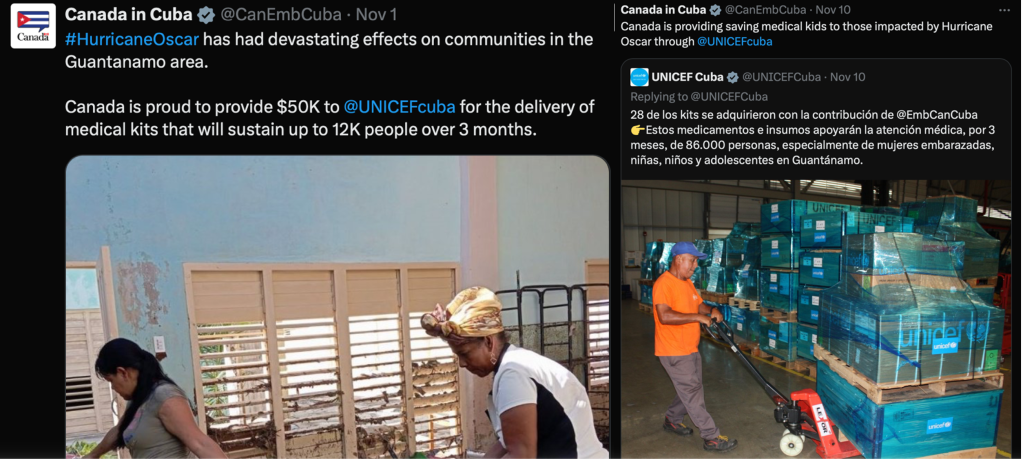
Canadian embassy Nov. 1 announcement of support to UNICEF’s delivery of medical kits in Guantánamo area, and a photo of delivery of 28 of the kits Nov. 10.

Now they’re asking for letters to be sent to Canadian politicians to press for more aid and for action with Biden on the sanctions. 

Here’s what Katrina vanden Heuvel had to say to Biden about Cuba after the U.S. election in The Nation

In another common-sense change that would undo decades of senseless policy, the president could also finally normalize relations with Cuba. That would mean the restoration of official diplomatic ties, removal of the island from the State Sponsors of Terrorism List, and honoring the 22 bilateral agreements signed during the Obama administration before being torn up by Trump. It would also mean lifting sanctions that have fuelled Cuba’s ongoing economic crisis, and providing robust aid to people beset by severe fuel shortages and food rationing. Closing Guantánamo Bay Naval Base and returning it to Cuba as a hospital would disassemble the starkest symbol of American domineering on the island. And though Trump will almost certainly seek to reverse any executive actions on Cuba, Biden could make that politically complicated by opening up private-sector investment there.

Here in Canada, we’ve had more success with our request for more aid. Canada announced Nov. 1 that it will provide $350,000 to Care Canada to provide water, sanitation, and hygiene services, and distribute relief supplies to 25,000 people for up to 6 months in Guantanamo, and for $50,000 to UNICEF-Cuba for delivery of medical kits that will sustain up to 12,000 people over three months. A further announcement that would bring aid up to $900,000 is expected soon.

Headlines Nov. 13 in the English-language version of Granma newspaper.

Now, with Trump set to take office on Jan. 20, the available window for Canada to press the Biden administration has become short.

What you can do:

Here’s a way that you can write to Canada’s foreign minister and other leaders to press for increased humanitarian aid and to press the U.S. government to ease sanctions and to remove Cuba from its list of “international sponsors of terrorism.”

Please act: https://petition.web.net/CanadaActNowOnCuba 

As you request more Canadian assistance, you may also wish in your letter to thank the government of Canada for its announcement Nov. 1 of $350,000 to Care Canada to provide water, sanitation, and hygiene services, and distribute relief supplies to 25,000 people for up to 6 months in Guantanamo, and for $50,000 to UNICEF-Cuba for delivery of medical kits that will sustain up to 12,000 people over three months.

Haitian claim for slavery reparations at the heart of a UN forum

by Jim Hodgson

A United Nations forum on the historic wrongs committed against people of African descent is building momentum in favour of an international tribunal on atrocities dating back to the transatlantic trade of enslaved people.

When the UN Permanent Forum on People of African Descent (PFPAD) held its third session in less than two years in Geneva in mid-April, African and Caribbean governments together with civil society organizations pressed forward with plans to create a tribunal that would be similar to that which oversaw the Nuremberg trials of Nazi war criminals after World War II.

Proponents say such a tribunal would help establish legal norms for international and historical reparations claims.

Supporters include many members of the Caribbean Community (CARICOM), made up of 15 member states, and the African Union (AU), which includes 55 states—and Antonio Guterres, the UN General Secretary. “We call for reparatory justice frameworks, to help overcome generations of exclusion and discrimination,” he said March 25.

Supporters argue that Western countries and institutions that continue to benefit from the wealth slavery generated should be held accountable, particularly given ongoing legacies of racial discrimination. Opponents say that contemporary states and institutions should not be held responsible for historical slavery.

The World Council of Churches was among faith-based and civil society organizations that came together at the PFPAD forum to examine what states and other actors may do to redress the historic exploitation and harms that Africans and people of African descent have suffered. (You can learn more here about global ecumenical efforts to overcome racism, discrimination and xenophobia.)

Righting the wrongs in Haiti

Given that Haiti’s claim for reparations is among the strongest, the voices of Haitian civil society groups and their diaspora counterparts were heard at the PFPAD forum. 

Those groups used the forum to put a spotlight on the crucial role that Haiti played in the struggle to end slavery. “To recognize the historic context is essential to understand the unique position of Haiti in the global struggle for justice and egality,” they said in a statement before the forum. Participating groups—including the Montana Accord network and of the Haitian-American Foundation for Democracy (HAFFD)—said they strongly approve calls for reparations to Haiti.

Le Marron Inconnu, and in the background, the National Palace before the 2010 earthquake.

Haiti was born as an independent nation in 1804 after the enslaved people revolted against their French colonial masters. The values of “liberté, égalité et fraternité,” expressed in the triumph of the French Revolution in 1789, resonated among slaves in Saint-Domingue, France’s richest colony. In 1804, the world’s first successful slave rebellion resulted in the birth of the Republic of Haiti. 

Beginning in 1825, France squeezed an “independence debt” from Haiti that adds up to at least $21 billion in today’s dollars. That estimate comes from The New York Times, but backers of the reparations claim say the amount is much higher.

“It’s $21 billion plus 200 years of interest that France has enjoyed so we’re talking more like $150 billion, $200 billion or more,” Jemima Pierre, professor of Global Race at the University of British Columbia, told Reuters.

Despite the obvious injustice of that debt, France continues to resist pressure to join in reparations. In August 2010, about 100 prominent academics, authors, and human rights activists signed on to an open letter to then-President Nicolas Sarkozy, arguing that the case for repayment was “morally, economically, and legally unassailable.” France dismissed the petition, pointing to its record of delivering other aid to Haiti and not addressing the legitimacy of the debt.

“What’s important is that it’s time that France recognises this and we move forward,” Haitian civil society activist Monique Clesca told Reuters. France, whose development agency has given hundreds of millions of dollars in aid to Haiti, has previously referred to a “moral debt” owed to Haiti.