
by Jim Hodgson
Readers of this blog may find it odd that I am concerned about the fate of a Canadian mining company operating overseas, especially just days after a new report showed that U.S. sanctions have tripled Cuba’s infant mortality rate over the past seven years. (By the way, retired Latin American studies professor John Kirk of Dalhousie University have a new article about the impact of sanctions posted May 7 at rabble.ca.)
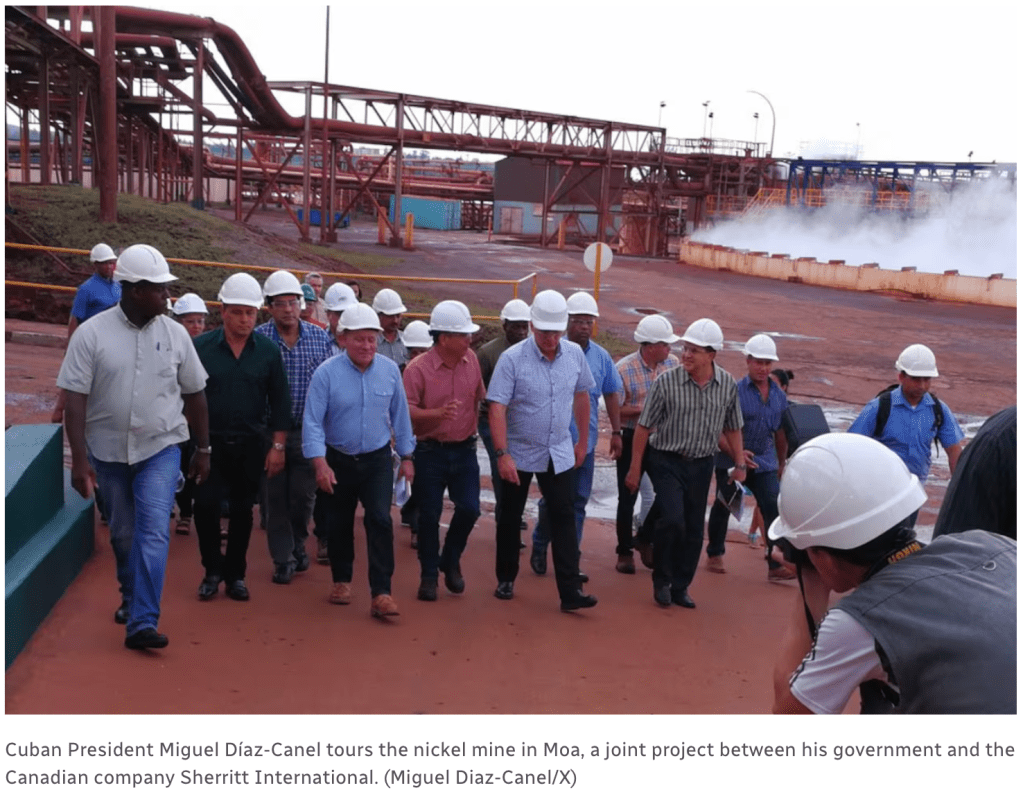
But Sherritt International Corp. had operated a nickel and cobalt mine in Holguín province as a joint venture with the Cuban state for more than 30 years, an arrangement that ensured Cubans shared the benefits of the mining operation. On May 7, as legal implications of new U.S. sanctions became clearer, Sherritt suspended its operations in Cuba.
In response to Sherritt’s announcement, the Canadian Network on Cuba (CNC) said the Canadian government must “take immediate and decisive action in defence of Canadian sovereignty, international law, and the right of Canadian companies to conduct lawful business free from foreign coercion and intimidation.”
CNC said President Donald Trump’s May 1 executive order “constitutes yet another illegal attempt to extend U.S. domestic law beyond its borders and impose Washington’s unilateral sanctions regime on the entire world. This represents not merely an attack on Cuba, but a direct assault on Canada’s sovereignty, on international trade law, and on the principle that no state has the right to dictate the economic relations of other nations.”
Further U.S. measures announced May 7 targeted Grupo de Administracion Empresarial S.A. (GAESA), partner of many foreign tourist operations, and Moa Nickel SA, the joint venture between Sherritt and Cuba’s state-owned nickel company.
The current escalation is rooted in the infamous Helms-Burton Act, passed by the U.S. Congress in 1996. The extraterritorial features of that law provoked anger in Canada and Europe, but those features were effectively waived by Presidents Bill Clinton, George W. Bush, and Barack Obama. In April 2019, Trump revived then. Canada’s then foreign minister, Chrystia Freeland, objected, saying Canada would “fully defend the interests of Canadians conducting legitimate trade and investment with Cuba.” She reminded Canadians that amendments in 1996 to Canada’s 1985 Foreign Extraterritorial Measures Act (FEMA) stipulate that any judgment issued under Helms-Burton “shall neither be recognized nor enforceable in any manner in Canada.”
CNC now poses the question: will the current government enforce FEMA? If the Canadian government fails to act now, FEMA becomes little more than a hollow gesture, and Canada effectively concedes that U.S. law supersedes Canadian law on Canadian soil. CNC argues that Ottawa must therefore:
- Publicly denounce the Trump administration’s Executive Order as an illegal extraterritorial measure that violates international law and Canadian sovereignty;
- Immediately invoke and enforce the Foreign Extraterritorial Measures Act to protect Canadian corporations operating lawfully in Cuba;
- Provide legal, diplomatic, and financial protections to Canadian firms targeted by U.S. sanctions;
- Coordinate with Mexico, the European Union, CARICOM nations, and other states opposing the blockade to resist Washington’s unlawful coercive measures; and
- Reaffirm Canada’s longstanding opposition to the U.S. blockade and demand its complete and unconditional end.
Taken together, more than six decades of U.S. sanctions are described in Cuba as a blockade. The term is most apt now after more than three months of a U.S. blockade of fuel shipments from Venezuela and Mexico. The UN General Assembly has overwhelmingly condemned the U.S. blockade in annual votes for more than three decades. CNC adds:
“The blockade and its extraterritorial application violate the UN Charter, international law, freedom of navigation and trade, and the sovereign equality of states. Yet Washington continues to intensify this economic siege, now seeking to punish not only Cuba, but also Canadian companies, Canadian workers, and Canadian economic interests.”
The new U.S. sanctions follow a “long-standing policy and campaign of economic warfare, sabotage and destabilization aimed at strangling Cuba regardless of the collateral damage inflicted internationally,” says CNC. “Canada must choose whether it will defend its sovereignty and uphold international law, or whether it will permit itself to be subordinated to the extraterritorial dictates of a foreign power: whether to join empire or challenge it.”
 Unwrapping Development
One thought on “Canadian casualties as U.S. takes aim at Cuban businesses”