Late but welcome: Biden lifts terrorist insult against Cuba

by Jim Hodgson

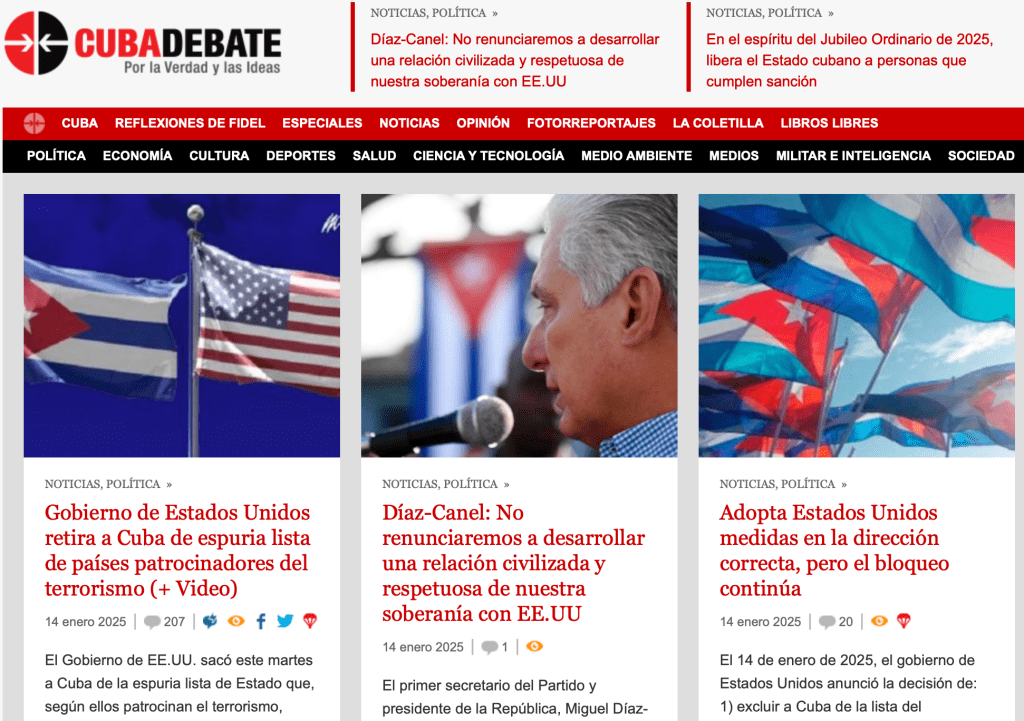
Less than a week before he vacates the White House, U.S. President Joe Biden removed Cuba from the U.S. government’s State Sponsors of Terrorism (SSOT) List. The move had been demanded by governments around the world and by U.S. civil society since it was imposed four years ago in a similar last-minute move by then out-going President Donald Trump.

The Biden administration also suspended Title III of the 1996 Helms-Burton Act. That measure, suspended by all presidents until Trump, allows U.S. claimants whose property was nationalized during the Cuban Revolution to sue companies for doing business on that property. Canada has persistently objected to the extraterritorial implications of that act, and promised to defend Canadians doing business in Cuba.

Biden also rescinded a 2017 national security memorandum (NSPM-5) that restricted financial transactions by various Cuban entities, including many hotels.

Now that Trump is returning to the White House (with an anti-Cuba hardliner, Marco Rubio, as his Secretary of State), the measures may not last long.

On the same day (Tuesday, January 14), “in the spirit of the Jubilee year 2025,” Cuba announced the release of 533 prisoners after talks with Pope Francis and other Vatican officials.

Cuba welcomed the new U.S. moves. “Despite its limited nature, this is a decision in the right direction and in line with the sustained and firm demand of the Government and the people of Cuba, and with the broad, emphatic and reiterated call of numerous governments,” said the Ministry of Foreign Affairs. Those calls had been echoed by political, religious and social organizations in the United States and elsewhere.

In the United States, the National Network on Cuba (NNOC) reaffirmed its commitment to fight against the blockade and noted the efforts of solidarity to achieve the result made public on Tuesday by the Biden administration. The co-president of the NNOC, Cheryl LaBash, told Prensa Latina that “When we fight, we win!”, referring to the “many resolutions that represent more than 60 million people in the United States—municipal councils, state legislatures, unions – who made their voices heard.”

Colombian President Gustavo Petro also celebrated the exclusion of Cuba from the list. He said that eliminating punitive measures, even partially, constitutes progress. The Colombian Foreign Ministry also expressed gratitude to the Cuban people for their unrestricted support in the negotiation and dialogue processes necessary to achieve peaceful coexistence in Colombia.

“Due to our firm conviction in multilateralism as a principle of international relations, we reject the imposition of sanctions and unilateral measures and therefore, together with other allied countries in the region, we support the efforts and requests for the sister Republic of Cuba to be excluded from this list,” the ministry said. 

Trump’s officials had put Cuba back on the SSOT four years ago after Cuba had hosted a dialogue between a previous government of Colombia and one of the guerrilla armies, the National Liberation Army (ELN). It was originally placed on the list by the Reagan administration in 1982 for supposedly aiding the liberation movements in Central America: that while Reagan sponsored the “contras” in their dirty war against Nicaragua.

Among all the sanctions levied against Cuba over the past 65 years, the SSOT designation may be the most damaging. Foreign-owned ships won’t dock in Cuba and foreign banks are reluctant to transfer funds for fear of running afoul of the U.S. laws. To understand better the impact of the SSOT in Cuba, please read a long report by the Washington Office on Latin America (WOLA).

For more background on the SSOT list, please see: “How Biden Embraced Trump’s Terror Smear Against Cuba,” by Alyssa Oursler and Jack Mcgrath (The Jacobin).

For more on Title III, please see: “Billboards and Backchannels: Deep Inside the Lobbying Campaign to Crush Investment in Cuba,” by Reed Lindsay and Daniel Montero (Belly of the Beast).

Cuba-U.S. relations: the thaw that didn’t happen

by Jim Hodgson

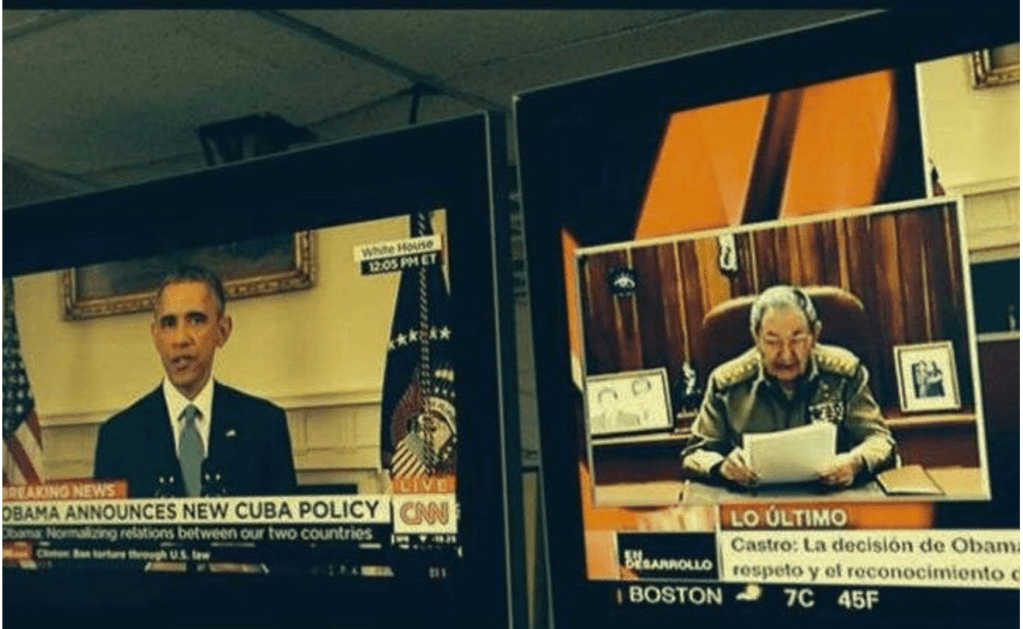
A decade ago this week came news that the United States and Cuba would begin a process to restore relations broken in 1961 in the wake of the Cuban Revolution and at the height of the Cold War. 

Simultaneous announcements, December 17, 2014. Image: OnCuba News. For more background, please see my 2021 series of posts about Cuba, beginning here.

“Today, America chooses to cut loose the shackles of the past so as to reach for a better future—for the Cuban people, for the American people, for our entire hemisphere, and for the world,” said President Barack Obama

“As we have repeated, we must learn the art of coexisting, in a civilized manner, with our differences,” said President Raúl Castro

Obama did not, however, back away from historic U.S. criticisms of Cuba’s revolutionary option; nor did Castro promise to surrender national sovereignty or its political system. But a process was set in place for dialogue over differences. Prisoners were released on both sides of the Straits of Florida. People could visit each other once again. Perhaps the United States would finally become a “good neighbour” to Cuba and other countries in Latin America and the Caribbean.

Tragically, hope inspired that week and by Obama’s visit to Havana in March 2016 has proved but fleeting—“ephemeral” says an editorial Tuesday in Mexico’s La Jornada daily newspaper. 

When Donald Trump came to power in January 2017, he cancelled all the advances of the Obama era and, as La Jornada puts it, added “new layers of sadism to the criminal blockade against Cuba.” He even maintained his “maximum pressure” on Cuba during the COVID-19 pandemic, obstructing Cuba’s efforts to obtain vital medical supplies during the crisis. (Yes, Cuba produced its own vaccines, but syringes and other specific items were in short supply.)

We kind of knew then (as we do now) that dealing with Trump in a rational manner would be difficult, but it was a disappointment that President Joe Biden failed so miserably to alter any but the most minor of sanctions that the United States—alone in the world—applies to Cuba. The harshest measure—maintaining Cuba on a U.S. list of “state sponsors of terrorism”—blocks Cuba from normal international financial activity. It is applied in an “extraterritorial” way, complicating efforts even by humanitarian organizations in other countries (including Canada) to share financial resources or for freight companies to carry material aid to Cuba.

As I have said before, sanctions in almost every instance harm civilian populations and fail to produce their stated goal: regime change. In Cuba today, the consequences verge on catastrophic (again, the word used by La Jornada): Cuba is now “unable to generate urgent resources in order to restore its energy system, start food production, take advantage of its tourism potential, and restore industries devastated by the isolation to which Washington has subjected it.”

Cubans will march to the U.S. embassy in Havana on Friday, December 20, against “imperial shame” and for an end to hostility.

In these next four years, leaders of the United States represent a menace to their own population—especially Trans people, pregnant women, and immigrants—but also to other nations. In the face of Trump’s tariff threats, Canada and Mexico are both scrambling to mitigate damage. They’ll be choosing which battles to fight.

Canada, together with countries like Mexico, must retain its distinct foreign policy, a feature of which for 65 years has been solidarity with Cuba. And those of us who care for Cuba’s choice to do things differently must remind Trump and his cohort that they cannot punish a country simply because it chooses not to govern itself as the United States wishes.