Take action in solidarity with Cuba

In the face of the flood of orders spewing from the White House since January 20, I feel compelled to attack all of them, everywhere, and all at once.

Today I am taking a deep breath to encourage you to take action in solidarity with Cuba. The item below focuses on what Canadians can do, but if you are in another country, please write to your government to encourage them to increase humanitarian aid to Cuba and not to be cowed by U.S. pressure.

A day before the new U.S. administration took power, I spoke about Cuba with my friends Dean Detloff and Matt Bernico for their Magnificast podcast. I feel now I was too optimistic, but have a listen. The image shows a bus given for use by churches and civil society organizations by Pastors for Peace.

Take Action for Cuba

You are invited to join other Canadians and Canadian international cooperation, trade, faith and civil society organizations to join forces in taking action in response to the economic hardships being faced by Cubans.

1.     Sign and share this new Take Action live at https://petition.web.net/CanadaActNowOnCuba.

In the midst of the difficult political situation in the U.S. and the leadership transition in Canada, advocacy is still necessary.

Cuban partner organizations and recent visitors say conditions in Cuba today are much more difficult than in the early 1990s when the implosion of the Soviet Union led to a sharp deterioration in living standards. The pandemic shuttered the tourism industry, a main source of revenue used to acquire food, medicines and fuel from abroad. Cuba has also suffered a series of hurricanes, droughts and floods, leading to lost crops and food shortages. Energy shortages limit public transit and even the collection of garbage.  

The Canadian government has responded to calls from civil society to increase humanitarian assistance but more is needed.

In 2024, Canada contributed $1.7 million in humanitarian assistance in response to several emergencies including Hurricanes Oscar and Rafael. Funds were shared via multilateral agencies including the World Food Program and UNICEF, along with NGOs including CARE Canada, the Canadian Red Cross and Humanity and Inclusion.  

In his first days in office, the new US president has revoked revoked Biden’s measures to remove Cuba from the U.S. list of sponsors of terrorism.  The difficulties of sending money and engaging in trade will continue.

Sign now!

2.      Use the information provided in the Take Action and its demands to engage candidates in your riding.  While the election period has not started yet, we know it’s coming. 

3.     Many Canadians are part of efforts to fill a container, carry a suitcase of medical supplies, are organizing a people-to-people delegations, or making a donation through a church, union, or humanitarian agency.  Please tell your MP and other politician to raise the profile of the economic crisis in Cuba.  Send them pictures, and post them on social media. 

Thank you!

PS: Over the past two years, I have worked with my former colleagues at The United Church of Canada, other churches, several trade unions and international development organizations to draw attention to the impact of U.S. sanctions (“the blockade”) on the Cuban people. We hoped for more positive change from the Biden administration and of course feel disappointment that the new U.S. government has reverted to harsh measures. In these times, Canada must maintain its independent foreign policy and not cave to U.S. pressure.]

Late but welcome: Biden lifts terrorist insult against Cuba

by Jim Hodgson

Less than a week before he vacates the White House, U.S. President Joe Biden removed Cuba from the U.S. government’s State Sponsors of Terrorism (SSOT) List. The move had been demanded by governments around the world and by U.S. civil society since it was imposed four years ago in a similar last-minute move by then out-going President Donald Trump.

The Biden administration also suspended Title III of the 1996 Helms-Burton Act. That measure, suspended by all presidents until Trump, allows U.S. claimants whose property was nationalized during the Cuban Revolution to sue companies for doing business on that property. Canada has persistently objected to the extraterritorial implications of that act, and promised to defend Canadians doing business in Cuba.

Biden also rescinded a 2017 national security memorandum (NSPM-5) that restricted financial transactions by various Cuban entities, including many hotels.

Now that Trump is returning to the White House (with an anti-Cuba hardliner, Marco Rubio, as his Secretary of State), the measures may not last long.

On the same day (Tuesday, January 14), “in the spirit of the Jubilee year 2025,” Cuba announced the release of 533 prisoners after talks with Pope Francis and other Vatican officials.

Cuba welcomed the new U.S. moves. “Despite its limited nature, this is a decision in the right direction and in line with the sustained and firm demand of the Government and the people of Cuba, and with the broad, emphatic and reiterated call of numerous governments,” said the Ministry of Foreign Affairs. Those calls had been echoed by political, religious and social organizations in the United States and elsewhere.

In the United States, the National Network on Cuba (NNOC) reaffirmed its commitment to fight against the blockade and noted the efforts of solidarity to achieve the result made public on Tuesday by the Biden administration. The co-president of the NNOC, Cheryl LaBash, told Prensa Latina that “When we fight, we win!”, referring to the “many resolutions that represent more than 60 million people in the United States—municipal councils, state legislatures, unions – who made their voices heard.”

Colombian President Gustavo Petro also celebrated the exclusion of Cuba from the list. He said that eliminating punitive measures, even partially, constitutes progress. The Colombian Foreign Ministry also expressed gratitude to the Cuban people for their unrestricted support in the negotiation and dialogue processes necessary to achieve peaceful coexistence in Colombia.

“Due to our firm conviction in multilateralism as a principle of international relations, we reject the imposition of sanctions and unilateral measures and therefore, together with other allied countries in the region, we support the efforts and requests for the sister Republic of Cuba to be excluded from this list,” the ministry said. 

Trump’s officials had put Cuba back on the SSOT four years ago after Cuba had hosted a dialogue between a previous government of Colombia and one of the guerrilla armies, the National Liberation Army (ELN). It was originally placed on the list by the Reagan administration in 1982 for supposedly aiding the liberation movements in Central America: that while Reagan sponsored the “contras” in their dirty war against Nicaragua.

Among all the sanctions levied against Cuba over the past 65 years, the SSOT designation may be the most damaging. Foreign-owned ships won’t dock in Cuba and foreign banks are reluctant to transfer funds for fear of running afoul of the U.S. laws. To understand better the impact of the SSOT in Cuba, please read a long report by the Washington Office on Latin America (WOLA).

For more background on the SSOT list, please see: “How Biden Embraced Trump’s Terror Smear Against Cuba,” by Alyssa Oursler and Jack Mcgrath (The Jacobin).

For more on Title III, please see: “Billboards and Backchannels: Deep Inside the Lobbying Campaign to Crush Investment in Cuba,” by Reed Lindsay and Daniel Montero (Belly of the Beast).

United States takes modest step towards easing its long embargo against Cuba

By Jim Hodgson

A modest step forward in the long struggle to end the failed U.S. embargo came this week when the United States removed Cuba from its short list of countries it alleges are “not cooperating fully” in its fight against terrorism. “This move… could well be a prelude to the State Department reviewing Cuba’s designation as a state sponsor of terrorism,” William LeoGrande, a professor at Washington’s American University, told Reuters.

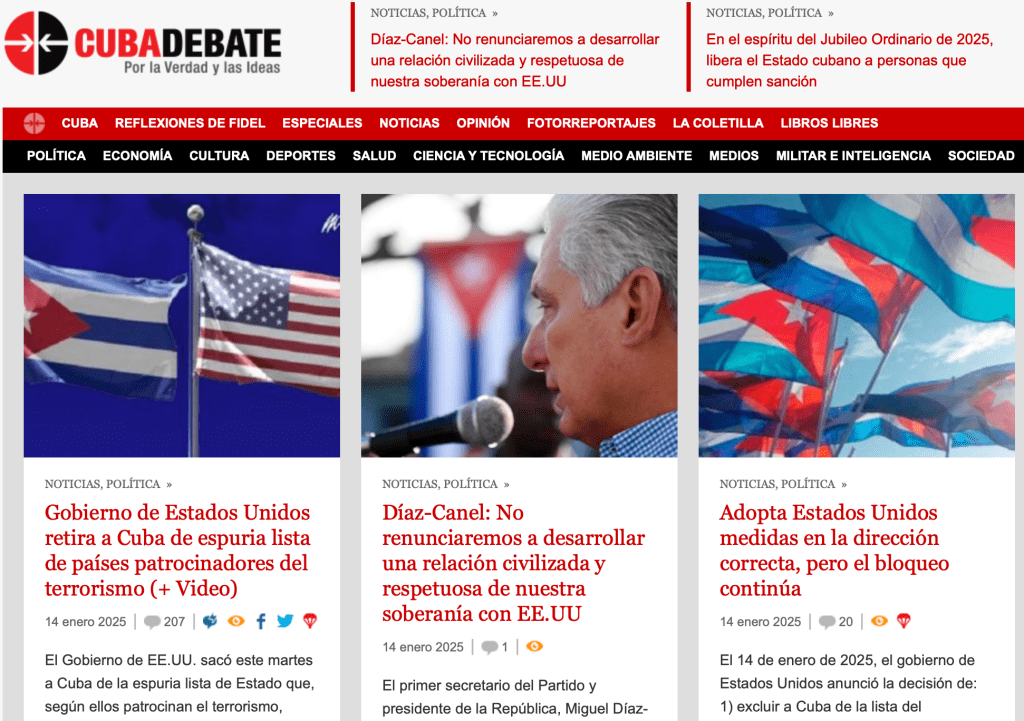
Left: Reuters coverage. Right: As reported by CubaDebate – “State Department recognises the lie, but does not remove Cuba from the list of state sponsors of terrorism.” President Miguel Diaz-Canel told interviewer Ignacio Ramonet that many of Cuba’s economic woes begin with the U.S. blockade, tightened in 2021 with “the inclusion of Cuba in a spurious list determined at will by the U.S. government of countries that supposedly support terrorism.”

Until this week, the administration of President Joe Biden had made only minor reforms—easing some restrictions on travel and family remittances in May 2022—but had scarcely budged from the harsh measures taken by his predecessor, Donald Trump, much less attaining Barack Obama’s level of engagement.

It was just days just before the end of Trump’s administration in January 2021 that Cuba was added to the list of “state sponsors of terrorism” (SST)—because Cuba was hosting peace talks between the Colombian government and one of the guerrilla armies, the Ejército de Liberación Nacional (ELN). Despite occasional setbacks, the Colombian peace process moves forward slowly.

Biden’s new move comes after three years of non-stop advocacy by churches and other non-governmental organizations to end the embargo and to have Cuba removed from the SST list.

Efforts by churches, unions and other groups are driven by a sharp deterioration of the Cuban economy that is partly a consequence of the SST and other measures as banks and other corporations fear running afoul of the U.S. measures. The economic downturn is also related to reduced tourist visits to the country during the Covid pandemic and Cuba’s abandonment of its former two-currency system (one tied to the U.S. dollar, and the other that effectively subsidized local transactions).

In April 2023, an informal alliance of more than 20 Canadian churches, trade unions, development agencies and community solidarity groups wrote to Foreign Affairs Minister Mélanie Joly and to then-International Development Minister Harjit Sajjan to express alarm at the “deterioration of the Cuban economy and consequent impacts on the Cuban people.”

They called on the government to press the United States to ease sanctions and to remove Cuba from the SST list. They also asked that Canada “scale up its efforts to provide immediate food, medicines, and medical supplies to Cuba” (whether directly with the Cuban state or via NGOs and multilateral organizations). 

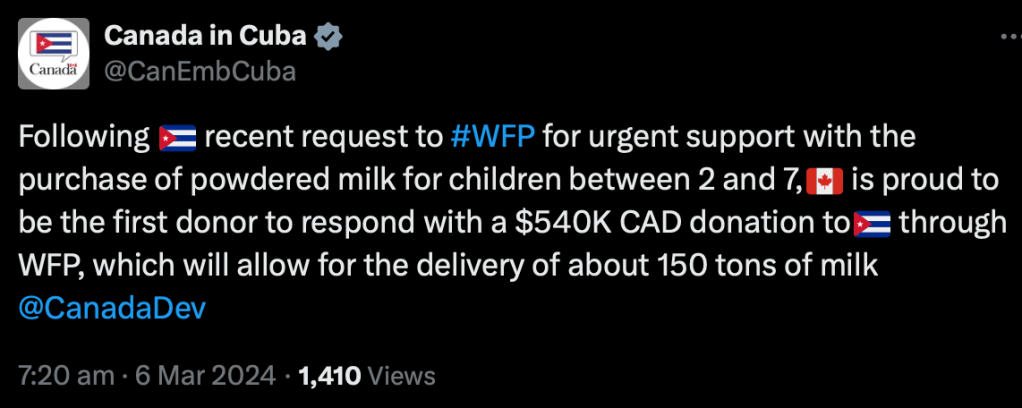
Canada has made some efforts, notably the announcement March 6 of a $540,000 contribution to the World Food Program to support provision of 150 tons of milk that will assist Cuban children. Canada’s response followed just two days after the Cuban government had made its first-ever request to WFP for food aid. Canada continues to fund the work of NGOs such as Oxfam and CARE Canada in Cuba.

The Canadian letter echoed earlier calls from Cuban and U.S. churches. In a joint letter sent Feb. 18, 2021, they asked Biden to to restore travel, remittances and trade with Cuba; to remove Cuba from the list of “state sponsors of terrorism;” to rescind Trump’s mandate to use extraterritorial provisions of the Helms-Burton law; and to rebuild U.S. diplomatic presence in Cuba. On March 13, 2023, more than 20 U.S. faith groups wrote to Biden to ask that Cuba be removed from the SST list.

The SST designation, along with Trump’s application of measures contained in the 1995 Helms-Burton Act, have extraterritorial impacts. Foreign-owned ships won’t dock in Cuba and foreign banks are reluctant to transfer funds for fear of running afoul of the U.S. laws. To understand better the impact of the SST in Cuba, please read a long report by the Washington Office on Latin America (WOLA).

The extraterritorial features of the Helms-Burton law provoked anger in Canada and Europe, but those features were effectively waived by Presidents Clinton, Bush and Obama. In April 2019, Trump revived them. Canada repeated its objection, and reminded Canadians that amendments in 1996 to Canada’s Foreign Extraterritorial Measures Act (FEMA) stipulate that any judgment issued under Helms-Burton “shall neither be recognized nor enforceable in any manner in Canada.”

But Canada, to my knowledge, has yet to say anything publicly about the SST list.

Meanwhile, churches, NGOs and solidarity groups continue to provide aid to Cuba, including in response to damage caused by Hurricane Ian in western Cuba in 2022 and after the oil storage facility fire in Matanzas in 2022. 

Vancouver-based CoDevelopment Canada is collecting material to send in a container to Cuban trade unions later this summer. 

The U.S. Cuba Normalization Coalition has a fact sheet about U.S.-backed attacks on Cuba. “Cuba has endured 64 years of a U.S. economic blockade.This intensified when President Trump unjustifiably put Cuba on a list of so-called State Sponsors of Terrorism (SSOT).President Biden has continued that listing. Companies worldwide that want to sell medicines or food to Cuba often can’t because their own bank refuses to accept Cuba’s payment under threat of enormous fines from the U.S.treasury for dealing with ‘terrorists’.”