Venezuelans head to the polls July 28 under shadow of sanctions

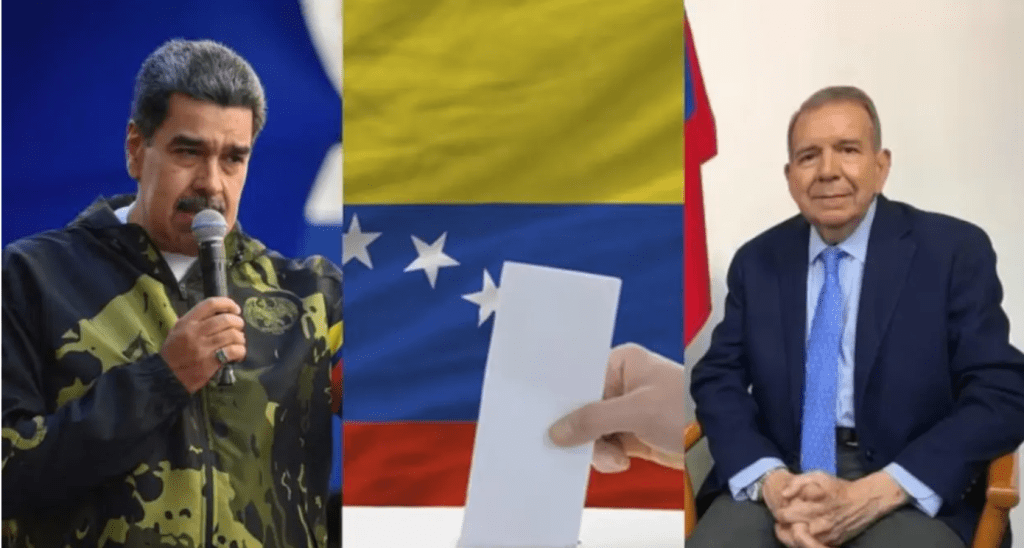
President Nicolás Maduro (left) is challenged by retired diplomat Edmundo González. (TeleSUR graphic)

by Jim Hodgson

Just over a week from now, Venezuelans will again head to the polls. For the election in 2018, I was there as an observer. This time, I’m watching with concern but from a distance as Venezuelans vote under the pressure of U.S., European and Canadian sanctions that have made living conditions worse for most people.

I got involved with Venezuela soon after the election of Hugo Chávez in December 1998. Those of us concerned about the expansion of corporate-driven “free trade” across the Americas had created the Hemispheric Social Alliance (HSA), a coalition of networks that included Common Frontiers Canada, the Mexican Action Network on Free Trade, Brazil’s Network for Peoples Integration and the U.S. Alliance for Responsible Trade.

At a meeting in Toronto in November 1999 with some of the region’s trade ministers, we found we had a new ally. Venezuela’s trade minister won applause when she said that concern for the rights of the poor needed to be central in trade talks and public policy.

The trade ministers, nevertheless, forged ahead with plans for a Free Trade Area of the Americas (FTAA).When their heads of government gathered in Quebec City in 2001, President Chávez was the one participant who refused to endorse the timetable for FTAA by 2005. By 2005, spurred by pressure from social movements, Chávez and other new leaders were able to defeat the FTAA.

Between 2004 and 2019, I visited Venezuela about a half-dozen times. I observed the 2004 recall referendum and the 2018 presidential election. With encouragement from faith-based organizations in Cuba and Colombia, I joined ecumenical encounters in 2004, 2006 and 2019, and attended the Americas Social Forum in Caracas in 2006.

Inside Venezuela, opposition to Chávez and to his successor Nicolás Maduro has been unrelenting. But their coup in 2002 failed. Their recall referendum in 2004 failed. Their attempt in 2019, in alliance with Canada’s then-foreign minister Chrystia Freeland and the “Lima Group,” to impose an interim head of a past national assembly, Juan Guaidó, as president failed—along with three coup attempts and then a botched invasion.

The May 2018 elections followed months of internationally-sponsored negotiations in the Dominican Republic between the government and opposition that, by February that year, achieved an agreement. But at the last minute, part of the opposition movement said no: other parties, notably that of Henri Falcón, did participate. Our Canadian delegation saw the May election as free and fair. Maduro won. I wrote about our experience in a series of articles for rabble.ca

After the vote, the pressure continued: the Lima Group’s Guaidó gambit; sanctions strengthened again in order to force regime change; and assets of the state oil company, PDVSA, and its U.S. subsidiary, CITGO, were blocked or seized, as were gold reserves held in London. Humanitarian aid became heavily politicized, even blocking access to vaccines during the Covid pandemic. In those circumstances, migration became a normal response. (International organizations set the number of Venezuelan who have left over the past dozen years above 7 million. The government says their figure is about 2.5 million and that of those, about 1.2 million returned between 2020 and 2023—almost half of them with government support.)
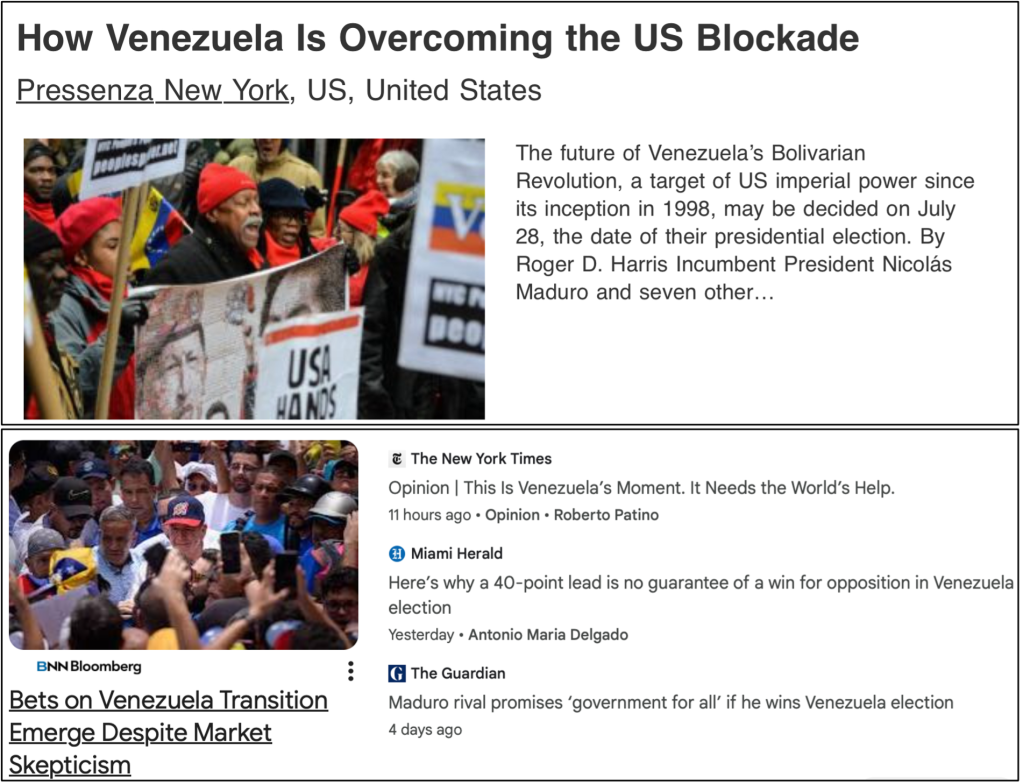
A deep dive into both mainstream media and alternative media (Pressenza, Orinoco Tribune, Venezuelanalysis, TeleSUR, among others, is necessary to get a reasonable sense of what is happening in this election. The far-right may reject official results, much as Trump did in the United States in 2020.

The July 28 vote

This election takes place while Venezuelans suffer under more than 930 “unilateral coercive measures”—sanctions—imposed by the United States, Canada and their European allies. “These should be elections without imperial sanctions,” argued the Mexican philosopher Fernando Buen Abad Domínguez recently. But that is not what is happening.

Early in 2023, UN High Commissioner for Human Rights Volker Türk said sanctions on Venezuela “have exacerbated the economic crisis and hindered human rights,” and called for the measures to be lifted. Türk visited Venezuela in January 2023. His comments reflected similar remarks made two years earlier by Alena Douhan, the UN special rapporteur on the negative impact of unilateral coercive measures on the enjoyment of human rights. She said that the Venezuelan “government’s revenue was reported to shrink by 99% with the country currently living on one per cent of its pre-sanctions income.”

Again this time, complex international negotiations unfolded to produce a basis for the election, finally established through the Barbados Accords. The document was signed in October 2023 by the Maduro government and an alliance of opposition parties known as the Unitary Platform.

The leading opposition candidate is retired diplomat Edmundo González. He is regarded as a stand-in for María Corina Machado whose candidacy was blocked because of her involvement in organizing violent street protests (sometimes called guarimbas) between 2014 and 2018, and for demanding sanctions. González and another far-right candidate, Enrique Márquez, refused to sign a declaration requested by the Electoral Authority promising they would respect the elections results and refrain from violence in its aftermath.

In the campaign, Maduro and his allies report a number of gains made over the past decade with regard to child care, medical attention, job-training and education. More recently, the inflation rate has dropped to 7.8 per cent, and that the GDP is up by seven per cent. The government has sought ways to diversify the resource-dependent economy and increase national production.

Throughout these 25 years, the government has expanded access to health care, education, housing, public transit, food and pensions through misiones—popular campaigns that use oil revenue for public benefit. 

A recent example is the “Great Mission Return to the Homeland” (Vuelta a la Patria). “We want to ensure that the vast majority of those who have not returned come here, with their family, with their friends,” said Maduro. Pointing to foreign sanctions as the principal cause of emigration, he added that it is his desire to “heal this wound” that the departure of millions of people caused , inviting them to return and to invest and enjoy their country.

It’s not that there are no legitimate criticisms to be made of the government. One might wish, for example, that much more had been done long ago to reduce criminal violence, advance LGBTQIA+ rights,* protect the country’s ecology, reduce dependence on oil revenue, and stimulate food production. If only such criticism could be made in an atmosphere of civil debate without threats to overthrow the government or to foment violence.

Since the 1970s in Latin America, the left in power has tried to govern according to the rules of liberal democracy, perhaps without sufficient regard for the roles of money, foreign interference and private media conglomerates. When the poor win power and actually have a shot at changing the rules of politics and economics—at transforming the structures that made them poor—what may they do to hold on? 

“It is not just any election. It is an election that defines the future,” said former vice-president Jorge Arreaza recently. In the face of strong external and internal opposition, Venezuelans sought to transform democracy so that they could continue re-inventing Latin American politics and economics in ways that benefit most people, not just the rich and not the corporations.

Will they have a chance to continue the effort? Or must they rebuild the social movements and networks necessary for a new attempt that may be decades away?

* Regarding LGBTQIA+ rights. In 2016, Venezuela’s Supreme Court declared that the state will provide protection without distinction to all families, including to children born into same-sex families. In the same year, Venezuela’s Public Ministry announced that transgender people may request a new identity card according to their gender identity.

Recent Pride celebrations are reported in the Orinoco Tribune, with some critical comments:

Venezuela is among the few countries in Latin America that have not legalized marriage equality and, unfortunately, a marriage equality bill has been languishing for nearly a decade in the Venezuelan National Assembly.

Recently, some Chavista politicians have been using socially conservative slogans that replicate US conservative approach towards the LGBTQ+ community and promoting so-called “family and traditional values” against what they call the “perversion” of “Western LGBTQ+ values.”

The ruling PSUV has failed to achieve adequate protections for the LGBTQ+ community which is both a failure of its responsibility to the nation and a national security vulnerability that is being exploited by the imperialists.

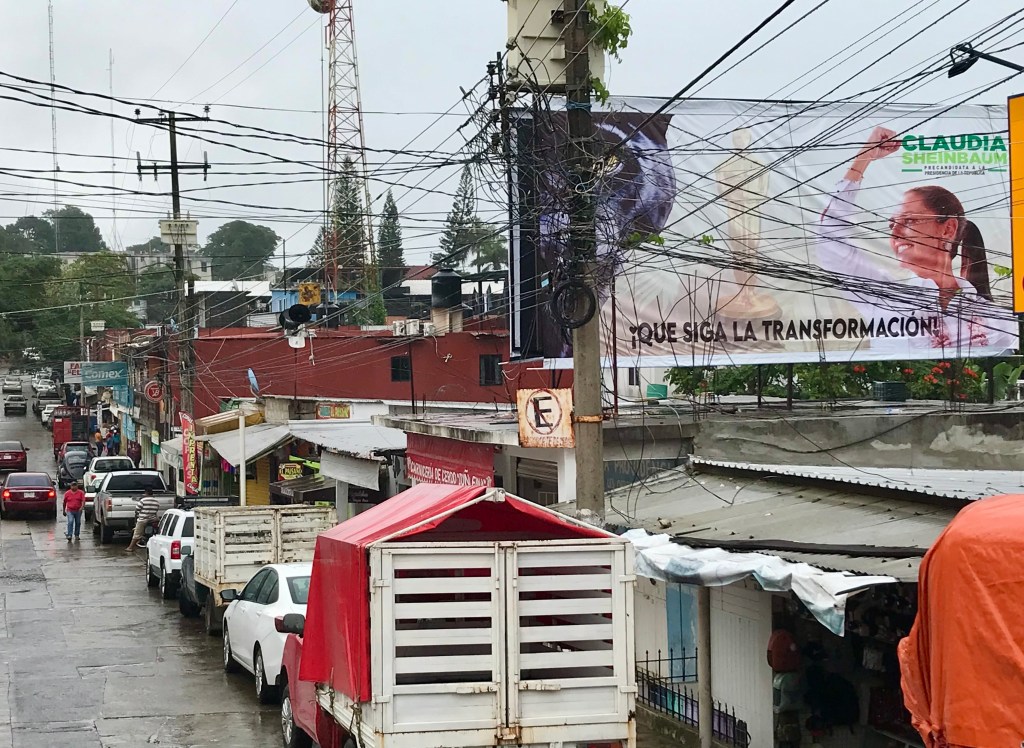
Mexico celebrates Presidenta Sheinbaum

by Jim Hodgson

For the first time, Mexicans have chosen a woman to be their president. She is Claudia Sheinbaum, 61, a climate scientist who previously served as mayor of Mexico City. 

“The transformation continues!” A campaign billboard promotes the campaign of Claudia Sheinbaum in the southern state of Chiapas. The slogan refers to the ‘Fourth Transformation‘ of Mexican political institutions and the economy begun by her predecessor, Andrés Manuel López Obrador.

That a woman is president is no minor detail. It was only in the middle of the last century that women in Mexico won the rights to vote and to run for public office. Even now, only 14 of 193 nations have women in power as presidents or prime ministers.

Sheinbaum can be expected to continue the generally progressive approaches taken by her predecessor, Andrés Manuel López Obrador (known as AMLO). Her leading opponent was businesswoman and former senator Xóchitl Gálvez, candidate of a centre-right coalition. 

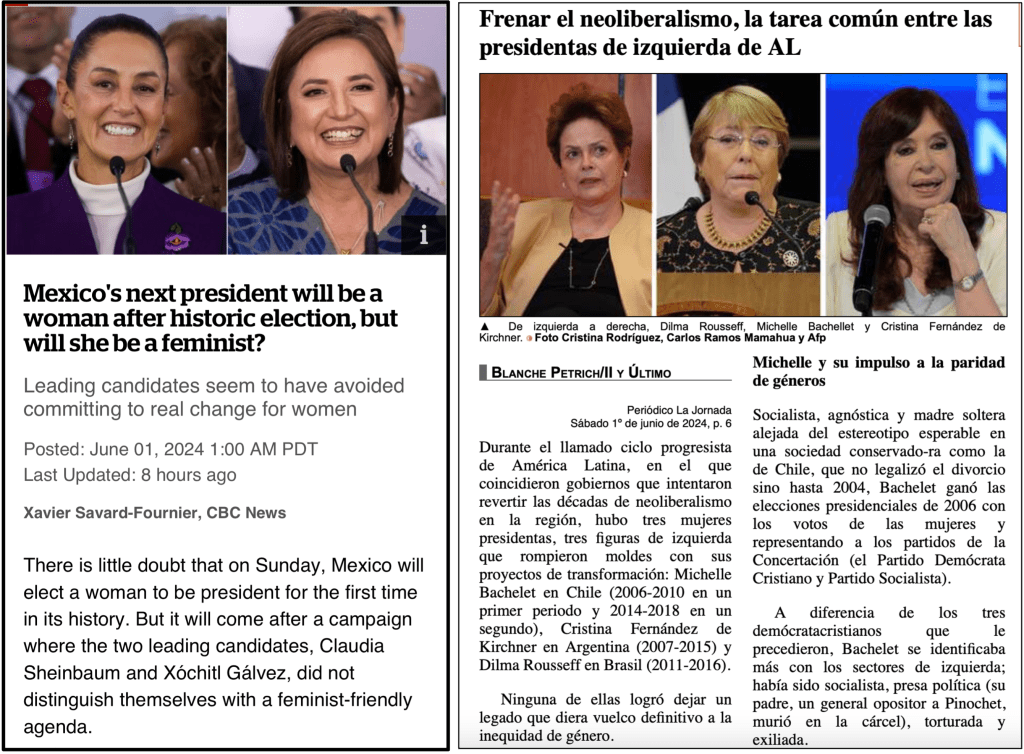
CBC News report days earlier said that neither Sheinbaum nor Gálvez actually committed themselves to “real change for women” on issues such as pay equity, reproductive rights, or violence against women. 

One of Mexico’s leading journalists, Blanche Petrich, wrote that three women (Michelle Bachelet in Chile, Cristina Fernández in Argentina, and Dilma Rousseff in Brazil) who were representative of the progressive “pink wave” governments in Latin America did not “leave a legacy that would definitively reverse gender inequality.” 

A CBC News report on the quality of feminism represented by Mexico’s two leading candidates, and Blanche Petrich’s review in La Jornada of past experiences of women as presidents in Latin America.

Bachelet, notes Petrich, once said: 

“What does it mean to be a woman in public office? Is it to be the same as a man, but with a skirt? No. When a woman arrives alone in politics, the woman changes. When many women arrive in politics, politics change. And clearly, one of the challenges and needs of our democracy is to improve the quality of politics.”

In the Mexican election, Sheinbaum and Gálvez tended to address issues of concern to women within a range of economic, social and criminal justice proposals. Framed this way, there were sharp differences between the two.

Sheinbaum will continue to give priority to social programs, pensions and scholarships that benefit the least advantaged, as well as concentrating on investment in infrastructure to support industries that create jobs. The approach by Gálvez was that of conservatives everywhere: keep taxes—and wages—low and let the market take care of the rest (though she did promise to maintain AMLO’s social programs).

At her victory celebration late Sunday night, Sheinbaum affirmed her movement’s commitment to democracy. “By conviction, we will never make an authoritarian or repressive government. We will also respect political, social, cultural and religious freedoms, and gender and sexual diversity.”

Regarding criminal justice issues (which media tend to subsume under the heading “security”), Mexico obviously has serious problems. At least 34 candidates were killed during the election period that included national as well as some state and municipal elections. 

There are still about 30,000 homicides per year, though the government says the number has been dropping by about five per cent per year. 

AMLO tried to turn back the violence unleashed by one of his predecessors. In 2006, then-President Felipe Calderón, with backing from the United States, launched a military-led offensive against the drug cartels to curb their violent turf wars. Instead, the violence became much worse. 

AMLO promoted an approach he called “abrazos no balazos”–hugs not bullets. It meant addressing the social roots of violence by giving people the education and other resources they need to avoid being drawn into the drug-trafficking cartels and their systems of power. Over the long term, the approach should lead to reduced levels of violence.

But it has been controversial and is subject to manipulation, even in mainstream media like The New York Times, and has led to threats of military intervention from various U.S. politicians, including the presumptive Republican nominee, Donald Trump. 

Even within the AMLO-Sheinbaum coalition, there is agitation. When Eduardo Ramírez–a former AMLO opponent who, like too many others, opportunistically shifted loyalties–celebrated his victory as governor of Chiapas Sunday night, he said: “There will be hugs, but no impunity.”

Haitian claim for slavery reparations at the heart of a UN forum

by Jim Hodgson

A United Nations forum on the historic wrongs committed against people of African descent is building momentum in favour of an international tribunal on atrocities dating back to the transatlantic trade of enslaved people.

When the UN Permanent Forum on People of African Descent (PFPAD) held its third session in less than two years in Geneva in mid-April, African and Caribbean governments together with civil society organizations pressed forward with plans to create a tribunal that would be similar to that which oversaw the Nuremberg trials of Nazi war criminals after World War II.

Proponents say such a tribunal would help establish legal norms for international and historical reparations claims.

Supporters include many members of the Caribbean Community (CARICOM), made up of 15 member states, and the African Union (AU), which includes 55 states—and Antonio Guterres, the UN General Secretary. “We call for reparatory justice frameworks, to help overcome generations of exclusion and discrimination,” he said March 25.

Supporters argue that Western countries and institutions that continue to benefit from the wealth slavery generated should be held accountable, particularly given ongoing legacies of racial discrimination. Opponents say that contemporary states and institutions should not be held responsible for historical slavery.

The World Council of Churches was among faith-based and civil society organizations that came together at the PFPAD forum to examine what states and other actors may do to redress the historic exploitation and harms that Africans and people of African descent have suffered. (You can learn more here about global ecumenical efforts to overcome racism, discrimination and xenophobia.)

Righting the wrongs in Haiti

Given that Haiti’s claim for reparations is among the strongest, the voices of Haitian civil society groups and their diaspora counterparts were heard at the PFPAD forum. 

Those groups used the forum to put a spotlight on the crucial role that Haiti played in the struggle to end slavery. “To recognize the historic context is essential to understand the unique position of Haiti in the global struggle for justice and egality,” they said in a statement before the forum. Participating groups—including the Montana Accord network and of the Haitian-American Foundation for Democracy (HAFFD)—said they strongly approve calls for reparations to Haiti.

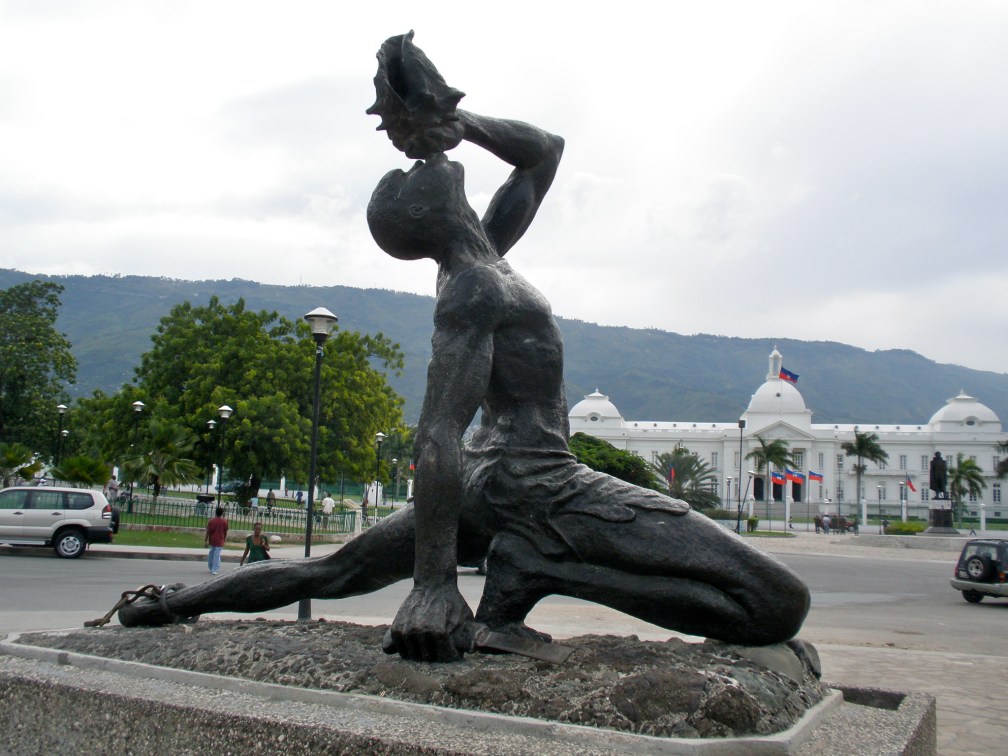
Le Marron Inconnu, and in the background, the National Palace before the 2010 earthquake.

Haiti was born as an independent nation in 1804 after the enslaved people revolted against their French colonial masters. The values of “liberté, égalité et fraternité,” expressed in the triumph of the French Revolution in 1789, resonated among slaves in Saint-Domingue, France’s richest colony. In 1804, the world’s first successful slave rebellion resulted in the birth of the Republic of Haiti. 

Beginning in 1825, France squeezed an “independence debt” from Haiti that adds up to at least $21 billion in today’s dollars. That estimate comes from The New York Times, but backers of the reparations claim say the amount is much higher.

“It’s $21 billion plus 200 years of interest that France has enjoyed so we’re talking more like $150 billion, $200 billion or more,” Jemima Pierre, professor of Global Race at the University of British Columbia, told Reuters.

Despite the obvious injustice of that debt, France continues to resist pressure to join in reparations. In August 2010, about 100 prominent academics, authors, and human rights activists signed on to an open letter to then-President Nicolas Sarkozy, arguing that the case for repayment was “morally, economically, and legally unassailable.” France dismissed the petition, pointing to its record of delivering other aid to Haiti and not addressing the legitimacy of the debt.

“What’s important is that it’s time that France recognises this and we move forward,” Haitian civil society activist Monique Clesca told Reuters. France, whose development agency has given hundreds of millions of dollars in aid to Haiti, has previously referred to a “moral debt” owed to Haiti.