
by Jim Hodgson
U.S. claims to have bombed a supposed “drug vessel” in the southern Caribbean were met with considerable scepticism and calls for action to stop an invasion.
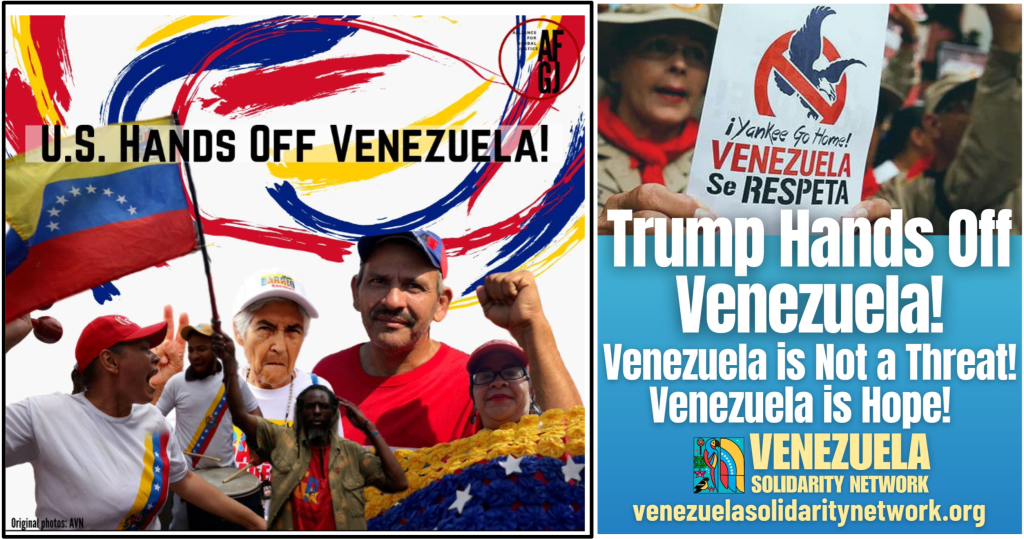
“Earlier this morning [Tuesday], on my Orders, U.S. Military Forces conducted a kinetic strike against positively identified Tren de Aragua Narcoterrorists in the SOUTHCOM area of responsibility,” President Donald Trump said in a Truth Social post. “The strike occurred while the terrorists were at sea in International waters transporting illegal narcotics, heading to the United States. The strike resulted in 11 terrorists killed in action.”
He added that TdA is a “foreign terrorist organization” that operates under the control of Nicolás Maduro, Venezuela’s president.

Neither Trump nor the video showed any proof that the boat was carrying drugs, nor that it came from Venezuela, nor that it had anything to do with TdA, much less that its destination was the United States. There is no indication of who the crew was. Why would 11 people be on a small boat that is supposedly carrying a large amount of drugs? Could they have been migrants? Human traffickers? It’s more common that such craft are stopped and searched. If anything is found, arrests follow. Not summary executions.
On social media, Venezuelan news outlet Venezuelanalysis speculated on how U.S. SOUTHCOM knew the small boat was carrying drugs without carrying out an inspection. On Monday, President Maduro said his country was at “maximum preparedness” and denounced the expanded U.S. military presence in the Caribbean as, “an extravagant, unjustifiable, immoral and absolutely criminal and bloody threat.”
In Colombia, President Gustavo Petro said he doubted the veracity of the U.S. claim. “We have spent decades capturing civilians who transport drugs without killing them.”
In Mexico, where Trump’s secretary of state Marco Rubio arrived Monday night, news of the attack was felt to be a warning to President Claudia Sheinbaum about methods the United States might use in its effort to dismantle Mexican cartels.

In March, Trump used the Tren de Aragua myth as a justification to justify the extraordinary rendition of young Venezuelan men to El Salvador. A New York Times article in April showed that Tren de Aragua is not invading the United States. Nor is it a “terrorist organization,” and to call such “criminal groups terrorist is always a stretch since they usually do not aim at changing government policy.” The article goes on to show that Tren de Aragua is not centrally organized, much less that it colludes with the Maduro government.
Maduro said in March that TdA “no longer exists; we defeated it.” The Venezuelans held in El Salvador were finally returned home in July.

This new chapter in Venezuela’s drama plays out in the context of historic U.S. refusal to accept the development in this hemisphere of a political and economic model other than the capitalist one. Since 1998, Venezuela has embarked upon a “Bolivarian Revolution” (named for Simon Bolivar, the hero of the 19thcentury independence struggle) and intended to break capitalist hegemony over every aspect of the lives of the people.
Since 2005, U.S. administrations have made the annual determination that Venezuela has “failed demonstrably to adhere to its obligations under international narcotics agreements.” A year later, the United States began applying sanctions (“unilateral coercive measures,” the UN calls them). These and other measures have been strengthened since 2015, eventually driving a severe economic crisis and exodus of millions of people who sought better opportunities elsewhere.
In this second Trump administration, some see incoherence. On the one hand, ongoing verbal threats and this military build-up. On the other, easing of sanctions to allow Chevron to import Venezuelan oil to the United States. Conjecture persists about the relative influence of corporations like Chevron that want back in, the south Florida Venezuelans and Cubans who are Rubio’s constituency, and the isolationist sector of the Trump-MAGA base that wants out of all foreign wars.
 Unwrapping Development
Thanks for this Jim.
LikeLiked by 1 person