
by Jim Hodgson
The claim by U.S. President Donald Trump that his forces attacked “a big facility” in Venezuela left me wondering if he was (again) flat-out lying, having another cognition meltdown, or maybe speaking some sort of truth.
In a radio interview Dec. 26, Trump said: “We just knocked out – I don’t know if you read or you saw – they have a big plant or big facility where they send the, you know, where the ships come from. Two nights ago, we knocked that out. So we hit them very hard.”
In Venezuela, officials reacted hesitantly. It turns out there was a fire earlier that day at a chemical warehouse run by a company called Primazol in Maracaibo, a major hub for the export of petroleum. But in Venezuela, the fire was treated as a minor event, and the company issued a statement rejecting “the versions circulating on social media,” stating that they “have no relation to the incident and it does not correspond to official or verified information.”
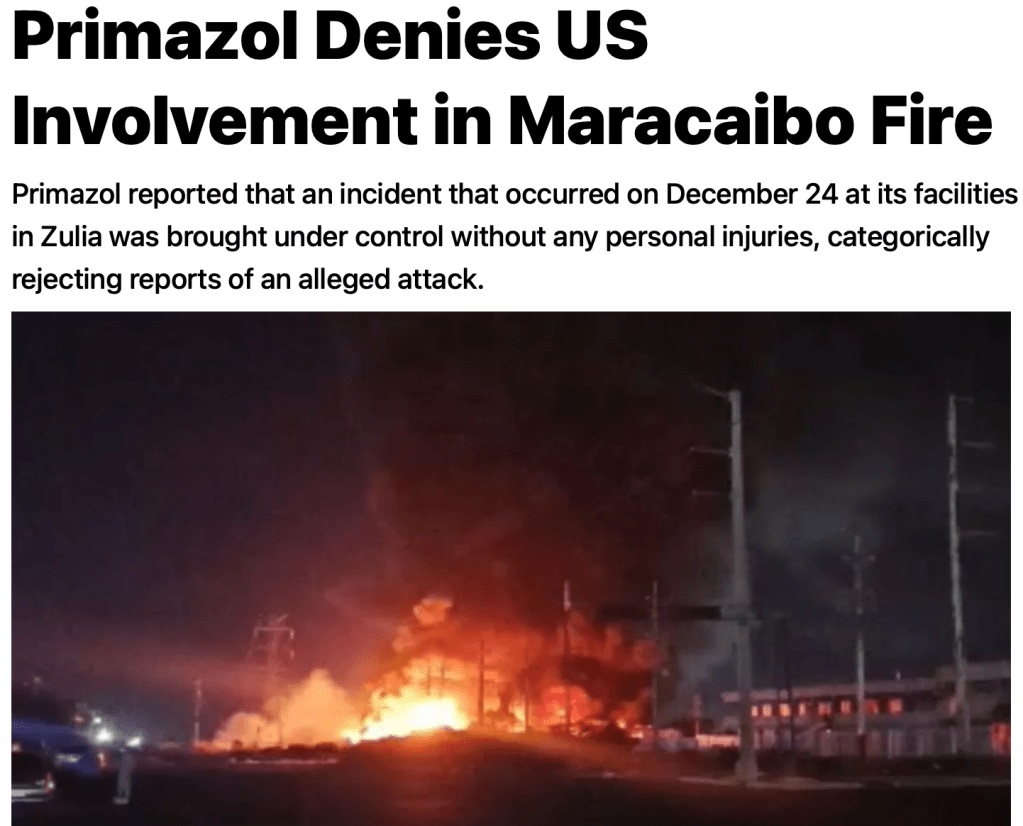
The Primazol plant is located five km from the sea, making it doubtful that there was any facility there from which boats carrying drugs could depart, much less a “dock,” as Trump claimed in a second set of comments at Mar-a-Lago Dec. 29. (“There was a major explosion in the dock area where they load the boats up with drugs.”)
Today’s New York Times morning newsletter quotes U.S. officials who may be trying to provide cover for their boss or offering a semi-truthful account:
A port strike
The C.I.A. [Central Intelligence Agency] conducted a drone strike on a port facility in Venezuela last week, people briefed on the operation said. The strike was on a dock where U.S. officials believe a Venezuelan gang was storing narcotics, and it did not kill anyone, they said. The strike is the first known American operation inside Venezuela.
This Times story offers new details on the strike, which President Trump has already discussed openly, despite the secrecy that typically surrounds C.I.A. operations.
The Trump administration has focused on three goals — to limit Nicolás Maduro’s power, to use military force against drug cartels and to secure access to Venezuela’s vast oil reserves for U.S. companies.
“We’ve had 27 weeks of imperial madness”
Venezuelan Interior Minister Diosdado Cabello denounced the silence of the international community, particularly the United Nations (UN) and other multilateral organizations, regarding the months-long offensive waged against his country by the United States government.
“We’ve had 27 weeks of imperial madness… harassment, threats, attacks, persecution, theft, piracy, murder, and the world – I mean the world, that UN and its cronies – is silent; nobody says a word,” he stated during the activation of a new security program in Aragua state.
He added that “imperialism, those who think they own the world,” not only intend to steal Venezuela’s natural resources, but “want to go further” and subjugate the Venezuelan people because “they don’t like dignified peoples who demand respect and respect themselves.”
Cabello, who highlighted the character of the Venezuelan people in the face of years of attacks of various kinds, offered assurance: “They are not going to ruin our Christmas or New Year, they cannot because of how many things we have endured, how many things they have tried against this people.”
On Monday afternoon, the U.S. Southern Command announced that it had struck another small boat in the eastern Pacific, killing two more men. The new strike means that the U.S. military has killed more than 100 individuals in an operation widely condemned as illegal.
Mexico’s president rejects interventions, call for greater UN leadership
Speaking at a news conference early on Dec. 30, President Claudia Sheinbaum said that the UN should play a more prominent role in these cases.
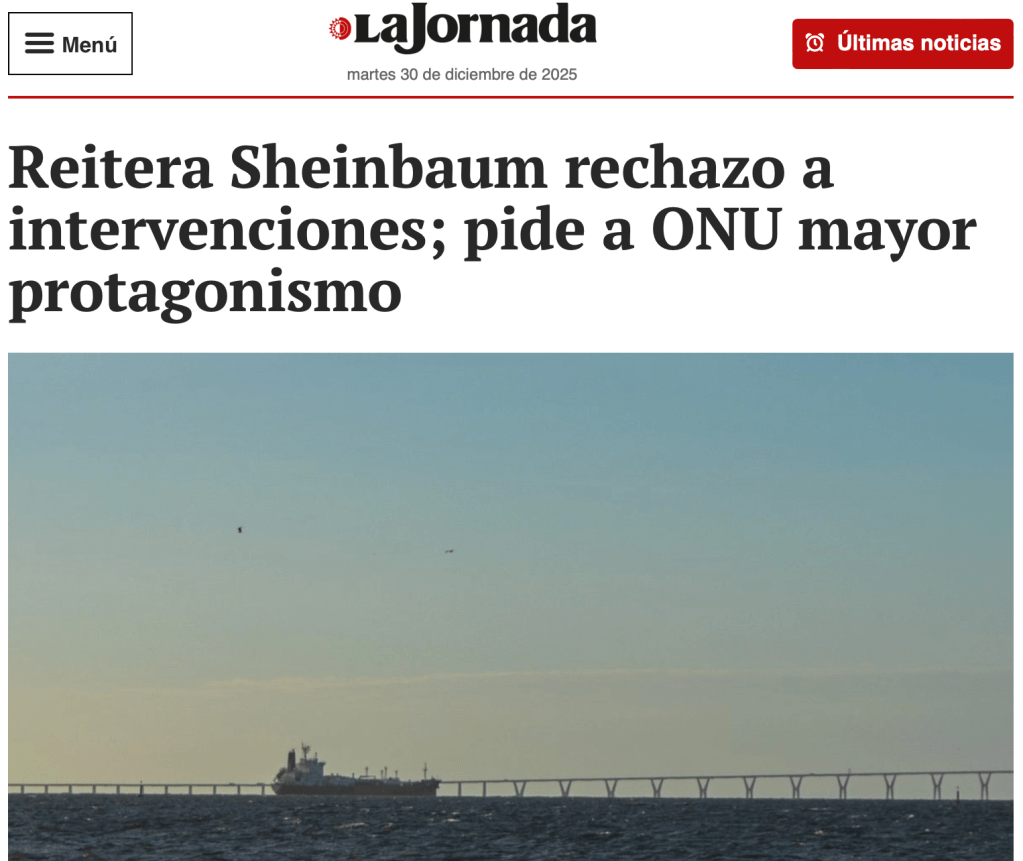
“What we have to say is that we do not agree with interventions, especially military ones. That is enshrined in our country’s constitution, and that is what we will continue to defend,” she said in response to a question about the case.
When asked if there should be a call in the region to support Venezuela, she replied, “Yes, and as we have said, the United Nations must take a more prominent role in these cases.”
Mexico and other countries backed Venezuela in a Dec. 23 meeting of the UN Security Council, but the United States used its veto power to block a Venezuelan resolution from even coming to a vote.
Diverse parts of the UN Office of the High Commissioner for Human Rights (OHCHR) are responding to the situations facing Venezuela in different ways.
On Dec. 24, several UN experts (“special rapporteurs”) denounced the partial maritime blockade imposed by the United States on Venezuela as violating fundamental rules of international law. The same day, Venezuelan Foreign Minister Yván Gil welcomed the statement: “The truth about Venezuela is breaking through around the world.”
Meanwhile, the OHCHR has announced a new “fact-finding” mission to Venezuela that will include Alex Neve, former secretary general of Amnesty International Canada.
And Canada?
Silence from Ottawa regarding U.S. aggression towards Venezuela has been resounding – even in the face of reports that Canada helps the United States in those boat attacks. It’s clear that the government of Prime Minister Mark Carney is choosing its words carefully in the face of U.S. threats to Canada’s sovereignty.
But Canada should at least uphold the 2014 declaration by Latin America and Caribbean countries that their region is a “zone of peace,” support calls for UN leadership in peace-making, and reject the new U.S. National Security Strategy.
 Unwrapping Development