
Let’s be clear. The U.S. kidnapping of President Nicolás Maduro and his wife Celia Flores today has nothing to do with debates over the quality of Venezuelan democracy or about drug-trafficking. Like Iraq more than 20 years ago, this intervention has everything to do with oil.
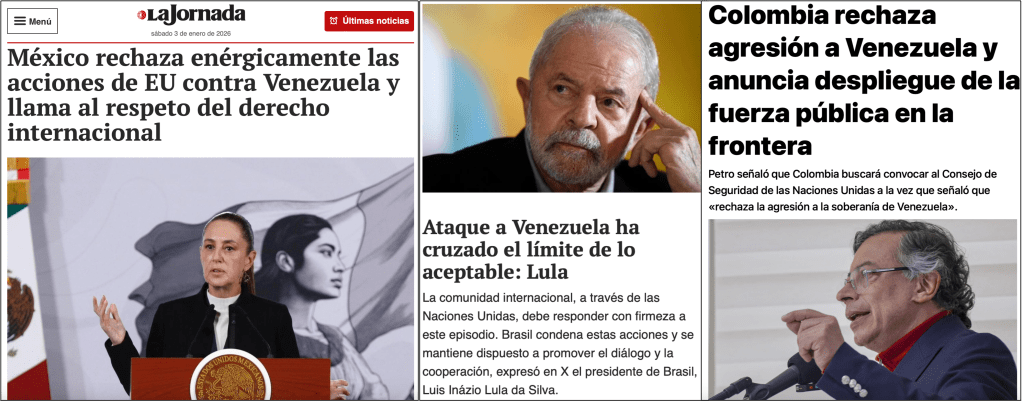
As responsible Latin American leaders are pointing out today, the U.S. assault on Venezuela is illegal. Mexican President Claudia Sheinbaum pointed to Article 2(4) of the United Nations Charter: “Members must refrain from threatening or using force against another state’s territory or independence.”
But the rules-based international order has been under attack for years, even by those who purport to uphold it. U.K. journalist Owen Jones writes today that the invasion of Iraq in 2003 helped normalize aggression, including Putin’s invasion of Ukraine and the on-going Israeli occupation of Palestine and genocide in Gaza. U.S. journalist Chris Hedges writes that the kidnapping of President Maduro shows “America is a gangster state.”
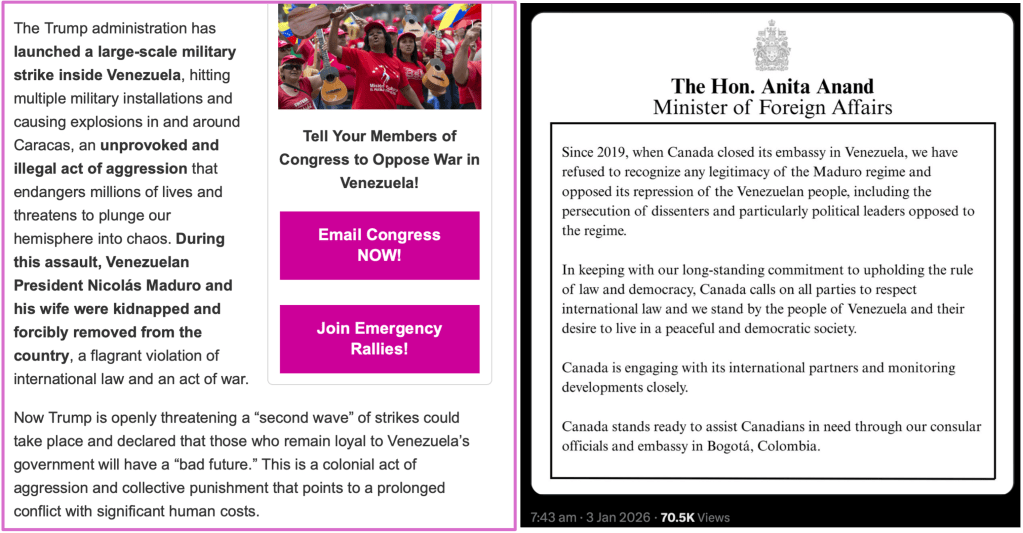
Other responses:
- The World Council of Churches condemned the U.S. attack.
- UN Secretary General ‘deeply alarmed’ and says attacks ‘sets a dangerous precedent,’ calls for international law to be respected.
- Cuba has condemned the action.
- Chilean President Gabriel Boric expressed concern and condemnation calls for respect for international law, non-intervention and respect for territorial integrity.
In his news conference today, Trump said, “We will run the country,” and: “We will stay until such time as a proper transition can take place.” Venezuelans may have other plans.
Perhaps you are following these events in mainstream media. You might also look at Latin America-based alternatives that have English-language sites. Among them:
Orinoco Tribune is an independent media outlet that provides news and analysis on Venezuela, Latin America and the Global South. It was founded in 2018 and is known for its progressive perspective and critical coverage of US foreign policy and imperialism.
Prensa Latina is a Havana-based news service.
TeleSUR is a Caracas-based television station viewed in many Latin American countries. It’s English-language service is here.
 Unwrapping Development
3 thoughts on “New intervention: U.S. seizes Venezuelan president, goes for the oil”