
by Jim Hodgson
You may have seen headlines about Salvadoran soldiers who died fighting gangs in Haiti. You may wonder why they were even there. You may have gone deeper and learned that the 2,500 soldiers deployed to Haiti last month are not there under UN authority, but rather because of a bilateral deal between the governments of Haiti and El Salvador.
An Argentinean journalist, Bruno Sgarzini, last week offered an answer to this and related questions. He points to Damián Merlo, a lobbyist for the Latin American and U.S. far-right who has emerged as a key link between the Trump administration and right-wing governments in Latin America.
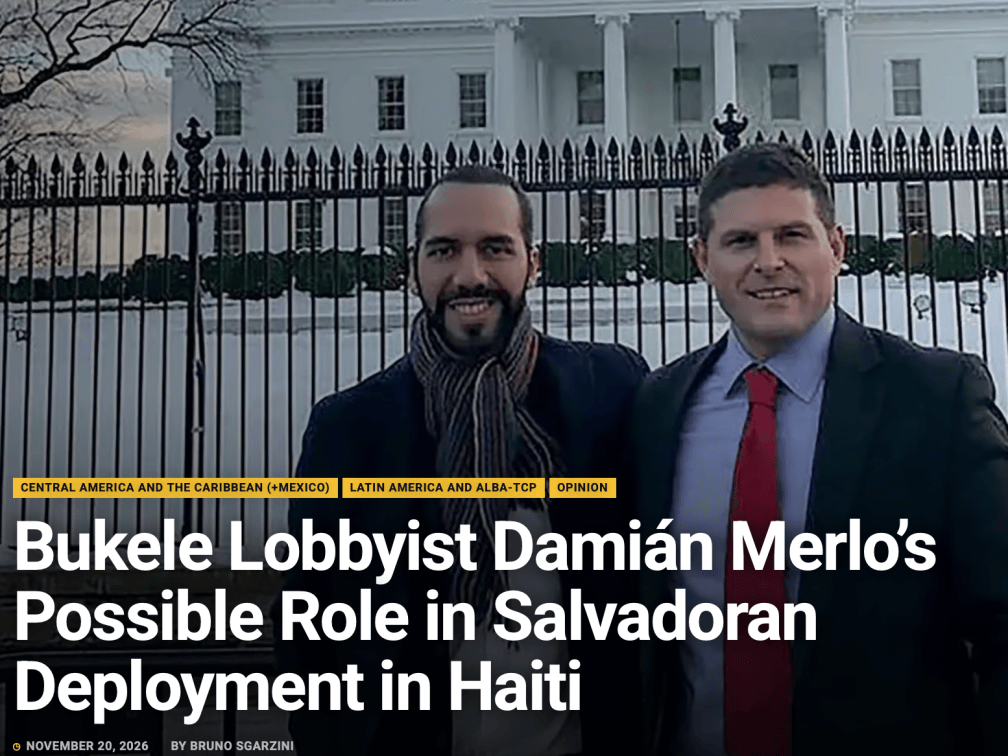
“One of his most fruitful relationships is the one he has built between the president of El Salvador, Nayib Bukele, and the MAGA world,” Sgarzini wrote in Diario Red. His article was translated and published in English by Orinoco Tribune.
After serving Republican luminaries (Otto Reich, John McCain) in various roles, he became a special assistant to former Haiti’s former president, Michel Martelly. Martelly (a former pop star known as “Sweet Mickey”) was elected after then-U.S. secretary of state Hillary Clinton pressed to alter the result of the first round of Haiti’s 2011 presidential election, vaulting Martelly into the second round, which he won. (She stops just shy of admitting the extent of her intervention in her memoir, Hard Choices (2014), pp. 542-43).
Merlo later worked for Martelly’s successor, Jovenel Moïse (assassinated in 2021), serving as a link into the administrations of Barack Obama and Donald Trump. Merlo also represented the Haitian government that succeeded Moïse after his assassination that was led until 2024 by Prime Minister Ariel Henry.
As Sgarzini points out, these relationships become more relevant when “Merlo’s work in Haiti is combined with the lobbying that he is doing for Bukele, in charge of a Salvadoran military deployment in Haiti to ‘fight against gangs.’” He cites records submitted to U.S. authorities under the Foreign Agents Registration Act that show his connections to El Salvador and Haiti.
Unilateral interventions vs cooperation
Two academics writing in Le Monde Diplomatique Brasil, Alberto Maresca and Gabriel Dib Daud De Vuono, point to El Salvador’s intervention in Haiti as an example of issues in Latin America that are “are increasingly being addressed through unilateral, military-style measures that appear to emulate the model proposed by Washington.” Their article was translated to English and shared by Panamerican Dispatch.
They call for overcoming political division to re-assert regional ways of working in areas where cooperation can be beneficial “such as infrastructure, public health, human mobility, energy, environmental protection, or disaster response.”
In the case of Haiti, they suggest, a regional approach might be based on “fundamental principles,” including: “support for Haitian institutions, a clear and verifiable mandate, the protection of the civilian population, and regional and international oversight.”
Yes. But many of us have been pressing for those principles and others like them for many years now.
For about a year after the 2010 earthquake, it felt to me that the Haitian government (still led then by President René Préval), the key foreign governments at the time (United States, France, Canada, Brazil, Cuba and Venezuela), and at least the larger non-governmental organizations were working (not quite together) in a cluster system. People working on health issues gathered regularly in a cluster. Ditto for education, agriculture, housing and other fields. It felt to me that the cluster system was a good way to rebuild capacity in Haitian institutions, especially the government ministries.
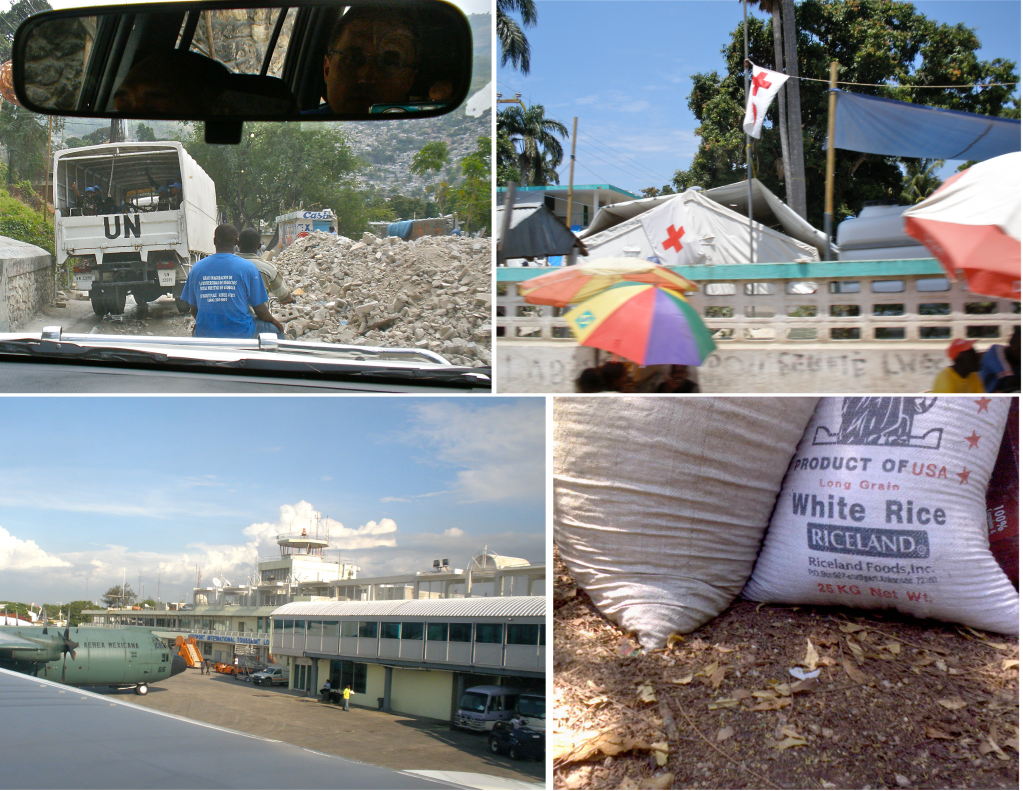
By the end of the year, the Interim Haiti Recovery Commission (known as CIRH) – the entity co-chaired by former U.S. President Bill Clinton and Haiti’s then prime minister, Jean-Max Bellerive – a cousin of Martelly), was asserting a different approach.* It sought to approve all project proposals, even the ones managed by NGOs with Haitian partners. Garment factories, assembly plants and call centres were viewed as engines of growth. Agriculture was set aside as not viable because of over-population and soil degradation, even though it was the largest sector of activity. The earthquake provided the opportunity to apply “shock doctrine” economic prescriptions such as those outlined and criticized in Naomi Klein’s well-known book. The state was weaker than ever.
All that was missing was a compliant president: hence Hillary Clinton’s backing of Martelly in the election described above. All that followed: Moïse, Henry, the transitional council (CPT) from 2024 to earlier this year, and now a prime minister, Alix Didier Fils-Aimé, accountable to no-one but his foreign backers.
Meanwhile, the United Nations procession of underfunded and understaffed security forces has evolved now into the Gang Suppression Force (FRG, or sometimes GSF in English), with all the same problems: not enough money or personnel.
Described as a lobbyist for El Salvador’s government, Merlo was cited Nov. 3 by the AP news service saying that the Salvadorans are “closely coordinating” with the FRG and with the office of Fils-Aimé.
Sgarzini’s article concluded:
“While the deployment of these soldiers is not part of the UN mission, it could serve Bukele to export his model of fighting gangs and turn his military into mercenaries for the highest bidder….
“This time, the objective is clear: to expand Bukele’s influence at the regional level and turn El Salvador into a reservoir of military personnel for the Trump administration’s war initiatives in Latin America, without going through the U.S. Congress or media criticism.”
NEXT (within a few days): What do Haitians make of all this?
* There are several good analyses of the roles of the Clintons and their enablers during the years just before and after the earthquake:
- Jonathan M. Katz was an Associated Press reporter in Haiti at the time of the earthquake and is the author of The Big Truck That Went By: How the World Came to Save Haiti and Left Behind a Disaster, St. Martin’s/Macmillan, 2013.
- Mark Weisbrot and Jake Johnston of the Center for Economic Policy and Research wrote many articles on the 2010-11 elections and subsequent events in The Guardian and elsewhere.
- See also: Jacob Kushner, “Haiti and the failed promise of US aid,” The Guardian, October 11, 2019.
- There are several insider accounts, notably those of Ricardo Seitenfus, a Brazilian academic who was the OAS representative to Haiti from 2009 to 2011. See, among others: “Hillary Clinton and Electoral Coup in Haiti,” Common Dreams, April 11, 2016: https://www.commondreams.org/views/2016/04/11/hillary-clinton-and-electoral-coup-haiti, and “Pourquoi la CIRH a échoué?“ AyiboPost, January 6, 2020: https://ayibopost.com/pourquoi-la-cirh-a-echoue-analyses-de-ricardo-seitenfus/.

