On murder and a birthday cake: Reflections on Colombia’s search for peace with justice

In human rights work, one’s first duty is to those who are harmed. But once in a while, one of the murderers says something that seizes attention as it reveals again the full banality of evil.

On July 19 in northern Colombia, the former professional solider Álex José Mercado asked forgiveness from a young woman for the murder of her father, saying: “The day that he was turned over to me (for killing), he had gone out to get a cake for your birthday.” In another moment, he said that he was not worthy to ask forgiveness from family members, but could only ask for pardon from God. “I lent myself to murder innocent people,” he said. He was 19 at the time at the time of his crimes.

This occurred during a hearing in Valledupar of Colombia’s Special Jurisdiction for Peace (referred to in Spanish as JEP). It’s the transitional tribunal that was set up to prosecute the perpetrators of crimes committed during six decades of armed conflict between the FARC-EP guerrilla fighters and the Colombian state. This hearing focused on the  falsos positivos, the false positives, that occurred just in the northern departments of Cesar and Guajira. In the country as a whole, Colombia’s armed forces kidnapped more than 6,000 young men, murdered them, dressed them as guerrillas, and then tried to pass them off “successes” in its war on “terrorism.”

Others spoke for the victims: 
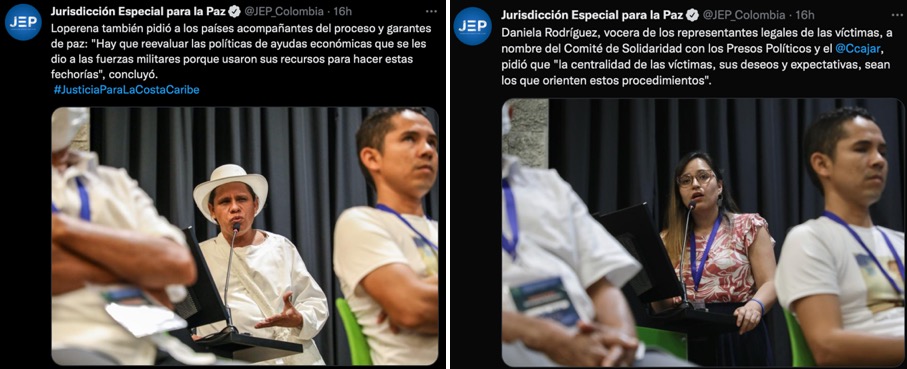
Left: Pedro Loperena, representing the Wiwa Indigenous people, said: “The economic aid policies of those who gave funds to the military forces must also be re-evaluated, because those resources were used to carry out these misdeeds.” Right: Daniela Rodríguez, spokesperson for the legal representatives of the victims and in the name of the Political Prisoners Solidarity Committee and the José Alvear Restrepo Lawyers’ Collective (CCAJAR), asked that the “centrality of the victims, their desires and expectations, be drives these proceedings.”

When he spoke about aid to the Colombian military, Loperena was polite and understated the problem:

This chart from U.S. civil society organizations shows more than two decades of U.S. aid to Colombia.

Over decades, the U.S. and Colombian governments have successively painted the war as: first, a war against communism; then, a war against drugs; and now, a war against terrorism. But the war in Colombia had its roots in the same struggle that has gone on in Latin America since the time of the European Conquest: the struggle by small farmers, Indigenous people and urban workers for land, social justice and basic human rights.

In the face of a peace process that has had limited support (and sometimes overt opposition) from the Colombian state, headed these past four years by Ivan Duque, that these tribunals continue to function is a triumph

One of the hardest parts of achieving a peace agreement between the Colombian state and the FARC guerrillas was to find language about how to manage crimes committed by state and non-state actors during the conflict. The two sides began negotiating in Havana in November 2012. The agreement on transitional justice and reparations was achieved in 2015 and the full peace accord signed in December 2016. The former adversaries agreed to a form of transitional justice, creating special tribunals to judge crimes committed by both members of the FARC and by state agents. 

It is not an amnesty, despite former president Álvaro Uribe’s characterization of the accord. In fact, that was what was avoided. Under international law that has come into force since the South African transition from apartheid to democracy in 1994, a full amnesty would not be legal. 
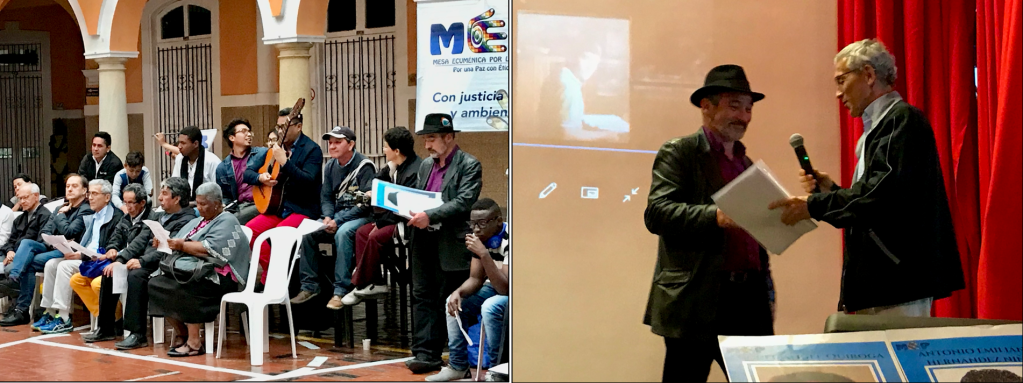
In November 2019, the Mesa Ecuménica por la Paz (Ecumenical Table for Peace) presented its report, “Blood of Martyrs, Seeds of Liberation,” to the chair of Colombia’s Truth Commission, Fr. Francisco de Roux SJ. In presenting the report, Omar Fernández acknowledged that it was not possible to encompass all of the many Christian martyrs of this long war: the team focused on those whose pastoral work represented the Church of the Poor.

Another triumph in recent weeks is the publication June 28 of the report of Colombia’s Truth Commission. Speaking July 14 to the United Nations Security Council, commission president Fr. Francisco de Roux said  that Colombia has demonstrated that those wounded by war can come together to build peace, happiness and “produce a tomorrow where there is hope”.  Over the last four years, the Commission has heard from more than 30,000 individuals and bodies and reviewed over 1,000 reports from victimized communities. He urged  the international community to give Colombia “nothing for war.”

Top of the list of recent triumphs is, of course, is the election of a new president, Gustavo Petro, and vice-president, Francia Márquez. Like the truth commission, Petro has criticized the U.S.-led war on drugs. The truth commission has urged Petro to lead a global conversation on changing drug policies, with a focus on regulation over criminalization.

Petro and Márquez will take office on Aug. 7, and already there is talk of capital flight – in effect, a boycott of Colombia by rich investors, including Colombians who already have one foot in Miami. The road ahead – ending the alliances of military forces with paramilitary death squads and drug-traffickers, ending the practice of assassinating leaders of social movements (at least 145 in 2021), protecting rain forests and reducing the grotesque gaps between wealth and poverty – will be difficult as evidenced by this long (and nevertheless incomplete) list of U.S.-sponsored coups and invasions launched against left leaders in Latin America. 
In Colombia, those who believe in peace with justice rejoice

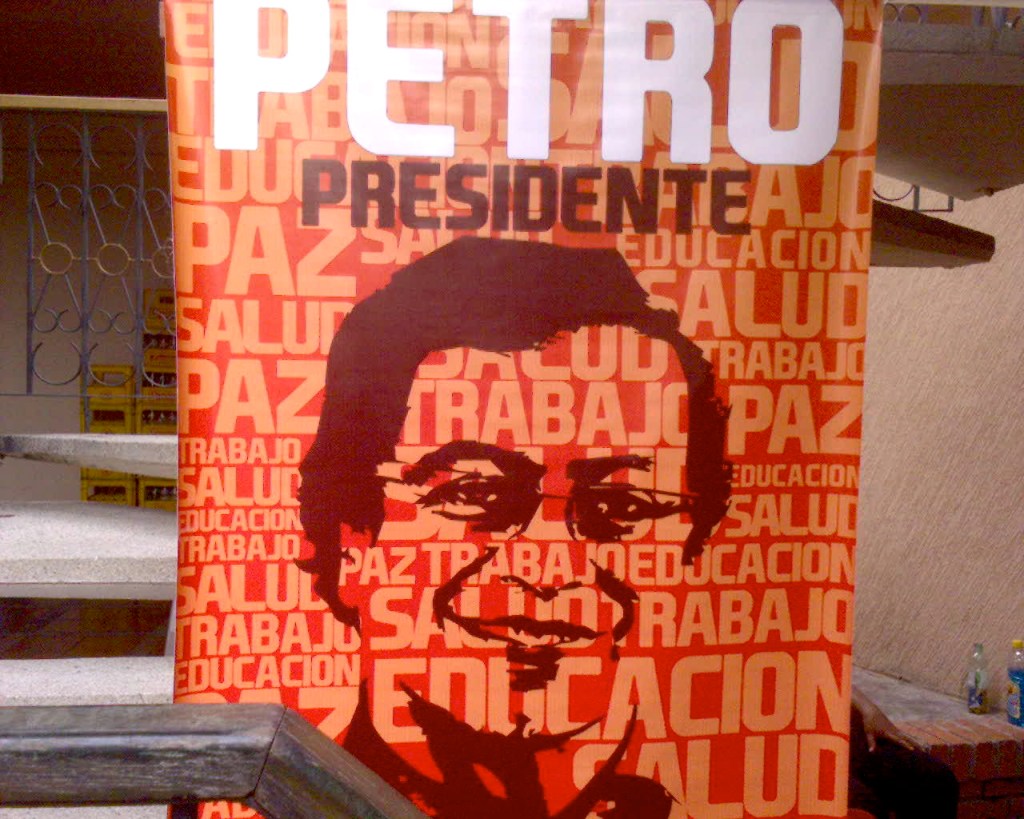
A Gustavo Petro campaign poster from 2010.

On a winter evening about 20 years ago – I am sorry that I cannot be more precise – Bill Fairbairn and I met in Toronto with a Colombian congressman and one of his aides. Bill worked for the Inter-Church Committee on Human Rights in Latin America (ICCHRLA), and I served on its board. And I can’t remember if this meeting was before or after mid-2001 when the work of ICCHRLA was folded (partially) into KAIROS. We were in what I think we used to call the Blue Room of Deer Park United Church in Toronto where the offices of ICCHRLA and later KAIROS were located.

I do remember the congressman, Gustavo Petro, and his earnest search for international allies in the struggle to end Colombia’s civil war and to obtain a measure of social justice to the oppressed majority.

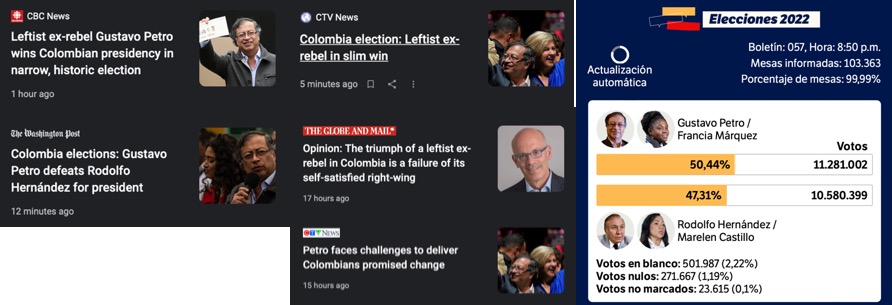
Two decades later, Petro is weeks away from being sworn in as Colombia’s first president from a party of the left. His victory results from the mobilization of young and new voters from parts of Colombia that are always ignored, especially the Caribbean and Pacific coasts. 

Celebrating victory (left); voters from the margins propelled Petro to power.

A large measure of credit goes to his running mate, the environmental activist and lawyer Francia Márquez, 40. She will become the country’s first Afro-Colombian to hold executive office. This election was the first time voter turnout topped 60 per cent, according to the International Institute for Democracy and Electoral Assistance (IDEA).

I met Petro again in August 2004 in Caracas, Venezuela. We were staying in the same hotel and both of us were observers of a referendum that opponents hoped would remove President Hugo Chávez from power. During Petro’s three campaigns to become president, along with his congressional and senate races, and the 2011 drive that made him mayor of Bogotá, right-wing politicians tagged him as castrochavista (as if that were a bad thing). They decried his youthful involvement in the M-19 guerrillas. They had made peace with the government in 1990. Petro, unlike many former fighters who laid down their weapons, survived the waves of selective assassinations that sought to eliminate them from political life.

Victory this past Sunday by Gustavo Petro, 62, in Colombia’s presidential election offers hope for reviving a peace process stalled these past four years by President Iván Duque, protegé of former president Álvaro Uribe – the fiercest guardian of the ways that things have always been done by those with power in Colombia.

Petro defeated Rodolfo Hernández, a millionaire conservative who was frequently compared to Donald Trump.

This election (like recent ones in Chile, Honduras and Peru) is also firm rejection of Canadian and U.S. foreign policy that for the past 20 years has paid lip service to the search for peace, but always protected the interests of those who control land and natural resources. Before Conservative Prime Minister Stephen Harper won his majority in Parliament in 2011, Canada negotiated a free trade agreement with Colombia that as a sop to the Liberal party contained a mechanism for a toothless human rights impact assessment. Colombia was also the key regional ally in setting up the “Lima Group,” the attempt by Washington and Ottawa to isolate Venezuela when most members of the Organization of American States refused to play along.

After the victories by Hugo Chávez in December 1998 in Venezuela and Luiz Inácio (Lula) da Silva in Brazil in 2002, some of us starting talking about a “pink tide” sweeping across Latin America (forgetting perhaps that tides also recede). Now the tide is back, this time stronger than before. In Brazil, Lula is again leading the polls in anticipation of the election later this year.

The road ahead for Petro will be difficult, just as it has been for Pedro Castillo in Peru since his victory a year ago. The opposition will set traps and take advantage of every misstep. In this third attempt to win power, Petro proposed pension, tax, health and agricultural reforms. He would change how Colombia fights drug cartels and start new talks with remaining guerrilla fighters. But his coalition has only about 15 per cent of the seats in Congress, which will force him to make deals, limit some reforms or abandon others. Parts of the U.S. government (military and intelligence agencies) will not be friendly, and Canada (because of influence by resource-extraction companies) may not be either.

When elites see their wealth threatened, they move heaven and earth

On Nov. 11, 1979, San Salvador’s Archbishop Oscar Romero preached on Mark 12:38-44, The Widow’s Offering: Jesus watched the crowd putting money into the treasury. Many rich people put in large sums. A poor widow came and put in two small copper coins, which are worth a penny. Then he called his disciples and said to them, “Truly I tell you, this poor widow has put in more than all those who are contributing to the treasury. For all of them have contributed out of their abundance; but she out of her poverty has put in everything she had, all she had to live on.” 

Colombia’s president sends more troops to Cali to try to quell a month of protests. The British magazine The Economist invites a resurgence of U.S. imperialism to thwart the Mexican president’s option for the poor. The six-decade-long U.S. blockade of Cuba is so severe that the country cannot obtain sufficient syringes to protect its population with the vaccines it has developed.

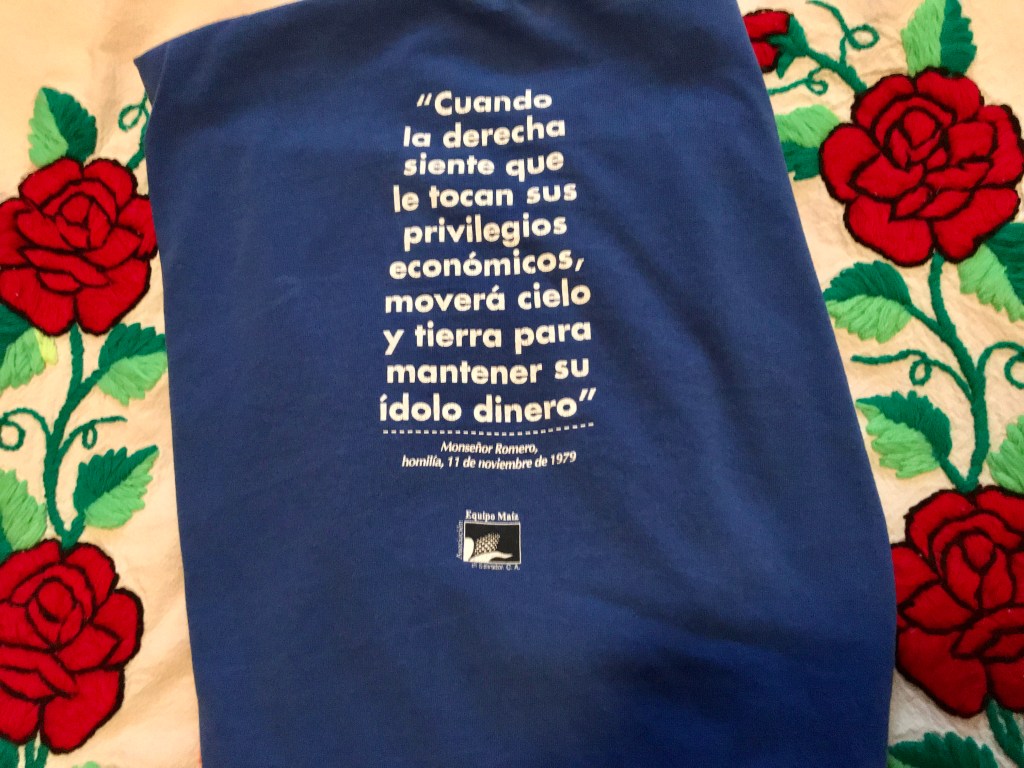
And I think of the words of St. Oscar Romero on Nov. 11, 1979, when he offered a warning about money when it becomes an idol:

It’s natural that when the right feels that their economic privileges are being threatened, they will move heaven and earth in order to maintain their idol of wealth.

Next Sunday, June 6, Mexicans and Peruvians head to the polls. In Mexico, these mid-term elections—the national legislature and many state and local races—are marred by violence: at least 35 candidates of various parties have been murdered. In Peru, it’s the second round of voting to elect a new president: from the left, Pedro Castillo stands a reasonable chance of defeating Keiko Fujimori, despite her powerful, rich supporters.

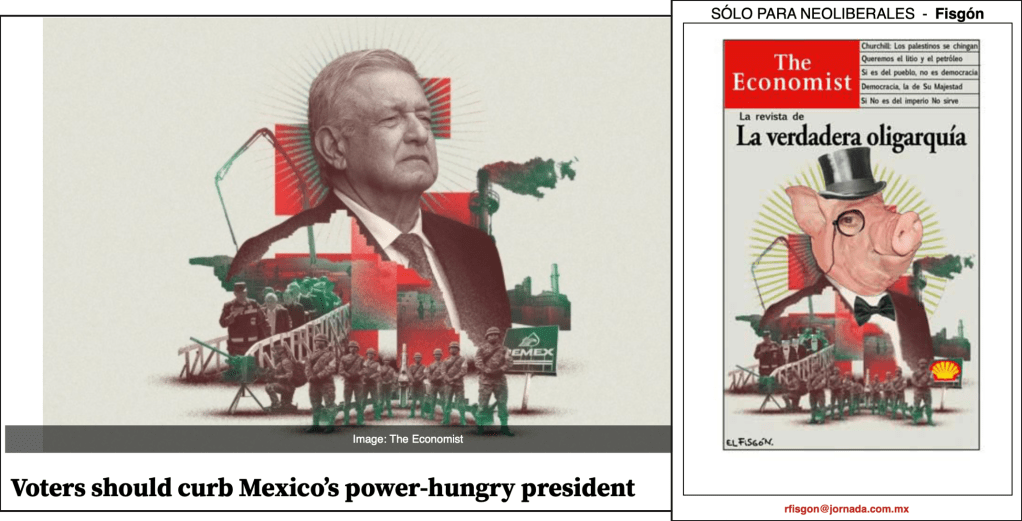
The Economist’s attack on Mexican President Andrés Manuel López Obrador (known by his initials as AMLO) in startling. There are reasonable grounds to debate this policy (the pandemic response) or that development plan (the tourist train in the Yucatán peninsula that is opposed by Indigenous people in the region), but The Economist argues that he is a populist comparable to Brazil’s Jair Bolsonaro, and that democracy is threatened:

Mr. López Obrador divides Mexicans into two groups: “the people”, by which he means those who support him; and the elite, whom he denounces, often by name, as crooks and traitors who are to blame for all Mexico’s problems. He says he is building a more authentic democracy. 

Left: Cartoon by Israel Vargas, The Economist, May 27, 2021. Right: cartoon by El Fisgón, La Jornada, May 29, 2021. (“The Economist: The magazine of the True Oligarchy.”)

It then goes further, suggesting that the United States get involved in Mexico’s internal affairs:

The United States needs to pay attention. Donald Trump did not care about Mexican democracy. President Joe Biden should make clear that he does. He must be tactful: Mexicans are understandably allergic to being pushed around by their big neighbour. But America ought not to turn a blind eye to creeping authoritarianism in its backyard. As well as sending vaccines, unconditionally, Mr. Biden should send quiet warnings.

So, what is a populist anyway? 

A Venezuelan friend who lives in Costa Rica, José Amesty, says populism is a term used by elites when they do not understand what is going on. I would refine that slightly and suggest that it is a term used by elites and technocrats to describe political movements that reject their narrow economic priorities—maintaining their own privileges—by putting social goals first. 

Amesty cites AMLO: “supporting the poor, supporting elderly adults, supporting youth: if that is to be populist, then add me to the list.” AMLO stands in the tradition of Lázaro Cárdenas, the revolutionary Mexican president who in the 1930s led a land reform that put half of the farming land in the hands of local community councils (ejidos) and who nationalized the petroleum industry.

Populism is one of the least useful terms in our political lexicon. I think we’re clearer when we use tags that are generally understood: left (social democrat, socialist, communist), centre (liberal), or right (conservative, traditional, elitist, militarist). Better yet: actually describe the content of political platforms. What does this candidate stand for? With whom do they stand? 

The government of Iván Duque in Colombia and the candidacy of Fujimori in Peru are projections of traditional elites trying to hold on to their power and economic privileges against diverse social and political movements that would empower people who have usually been locked out of power: the rural and urban poor, Indigenous and descendants of Africans, women and LGBTI people. 

In that sense, democracy in Latin America is not so much being threatened as it is still being invented.