Almost a decade later, truth still elusive in case of the 43 students in Guerrero, Mexico 

They’ve been gone for almost 10 years now, those 43 education students who were taken one night in Iguala, Guerrero. Hypotheses abound but despite promises and investigations, the crime is not solved. 

But there are new revelations about the cover-up orchestrated at the highest levels of the Mexican state in weeks after the disappearance (see below).

President Andrés Manuel López Obrador (known popularly as AMLO) has done many good things as he nears completion of his six-year term. But his failure to press finally for the full truth of the Mexican army’s involvement in the disappearance of the students who attended the Ayotzinapa teachers training school stains his record. 

“A decade of failure,” says a headline in the Mexico City daily newspaper, La Jornada. Students, teachers and family members say their struggle will continue.

During a march in Mexico City on Monday, Aug. 27, Luz María Telumbre, mother of one of the disappeared students, told a reporter that she would be among the parents who would meet the president again the following day. This time, she said, it will be to say: “’thanks for nothing’ because we’re still walking, shouting in the streets for justice and truth.”

Another mother, Joaquína García, said “it isn’t fair that we should be in the streets for 10 years seeking justice and we still don’t know anything about the boys.” She added that she wants to tell the next president, Claudia Sheinbaum, “that we will not stop struggling until we find them and that as a woman and mother, we hope she will understand us.”

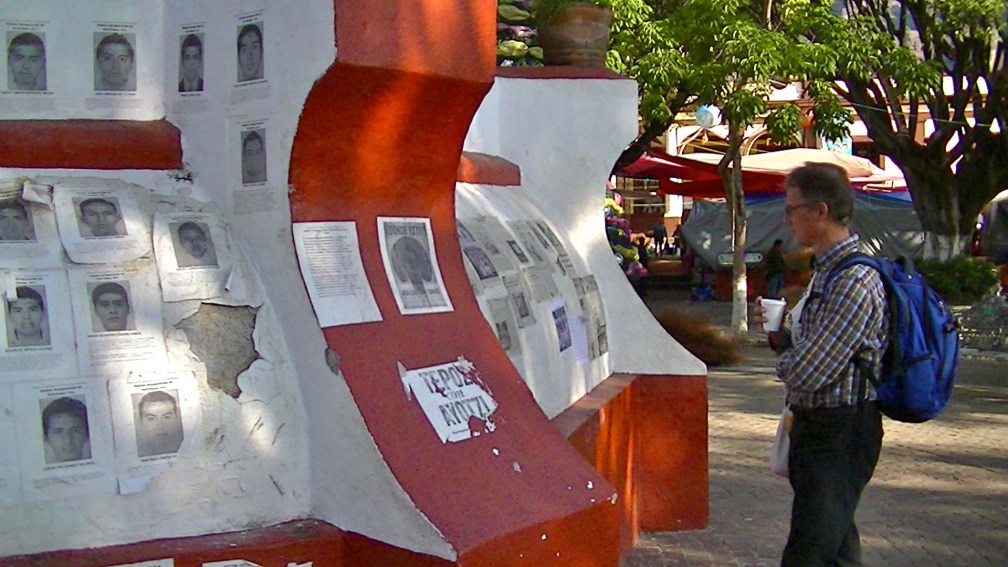
On the night of Sept. 26, 2014, students from the Ayotzinapa Normal School were attacked in Iguala, Guerrero, after they had commandeered buses to travel onward to Mexico City for a protest over the Oct. 2, 1968, massacre of student protesters at Tlatelolco plaza in Mexico City.

In Iguala, six people—including three students—were killed in the assault, 25 were injured and 43 students were abducted and presumably murdered later. Leading suspects are members of the Mexican army who worked alongside municipal officials and drug-traffickers who were trying to move opium gum (semi-processed heroin) on one of the buses that was taken.

What happened before?

One afternoon in the late 1990s, I accompanied a group of students from Canada and the United States to a meeting with rural teachers in the mountains near Tlapa in northeast Guerrero.

These teachers spoke for communities afflicted by poverty, military incursions and the drug war. They taught their students in Spanish as well as in Nahuatl or one of the other Indigenous languages spoken in the area. They dedicated their lives to strengthening rural communities through the education of children. They were convinced that people needed to be able to organize themselves and demand that their rights be respected so that things would begin to change.

“The rural teachers colleges are among the only means of social mobility within the reach of young people from campesino communities,” wrote Luis Hernández Navarro, opinion editor at La Jornada, back in 2011. “Through them, they have access to education, housing, food and later, with luck, a job they are qualified to do.” 

The first time I that I can recall hearing of the Ayotzinapa school was in January 2008, when Blanche Petrich, another La Jornada journalist, came to Toronto to support work by Canadian churches in defense of refugees from Mexico. She told us:

“To describe the panorama of repression in Guerrero, it’s enough to follow the route of the popular movement. ‘Wherever there is organization, protest, defense of human rights, mobilization of roadblocks, there is repression, irregular apprehensions and arrest warrants,’ we’re told by the [Tlachinollan] human rights organization in the La Montaña area, led by Abel Barrera. That is, the campesinos who oppose the taking of their lands for a dam in La Perota, close to Acapulco, the ecologists who resist cutting of trees in the Petatlán sierra, the laid-off workers of a government office in the state capital of Chipalcingo, the community leaders of Xochistlaguaca, the students at the normal school in Ayotzinapa: they all suffer persecution.”

And what’s new?

Through an access to information request, journalists obtained new information about the cover-up that was orchestrated after the abductions by high ranking authorities in the government during meetings presided over by then-President Enrique Peña Nieto and attended by then-Attorney General Jesús Murillo Karam and other officials. Their “historic truth” version—since proven false—contended that local police turned the students over to a drug gang which murdered them, burned the bodies at a garbage dump, and put the remains into a river.

AP photo and story (left) about revelations by a former senior official; a tweet by the Fábrica de Periodismo about the cover-up led by high officials of the previous Mexican government.

Tomás Zerón, former head of investigations for Mexico’s Attorney General’s Office, is now a fugitive hiding in Israel, beyond the reach of the Mexican justice system. But in 2022, he answered questions posed in writing by Alejandro Encinas, then Mexico’s Interior Undersecretary for Human Rights.

Appointed by AMLO’s government, Encinas chaired the Commission for Truth and Access to Justice in the Ayotzinapa Case (COVAJ). The commission included family members and their advisors. Their report, published in August 2022, said federal, state and municipal politicians, along with the armed forces and local police, knew what had happened. 

But that report and a subsequent one in September 2023 have been undermined by the refusal of President López Obrador to accept its conclusions and his accusations against the human rights groups that accompany the families, including Tlachinollan and the Jesuit-backed Miguel Augustín Pro Human Rights Centre.
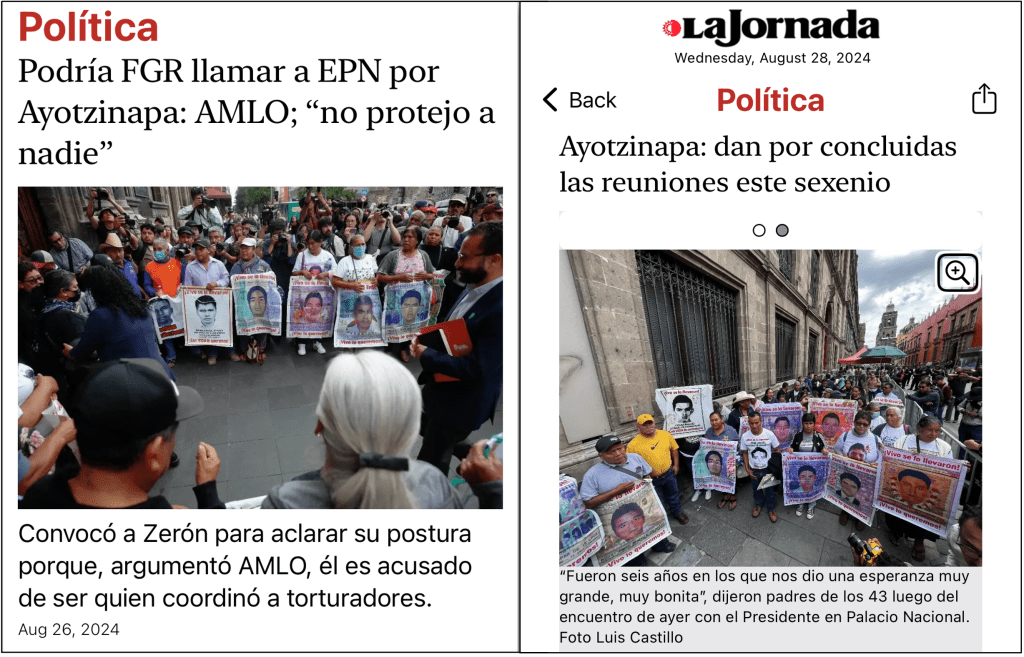
Left: La Jornada story Tuesday with headlines (adding my own details): federal prosecutors may call former president Ernesto Peña Nieto to testify about Ayotzinapa; AMLO: “I don’t protect anybody.” Below the photo, the text says that AMLO has also called on Zerón “to clarify his position because he is accused of coordinating the torturers.” Right: story today about the last of the parents’ meetings with AMLO.

After a meeting Tuesday (Aug. 27) with the president, the parents said it was the last one they would hold with him before he leaves office Oct. 1. 

“We ended badly,” said their lawyer, Vidulfo Rosales of Tlachinollan. He added that while in the first three years of this government, they saw clear good will to get to the truth, in 2022, the situation changed. “This is when we touched the sensitive fibres of the Mexican Army; we could advance no further. There was a break, a crisis, including in the relationship, the dialogue.”

“This government, unfortunately, could not give us truth and justice,” he added.

Human rights and land rights defenders are still under attack in Guatemala

by Jim Hodgson

Despite the inauguration earlier this year of a more progressive government in Guatemala, community land defenders still face criminal violence and judicial threats.

The government of President Bernardo Arévalo condemned the murder June 5 of a 47-year-old lawyer who worked to protect Indigenous and small-farmer land rights.

José Alberto Domingo Montejo worked with the Comité de Unidad Campesina (CUC, Committee for Farmworkers Unity) and had been part of CUC’s legal team since 2019. 

Left: A poster from Prensa Comunitaria denouncing the murder of José Domingo. Right: a statement from the Office of the UN High Commissioner for Human Rights upholding the right of small farmers’ organizations to work freely and safely, and calling for a fast and impartial investigation.

Domingo was shot during an ambush on a gravel road in Palin, Escuintla department, southwest of the Guatemalan capital. Two other CUC members, Gustavo Yoxon and Marcelo Yoxon, were wounded in the same attack.

They were doing what CUC and another organization with which I am more familiar, the Comité Campesino del Altiplano (CCDA, Highlands Committee of Small Farmers) do all the time: working to advance the interests of small farmers and Indigenous peoples by helping to legalize a community land title. The CCDA condemned the attack and expressed its solidarity with families of the victims.

“This attack is added to the wave of violent judicial and extrajudicial evictions, captures and arrest warrants,” said CCDA in a statement on social media. 

The Pact of the Corrupt

Guatemala may have that more progressive government but Arévalo and his cabinet do not control all the levers of power. 

A key obstacle is Consuelo Porras, the attorney general appointed in 2018; her term was renewed in 2022 and extends to 2026; she can only be removed if convicted of a crime. 

Left: A CCDA news conference [text in English] on June 3 warned the “Pact of the Corrupt” tries to provoke confrontations between government and small farmers and Indigenous communities.

The U.S. Department of State added Porras to a list of “undemocratic and corrupt” officials in 2021. And last year, the Organization of American States (OAS) called her efforts to annul Arévalo’s election “an attempted coup d’état.”

“Porras has served as the spearhead of the Pact of the Corrupt,” wrote former Guatemalan foreign minister Edgar Gutiérrez in December while she was still trying to quash the election result. He described the Pact of the Corrupt as “a loose coalition of politicians, bureaucratic and business elites, plus powerful drug trafficking groups, which has pushed back civil and political liberties, unleashing fierce persecution against dissent, particularly against independent justice operators, who now number half a hundred in exile.”

For people in a community that is struggling to establish a land claim, even with good legal advisors from CCDA or CUT, it is often a challenge to identify opponents. One example is the Xinca Indigenous community of Nueva Jerusalén, located further south in the same Escuintla department where José Domingo was killed. By March 2023, the community had exhausted legal avenues within Guatemala (despite having shown the land in question belongs to the government and having proven irregularities in the claim of a supposed owner. After I had joined a meeting with community leaders and CCDA advisors, I wrote about the community’s appeal to the Inter-American Court of Human Rights (IACHR).

But a few months later, on August 9, police and private security forces burned the community to the ground and forced the 53 resident families to flee. 

In these scenarios—and there are scores of them—it can be difficult to distinguish between a legal, court-ordered eviction (even if fraudulently obtained) and a private army: in effect, a paramilitary death squad. 

And so you find a paragraph like this one in an Amnesty International report that (correctly, in my view) blends the crimes of state and non-state actors. From the victims’ point of view, it’s hard to see the difference.

“The Unit for the Protection of Human Rights Defenders in Guatemala (UDEFEGUA) reported 5,965 attacks against human rights defenders between January and November 2023, including threats, killings, harassment and arbitrary detentions. Criminalization increased, particularly against those involved in the fight against impunity and corruption.”

And this paragraph from a Maritimes-Guatemala Breaking The Silence (BTS) Network report on the Nueva Jerusalén eviction:

“[T]he state abets and perpetrates violence against the community. The police—the armed wing of the state—have…ransacked homes, destroyed possessions and sought to provoke community members to protect themselves. With this sleight of hand, they bring charges against community members, used to defame and criminalize the residents of Nueva Jerusalen.”

“Bringing charges.” “Criminalization.” 

Mélisande Séguin of BTS notes that land defenders continue to meet with government officials to stop future arrests. “Nonetheless, with Consuelo Porras at the helm of the Public Prosecutor’s office, criminalization remains a major threat for Indigenous and campesino movements.”

On Feb. 8, the new government signed an agreement with CCDA, CUT and other organizations of small farmers and Indigenous peoples. 

“For our administration, dialogue is not just a tool but a key pillar that promotes citizen participation in defining the agendas that effectively solve different needs,” said Arévalo during the signing ceremony. He said the agreement was the product of a dialogue process that began in the last quarter of 2023.

“All Guatemalans are equal in dignity and rights. The new government embraces the idea that everyone has something valuable to contribute and deserves to be heard,” he said.

Speaking at the ceremony, CCDA national coordinator Neydi Yasmín Juracán stated: “For us, it is a historic day because we have been meeting politically and technically for these agreements.” She said CCDA has worked for more than 28 years to prevent and end land evictions, but:

  • 12 community leaders were assassinated between 2018 and 2022.
  • Seven leaders are currently imprisoned.
  • 1,788 arrest warrants, 35 per cent targeting women.
  • Seven active temporary shelters to attend to agrarian conflicts.
  • 1,320 cases were accompanied by the CCDA.

United States takes modest step towards easing its long embargo against Cuba

By Jim Hodgson

A modest step forward in the long struggle to end the failed U.S. embargo came this week when the United States removed Cuba from its short list of countries it alleges are “not cooperating fully” in its fight against terrorism. “This move… could well be a prelude to the State Department reviewing Cuba’s designation as a state sponsor of terrorism,” William LeoGrande, a professor at Washington’s American University, told Reuters.

Left: Reuters coverage. Right: As reported by CubaDebate – “State Department recognises the lie, but does not remove Cuba from the list of state sponsors of terrorism.” President Miguel Diaz-Canel told interviewer Ignacio Ramonet that many of Cuba’s economic woes begin with the U.S. blockade, tightened in 2021 with “the inclusion of Cuba in a spurious list determined at will by the U.S. government of countries that supposedly support terrorism.”

Until this week, the administration of President Joe Biden had made only minor reforms—easing some restrictions on travel and family remittances in May 2022—but had scarcely budged from the harsh measures taken by his predecessor, Donald Trump, much less attaining Barack Obama’s level of engagement.

It was just days just before the end of Trump’s administration in January 2021 that Cuba was added to the list of “state sponsors of terrorism” (SST)—because Cuba was hosting peace talks between the Colombian government and one of the guerrilla armies, the Ejército de Liberación Nacional (ELN). Despite occasional setbacks, the Colombian peace process moves forward slowly.

Biden’s new move comes after three years of non-stop advocacy by churches and other non-governmental organizations to end the embargo and to have Cuba removed from the SST list.

Efforts by churches, unions and other groups are driven by a sharp deterioration of the Cuban economy that is partly a consequence of the SST and other measures as banks and other corporations fear running afoul of the U.S. measures. The economic downturn is also related to reduced tourist visits to the country during the Covid pandemic and Cuba’s abandonment of its former two-currency system (one tied to the U.S. dollar, and the other that effectively subsidized local transactions).

In April 2023, an informal alliance of more than 20 Canadian churches, trade unions, development agencies and community solidarity groups wrote to Foreign Affairs Minister Mélanie Joly and to then-International Development Minister Harjit Sajjan to express alarm at the “deterioration of the Cuban economy and consequent impacts on the Cuban people.”

They called on the government to press the United States to ease sanctions and to remove Cuba from the SST list. They also asked that Canada “scale up its efforts to provide immediate food, medicines, and medical supplies to Cuba” (whether directly with the Cuban state or via NGOs and multilateral organizations). 

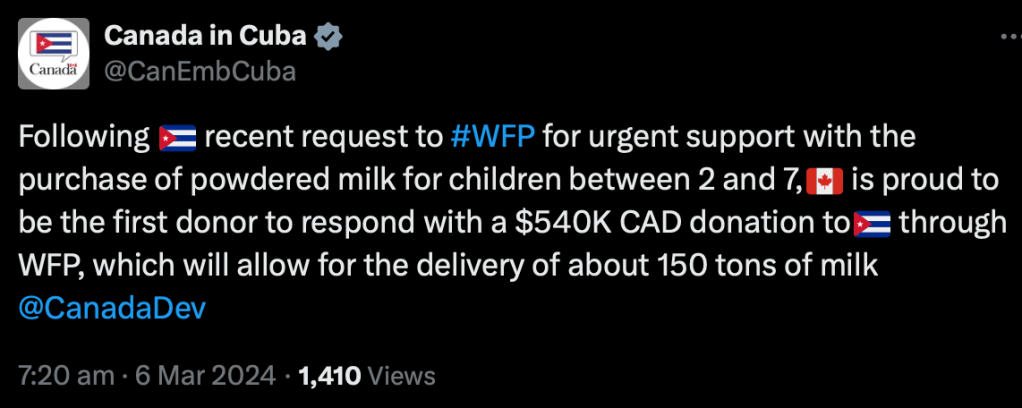
Canada has made some efforts, notably the announcement March 6 of a $540,000 contribution to the World Food Program to support provision of 150 tons of milk that will assist Cuban children. Canada’s response followed just two days after the Cuban government had made its first-ever request to WFP for food aid. Canada continues to fund the work of NGOs such as Oxfam and CARE Canada in Cuba.

The Canadian letter echoed earlier calls from Cuban and U.S. churches. In a joint letter sent Feb. 18, 2021, they asked Biden to to restore travel, remittances and trade with Cuba; to remove Cuba from the list of “state sponsors of terrorism;” to rescind Trump’s mandate to use extraterritorial provisions of the Helms-Burton law; and to rebuild U.S. diplomatic presence in Cuba. On March 13, 2023, more than 20 U.S. faith groups wrote to Biden to ask that Cuba be removed from the SST list.

The SST designation, along with Trump’s application of measures contained in the 1995 Helms-Burton Act, have extraterritorial impacts. Foreign-owned ships won’t dock in Cuba and foreign banks are reluctant to transfer funds for fear of running afoul of the U.S. laws. To understand better the impact of the SST in Cuba, please read a long report by the Washington Office on Latin America (WOLA).

The extraterritorial features of the Helms-Burton law provoked anger in Canada and Europe, but those features were effectively waived by Presidents Clinton, Bush and Obama. In April 2019, Trump revived them. Canada repeated its objection, and reminded Canadians that amendments in 1996 to Canada’s Foreign Extraterritorial Measures Act (FEMA) stipulate that any judgment issued under Helms-Burton “shall neither be recognized nor enforceable in any manner in Canada.”

But Canada, to my knowledge, has yet to say anything publicly about the SST list.

Meanwhile, churches, NGOs and solidarity groups continue to provide aid to Cuba, including in response to damage caused by Hurricane Ian in western Cuba in 2022 and after the oil storage facility fire in Matanzas in 2022. 

Vancouver-based CoDevelopment Canada is collecting material to send in a container to Cuban trade unions later this summer. 

The U.S. Cuba Normalization Coalition has a fact sheet about U.S.-backed attacks on Cuba. “Cuba has endured 64 years of a U.S. economic blockade.This intensified when President Trump unjustifiably put Cuba on a list of so-called State Sponsors of Terrorism (SSOT).President Biden has continued that listing. Companies worldwide that want to sell medicines or food to Cuba often can’t because their own bank refuses to accept Cuba’s payment under threat of enormous fines from the U.S.treasury for dealing with ‘terrorists’.”